

Disclaimer
Content on this page of topcolleges.com is computer generated and therefore is not guaranteed to be 100 percent accurate about various aspects of the education sector. On balance, however, many students and families seek general information about high schools, colleges and universities, graduate programs, testing, education and career planning, and job placement before beginning one-on-one admissions counseling tailored to their specific needs.
Why do high-caliber candidates with exceptional GMAT scores still face rejection from the M7? It’s rarely a lack of merit. Instead, it’s often a failure of tactical timing. You’re likely feeling the mounting pressure of the upcoming cycle, perhaps worrying that your current pace won’t meet the rigorous Round 1 deadlines or that your narrative lacks the depth required for elite scrutiny. It’s a valid concern. The path to a top-tier program is a high-stakes endeavor where every month counts toward your eventual success.
This article serves as your strategic blueprint to master the MBA application timeline for 2026 entry. You’ll gain the clarity needed to transform anxiety into structured preparation, ensuring your portfolio reflects the prestige of your target institutions. We’ll provide a comprehensive, month-by-month roadmap that covers everything from standardized testing windows to the complexities of narrative-building. By the end of this guide, you’ll have a clear understanding of round selection and the confidence that your preparation supports a winning admissions portfolio.
Key Takeaways
- Establish a 12-month lead time to define your “Strategic Why” and address profile gaps before elite admissions cycles begin.
- Analyze the tactical advantages of Round 1 versus Round 2 to align your MBA application timeline with your peak portfolio quality.
- Architect a cohesive narrative that moves beyond the resume, focusing on deep tactical positioning across essays and recommendations.
- Prioritize the final 90 days for submission logistics and rigorous interview preparation to manage the high-stakes final evaluation phase.
- Identify and mitigate common pitfalls, such as narrative misalignment or underestimating the time required for short-answer components.
The 12-Month Strategic Foundation: Reflection and Profile Gap Analysis
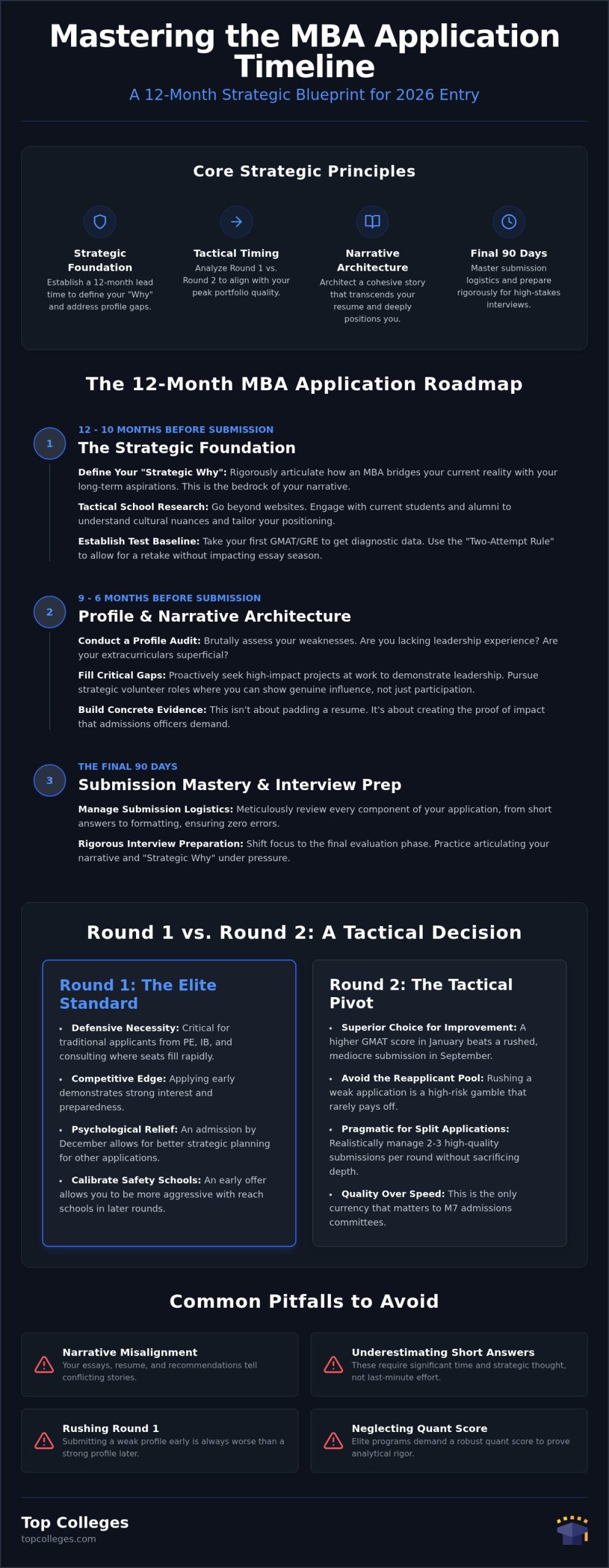
Why do most applicants wait until the summer to begin their journey? For those targeting elite institutions, the MBA application timeline begins exactly one year before the Round 1 submission date. This 12-month lead time isn’t a luxury; it’s the gold standard for candidates who refuse to leave their success to chance. Within this timeframe, you must transition from a passive observer to a strategic architect of your own narrative. Success at this level requires a proactive mindset that anticipates hurdles before they become roadblocks.
Before drafting a single essay, you must define your “Strategic Why.” This isn’t a generic statement of ambition. It’s a rigorous articulation of how a Master of Business Administration (MBA) bridges the gap between your current professional reality and your long-term aspirations. Without this foundation, even the most polished resume lacks the gravity required to move an admissions committee. A successful narrative requires deep reflection. It demands that you understand your trajectory better than anyone else in the room.
Tactical school research involves more than browsing websites. You must engage with current students and alumni to understand the cultural nuances of each program. This foresight allows you to tailor your strategic positioning to the specific values of the institution. Are you a fit for their leadership style? Can you contribute to their specific community? These questions must be answered long before the application portals open.
Standardised Testing Strategy: GMAT vs. GRE
Establishing a baseline score at least 10 months before submission is non-negotiable. It provides the diagnostic data needed to determine if your target schools are within reach or if a pivot is required. We recommend the “Two-Attempt” rule: schedule your first official sit-down early enough to leave room for a tactical retake without encroaching on essay-writing season. Elite programs don’t just look at the total score. They demand a robust quantitative breakdown that proves you can handle the analytical rigor of their curriculum. Don’t let a low quant percentile derail an otherwise stellar profile.
Filling the Profile Gaps
Conduct a brutal self-audit of your profile today. Are you lacking direct leadership experience? Do your extracurriculars feel like “box-checking”? Identifying these weak spots early allows you to pivot your professional focus within your MBA application timeline. Seek out high-impact projects at work that demonstrate immediate leadership and measurable results. If your community involvement is thin, pursue strategic volunteerism where you can show genuine influence. This isn’t about padding a resume; it’s about building the concrete evidence of your impact that admissions officers crave.
Round 1 vs. Round 2: A Comparison of Tactical Advantages
Round selection is the first major tactical fork in your MBA application timeline. It’s a decision that weighs the urgency of the early mover against the uncompromising necessity of portfolio quality. Don’t view these deadlines as mere dates on a calendar. They’re strategic windows that dictate the composition of the cohort you’ll eventually join. Choosing the wrong round can diminish even the most impressive professional profile.
Round 1: The Elite Standard
Round 1 is the primary battlefield for traditional applicants. If you’re coming from private equity, investment banking, or management consulting, the seats for your profile are finite and fill rapidly. Applying early isn’t just an advantage; it’s a defensive necessity. Beyond the competitive edge, securing an admission by December provides immense psychological relief. It also allows you to calibrate your safety school strategy for the winter. If you’re already holding an offer from a top-ten program, your approach to the January cycle changes entirely. You can afford to be more aggressive with your reach schools.
Round 2: The Tactical Pivot
What happens if your GMAT score is still ten points shy of the school’s median? In this scenario, Round 2 is the superior choice. A higher score in January consistently beats a rushed, mediocre submission in September. Rushing to meet a Round 1 deadline often results in a rejection that forces you into the “reapplicant” pool the following year. This is a high-risk gamble that rarely pays off. For many, splitting applications between rounds is the most pragmatic approach. Realistically, few candidates can manage more than three high-quality submissions per round without sacrificing the depth of their narrative. Quality is the only currency that matters to the M7.
Round 3 remains a statistical outlier for elite admissions. It’s rarely a viable strategy unless you possess a truly unique profile or come from an underrepresented geographic region that the school still needs to fill. Additionally, scholarship and merit aid pools are often significantly depleted by the spring. If funding is a critical component of your decision, your MBA application timeline should prioritize the first two windows. Navigating these complexities requires a level of foresight that MBA admissions consulting provides, ensuring your round selection aligns with your specific competitive profile and financial goals.
The Narrative Build: Architecting Your MBA Portfolio
Elite admissions offices don’t just read applications; they evaluate potential. Shifting from a standard resume to a “Strategic Portfolio” is the core of the Top Colleges methodology. This phase of your MBA application timeline requires you to connect disparate achievements into a single, high-ROI narrative. Why settle for a summary when you can present a strategy? Your personal statement must act as a blueprint for your future. It’s not a history lesson; it’s a projection of value. You must prove that your trajectory is not only impressive but also uniquely suited to the institution’s specific resources.
Precision in your narrative build prevents the misalignment that haunts many otherwise qualified candidates. When your essays, resume, and recommendations tell three different stories, you create doubt in the mind of the evaluator. Strategic clarity is your greatest asset. Many candidates stumble on short-answer questions and video prompts, treating them as administrative afterthoughts. In reality, these are high-stakes opportunities to project executive presence and cultural fit. They require the same level of tactical foresight as your primary essays. You don’t get a second chance to make a digital first impression.
Recommender Management: A 4-Month Process
Selecting recommenders is a tactical exercise in credibility. A title from a C-suite executive who barely knows your work is a liability, not an asset. You need a direct supervisor or mentor who can speak to your specific impact with granular detail. This is a four-month process of engagement. Provide your recommenders with a “Recommender Brief” eight to ten weeks before the deadline. This document ensures they have the tactical data needed to support your broader narrative without sounding coached. It’s about empowering them to be your strongest advocates.
Essay Architecture and Iteration
Drafting your “Cornerstone Essay” is the most intellectually demanding part of the MBA application timeline. This core narrative establishes your professional identity, but it must never be blindly copy-pasted. Each school has a distinct culture and value system. Rushed customization is the fastest path to a rejection letter. Engaging in professional MBA Admissions Consulting ensures your voice remains authentic while meeting the specific, nuanced expectations of each elite institution. Iteration is key; your first draft is rarely your most persuasive.
The Final 90 Days: Submission Mastery and Interview Prep
The final stretch of your MBA application timeline is where many candidates lose focus. You’ve spent months architecting a portfolio; now you must ensure its delivery is flawless. This isn’t just about clicking “submit.” It’s about a holistic review to ensure every word across every document reinforces your strategic position. One minor inconsistency in a short-answer field can undermine a thousand words of essay content. Precision is the only acceptable standard.
Submission logistics are often underestimated. Don’t wait for the inevitable server crash on deadline day. Aim to submit at least 48 hours early. This window provides a psychological buffer, allowing you to transition your mindset from written narrative to verbal performance. Elite schools don’t just want to read your story; they want to see you inhabit it. The interview is your opportunity to prove that the person on paper matches the executive in the room.
High-Stakes Interview Preparation
Success in the interview phase requires understanding school-specific formats. A Wharton Team-Based Discussion (TBD) tests your collaborative leadership in a group setting. Conversely, a Harvard Business School interview is a rapid-fire “Deep Dive” into your professional choices. You can’t use the same preparation for both. Mock interviews are mandatory. You must record and critique your performance to identify verbal tics or lapses in confidence. Mastering the “Walk me through your resume” opening is essential; it sets the tone for the entire conversation. If you stumble in the first three minutes, the recovery is twice as hard.
Post-Submission Vigilance
The period between submission and decision is a time for tactical patience, not passivity. Monitor the portal diligently and manage your expectations for “Decision Day.” If you’re placed on a waitlist, don’t panic. Develop a “Letter of Enthusiasm” strategy that provides meaningful updates without appearing desperate. This is the time to share new professional milestones or a significant promotion. Managing multiple offers is the final hurdle in your MBA application timeline. The art of the deposit extension can buy you the time needed to weigh a reach school offer against a safety school’s merit aid. Every move in this final phase must be as calculated as your first.
Avoiding the Common Pitfalls of the MBA Timeline
Why do meticulous planners still fail? It’s rarely for lack of effort. Instead, it’s often a failure to recognize that a successful MBA application timeline is a cohesive ecosystem where every part must support the whole. One of the most frequent errors is treating short-answer questions as administrative filler. They aren’t. These sections are high-value real estate. If you underestimate them, you’ll find yourself rushing during the final week, leading to sloppy errors that suggest a lack of executive presence. Precision in these smaller fields is just as vital as the depth of your primary essays.
Friction is the enemy of an elite application. Narrative misalignment occurs when your essays, resume, and recommendations tell three different stories. If your recommender praises your technical skills while your essays focus on visionary leadership, the admissions committee is left with a fragmented image of your profile. Every component must be architected to reinforce a single, powerful strategic position. Similarly, ignoring cultural fit can be fatal. Applying to schools based solely on rankings rather than strategic alignment shows a lack of maturity. Elite programs have distinct identities; if you don’t show why you belong in their specific community, a high score won’t save you.
The Trap of the “Perfect” Score
The obsession with a near-perfect GMAT or GRE score can be a death knell for your timeline. You must know when your score is “good enough” for the M7. Chasing an extra ten points during your third or fourth attempt often yields diminishing returns. This time is better spent on the un-quantifiable parts of your application, such as refining your impact narrative or engaging in deeper school research. Don’t let a testing fixation starve the creative and reflective phases of your process. A 750 with a compelling story consistently beats a 780 with a hollow narrative.
Strategic Alignment with Top Colleges
Managing a high-stakes MBA application timeline while maintaining a demanding career is an immense challenge. Professional Admissions Consulting prevents timeline collapse by providing the structure and accountability required for elite success. An external, authoritative eye can identify narrative friction and profile gaps that you’re too close to see. We ensure that your strategic portfolio is not just completed, but optimized for the nuances of high-level evaluation. This tactical foresight turns a chaotic process into a methodical march toward an acceptance letter.
Securing Your Future at the World’s Elite Business Schools
The path to an M7 acceptance isn’t found in a checklist; it’s forged through a year of relentless tactical positioning. You’ve seen why a 12-month MBA application timeline is the non-negotiable standard for those who refuse to settle for mediocrity. Success requires more than just a high score. It demands a strategic portfolio that bridges the gap between your past achievements and the high-ROI future you’re projecting to the admissions committee. Every month in this cycle is an opportunity to strengthen your narrative or a risk of falling behind.
Will you leave your narrative to chance, or will you architect it with the precision that elite institutions demand? Navigating the nuances of global admissions requires a mentor who understands the inner workings of competitive systems. Led by Steven Roy Goodman, a global authority on admissions, Top Colleges specializes in the elite graduate program strategy required to navigate these high-stakes milestones. From bespoke portfolio development to the rigors of interview prep, our approach is designed to replace anxiety with structured, strategic confidence for M7 applicants.
Your aspirations deserve a roadmap characterized by intellectual depth and proactive planning. Take the first step toward your future today. You’ve the talent; now ensure you’ve the strategy to match it.
Frequently Asked Questions
When should I start my MBA application for the 2026 intake?
You should begin your preparation exactly 12 months before your target Round 1 deadline. For a 2026 entry, this means initiating your profile gap analysis and standardized testing baseline by late 2024 or early 2025. This lead time is essential for addressing leadership deficits and refining your strategic positioning. Waiting until the summer before submission is a tactical error that leaves no room for the iterative reflection required by elite programs.
Is it better to apply in Round 1 or Round 2 for business school?
Round 1 is the strategic choice for traditional backgrounds like finance or consulting where seats fill rapidly. However, Round 2 is superior if it allows you to submit a higher GMAT score or a more polished narrative. Never sacrifice portfolio quality for speed. Admissions committees at top-tier schools prioritize the caliber of your profile over the timing of your submission, provided you apply before the class is statistically full.
How long does it typically take to write MBA essays?
You should allocate three to four months for a comprehensive essay build. This isn’t just about drafting words; it’s about an iterative process of narrative architecture and school-specific customization. A cornerstone essay takes weeks to refine, followed by another month of tailoring for each target institution. Rushing this process often leads to generic content that fails to project the executive presence and cultural alignment that elite programs demand.
Can I apply for an MBA before I have my GMAT or GRE score?
You cannot submit a complete application to most elite schools without a valid test score. While some programs allow you to update your score post-submission, it’s a high-risk strategy that complicates your MBA application timeline. Aim to have your final score settled at least two months before the deadline. This allows you to pivot your school selection based on hard data rather than optimistic projections about your testing performance.
What is the most common mistake applicants make with their timeline?
The most frequent error is underestimating the short-answer sections and administrative logistics. Many candidates treat these as minor tasks to be completed on deadline day. In reality, these fields require the same tactical foresight as your primary essays to ensure narrative alignment. When you rush these components, you risk creating friction in your profile that suggests a lack of attention to detail, undermining months of strategic preparation.
How many schools should I apply to in a single round?
Most successful candidates apply to three or four schools per round. Attempting more than four often leads to a copy-paste mentality that results in generic applications and immediate rejection. Each institution requires a bespoke strategic positioning that respects its unique culture. By focusing your energy on a smaller number of high-quality submissions, you ensure that every part of your portfolio reflects the prestige and depth of your professional profile.
What happens if I miss the Round 1 deadline?
Missing Round 1 means you must pivot your strategy toward a high-impact Round 2 submission. Use the additional three months to strengthen your profile through new professional milestones or a higher test score. While some seats will be gone, Round 2 remains a highly viable window for most candidates. The key is to avoid the reapplicant risk by ensuring your January submission is significantly more polished than your missed September attempt.
Do elite business schools prefer Round 1 applicants?
Elite schools don’t have a formal preference, but Round 1 offers the tactical advantage of a full class size and maximum scholarship availability. For overrepresented groups, applying early is a defensive necessity to secure a spot before the quota for their profile is met. However, an exceptional candidate in Round 2 will always beat a mediocre one in Round 1. Your MBA application timeline must prioritize the moment your portfolio reaches its peak quality.