

Disclaimer
Content on this page of topcolleges.com is computer generated and therefore is not guaranteed to be 100 percent accurate about various aspects of the education sector. On balance, however, many students and families seek general information about high schools, colleges and universities, graduate programs, testing, education and career planning, and job placement before beginning one-on-one admissions counseling tailored to their specific needs.
Is your medical school application a race against a deadline or a tactical deployment of a professional portfolio? Most candidates view the medical school application timeline as a series of hurdles to clear. They’re wrong. In reality, this cycle is a sophisticated game of positioning where timing is as critical as your MCAT score. You likely feel the weight of rolling admissions and the anxiety of balancing primary essays with secondary prompts. It’s a high-stakes environment where a single week’s delay can diminish your standing at elite institutions.
Success requires more than just meeting deadlines; it demands a strategic advantage. You deserve a clear, non-negotiable schedule that replaces panic with precision. This guide provides a methodical, month-by-month roadmap to master the 2026 cycle with confidence. We’ll examine the critical dates for AMCAS, AACOMAS, and TMDSAS while outlining a submission strategy that transforms your preparation from reactive to proactive. By the end of this analysis, you’ll possess the foresight necessary to navigate the surge of secondary applications and secure your place in the next generation of physicians.
Key Takeaways
- View the pre-med years as a period of strategic portfolio development, prioritizing longitudinal research and clinical exposure to build a competitive foundation.
- Understand that the medical school application timeline rewards early action, making “Day One” submission of your primary application a tactical necessity for rolling admissions.
- Master the secondary application surge by adhering to the “Two-Week Rule,” ensuring your turnaround time reflects high-level professional intent and organizational discipline.
- Prepare for the shift from written excellence to interpersonal mastery as the cycle moves into the rolling interview invitation phase from September through March.
- Navigate the final enrollment phase with a clear decision matrix, aligning your school selection with long-term career goals before the AAMC “Commit to Enroll” deadlines.
Architecting the Pre-Submission Phase: Years One Through Three
The pre-med years are often misunderstood as a frantic race to accumulate credentials. This is a mistake. To succeed within the elite medical education system in the United States, you must view these years as a period of deliberate portfolio construction. Every course selection and clinical hour should serve a specific strategic purpose. Are you merely fulfilling prerequisites, or are you demonstrating a capacity for intellectual rigor that distinguishes you from thousands of other high-achieving applicants? Mastery of the medical school application timeline begins long before the first portal opens.
The Academic and Clinical Foundation
Admissions committees look for longitudinal commitment rather than sporadic volunteerism. You shouldn’t just shadow physicians; you should seek clinical exposure that allows for meaningful advocacy and patient interaction. This depth provides the evidence needed for a compelling narrative. Simultaneously, you must curate a course load that challenges your intellectual boundaries. When it’s time to secure letters of evaluation, approach faculty who have witnessed your analytical growth. These letters should be more than endorsements. They should be professional testimonials to your readiness for the rigors of medical training. Establishing a consistent record of service and clinical advocacy early on ensures your portfolio has the gravity required for top-tier programs.
The MCAT Strategic Timeline
The medical school application timeline hinges on your MCAT performance. For the 2026 cycle, the peak window for testing is January through April. This timing ensures your score is verified and available before the primary application systems open in early May. Many students make the error of testing in June or July, which delays their entire cycle and places them at a severe disadvantage in rolling admissions. You can’t afford to be late in a system that rewards the early.
Adopt a “Submit Once” mentality. Planning for a retake is a failure of preparation that signals a lack of professional foresight. Your score isn’t just a metric; it’s a tactical tool used to align your target school list with institutional expectations. If your score doesn’t meet the threshold of your target programs, you must be prepared to adjust your strategy immediately rather than hoping for a late-season miracle. Aligning your scores with your target schools early allows for a more focused and effective application effort.
Before you draft a single sentence of your personal statement, engage in rigorous self-reflection. Why medicine? The answer must be more than a general desire to help others. It must be a diagnostic look at your own journey, identifying the specific “hook” that will anchor your entire application. This internal audit is the most critical step in the medical school application timeline because it dictates the coherence of your professional brand. Without this foundation, your application is merely a list of achievements; with it, it becomes a persuasive argument for your admission.
The Primary Application Window: Tactical Execution in Late Spring
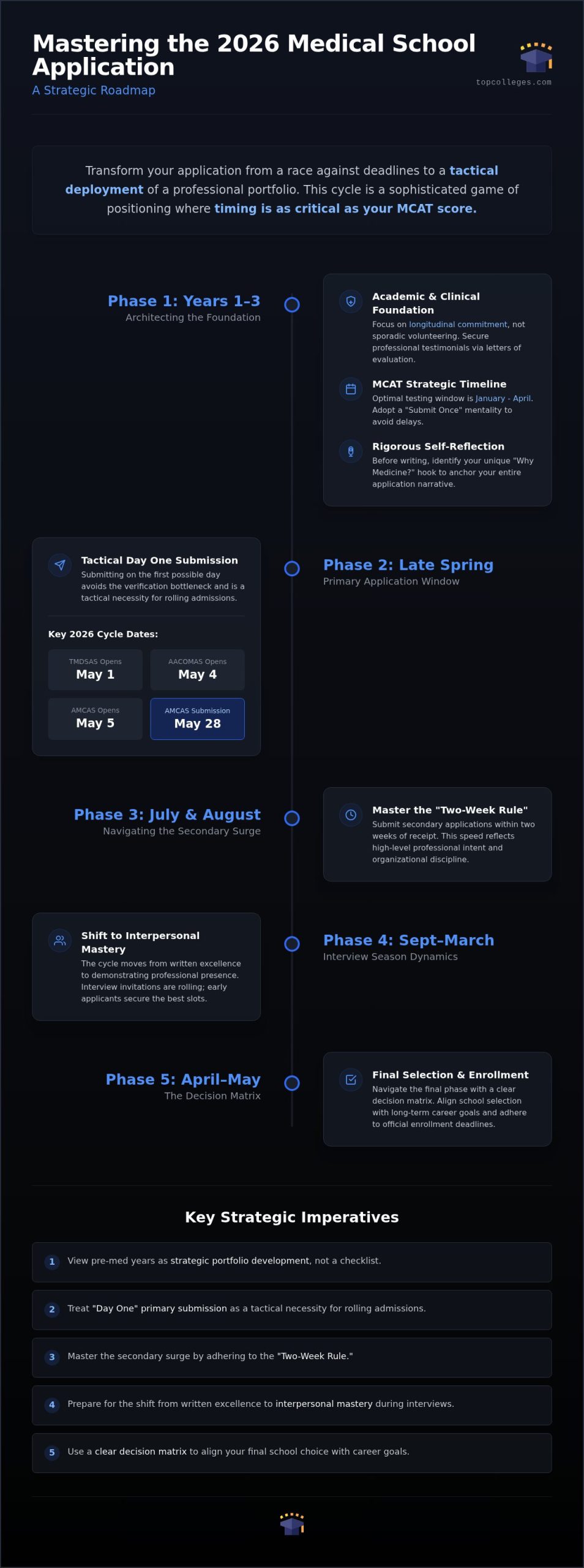
Late spring is the moment when long-term preparation transitions into high-stakes execution. For the 2026 cycle, the portals open with rapid succession: TMDSAS on May 1, AACOMAS on May 4, and AMCAS on May 5. While these dates mark the beginning of data entry, the true tactical milestone for AMCAS is May 28, the first day submission is permitted. These aren’t merely administrative deadlines. They are the opening moves in a highly competitive landscape where timing is a form of currency.
Treating “Day One” as a suggestion rather than a mandate is a common, and often fatal, error. Medical schools utilize rolling admissions, meaning seats are filled as qualified candidates are identified. The medical school application timeline is heavily influenced by the verification bottleneck. During the peak of June and July, the verification process can stretch from a few days to several weeks. Submitting on the earliest possible date ensures your file reaches admissions committees before the first wave of interview invitations is issued. You don’t want to be the candidate whose file is verified in August when the most desirable interview slots are already claimed.
The Personal Statement and Work/Activities Section
Your personal statement functions as a professional mission statement. It must command attention by articulating a clear, unique value proposition. Avoid the trap of generic, chronological storytelling. Instead, focus on quantifying your impact within the Work and Activities section. Did you manage a specific research budget or coordinate a high volume of community outreach hours? Precision signals professional maturity. When selecting your “Most Meaningful” experiences, exercise strategic foresight by choosing narratives that align with the core values of your target institutions.
The Logistics of Primary Submission
Success in this phase requires meticulous administrative discipline. Follow these steps to ensure a seamless transmission:
- Step 1: Request official transcripts in early May. Processing delays at the registrar level can stall your entire medical school application timeline.
- Step 2: Finalize your school list using MSAR and DO Explorer data. Aim for a balanced portfolio of reach, target, and baseline programs.
- Step 3: Execute a comprehensive final review of your AMCAS application by June 1st to verify every entry for accuracy.
Navigating these logistical hurdles requires a level of precision that many applicants find overwhelming. Engaging with medical school admissions consulting can provide the structural oversight necessary to ensure your primary application is both early and impeccable.
The Secondary Surge: Navigating the July and August Peak
The period following your primary submission is often characterized by a deceptive calm. Do not be misled. By early July, the “Secondary Surge” begins, transforming your inbox into a relentless stream of school-specific prompts. This phase is the ultimate test of your endurance within the medical school application timeline. While primary applications establish your eligibility, secondaries are where you demonstrate institutional fit. The industry standard is the “Two-Week Rule.” Returning a completed secondary within 14 days isn’t just about speed; it’s a signal of professional intent and high-level interest. Delaying suggests that the institution is a backup choice, a perception that can be fatal at elite programs. Schools track these metrics. They want candidates who are decisive, organized, and clearly committed to their specific medical community.
Strategic Pre-Writing for Secondaries
Tactical errors often begin with waiting for official prompts to arrive. Most medical schools rarely change their essay requirements from year to year. You should architect your responses in June while your primary is being verified. Focus on recurring themes like the “Adversity Challenge,” “Diversity Statement,” and the critical “Why our school?” prompt. By building a library of adaptable, high-quality essays, you maintain tactical momentum. Each response must be meticulously tailored to reflect the specific clinical focus or research mission of the institution. A generic essay is easily detected and suggests a lack of genuine interest. Use this time to refine your voice, ensuring your personality and professional values are woven into every paragraph.
Managing the Administrative Burden
Managing a list of twenty or thirty schools creates a massive administrative load. You might face sixty or more individual essays in a six-week window. A rigorous tracking system is mandatory. You must monitor submission dates, unique portal logins, and the status of ancillary requirements like Casper or Duet scores. Ensure your letters of recommendation are correctly assigned to each program. As the volume increases, “application fatigue” becomes a real threat to the quality of your prose. To maintain high-level output, treat this phase like a professional residency. Set strict daily writing quotas and conduct final reviews with a diagnostic eye. This level of discipline ensures your medical school application timeline remains on track through the most demanding month of the cycle. Remember, a single overlooked email or a missed portal deadline can negate months of primary preparation.
Interview Season Dynamics: Execution from September to March
By September, the focus of the medical school application timeline shifts from the desk to the boardroom. Your written credentials have opened the door. Now, your interpersonal professional presence must secure the offer. The 2026 cycle follows a rolling invitation pattern, meaning schools review and invite candidates in waves. If you followed the early submission strategy, you might see invitations as early as late August. Others may arrive as late as February. This period requires a shift in mindset from analytical writing to dynamic, real-time engagement. It’s a test of your ability to project authority and empathy simultaneously.
Mastering the Professional Persona
Medical schools employ two primary formats: the Multiple Mini Interview (MMI) and the Traditional Panel. The MMI tests your ability to navigate ethical ambiguity and rapid-fire problem-solving across several stations. Conversely, the Traditional Panel focuses on your longitudinal experiences and personal motivations. You must develop a repertoire of patient-centric and ethics-based responses that feel authentic rather than rehearsed. Don’t simply memorize answers. Instead, internalize the principles behind them. Conduct mock interviews that simulate high-stakes pressure to identify weaknesses in your delivery. Refine your non-verbal communication, paying close attention to eye contact and posture. These subtle cues often carry as much weight as your verbal answers in both virtual and in-person formats.
Post-Interview Strategic Communication
The interview isn’t the final step in the medical school application timeline. A well-crafted “Thank You” note, sent within 24 hours, reinforces your professional courtesy. As the season progresses, you may need to send a Letter of Interest or a Letter of Intent to your top-choice programs. A Letter of Interest keeps you on their radar. A Letter of Intent is a binding promise that you’ll enroll if accepted. Navigating the waitlist requires a delicate balance. You must stay visible through periodic updates without appearing desperate or unprofessional. This level of tactical communication is a cornerstone of Medical School Admissions Consulting: The Strategic Blueprint for 2026, ensuring every post-interview touchpoint adds value to your candidacy.
The Decision Matrix: Final Selection and Enrollment
The final phase of the medical school application timeline represents a significant shift in the power dynamic. You’ve moved from the position of an applicant seeking validation to a future physician selecting a professional home. This isn’t a choice to be made on prestige alone. It requires a diagnostic evaluation of how each institution aligns with your long-term career trajectory. Whether you’re weighing two offers or ten, your decision must be rooted in a pragmatic analysis of institutional resources and cultural fit. The goal is to identify the environment that will best facilitate your transition into a high-level medical professional.
Evaluating Institutional Fit
Look beyond the marketing brochures. Analyze residency match lists with a critical eye to see if a school consistently places graduates into your target specialties. Research opportunities and clinical rotation sites are equally vital. Does the school offer early clinical exposure in diverse settings, or are you limited to a single tertiary care center? Second-look weekends serve as your final diagnostic tool. Use these visits to engage with current students and faculty without the pressure of an interview. It’s your opportunity to verify the claims made during the recruitment phase and ensure the environment supports your specific learning style. If the culture doesn’t resonate during a casual weekend, it’s unlikely to support you during the rigors of your second year.
Finalizing the Transition
Once you’ve identified your top choice, you must navigate the AAMC “Plan to Enroll” and “Commit to Enroll” protocols. By April 30, 2026, most schools require you to narrow your selections to a single institution. This deadline is non-negotiable. Failing to adhere to these protocols can result in rescinded offers across multiple programs. During this window, you should also evaluate your financial aid packages. Merit-based aid is often negotiable if you possess competing offers from peer institutions. Approach these conversations with the same professional poise you demonstrated during your interviews, using data and clear communication to advocate for your needs.
The transition to medical school also involves a final surge of administrative requirements. You’ll need to complete background checks, health screenings, and final transcript submissions by June. While the temptation to keep working is strong, prioritize strategic rest. A pre-medical school hiatus is essential for preventing early burnout. For those still early in their academic journey, understanding The Strategic Blueprint for College Admissions Counseling in 2026 can help build the foundation necessary to reach this final, decisive stage with multiple options on the table.
Executing Your Strategic Path to Medical Education
Success in this competitive landscape isn’t a matter of chance. It’s the result of a meticulously architected strategy. You’ve seen how early submission, rapid secondary turnaround, and professional interview presence form the pillars of a winning candidacy. The medical school application timeline rewards those who view each deadline as a tactical opportunity rather than a bureaucratic hurdle. By mastering this rhythm, you transform a high-pressure process into a structured path toward your professional goals.
Navigating these complexities requires a level of foresight that few can achieve alone. Steven Roy Goodman provides the national expertise and methodical, results-oriented approach necessary to guide elite applicants through shifting admission trends. As a seasoned expert advisor to elite applicants, he offers the strategic clarity needed to replace anxiety with confidence. Your journey toward becoming a physician is too important to leave to chance.
Take the decisive step toward your medical career today. With the right roadmap and expert advocacy, your aspirations are within reach.
Frequently Asked Questions
When is the absolute latest I should take the MCAT for the 2026 cycle?
Taking the MCAT by April 2026 is the strategic cutoff for most competitive applicants. While the AAMC offers test dates through September, scores take approximately 30 days to process. Testing in the early spring ensures your scores are verified before the primary application portals open in May. A late test date forces you into a reactive position, delaying your entire cycle and placing you at a disadvantage against candidates who are already verified.
Does it matter if I submit my primary application in June versus July?
Submission timing is a critical factor in your success. Submitting in June positions you at the front of the rolling admissions queue, ensuring schools receive your file in the first wave of transmissions. A July submission often lands you in the middle of the verification bottleneck, where processing times can triple. This delay can result in later interview invitations, as many competitive seats are filled on a first-come, first-served basis.
How many medical schools should be on my strategic application list?
A strategically curated list generally includes 20 to 25 schools. This volume provides a sufficient range of reach and target programs while remaining manageable during the intense secondary application surge. Over-applying often leads to a decline in essay quality, which is a tactical error. Focus on institutions where your portfolio aligns with their specific mission, clinical focus, and research opportunities to maximize your chances of a successful match.
What happens if my letters of recommendation are late?
Late letters of recommendation will stall your candidacy. Although you can submit your primary application without them, schools won’t mark your file as “complete” for review until every required document is present. This delay prevents admissions committees from extending interview invitations, regardless of your MCAT scores or GPA. To maintain momentum in the medical school application timeline, you must ensure all evaluators meet your internal deadlines by early June.
Can I update my application after it has been submitted?
You cannot edit your primary personal statement or work experiences once submitted. However, you can strategically use secondary applications and update letters to provide new information. Many schools welcome updates regarding significant clinical achievements or research publications later in the cycle. This allows you to maintain professional visibility and demonstrate ongoing growth, provided you follow the specific communication protocols established by each individual admissions office.
What is the “verification process” and how long does it take?
Verification is the administrative process where AMCAS or AACOMAS confirms that your self-reported grades match your official transcripts. The duration varies based on volume. In early June, it might take one week; by late July, it often extends to six weeks. Mastering the medical school application timeline requires you to submit early enough to bypass this bottleneck, ensuring your verified data reaches schools before the first interview slots are allocated.
How do I handle a waitlist decision strategically?
Handle a waitlist decision with proactive professional communication. Submit a Letter of Intent to your top-choice school, clearly articulating why their program remains your primary destination. Include a concise update on any high-level achievements earned since your interview. This strategic engagement keeps your portfolio at the top of the committee’s mind during the spring enrollment shifts, transforming a period of uncertainty into a final push for admission.