

Disclaimer
Content on this page of topcolleges.com is computer generated and therefore is not guaranteed to be 100 percent accurate about various aspects of the education sector. On balance, however, many students and families seek general information about high schools, colleges and universities, graduate programs, testing, education and career planning, and job placement before beginning one-on-one admissions counseling tailored to their specific needs.
What if the activity that looks least impressive on a résumé reveals the most about how you think, contribute, and grow? Choosing what to include can be difficult when application fields are tight and you want to avoid descriptions that sound inflated or interchangeable. Learning how to write about extracurricular activities effectively means making each detail earn its place.
A strong description does more than name a club, job, or project. It shows what you did, why your contribution mattered, and what the experience reveals about your priorities. You don’t need a dramatic title or a long list of awards. Specific, honest details can make commitment, initiative, and growth clear.
This guide explains how to choose experiences, identify useful details, and write concise descriptions without overstating your role. You’ll also learn how individual activities can support a coherent application, so readers understand not only what you did, but what you learned and value.
Key Takeaways
- Use a five-step process to move from an activity inventory to a focused, carefully revised description.
- Learn how to write about extracurricular activities effectively by matching each detail to the application field or essay prompt.
- Compare hypothetical weak and revised descriptions to see how precise wording makes a student’s role easier to understand.
- Apply a final checklist to catch vague language, unsupported claims, and details that don’t serve the application.
- Connect selected activities to a broader application narrative without forcing every experience to tell the same story.
What Makes an Extracurricular Activity Description Effective?
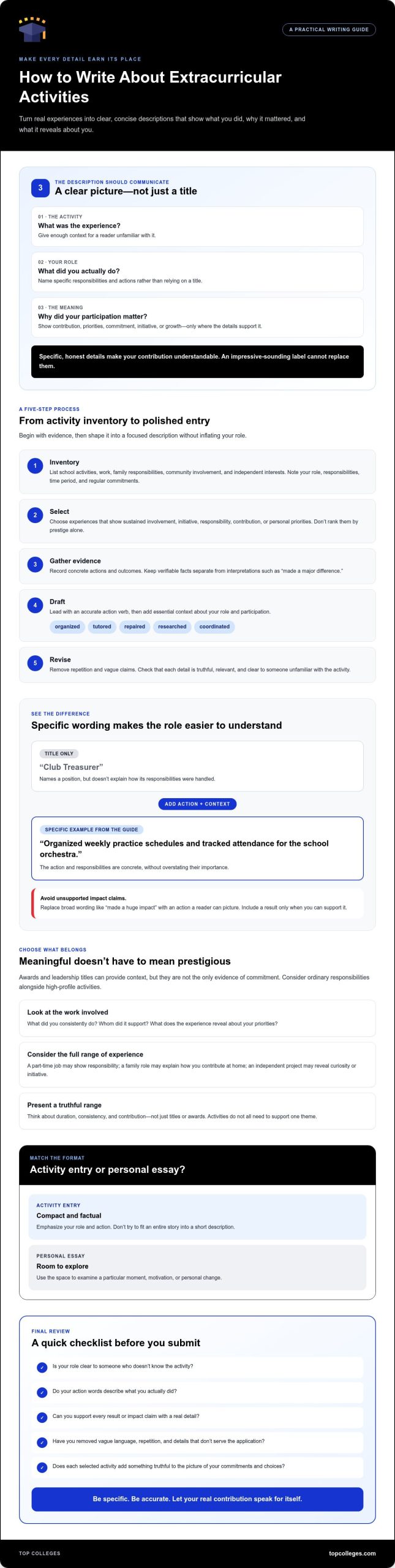
An effective activity description is accurate, specific, concise, and clear about your role. It helps readers understand what the activity involved, what you did, and why your participation mattered. A title alone rarely provides enough context. “Club Treasurer” names a position, but not how you handled its responsibilities.
The term Extracurricular activity covers many pursuits beyond formal coursework, including clubs, jobs, hobbies, family responsibilities, and community involvement. What matters in an application isn’t whether an activity sounds prestigious. It’s whether you can describe your contribution honestly and specifically.
Meaningful participation doesn’t require a major award or dramatic result. Showing up consistently, taking responsibility, developing a skill, or contributing to a community can all provide useful context. The goal of learning how to write about extracurricular activities effectively is to make that participation understandable without turning an entry into a personal essay.
What should a college activity description communicate?
Start with the activity and your role, then clarify what you did. Replace broad claims such as “made a huge impact” with an action a reader can picture. For example, a hypothetical student might write, “Organized weekly practice schedules and tracked attendance for the school orchestra.” This gives context and names specific responsibilities without overstating their importance.
Include a result, improvement, or lesson only if you can support it. A completed project, a change in attendance, or a skill developed through regular practice may help explain your involvement. If there’s no measurable outcome, don’t manufacture one. A precise account of your actions is stronger than an unsupported claim about impact.
An activity entry serves a different purpose from a personal essay. The entry is compact and factual, with an emphasis on role and action. An essay has more room to explore a particular moment, motivation, or personal change. Don’t try to fit an entire story into a short description.
Do activities need awards or leadership titles to matter?
No. Recognition can provide useful context, but it isn’t the only evidence of commitment. A student who regularly cares for a family member, works part-time, or supports a community group may have meaningful responsibilities without a leadership title or award.
Consider ordinary commitments alongside high-profile activities. Ask what you consistently did, whom it supported, and what the experience reveals about your priorities. Prestige can’t replace detail. A truthful description of steady contribution gives a clearer picture than an impressive-sounding label without an explanation.
How to Write About Extracurricular Activities: A Five-Step Process
Good descriptions begin with evidence, not polished language. Before drafting, record what you did and what you can accurately explain. This five-step process turns scattered memories into focused application entries without inflating your role.
- Inventory: List activities from school, work, family responsibilities, community involvement, and independent interests. Note your role, responsibilities, time period, and regular commitments.
- Select: Choose experiences that reveal sustained involvement, initiative, responsibility, contribution, or personal priorities. Don’t rank them by prestige alone.
- Gather evidence: Record concrete actions and outcomes. Separate verifiable facts, such as tasks completed or people served, from interpretations, such as “made a major difference.”
- Draft: Lead with an accurate action verb, then add essential context about your role and participation.
- Revise: Remove repetition and vague claims. Check that every detail is truthful, relevant, and clear to someone unfamiliar with the activity.
How do you choose which activities to include?
Look for what each experience helps a reader understand about your commitments and choices. A part-time job may show responsibility, a family role may explain how you contribute at home, and an independent project may reveal curiosity or initiative. Consider duration, consistency, and the work involved, not just titles or awards.
Selection is also about fit. Ask what each activity adds to the picture of you and whether it connects naturally to your interests or priorities. You don’t need to make every entry support one theme. Aim to present a truthful range of meaningful experiences.
How do you turn notes into a concise first draft?
Start with a verb that names your action: organized, tutored, repaired, researched, coordinated. Add verified context, such as how often you participated, whom you supported, or how long you held a responsibility. Replace “helped a lot” with the specific task you performed.
Illustrative example: “Helped at community garden” could become “Prepared planting beds and tracked weekly watering for a community garden.” The revision clarifies actions and frequency without claiming an unverified result. It’s a model of specificity, not a promise of an admissions outcome.
If you’re unsure how individual entries fit your broader application, personalized college admissions counseling can offer another perspective on presenting your experiences accurately and coherently.
How to Improve Activity Descriptions: Weak Versus Strong Examples
A useful revision doesn’t make an activity sound grander. It makes your actual role easier to picture. These hypothetical examples show how replacing broad phrases with observable actions can add clarity without inventing impact. They’re models for revision, not templates to copy. Use only details that reflect your own experience.
| Generic wording | Revised wording | What makes the revision clearer |
|---|---|---|
| Helped the team | Set up equipment and recorded attendance at weekly team practices | Names specific responsibilities and the regular commitment. |
| Volunteered at a community event | Welcomed visitors and directed families to activity stations at a community event | Gives readers context for the event and explains the student’s contribution. |
| Worked on a school newsletter | Proofread student submissions and organized articles for the school newsletter | Clarifies the work performed without implying an editor role or claiming an outcome. |
How can students replace vague phrases with concrete details?
Start by asking what “helped,” “supported,” or “participated” meant in practice. Choose an action verb that accurately describes your work: prepared, scheduled, translated, practiced, researched, or maintained. Don’t use a title or verb that suggests authority you didn’t have. “Recorded practice attendance” communicates a real responsibility more precisely than “managed the team.”
Context can also make an unfamiliar activity easier to understand. Briefly explain what the group does or whom it serves, then identify your part. For example, a student in a peer language group might describe leading conversation practice for younger learners. That detail orients a reader without requiring a long explanation.
How can students describe impact without overstating it?
Numbers can add useful scale, but only when they’re accurate and clearly tied to your contribution. If you report how many people attended an event, be sure you know what the number measures. Don’t claim that you “grew attendance” unless you can verify the change, and distinguish a group outcome from your individual work.
Use precise wording to make that distinction: “Helped organize a group fundraiser” describes a contribution, while “Raised funds for the organization” may imply sole credit. If an outcome isn’t measurable, say what you consistently did, what responsibility you carried, or what skill you developed. Learning how to write about extracurricular activities effectively means making the evidence precise, not making the achievement sound larger.
Adapting Activity Writing for Applications and Essays
The same experience may need a different presentation in each part of an application. A platform field asks for compressed facts, a résumé bullet may emphasize responsibilities, and an essay can explore meaning and change. To learn how to write about extracurricular activities effectively, keep the facts consistent while adjusting the emphasis and reflection to fit the format.
Check the current application cycle’s field labels, instructions, and character limits before drafting. For the 2026-2027 cycle, the Common App allows 150 characters for an activity description, the UC application allows 350 characters per activity or award description, and the Coalition Application via Scoir allows 255 characters. Limits differ and platforms may change, so verify each application directly instead of relying on a saved draft or last year’s guidance.
How should students handle application character limits?
Draft from complete notes, then tailor the entry to the space available. Keep the details that help a reader understand your role and participation. Cut repeated ideas, filler, and generic praise before removing context needed to understand the activity. Even a short description should make clear what you did.
Use a character counter, then check the text in the application field itself. Spaces and punctuation may count, and a platform may request information in separate fields. Don’t assume one version will fit every form.
When does an activity belong in an essay instead?
Use an activity field to summarize what you did and the responsibilities you held. A résumé bullet can provide a compact record of duties or accomplishments. An essay has more room to examine why an experience mattered, how your thinking changed, or how it connects to a larger personal story. If a prompt invites reflection, use the activity as a starting point rather than repeating its full description.
For example, an activity entry might note regular tutoring responsibilities, while an essay about that experience could focus on a moment that changed how you approach teaching. Keep details accurate across sections, but let each format contribute something distinct. A considered college essay strategy can help you decide where deeper reflection belongs and how it complements your activity entries.
Before submitting, compare the facts in every version. Dates, role, time commitment, and outcomes should agree. Adapt the framing, not the truth.
A Final Review Checklist for Writing About Extracurricular Activities
Before submitting, review each entry on its own and alongside the rest of your application. A description can be accurate yet unclear, or clear but repetitive. This final check helps ensure the details are dependable, easy to understand, and relevant to the picture you want to present.
What should students check before submitting?
- Accuracy: Confirm dates, role, time commitment, organization name, and outcomes against your own records or other reliable sources.
- Clarity: Can someone unfamiliar with the activity understand what you did? Replace unexplained abbreviations or insider terms with plain language.
- Specificity: Does the entry name your actions and responsibilities rather than relying on broad claims such as “made a difference”?
- Evidence: Can you support every number or result, and does the wording distinguish your contribution from the group’s?
- Relevance: Does this experience add useful context about your commitments, interests, or priorities?
- Concision: Can you remove repeated ideas without losing information needed to understand your role?
- Fit: Does the entry follow the current application’s instructions and fit the correct field and character limit?
Then ask one direct question: Would a reader understand my actions and role without needing me to explain them? If not, revise for clarity before polishing the wording. A trusted reader can help identify ambiguity, repetition, or claims that need evidence. Ask them to flag what they don’t understand rather than rewrite the entry in their own voice. The final description should still sound like you.
When can admissions counseling help refine an application?
Sometimes the challenge isn’t an individual description, but deciding how activities relate to broader application priorities. A personalized review can offer perspective on which details are clear, where the application repeats itself, and whether the experiences support an authentic overall narrative. An advisor can help you assess the presentation, but you remain responsible for confirming the facts and preserving your voice.
Use the same standards throughout: truthful details, clear responsibilities, and no claims you can’t substantiate. That’s the foundation of how to write about extracurricular activities effectively, whether you’re revising one entry or reviewing an entire application.
For a personalized review of how your experiences fit together, explore Top Colleges admissions counseling.
Make Your Activity Descriptions Count
Strong activity descriptions don’t depend on prestigious titles or dramatic claims. They help readers understand what you chose to do, how you contributed, and what your involvement reveals about your priorities. Start with accurate notes, select experiences that add meaningful context, and revise until each entry is clear, specific, and suited to its application field.
Knowing how to write about extracurricular activities effectively also means seeing how each entry fits the larger application. Keep the facts consistent across sections, and use essays to explore reflection or meaning that a short activity description can’t hold. A careful final review can help you share your experiences confidently while keeping your voice authentic.
Top Colleges offers personalized admissions counseling, portfolio development, and personal statement review to help applicants refine how their experiences connect across an application.
Your activities don’t need embellishment to matter. Clear, truthful descriptions give your contributions room to speak for themselves.
Frequently Asked Questions
How do you write about extracurricular activities effectively?
Start with an accurate account of your role, responsibilities, and participation. To understand how to write about extracurricular activities effectively, choose concrete details that show what you did and why it mattered rather than relying on broad praise. Add outcomes only when you can verify them, and distinguish your contribution from the group’s. Then revise for clarity, relevance, and the application field’s current instructions. Keep the description in your own voice.
What extracurricular activities should I include on a college application?
Include experiences that help explain how you spend your time, what responsibilities you hold, and what matters to you. These may include school clubs, paid work, caregiving, community involvement, creative projects, or independent interests. Consider sustained commitment and meaningful contribution, not only awards or titles. Check each application’s instructions, and don’t add an activity just because it seems prestigious. Choose details that give a truthful picture of your commitments and priorities.
Do extracurricular activities need to show leadership?
No. A formal leadership title isn’t necessary to show responsibility or contribution. You can describe how you supported a group, maintained a commitment, developed a skill, or took initiative within your actual role. Be precise about what you did rather than giving yourself a title that overstates your authority. Specific, accurate details help readers understand your involvement, whether you led a project, completed assigned tasks, or contributed consistently as a member.
How do I describe an extracurricular activity when I do not have measurable results?
You don’t need a numerical outcome for every activity. Explain your responsibilities, the actions you took, and the context that makes your involvement understandable. You might describe regular service, a task others relied on you to complete, or a skill you developed through practice. Use numbers only when they’re accurate and relevant. If there’s no measurable result, don’t invent one to make the entry seem more impressive.
Should I write about the same extracurricular activity in my activities list and college essay?
Yes, you can discuss the same experience in both places if each serves a distinct purpose. An activity entry can summarize your role and contribution, while an essay can explore a personal perspective or change when the prompt invites reflection. Avoid repeating the same wording or retelling the same facts without adding insight. Review the prompt and application instructions, and keep details such as your role and dates consistent across sections.
How long should an extracurricular activity description be?
The right length depends on the application field and its current instructions. For the 2026-2027 cycle, the Common App activity description limit is 150 characters, the UC application allows 350 characters per description, and the Coalition Application via Scoir allows 255 characters. Verify each platform’s current limit before drafting. Write the most informative version first, then remove repetition while preserving enough context to make your actions and role clear.
Can work or family responsibilities count as extracurricular activities?
They may be relevant experiences to include, but the application’s instructions determine where to enter them. Work, caregiving, and other family responsibilities can help explain how you spend your time and what you contribute. Describe them accurately and with the same care you’d give a club or organized program. Don’t minimize a meaningful commitment just because it isn’t a formal school activity. Check the platform’s field labels and guidance before submitting.