

Disclaimer
Content on this page of topcolleges.com is computer generated and therefore is not guaranteed to be 100 percent accurate about various aspects of the education sector. On balance, however, many students and families seek general information about high schools, colleges and universities, graduate programs, testing, education and career planning, and job placement before beginning one-on-one admissions counseling tailored to their specific needs.
Can a college admissions chances calculator tell you how competitive your application really is, or does it turn a few inputs into a confident-looking number? It’s reasonable to want a clear estimate when your college list feels too long and the stakes are high. But a calculator’s result depends on its assumptions, and a percentage can’t explain how your grades, course rigor, activities, and essays work together. A college admissions profile evaluation can help put those pieces into context.
A thoughtful evaluation isn’t a promise of admission. It’s a way to understand strengths, identify gaps, and make better-informed choices. The key is to distinguish what an estimate can suggest from what a contextual review can reveal.
In this article, you’ll learn how admissions calculators generate estimates, why colleges read applications in context, and how to assess the parts of your profile as a whole. You’ll also see how to use an evaluation to refine your school list and focus your next steps, based on your individual application rather than a single number.
Key Takeaways
- Use a college chances calculator for a quick estimate, not as a verdict on your application or a promise of admission.
- Look beyond headline numbers to understand how your academic choices, activities, essays, and personal context may fit together.
- A college admissions profile evaluation can identify strengths and gaps that a calculator may not explain.
- Refine your college list by weighing selectivity alongside academic options, personal priorities, and practical family considerations.
- If you seek professional feedback, clarify the review’s scope, process, and limitations before deciding what guidance would be useful.
What Does a College Admissions Chances Calculator Actually Measure?
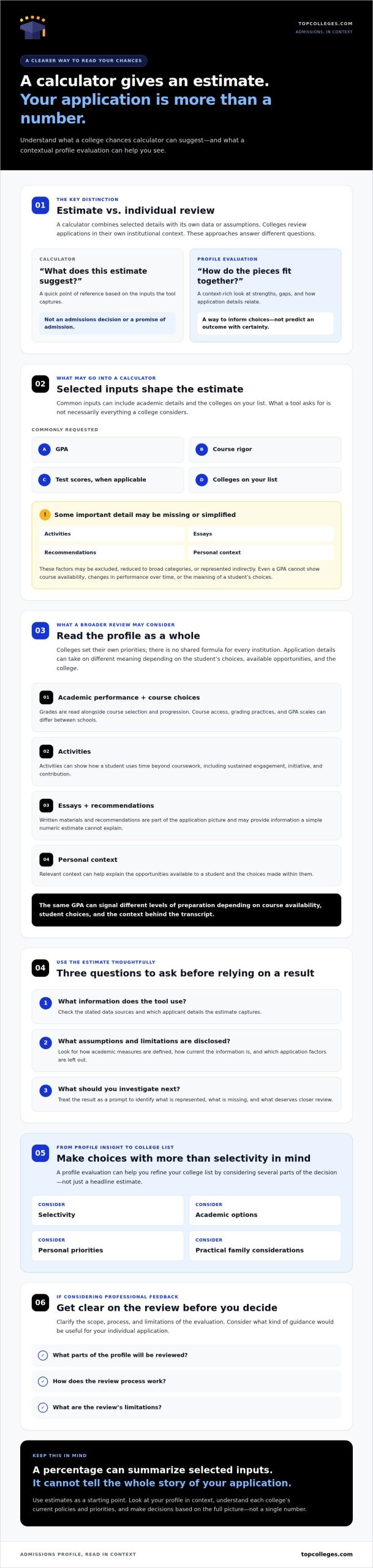
Can a college admissions chances calculator tell you whether you’ll get into a particular school? Not exactly. It uses selected details about an applicant and a college to produce an estimate, often by comparing those details with information or assumptions built into the tool. The result can offer a quick point of reference, but it isn’t an admissions decision, a guarantee, or a complete reading of your application.
A calculator estimates from selected inputs; an institution reviews an individual application in its own context. That distinction matters because the college admissions process differs across institutions, and a tool’s result reflects only the factors it can capture.
Which applicant details might a calculator use?
Common inputs include GPA, course rigor, test scores when applicable, and the colleges on your list. Some tools may ask for additional academic or personal details, but the information they request isn’t necessarily the full set of factors a college considers.
Activities, essays, recommendations, and personal context may be excluded, reduced to a few categories, or represented indirectly. Even academic details can lose nuance. A GPA alone doesn’t show which courses were available at your school, how your performance changed over time, or what your choices say about your interests.
Before relying on a result, check the tool’s stated data sources, assumptions, and limitations. Does it explain how it defines academic measures, how current its information is, or which application factors it leaves out? If those details aren’t clear, treat the estimate cautiously.
Why does one estimate not define your admissions potential?
Colleges set their own priorities and evaluate applicants within their institutional context. A student’s course choices, accomplishments, and written materials may carry different meaning depending on the school and the opportunities available to that student. No single formula can represent every institution’s review.
A broad estimate and a holistic review answer different questions. The estimate summarizes selected data points. A fuller review considers how the application’s parts relate, including academic preparation, activities, essays, recommendations, and relevant context. A strength in one area may clarify another; a number alone can’t show that relationship.
For that reason, don’t interpret a calculator’s percentage as a reliable individual probability of acceptance. Use it as an initial prompt: which parts of your profile are represented, which are missing, and what should you investigate next? A college admissions profile evaluation can provide a more context-rich interpretation, helping you assess strengths and gaps without claiming certainty about an outcome.
How Do Colleges Evaluate an Applicant Profile Beyond the Numbers?
How does an admissions reader make sense of an application as a whole? Colleges may consider academic performance, course choices, activities, essays, recommendations, and personal context, but they don’t all apply a shared formula. The College Board’s guide to holistic review explains how colleges can look beyond grades and test scores. Each institution sets its own priorities and requirements, so applicants should confirm current policies directly with the colleges they’re considering.
The same GPA can signal different levels of preparation depending on the courses available, the student’s choices, and the context behind the transcript. That’s why a college admissions profile evaluation should examine how details relate instead of treating each one as an isolated score.
How do academics and course rigor fit together?
Grades matter, but they’re read alongside course selection and progression. A transcript can show whether a student pursued appropriate challenges among the options available and how their performance developed over time. GPA scales, grading practices, and course access differ across schools, so simple comparisons between applicants may miss important context.
Testing can be another part of the academic picture, but its role depends on the college. Policies may be test-required, test-optional, or test-blind, and they can change. Check each institution’s current admissions guidance before deciding whether a score is required or considered.
What do activities, essays, and recommendations add?
Activities help show how a student uses time beyond coursework. Admissions readers may consider sustained engagement, initiative, contribution, and personal meaning, not just the number of clubs or titles listed. A student’s responsibilities at home, for example, may help explain how they allocate time and where they’ve taken initiative.
Essays can add a voice and perspective that a transcript or activity list can’t convey. Rather than repeating a résumé, an essay can help readers understand why an experience mattered, how the applicant thinks, or what shaped an interest. Recommendations offer another perspective on a student’s work and contributions, but they complement the applicant’s own record rather than replace it.
Look for connections across the materials. A demanding course sequence, a sustained activity, and an essay about a related interest may together communicate a clearer direction than any one item alone. Personalized college admissions counseling can help applicants interpret those connections and identify questions to address in their school strategy, without promising a particular outcome.
College Chances Calculator vs. Profile Evaluation: Which Is More Useful?
Which should you trust: a calculator that returns an estimate in seconds or a reviewer who explains how your application comes across? They serve different purposes. A calculator can help orient your early research; a profile evaluation can interpret connections and gaps across your materials. Neither can predict an institution’s decision with certainty.
| Comparison | Chances calculator | Profile evaluation |
|---|---|---|
| Purpose | Offer a quick estimate for a selected college | Interpret an applicant’s overall profile and positioning |
| Typical inputs | Details such as GPA, course rigor, test scores, and intended colleges | Academic records and, depending on the review, activities, essays, recommendations, and context |
| Output | A score, range, or category based on the tool’s model | Feedback on strengths, gaps, and questions to explore |
| Limitations | May omit application details or rely on unclear assumptions | Uses human judgment and can vary in quality; feedback should be supported by clear reasoning |
| Best use | Early orientation and broad exploration | Informing application and school-list strategy |
When is a college admissions chances calculator useful?
Use a calculator as an early research aid, not as a ranking of your worth or potential. If you compare results from different tools, enter consistent information and note each tool’s assumptions. A large difference between outputs may reflect different methods, not a change in your actual application strength. Don’t make a high-stakes choice based on one unexplained percentage.
What can a personalized profile evaluation add?
A thoughtful college admissions profile evaluation can connect academic choices, extracurricular involvement, and personal experiences into a clearer account of what your application communicates. It can identify strengths to make more visible, gaps that need attention, and questions to investigate before applying. The interpretation is subjective, but it can still be useful when the reviewer explains the evidence behind the feedback and acknowledges uncertainty.
For example, feedback is more actionable when it explains how a sustained activity supports an interest, or why a course pattern may prompt a question, rather than simply assigning a label. Individualized guidance can inform your strategy; it can’t control how a college weighs your application or determine its decision.
The two tools can complement each other: use a calculator to explore, then use careful review to understand what the estimate leaves out. Before acting on either, check each college’s current application requirements and policies. Those institution-specific details remain essential to a sound plan.
Using Profile Evaluations for a Grounded College List
A useful evaluation should lead to decisions, not just labels. Turn feedback into a college list with a deliberate sequence: organize your information, clarify what matters to you, assess your application in context, check each college’s requirements, and revisit your choices as circumstances change.
What information should you prepare for an evaluation?
Gather materials that explain both your academic record and your priorities. A concise, organized summary makes it easier to ask focused questions and get actionable feedback.
- Academic records: Transcripts, course history, and current testing information where relevant.
- Activities: A brief record of commitments, responsibilities, contributions, and interests.
- Priorities: Academic interests, campus preferences, and factors that matter to you and your family.
- Questions: Potential colleges you’re considering and what you want to understand about them.
Include context that helps explain your choices or constraints, such as limited access to certain courses or significant responsibilities outside school. Share what’s needed for guidance, not every personal detail. A college admissions counseling strategy blueprint can also help you think systematically about how evaluation connects to planning.
How should an evaluation shape next steps?
Translate observations into actions. If feedback identifies an unclear academic direction, research programs that match your interests. If an application element needs stronger explanation, consider how your materials can present it more clearly. If a college’s requirements don’t align with your plans, investigate alternatives before committing effort to an application.
As you refine the list, consider more than selectivity. Compare academic options and personal fit alongside practical family constraints, such as location, travel, and affordability. Aim for a balanced range of schools, but don’t treat any category as a guarantee of admission.
Verify current application requirements and policies directly with each institution. Testing rules, deadlines, and application components can differ and change, so check official admissions information before making decisions.
Separate what you can influence from what you can’t. You can research, prepare, and present your experiences thoughtfully; college review committees make admission decisions. Revisit your assessment if grades, interests, testing plans, or target schools change. That keeps your college admissions profile evaluation connected to the application you’re actually preparing, rather than an outdated snapshot.
When Is Professional College Admissions Profile Evaluation Worth Considering?
Outside perspective may be useful when you’re unsure how to present your strengths, which gaps deserve attention, or whether your college list reflects your priorities and academic profile. A professional college admissions profile evaluation can help turn those questions into a deliberate plan. It should offer perspective, not fixed odds or a promise of admission.
What should families ask before choosing an admissions counselor?
Use an initial conversation to understand how the counselor works and whether the approach fits your needs. Ask how they review academic and personal information, connect their findings to an actionable plan, and explain the reasoning behind their recommendations.
- What does the guidance include, and who provides it?
- What information should the student prepare?
- Which tasks remain the student’s responsibility?
- How does the counselor communicate uncertainty and avoid promising admission results?
Clear answers help families assess the service’s scope and transparency. Be cautious of guarantees or claims that a counselor can control an institution’s decision.
How does personalized guidance support an application strategy?
Profile interpretation can inform how an applicant develops a portfolio, approaches personal statement review, and prepares for interviews. These elements should connect to the student’s experience and goals, rather than follow a formula detached from their individual profile. A useful review also clarifies what the student can act on and what remains outside their control.
Top Colleges provides personalized college admissions counseling, portfolio development, personal statement review, and interview preparation. The firm is led by educational consultant Steven Roy Goodman and serves families nationally, with guidance also available to international students. Consider whether that scope matches the support you’re seeking, and ask how feedback would connect your profile with school selection and application preparation.
Professional guidance is most valuable when it sharpens your decisions while respecting uncertainty. The goal isn’t to secure a predicted result; it’s to understand your options, prepare thoughtfully, and make choices that reflect your priorities.
Turn Your Admissions Insights Into a Clearer Plan
A calculator can offer a starting point, but its estimate reflects only the information and assumptions behind it. A college admissions profile evaluation adds context by examining how your academics, activities, and application materials work together. Use either perspective to ask better questions, refine your school choices, and identify preparation steps, not to treat admission as predictable.
The most useful next step is one you can act on: verify each college’s requirements, clarify your priorities, and seek thoughtful guidance if you’re uncertain about how to present your profile. Personalized admissions counseling and strategy can connect that review with portfolio development, personal statement review, and interview preparation. At Top Colleges, this guidance is led by educational consultant Steven Roy Goodman and is intended to inform your approach, not promise an outcome.
You don’t need a perfect prediction to move forward. A grounded plan can help you make deliberate choices and prepare with greater confidence.
Frequently Asked Questions
Can a college admissions chances calculator accurately predict whether I will get in?
No. A chances calculator can offer an estimate, but it can’t determine an individual admission decision. Its result depends on the information entered, the tool’s data, and its assumptions about how those details relate to a college. Institutions set their own priorities and review applicants in context, often considering materials a calculator doesn’t capture. Treat the output as an early research prompt, not a personal probability or promise.
What information does a college admissions profile evaluation include?
A college admissions profile evaluation may review grades, course history, academic interests, testing information where relevant, activities, essays, recommendations, and personal context. The scope depends on who conducts the review and what materials they examine. Before sharing information, ask what the evaluation covers, how the reviewer interprets each element, and what limitations apply. A useful review should explain its reasoning, not just provide a label or general impression.
Is a profile evaluation better than a college admissions chances calculator?
Neither is universally better because each serves a different purpose. A calculator offers quick orientation based on selected inputs, while a profile evaluation can interpret how different parts of an application fit together and identify questions to investigate. You can use a calculator to begin exploring, then consider a review for more detailed feedback. Neither tool can establish how a specific admissions committee will decide.
How do colleges evaluate applicants beyond GPA and test scores?
Colleges may consider course choices, activities, essays, recommendations, and the context in which a student pursued opportunities. These elements can help readers understand preparation, interests, contribution, and perspective. The weight assigned to each factor varies by institution, and there isn’t one universal rubric for every college. Check each school’s current application guidance to understand its requirements and stated review approach.
Can a profile evaluation help me choose which colleges to apply to?
Yes. A profile evaluation can help you compare your preparation and priorities with the academic options and requirements at potential colleges. Use that perspective to build a balanced list that considers fit, selectivity, available programs, and practical family constraints. Verify current policies directly with each institution. An evaluation can inform your choices, but it can’t guarantee admission to any school or replace your own judgment about fit.
When should I get a college admissions profile evaluation?
Consider a college admissions profile evaluation while you still have time to use its feedback, such as when shaping your school list or preparing application materials. Revisit it if grades, interests, testing plans, or target colleges change. Before acting on recommendations, confirm each college’s current requirements and policies, since application details can vary. The review is most useful when it leads to practical next steps rather than a fixed prediction.
Does hiring a college admissions counselor guarantee acceptance?
No. A counselor can offer guidance on application strategy and preparation, but admissions decisions belong to each institution. Before choosing support, ask how the counselor reviews your information, what services and feedback are included, who is responsible for each task, and how uncertainty is handled. Be cautious of guaranteed outcomes or fixed acceptance odds. Clear scope and transparent reasoning are more useful than claims of certainty.