

Disclaimer
Content on this page of topcolleges.com is computer generated and therefore is not guaranteed to be 100 percent accurate about various aspects of the education sector. On balance, however, many students and families seek general information about high schools, colleges and universities, graduate programs, testing, education and career planning, and job placement before beginning one-on-one admissions counseling tailored to their specific needs.
With law school applications surging by 7.9% in 2026, why do most candidates still treat the interview as a mere formality rather than a high-stakes audition for their professional future? You’ve likely spent years curating a perfect GPA and months drilling for the LSAT. It’s natural to feel a paralyzing anxiety that a single curveball question might dismantle your hard work or that you’ll sound like a stilted, over-rehearsed version of yourself. You know that in a pool of near-perfect scores, differentiation is the only currency that matters. Effective law school interview preparation is not about memorizing answers; it’s about mastering the sophisticated narrative tactics required to prove your professional judgment to T14 admissions committees.
We understand the pressure of aligning your spoken persona with the elite credentials on your resume. This article provides a clear, methodical roadmap for every stage of the interview process. You’ll learn how to handle unpredictable prompts with strategic confidence and transform high-stress responses into opportunities for deep reflection. By the end of this guide, you’ll have the tools to navigate the most competitive admissions cycle since the Great Recession with the poise of a seasoned advocate.
Key Takeaways
- Understand why elite institutions are intensifying interview requirements to authenticate candidate voices in the age of AI.
- Bridge the gap between your written application and spoken persona by identifying the core pillars of your strategic portfolio.
- Refine your law school interview preparation by decoding the strategic intent behind high-stakes prompts and mastering the “Big Three” questions.
- Adopt professional presence techniques and the “Three-Second Rule” to maintain a calm, authoritative stance during unpredictable curveball questions.
- Leverage the Top Colleges methodology to align your unique background with the specific evaluative nuances of T14 admissions committees.
The Evolution of Law School Interviews in 2026
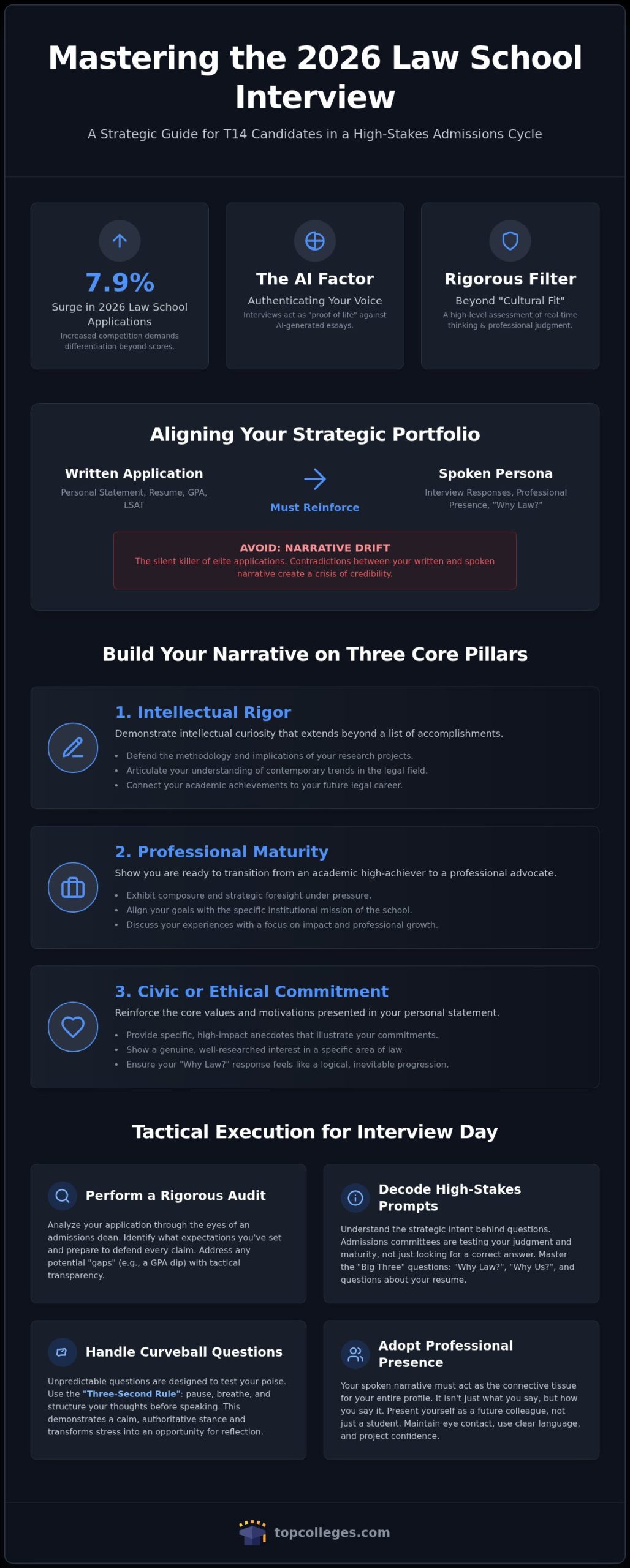
The 2026 admissions cycle has fundamentally redefined the interview’s role. It’s no longer a casual conversation to ensure you’re a “cultural fit.” Instead, it has become a rigorous filter. With law school applications increasing by 7.9% this year, elite institutions are facing an unprecedented volume of high-scoring candidates. This surge has forced committees to look beyond the LSAT and GPA. They need to see how you think in real time. Your law school interview preparation must reflect this shift from a personality check to a high-level assessment of professional judgment.
Why is this happening now? The proliferation of AI-generated content has cast a shadow of doubt over the traditional essay. While your written materials are still vital, admissions officers now use the interview as a “proof of life” to verify that the intellectual depth on the page matches the person on the screen. A 15-minute window at a T14 institution is a high-stakes arena. You have a quarter of an hour to prove you possess the composure and foresight required for the legal profession. If you can’t articulate your “why” with precision, even a perfect 180 LSAT won’t save your application.
Holistic Review and the Professional Persona
Committees use this brief interaction to verify the specific “voice” established in your law school personal statement. Your spoken narrative shouldn’t merely repeat your resume; it must act as the connective tissue for your entire profile. It’s about demonstrating intellectual curiosity that extends beyond a list of accomplishments. Do you understand the nuances of the legal field? Can you discuss contemporary trends with gravity? Admissions officers are looking for a candidate who can transition seamlessly from an academic high-achiever to a professional advocate.
The 2026 Admissions Climate
Elite schools like Harvard and Yale have recently refined their interview rubrics to place a higher premium on yield and professional maturity. They aren’t just looking for the smartest students; they’re looking for those most likely to succeed in a complex, global legal market. Holistic review is the integration of quantitative excellence and qualitative professional potential. This evaluative shift is a direct response to the competitive nature of the Law School Admissions Process in 2026. Schools are increasingly protective of their rankings and seek students who demonstrate a clear, strategic alignment with their specific institutional mission. You aren’t just applying to a school; you’re auditioning for a seat in a highly curated professional cohort.
Narrative Consistency: Aligning Your Strategic Portfolio
Narrative drift is the silent killer of elite law school applications. It occurs when a candidate’s interview persona contradicts the voice established in their written materials, creating a crisis of credibility for the admissions committee. If your essays project the image of a focused human rights advocate but your interview responses suggest a vague interest in corporate litigation, you’ve dismantled your own authority. Successful law school interview preparation requires you to view your application not as a collection of documents, but as a cohesive strategic portfolio. Every word you speak must reinforce the primary themes you’ve already presented to the dean.
Before entering the room, you must identify the three core pillars of your personal brand: Intellectual Rigor, Professional Maturity, and Civic or Ethical Commitment. These pillars serve as your north star during high-stakes questioning. Your law school resume acts as a tactical map for this conversation. It isn’t merely a list of past roles; it’s a series of launchpads for specific, high-impact anecdotes. When you map your experiences to these categories, you ensure that every answer you provide builds upon your existing foundation rather than drifting into unrelated territory.
The Audit: What Does Your Application Promise?
Perform a rigorous audit of your portfolio through the eyes of an admissions dean. What expectations have you set? If your personal statement highlights a specific research project, expect to defend its methodology and implications in detail. You must identify any “gaps” in your written story that the interview is designed to fill. For instance, if your GPA shows a slight dip in your sophomore year, your spoken narrative must address this with tactical transparency. Ensure your “Why Law?” response feels like a logical, inevitable progression of your past experiences. If the transition feels forced, the committee will detect a lack of professional foresight.
Strategic Storytelling for Lawyers
Many applicants rely on the standard STAR method (Situation, Task, Action, Result), but elite candidates employ what we call the Lawyerly Narrative. This approach shifts the focus from simple results to impact and ethical considerations. How did your actions influence a broader system? What legal or moral dilemmas did you navigate? Yale Law School’s Interview Guide suggests that knowing your application materials inside out is the baseline; the next level is articulating the “why” behind every choice. When discussing weaknesses or application red flags, don’t offer excuses. Instead, provide a diagnostic analysis of the situation and demonstrate the growth that followed. This level of self-reflection signals to the committee that you’re ready for the intellectual demands of a T14 environment. For those seeking to refine this alignment, engaging with professional admissions consulting can provide the external perspective needed to bridge these narrative gaps.
Decoding the Strategic Intent of Elite Law Questions
Elite admissions committees aren’t interested in your ability to recite facts. They’re testing your professional judgment. When they ask about your background, they aren’t looking for a summary; they’re searching for the “why” behind your choices. Your law school interview preparation must prioritize this strategic layer. In 2026, the “Big Three” questions—Why Law? Why Us? Why Now?—remain the foundation of every successful interaction. However, institutions like Harvard now employ “The Joy Question,” asking what brings you genuine happiness to gauge your authenticity and internal motivation. Even casual small talk may hide ethical prompts designed to see if you maintain professional boundaries under pressure.
This shift toward behavioral evaluation means that every response is a data point for your future performance as an attorney. Committees are looking for the “Strategic Mastermind” who can anticipate challenges and articulate a clear path forward. If you can’t explain the strategic intent behind your previous career shifts or academic focus, you risk appearing reactive rather than proactive. Every prompt is an invitation to demonstrate that you possess the analytical mindset required for T14 success.
The “Why Us?” Question: A Tactical Deep Dive
Generic praise for a school’s prestige or high ranking is a fatal error. It signals a lack of due diligence. To stand out, you must create a bespoke answer that demonstrates a deep understanding of the institution’s clinical programs, specific faculty research, and student-led journals. You aren’t just looking for a degree; you’re looking for a specific intellectual environment. If your trajectory includes interdisciplinary goals, connect the law school’s culture to your broader aspirations, perhaps even referencing how your path aligns with MBA Admissions Consulting strategies for dual-degree candidates. This level of specificity proves that you’ve analyzed how their resources will facilitate your unique professional contribution. Schools prioritize yield, and a candidate who can articulate a precise “fit” is far more likely to receive an offer.
Behavioral Prompts and Professional Judgment
Behavioral questions often center on conflict or failure. When asked to describe a disagreement with a supervisor, the committee isn’t looking for drama. They’re evaluating your ability to navigate hierarchy and maintain professional decorum while advocating for a position. Similarly, demonstrating resilience isn’t about recounting a hardship; it’s about showing the diagnostic process you used to overcome it. Avoid clichés about “working hard.” Instead, provide a measured analysis of the situation and your specific response. This approach signals that you possess the temperament required for high-stakes litigation or complex negotiations. Every behavioral answer should conclude with a reflection on how the experience prepared you for the rigors of legal practice.
Tactical Execution: From Professional Presence to Curveballs
In 2026, the medium is as critical as the message. While your narrative pillars provide the foundation, your tactical execution during the 15-minute T14 window determines whether that foundation holds. Modern law school interview preparation must account for the nuances of digital persuasion. It isn’t enough to have the right answers; you must deliver them with an authoritative presence that transcends the screen. This requires a shift from passive participation to active management of the interview environment and the conversational flow.
Virtual Professionalism in a Digital Age
Excellence in a virtual setting is a baseline expectation. Your framing should be at eye level, ensuring you aren’t looking down at the committee or appearing distant. Lighting must be front-facing to eliminate shadows that can obscure your expressions and diminish rapport. Beyond the visual, technical redundancy is your insurance policy. Have a secondary hotspot ready and a clear protocol for the inevitable “WiFi drop.” By preparing for these disruptions, you demonstrate the foresight and crisis management skills essential for a legal career. Remember, looking at the camera lens, rather than the person on the screen, is the only way to simulate true eye contact and build a sense of professional connection.
Managing the Unexpected
The most dangerous moment in any interview is the curveball question designed to test your stress response. When faced with an off-the-wall prompt, employ the “Three-Second Rule.” Instead of rushing into a filler-heavy response, take three full seconds of silence to breathe and process. This pause doesn’t signal a lack of knowledge; it signals a thoughtful, measured mind. It’s a tactical stall that allows you to pivot from the unexpected prompt back to your core narrative. If you realize you’ve given a “bad” answer, don’t panic. Perform a mid-interview course correction by saying, “To refine my previous point,” and then steer the conversation back to your strategic strengths.
The final phase of tactical mastery is the “Reverse Interview.” When the committee asks if you have questions for them, avoid logistical queries about housing or class sizes. Ask high-level, diagnostic questions about the school’s clinical evolution or how they’re preparing students for the 2027 legal landscape. This demonstrates that you aren’t just a student seeking a seat, but a future colleague interested in the institution’s intellectual trajectory.
The Top Colleges Methodology for Law School Success
Elite admissions is a game of marginal gains where the difference between a rejection and a seat at a T14 institution often rests on a single interaction. Our methodology moves beyond the generic advice found in standard forums. We transform candidates into “Strategic Masterminds” who understand that the interview is the final, most critical component of their portfolio. By the time you sit across from an admissions officer, you must have transitioned from a hopeful applicant to a future colleague. This mental and tactical shift is the hallmark of effective law school interview preparation at the highest level.
Top Colleges utilizes a diagnostic approach to identify the specific narrative threads that will resonate with elite committees. We don’t just drill questions. We analyze the strategic intent behind every prompt to ensure your responses project professional maturity and analytical depth. Integrating resources from our Educational Publication Sales and consulting blueprints allows you to build a foundation of knowledge that extends well beyond your resume.
The Steven Roy Goodman Advantage
Steven Roy Goodman provides a national perspective that is indispensable for navigating the complexities of elite admissions. With decades of experience, he understands the subtle shifts in institutional priorities that rankings alone cannot reveal. This expertise allows us to leverage current media trends and higher education analysis to anticipate the next cycle of admissions questions. Our success stories often involve candidates who overcame “borderline” LSAT scores through superior strategic positioning. By focusing on the qualitative professional potential that holistic review seeks to uncover, we ensure your voice is the most compelling in the room.
Your Next Strategic Move
Early preparation is the only viable path for elite law programs. Waiting for an interview invite to begin your training is a tactical error that often leads to the “over-rehearsed” or stilted delivery that committees reject. Booking a comprehensive interview audit with Top Colleges provides the personalized, one-on-one feedback necessary to refine your delivery and composure. As you approach your high-stakes meeting, follow this final 24-hour checklist:
- Review your strategic pillars: Ensure your three core brand themes are at the forefront of your mind.
- Technical rehearsal: Conduct a final check of your virtual environment, lighting, and backup connectivity.
- Narrative audit: Re-read your personal statement and resume to ensure absolute narrative consistency.
- Mental calibration: Practice the “Three-Second Rule” to ensure your tone remains calm and authoritative under pressure.
Success in the 2026 cycle requires more than just academic excellence. It requires a proactive spirit and a methodical plan. When the stakes are this high, your preparation must be as rigorous as the legal career you seek to build.
Mastering Your Professional Audition for 2026
The 2026 admissions cycle demands more than just academic excellence; it requires a disciplined persona that withstands the scrutiny of holistic review. You’ve learned that narrative consistency is your greatest asset and that tactical execution, from the “Three-Second Rule” to optimizing your virtual presence, differentiates you in a pool of near-perfect scores. Effective law school interview preparation is the final bridge between your credentials and a seat at a T14 institution.
Top Colleges, led by internationally recognized consultant Steven Roy Goodman, utilizes a strategic, result-oriented approach to holistic admissions. With decades of success placing students in T14 law programs, we understand the nuances that move an application to the acceptance list. By treating the interview as a high-stakes audition rather than a formality, you position yourself as a future colleague ready for elite legal practice. This level of foresight is what admissions deans prioritize in a competitive landscape.
Your future at a prestigious law school is within reach if you approach this milestone with the gravity it deserves. You’ve done the work; now execute with the authoritative confidence of a strategist.
Frequently Asked Questions
How long should my law school interview answers be?
Aim for 90 to 120 seconds for major narrative questions and 30 to 60 seconds for logistical or follow-up prompts. This specific duration allows enough time to establish intellectual depth without losing the interviewer’s attention. Precision is a hallmark of professional judgment. If you find yourself speaking past the two-minute mark, you risk appearing undisciplined. Use the “Three-Second Rule” mentioned earlier to structure your thoughts effectively before you begin speaking.
What should I wear for a virtual law school interview in 2026?
You must wear full professional business attire, exactly as you would for an in-person appearance at a T14 institution. This typically includes a dark suit, a conservative tie, or a professional blouse. Even in a virtual setting, dressing fully signals a high degree of respect for the process. Avoid distracting patterns that might shimmer on camera. Your clothing should reinforce your authoritative persona rather than distract from your strategic narrative during the call.
Do all top law schools require an interview for admission?
No, not every elite institution requires an interview, but the trend toward holistic evaluation in 2026 has made them more common. Schools like Harvard, Chicago, and Virginia utilize interviews as a critical filter for their most competitive applicants. Other institutions may offer them by invitation only or use recorded video prompts. Regardless of the school’s specific policy, thorough law school interview preparation remains essential for any high-achieving candidate targeting the T14.
How do I explain a gap year or career change during the interview?
Frame your gap year or career transition as a deliberate, strategic choice rather than a period of indecision. Focus on the transferable skills you acquired, such as negotiation, project management, or ethical reasoning. Admissions committees value candidates who show professional maturity and a clear “why” behind their life path. Describe how these experiences provided a diagnostic lens that eventually led you to pursue a legal career with a renewed, proactive focus.
What are the best questions to ask a law school interviewer?
Ask high-level, diagnostic questions that demonstrate your interest in the school’s intellectual trajectory and clinical evolution. You might ask how the faculty is addressing specific contemporary legal trends or how the institution supports interdisciplinary research in your area of interest. Avoid logistical questions that are easily answered on the school’s website. Your goal is to engage the interviewer in a professional dialogue that positions you as a future colleague and a strategic thinker.
Can I use notes during a virtual law school interview?
It’s best to avoid relying on physical notes during the call to maintain natural eye contact with the camera. If you must have a reference, use a single “cheat sheet” with three to five strategic bullet points placed at eye level behind your monitor. Glancing down at a notebook breaks the connection and can make you appear under-prepared or stilted. Rely instead on the core narrative pillars you established during your proactive planning phases.
What happens if I don’t get an interview invite from a T14 school?
An absence of an interview invitation doesn’t always signal a rejection, as some schools admit a portion of their class without one. However, in the 2026 cycle, a lack of an invite often means your written portfolio must work twice as hard. If you’re waitlisted, use that opportunity to submit a letter of continued interest that reinforces your strategic alignment with the school. Focus your energy on the institutions where you are actively being evaluated.
How should I follow up after a law school interview?
Send a brief, professional thank-you email to your interviewer within 24 hours of the meeting. This isn’t just a courtesy; it’s a final touchpoint for your strategic narrative. Reference a specific, high-level topic discussed during the conversation to demonstrate your active engagement and intellectual curiosity. Keep the message concise and formal. A well-crafted follow-up reinforces the professional persona you projected during your law school interview preparation and the actual session.