

Disclaimer
Content on this page of topcolleges.com is computer generated and therefore is not guaranteed to be 100 percent accurate about various aspects of the education sector. On balance, however, many students and families seek general information about high schools, colleges and universities, graduate programs, testing, education and career planning, and job placement before beginning one-on-one admissions counseling tailored to their specific needs.
Is a 175 LSAT and a 3.9 GPA still enough to secure a seat at a T14 institution? In the 2026 cycle, the answer is increasingly no. Law school admissions is no longer a beauty pageant of statistics; it is a tactical exercise in aligning your unique value with a school’s specific institutional trajectory. You likely feel the pressure of shifting US News rankings and the confusion of holistic evaluation metrics that seem to move with every passing cycle. It is natural to fear that a generic personal statement will bury your potential under a mountain of similar profiles.
Elite law school admissions consulting replaces this anxiety with a structured, results-oriented roadmap. This article provides the 2026 blueprint for transforming a standard application into a compelling narrative that commands attention from the most discerning committees. We will examine how to build a cohesive portfolio, find strategic clarity in school selection, and develop the confidence necessary for high-stakes interview performance. By moving from a reactive state to a proactive strategy, you can bridge the gap between your current credentials and your highest professional aspirations.
Key Takeaways
- Understand the critical shift toward holistic evaluation and why elite admissions require a strategic advisory approach rather than simple proofreading.
- Discover how law school admissions consulting provides an institutional alignment framework to connect your unique history with the specific priorities of T14 committees.
- Learn to implement a Narrative Architecture that transforms disparate application materials into a singular, cohesive professional manifesto.
- Gain tactical clarity on navigating ranking volatility to ensure your school selection is driven by long-term career outcomes rather than shifting metrics.
- Develop a high-stakes application portfolio designed to command attention and replace generic statements with a compelling personal narrative.
Understanding the High-Stakes Landscape of Law School Admissions
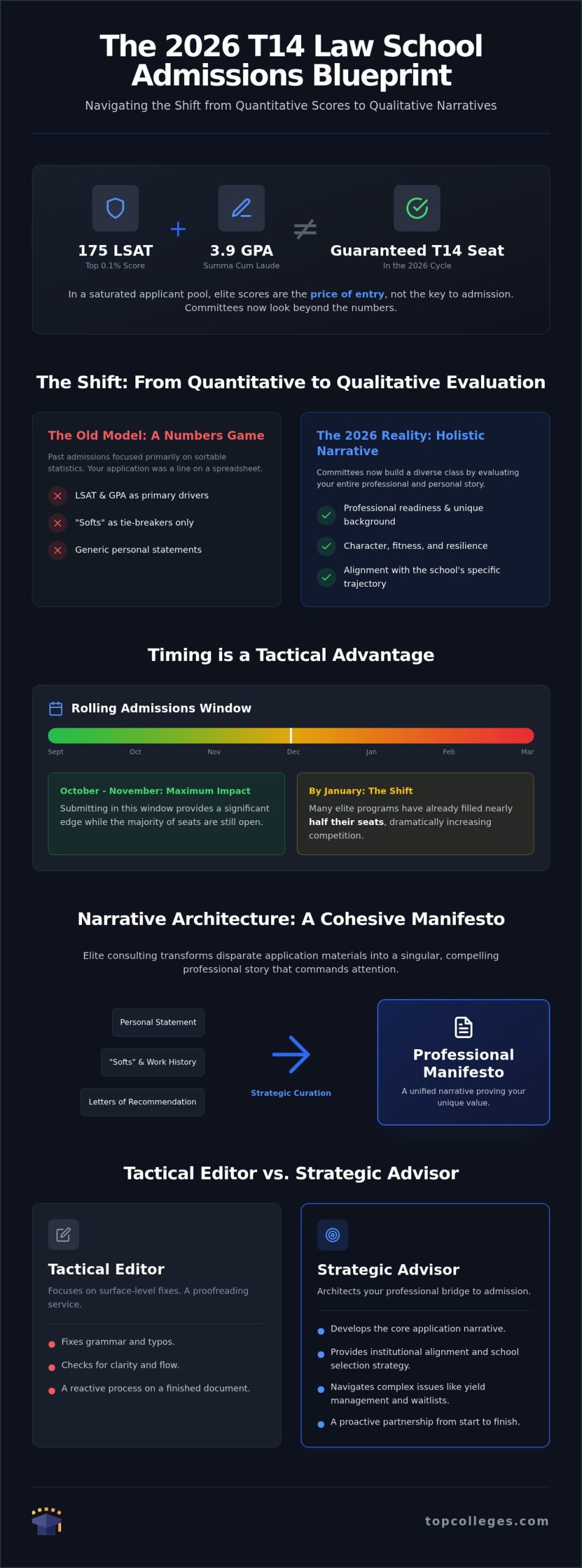
The 2026 admissions cycle operates on a premise of saturation. Every applicant targeting the T14 possesses a near-perfect profile on paper. In this environment, your LSAT and GPA are merely the price of entry. They get your file opened, but they don’t get you admitted. This is where elite law school admissions consulting transitions from a luxury to a necessity. It is not a proofreading service. It is a strategic advisory designed to navigate a system that has moved beyond the spreadsheet. You aren’t just competing against scores; you’re competing against stories.
Timing is your first tactical advantage. Data from the Law School Admission Council (LSAC) suggests that while the LSAT remains a critical benchmark, the window for maximum impact is narrow. Submitting your application in October or November provides a significant edge in rolling admissions. By January, many elite programs have already filled nearly half of their available seats. Waiting for a “perfect” score often means applying when the odds have already shifted against you. Strategic positioning requires moving when the gates are widest.
The Shift from Quantitative to Qualitative Evaluation
Admissions committees now use “softs” to differentiate between identical statistical profiles. These qualitative metrics are no longer secondary. They are the primary tools used to build a diverse, resilient class. Evolving ABA standards have pushed law schools to look deeper into an applicant’s professional readiness and their ability to contribute to a global legal discourse. This shift means your undergraduate history and professional background must be curated, not just listed.
Character and fitness disclosures have also evolved. They are no longer just bureaucratic hurdles to be cleared. In the modern application, these sections are opportunities to demonstrate transparency, growth, and professional integrity. A well-handled disclosure can actually strengthen a narrative by proving the applicant’s resilience under pressure. It’s about controlling the narrative before the committee can invent its own.
The Role of a Strategic Advisor in 2026
There is a vast gulf between a tactical editor and a high-level admissions strategist. A tactical editor fixes your grammar; a strategist builds your professional bridge. The highest ROI for law school admissions consulting occurs at critical turning points, such as school selection and the framing of unconventional career paths. You need someone who understands the inner workings of competitive systems to identify which schools will value your specific trajectory. The strategic consultant serves as the architect of the applicant’s professional bridge, ensuring every piece of the portfolio supports a singular, unassailable objective.
The Core Methodologies of Elite Admissions Strategy
Success in the elite legal arena begins with a calculated offensive. It isn’t enough to be a strong candidate; you must be the right candidate for a specific institution. This is the foundation of law school admissions consulting at its highest level. We move beyond the static checklist of requirements to focus on institutional fit. Why do candidates with 178 LSAT scores occasionally receive rejections from schools where they exceed the median? The answer lies in yield management.
Timing serves as a powerful strategic lever. The choice between Early Decision (ED) and Regular Decision (RD) cycles is not merely a matter of preference; it is a tactical decision based on a school’s historical yield patterns and current class needs. Similarly, the waitlist should never be viewed as a passive waiting room. It is a proactive phase where targeted updates can turn a “maybe” into an acceptance. If you are seeking a strategic mentor to navigate these nuances, the preparation must begin long before the application portals open.
Institutional Alignment and Yield Management
Schools protect their yield by identifying applicants who are genuinely likely to enroll. Reviewing the NYU Law admissions requirements reveals a complex set of expectations that go far beyond numerical data. If a committee suspects you are using them as a safety, they may issue a rejection to protect their rankings. You must signal authentic interest by matching your professional goals with their specific clinical strengths and faculty expertise. This alignment proves that you aren’t just looking for a law degree, but for their law degree specifically.
The Strategic Audit: Identifying Gaps and Strengths
A diagnostic audit of your undergraduate and professional history is the first step in building this alignment. We identify the red flags, such as a GPA dip or an unconventional career pivot, and address them before the committee can form an unfavorable conclusion. This audit also dictates your choice of recommenders. You don’t need a generic letter of praise. You need an advocate who can speak to the specific institutional values of your target schools. We look for specific evidence of leadership and intellectual curiosity that mirrors the school’s own mission statement.
Mitigating weaknesses is only half the battle. A strategic audit also uncovers hidden strengths that you might have overlooked. Perhaps a summer internship or a volunteer position holds the key to a compelling narrative thread. By auditing your history through the lens of an admissions officer, we ensure that every component of your portfolio serves a singular, persuasive purpose.
Narrative Architecture: Crafting an Application That Commands
A collection of impressive documents is not an application; it is merely a pile of data. To command attention in a T14 committee review, you must employ Narrative Architecture. This is the cohesive thread that connects your resume, essays, and letters of recommendation into a singular, undeniable case for your admission. High-level law school admissions consulting ensures that every component of your portfolio reinforces a central theme rather than repeating the same facts. Without this connective tissue, your candidacy remains fragmented and forgettable.
Non-traditional applicants often struggle to translate professional experience into a legal context. Your years in finance, technology, or public policy aren’t just “time spent”; they are evidence of your ability to handle complex systems and high-stakes decision-making. We leverage these backgrounds to show how your specific expertise will enrich the classroom discourse. Diversity statements and addenda serve as supplemental layers to this architecture. They provide necessary context for unconventional paths or past setbacks, ensuring that no part of your history is left to the committee’s imagination.
The Personal Statement as a Strategic Manifesto
Most applicants fall into the “cliché trap” by writing about a childhood desire to seek justice. Elite committees aren’t interested in your origin story; they want to know what you will contribute to their legal community. Your law school personal statement must pivot from “why I want to be here” to “why this school needs my perspective.” It’s a professional manifesto that demonstrates intellectual maturity and a clear-eyed understanding of the legal profession. The personal statement must function as a closing argument for your admission, leaving the reader with no logical choice but to grant you a seat.
Optimizing the Law School Resume
A legal resume is fundamentally different from a standard corporate CV. While a corporate resume focuses on profit and efficiency, a law school resume highlights research, analytical rigor, and community leadership. Every bullet point must be audited for its ability to demonstrate “lawyerly” qualities. We prioritize depth over breadth, focusing on clerkships, significant academic research, or leadership roles that required complex negotiation. Professional formatting and strategic use of “white space” are critical. A cluttered resume suggests a cluttered mind; a clean, authoritative layout signals a candidate who understands the value of clarity and precision in the legal field.
Strategic Decision-Making: Rankings, Yield, and Priorities
The landscape of legal education is currently defined by institutional upheaval. When Yale and Harvard withdrew from the traditional ranking systems, they didn’t just exit a list; they signaled a fundamental shift in how prestige is calculated. This volatility in the us news law school rankings has left many applicants adrift, clinging to outdated metrics while the ground shifts beneath them. In this environment, law school admissions consulting must prioritize long-term career outcomes over the ephemeral status of a magazine’s annual list. Prestige is a currency, but its value fluctuates. You must decide whether you are buying a name or an outcome.
Schools are acutely aware of their own standing and use financial aid as a precision tool to manage their yield. A merit scholarship is rarely just a reward for high scores. Instead, it is a tactical move to lure a candidate who might otherwise choose a higher-ranked peer. This creates a “Ranking vs. Reality” debate. Is it better to be at the bottom of a T10 school with full debt, or at the top of a T20 school with a full-tuition scholarship? For many, the latter provides the financial freedom to pursue high-stakes litigation or public interest roles that debt-heavy graduates simply cannot afford. Strategic decision-making requires looking past the number to the actual employment data and debt-to-income ratios.
Navigating the T14 and Beyond
Constructing a school list requires a balance of reaches, targets, and safeties, but these categories must be informed by geographic mobility. An elite degree from a T14 school often grants national portability, allowing you to practice in any major market. However, if your goal is to dominate a specific regional market, a top-tier local school might offer a more robust alumni network and better clerkship pipelines. We evaluate employment outcomes, such as “Big Law” placement and federal clerkship rates, to ensure your list is built on data rather than vanity. A school’s ranking is a snapshot; its employment report is a roadmap.
Leveraging Merit Aid and Negotiation
The admissions process doesn’t end with an acceptance letter. It moves into a phase of negotiation where competing offers become your most valuable leverage. Schools expect sophisticated candidates to request scholarship reconsiderations. This isn’t a simple ask for more money; it is a professional presentation of your value to their incoming class. You must demonstrate how their peer institutions are valuing your profile and why a specific adjustment would make their school your definitive choice. Merit aid is a reflection of the school’s strategic investment in your profile. Treat these negotiations with the same rigor you would a legal brief, focusing on evidence and institutional benefit rather than personal need.
Implementing Your Strategic Blueprint with Top Colleges
Constructing a theoretical strategy is only the beginning. The true test of any blueprint lies in its execution under the scrutiny of an elite admissions committee. Top Colleges positions itself as the premier architect for high-stakes law school applications, moving beyond the standardized packages offered by generic firms. We replace the widespread anxiety of the 2026 cycle with a methodical, structured preparation that leaves nothing to chance. Success requires more than just following a list of instructions; it demands a deep integration of media-informed insights and a proactive understanding of institutional trends.
The Steven Roy Goodman Advantage
Steven Roy Goodman brings a Washington DC-level strategic rigor to the field of law school admissions consulting. Since 1999, he has guided applicants through the most complex and competitive academic systems in the world. This experience provides a unique perspective on the national education landscape, allowing the firm to anticipate shifts in committee priorities before they become common knowledge. We don’t just help you apply; we provide a bridge to elite campus life and the professional milestones that follow. This high-level mentorship is the differentiator that transforms a strong candidate into an inevitable choice.
Interview Preparation and Final Execution
The final selection phase often hinges on a single conversation. As committees seek to verify the person behind the paper, law school interview preparation becomes the critical focus of our strategic execution. We simulate the high-pressure environment of T14 admissions interviews, ensuring that your responses are as intellectually rigorous as your written manifesto. This process refines your ability to pivot under questioning and demonstrate the professional poise expected of a future legal leader.
Finalizing the portfolio for submission represents the “last mile” of strategic excellence. We audit every word, every formatting choice, and every piece of evidence to ensure the Narrative Architecture we’ve built is unassailable. This level of scrutiny ensures that when you hit submit, you do so with the calm confidence of someone who has already seen the inner workings of the system. The journey from a standard application to a commanding narrative is a high-stakes transition, but with the right law school admissions consulting mentor, it is a manageable and rewarding one.
Securing Your Place in the Next Generation of Legal Leaders
The 2026 cycle demands a departure from traditional, reactive application methods. Success in this high-stakes environment requires a sophisticated narrative architecture and precise institutional alignment. You now understand that elite admissions committees look past the numbers to find candidates who can articulate a clear professional manifesto. By navigating ranking volatility with tactical foresight, you transition from a state of uncertainty to one of command. Results matter.
Top Colleges provides the structured preparation necessary to bridge the gap between your current credentials and a T14 acceptance. Led by nationally recognized expert Steven Roy Goodman, our firm leverages decades of experience and a results-oriented methodology to ensure your portfolio is unassailable. Elite law school admissions consulting isn’t just about the letter of acceptance; it’s about architecting the foundation for your entire legal career.
Your future in the legal profession starts with a single, strategic choice. Move forward with the clarity and confidence that comes from expert preparation.
Frequently Asked Questions
How early should I engage a law school admissions consultant?
Engage at least 12 to 18 months before your intended matriculation date. This lead time allows for a comprehensive strategic audit and portfolio development. Early engagement ensures you hit the October or November rolling admissions window, which is critical for T14 success. Waiting until the application portals open forces you into a reactive posture. Proactive planning secures the tactical advantage necessary for elite placement.
Is law school admissions consulting worth it for applicants with high LSAT scores?
High scores are merely the price of entry; they don’t guarantee admission to top tier programs. Elite committees reject thousands of high stat applicants every year who lack a cohesive narrative. Professional law school admissions consulting transforms your data into a compelling manifesto. It ensures your profile aligns with institutional priorities. You aren’t just selling your intelligence; you’re selling your future contribution to their legal community.
Can a consultant help if my undergraduate GPA is below the median?
Strategic intervention is essential for candidates with GPA gaps. We identify the specific causes of the academic dip and address them through targeted addenda or professional context. By highlighting upward trends or significant post graduate achievements, we mitigate the numerical weakness. The goal is to provide the committee with a logical reason to look past the median and focus on your current professional readiness.
How does a consultant help with law school scholarship negotiations?
Consultants treat scholarship reconsiderations as high stakes professional negotiations. We help you leverage competing offers from peer institutions to demonstrate your market value. This isn’t a plea for financial aid; it’s a presentation of your value to the school’s strategic investment portfolio. We refine the tone and evidence in your requests to ensure they reflect the professional poise expected of a future advocate who understands their worth.
What is the difference between general admissions help and T14 strategy?
General help focuses on bureaucracy and grammar. T14 strategy focuses on narrative architecture and institutional alignment. Elite schools require a sophisticated understanding of yield management and class composition. We move beyond the checklist to build a portfolio that commands attention in a saturated market. It’s the difference between being a qualified applicant and being an indispensable addition to the class that committees cannot afford to overlook.
How do shifts in law school rankings affect my application strategy in 2026?
Ranking volatility requires a shift toward outcome based school selection. When major institutions depart from traditional systems, prestige becomes a moving target. We help you evaluate schools based on employment data, clerkship rates, and geographic mobility rather than a magazine’s annual list. This foresight ensures your investment is grounded in reality. Law school admissions consulting provides the clarity needed to navigate this ongoing institutional upheaval with confidence.
Can a consultant assist with character and fitness disclosures?
Disclosures are strategic opportunities to demonstrate growth and integrity. We help you frame past setbacks with transparency and resilience, ensuring they don’t derail your candidacy. A well crafted disclosure addresses the committee’s concerns before they can form a negative conclusion. It’s about taking ownership of your history and proving your fitness for the legal profession’s high ethical standards through professional and honest communication.
Does Top Colleges offer help with law school transfer applications?
Yes, Top Colleges provides comprehensive support for law school transfer applications. Transferring is a distinct strategic exercise that requires proving your academic success at your current institution. We help you articulate a compelling professional reason for the move, focusing on clinical strengths and career goals that your current school cannot satisfy. It’s a high stakes transition that requires precise narrative alignment to secure a seat at a more prestigious institution.