

Disclaimer
Content on this page of topcolleges.com is computer generated and therefore is not guaranteed to be 100 percent accurate about various aspects of the education sector. On balance, however, many students and families seek general information about high schools, colleges and universities, graduate programs, testing, education and career planning, and job placement before beginning one-on-one admissions counseling tailored to their specific needs.
What if the silence from an admissions committee isn’t a sign of impending rejection, but rather a strategic opening for you to seize control of your narrative? Receiving a notification stating that a decision cannot yet be made about your application is often the most unsettling phase of the entire admissions cycle. It’s natural to feel like a secondary candidate caught in an administrative backlog. You’ve invested months of effort into your portfolio, and this sudden stasis can trigger a profound sense of uncertainty regarding your future plans.
We understand the gravity of this moment. This article replaces that anxiety with a structured, professional framework designed to help you navigate admissions limbo with tactical precision. You’ll gain a clear understanding of why these delays occur and, more importantly, how to influence the final decision. We will examine the institutional priorities driving these pauses and provide a roadmap of actionable steps to improve your odds of success. Your journey isn’t over; it’s simply entered a phase where expert positioning matters most.
Key Takeaways
- Recognize that receiving notice that a decision cannot yet be made about your application is a formal holding pattern, providing a critical window for tactical re-positioning.
- Decode the institutional logic of yield management to understand how elite colleges protect their rankings while evaluating the depth of your specific applicant pool.
- Implement the Three-Pillar framework for your Letter of Continued Interest to effectively communicate academic updates, institutional fit, and unwavering commitment.
- Identify the influence of regional officers in the committee room so you can provide the specific evidence they need to advocate for your admission.
- Leverage professional admissions counseling to diagnose the root cause of the delay and execute a high-level strategy that turns a “maybe” into a definitive “yes.”
Decoding the Status: What ‘A Decision Cannot Yet Be Made’ Signifies
Receiving a notification that a decision cannot yet be made about your application is a calculated move by an admissions committee. It is not a rejection. Instead, view this status as a formal holding pattern; a strategic pause where the institution has determined that your profile warrants further consideration but requires a broader context of the entire applicant pool to finalize their choice. Whether you are applying to an elite undergraduate program, a competitive MBA, or a specialized medical school, this message indicates that you remain a viable candidate in a high-stakes environment.
It’s vital to distinguish this academic status from similar phrasing found in government sectors. If you are searching for updates regarding naturalization or visa interviews, you’ve likely encountered the USCIS 120-day rule. That is a legal timeline entirely separate from the college admissions process. In the academic world, “not yet” is a request for more time to balance institutional needs against the specific strengths of your cohort.
The Difference Between a Deferral and a Waitlist
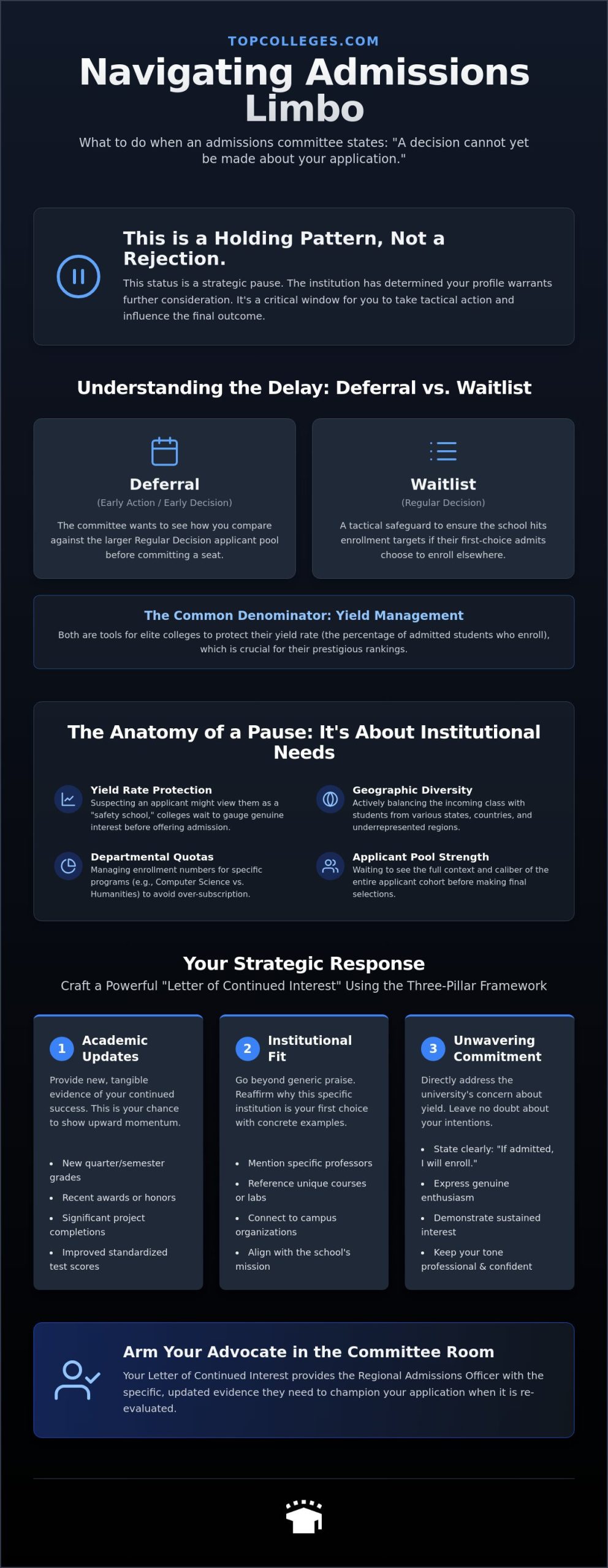
Why do schools choose limbo over a definitive answer? The answer lies in yield management. A deferral typically occurs during Early Action or Early Decision rounds. It means the committee wants to see how you compare to the larger Regular Decision pool before committing a seat. Conversely, a waitlist offer usually arrives in the spring. This is a tactical safeguard used by schools to ensure they hit their enrollment targets if their first-choice admits choose to go elsewhere. In both scenarios, the school is protecting its rankings and class composition. They aren’t ready to let you go, but they aren’t ready to say yes.
Common Portal Language Variations
The 2026 admissions cycle has seen a rise in “soft” status updates within digital portals. You might see phrases like “Application under further review” or “Decision deferred to a later date.” These external messages often mask internal deliberations where regional officers are advocating for specific candidates. For the 2026-2027 cycle, these messages typically appear in mid-December for early applicants and late March for regular rounds. Understanding the timing is crucial. If your portal updates to this status, it’s a signal that the committee is actively weighing your potential against the evolving needs of the incoming class. It is the moment when passive waiting must transform into active, strategic communication.
The Anatomy of Admissions Limbo: Why Decisions Are Paused
The notification that a decision cannot yet be made about your application is rarely a reflection of academic inadequacy. It is a strategic byproduct of the modern holistic review process. In the 2026 cycle, elite institutions are not merely ranking students based on metrics; they are curating a complex ecosystem. They must balance geographic diversity, gender ratios, and specific departmental quotas. If a university’s computer science program is over-subscribed while its humanities division remains under-enrolled, the committee may pause decisions on high-achieving STEM applicants to see how the rest of the pool settles.
Yield management is the invisible engine driving this delay. Schools are intensely protective of their yield rates, which is the percentage of admitted students who ultimately enroll. If an admissions officer suspects you might view their institution as a safety school, they may issue a deferred admission decision. This “wait-and-see” approach allows the school to protect its rankings by only offering immediate admission to those they are certain will attend or those whose profiles are too exceptional to risk losing. They are essentially waiting to gauge the true strength and intent of the entire Regular Decision pool.
Institutional Priorities vs. Individual Merit
It’s vital to recognize that this delay is often about the school’s shifting needs, not your personal flaws. Institutional fit is a moving target. As the class takes shape, the “ideal” candidate profile evolves based on who has already committed. Steven Roy Goodman frequently analyzes these institutional trends to help students understand that a pause is often a logistical necessity for the university. When you’re stuck in this phase, college admissions counseling can provide the diagnostic clarity needed to understand which institutional “puzzle piece” you represent and how to sharpen that image.
The Role of New Data in the 2026 Cycle
A pause in the decision process is an invitation to provide superior data. Committees are often waiting for mid-year grades to confirm a student’s academic trajectory remains upward. With 52% of applicants now submitting standardized test scores again in the 2026 cycle, a delay might also be a window for you to submit updated SAT or ACT results that better align with the school’s rising mid-ranges. Significant late-season awards or new leadership roles in extracurricular activities can serve as the catalyst that breaks a stalemate. If they haven’t said no, they’re waiting for a reason to say yes.
Behind the Scenes: How Admissions Committees Re-Evaluate
Behind the closed doors of the admissions office, the process shifts from quantitative screening to qualitative advocacy. When a notification arrives stating that a decision cannot yet be made about your application, your file has effectively survived the first cut. It now moves into the committee room, a space defined by high-stakes negotiation where regional officers act as your primary advocates. These officers know your high school’s profile and your local context; they are the ones who must convince their colleagues that you belong in the Class of 2030. In this environment, a formal review process often explains a deferred decision as a request for clarification or supplementary information that could tip the scales in your favor.
The 2026 landscape has introduced new layers of complexity to these deliberations. With the resurgence of standardized testing and the rise of AI-generated content, committees are spending more time scrutinizing the authenticity and depth of each portfolio. Record-high applicant pools, such as those seen at Duke and Columbia in 2026, mean that even exceptional candidates are being paused as schools navigate “application inflation.” This challenge is especially acute for students from elite preparatory environments, where boarding school college counseling that goes beyond the standard institutional offering is essential to standing out in a pool saturated with equally credentialed peers. A clean, updated portfolio is no longer a luxury. It is a baseline requirement for remaining in the conversation during these final rounds of evaluation.
The Second Read: Fresh Eyes on Your Application
The second read is a strategic opportunity for your candidacy. A new reader, unburdened by the initial assessment, may find a “hidden gem” quality in your personal statement that was previously overlooked. This reader is looking for nuance and institutional fit that aligns with the finalized class composition. This is where college admissions counseling becomes indispensable. An expert can help you audit your existing materials to ensure your narrative is cohesive while identifying the specific updates that will resonate with a fresh pair of eyes.
Yield Protection: Are You ‘Overqualified’?
Sometimes, the delay is a symptom of your own success. This phenomenon, historically referred to as “Tufts Syndrome,” occurs when selective schools defer highly overqualified students because they suspect those students will ultimately enroll at a higher-ranked institution. They use this “limbo” status to protect their yield rates; the percentage of admitted students who actually attend. To overcome yield protection, you must provide empirical evidence of your commitment. Use specific data points and deep institutional knowledge to prove that you are a serious candidate who views their school as a primary choice, not a fallback option.
Tactical Maneuvers: How to Influence Your Final Outcome
Limbo is not a passive state. It’s a tactical window. When you receive notice that a decision cannot yet be made about your application, the institution is effectively inviting you to provide the missing piece of the puzzle. You must pivot from a static applicant to a proactive candidate. The primary tool at your disposal is the Letter of Continued Interest (LOCI). A standard letter won’t suffice in the competitive 2026 environment. You need a document built on three strategic pillars: a significant update, a reinforced fit, and an unwavering commitment. This is your chance to address the institutional priorities discussed earlier by proving you are the exact puzzle piece the committee is currently missing.
Timing is a critical component of this maneuver. Don’t rush. Responding within hours suggests a lack of reflection. Conversely, waiting weeks suggests a lack of interest. Aim for a window of seven to ten days after the status update appears. This period allows you to gather meaningful updates that truly move the needle. Avoid sharing trivial details; they only serve to dilute your narrative. If a decision cannot yet be made about your application, the committee is looking for a reason to tip the scales. Give them a reason that is both substantial and professionally presented.
Architecting the Letter of Continued Interest
A sophisticated LOCI follows a precise architecture. First, if the school is your absolute top choice, state it clearly. This reduces the university’s yield risk and signals that an offer of admission will result in an immediate deposit. Second, provide two or three high-level updates. Did you secure a new leadership role, complete a significant research project, or win a prestigious award since your initial submission? Third, connect these updates to specific campus resources. Don’t just say you like the school. Explain how your new achievements make you a perfect match for a specific lab, seminar, or initiative that you’ve identified through deep research.
Securing Additional Support
Evaluate if your support network can be leveraged for the final push. A targeted, additional letter of recommendation from a mentor who can speak specifically to your most recent successes can be the deciding factor. Beyond this, an internal advocate, such as a well-placed alumnus or a professional contact with ties to the institution, can provide the institutional nudge required to break a stalemate. This is the moment for comprehensive portfolio development to ensure every component of your candidacy is optimized for the final committee read. Every touchpoint from this moment forward must be intentional, professional, and aligned with your broader strategic goals.
If you’re ready to transform your “maybe” into a definitive acceptance, contact Steven Roy Goodman for expert admissions consulting today.
Strategic Re-Positioning: Why Professional Guidance Matters Now
A notification that a decision cannot yet be made about your application represents a critical strategic pivot point. It’s the moment where the path of least resistance; simply waiting for an update; often leads to a final rejection. In contrast, a masterminded admissions strategy treats this delay as a diagnostic opportunity. While most applicants remain paralyzed by the uncertainty of the committee’s timeline, the elite candidate uses this window to re-evaluate their positioning and address the specific institutional gaps that caused the pause. You’ve reached a fork in the road where the quality of your next move determines your academic future.
Professional guidance replaces guesswork with clinical precision. Steven Roy Goodman leverages over 25 years of experience to diagnose why the delay happened in the first place. Was the personal statement too generic for a high-stakes Ivy League pool? Did the portfolio lack the specific “institutional fit” required for a record-breaking 2026 applicant cycle? A DIY response often relies on sentiment and hope, but a masterminded plan relies on a deep understanding of holistic review and shifting university priorities. We move beyond the “what” of your delay to solve the “why,” ensuring your final communication to the committee is both authoritative and unignorable.
The Elite Advantage in the 2026 Cycle
The 2026-2027 cycle is defined by unprecedented volatility. With several universities reporting record-high application volumes, forecasting waitlist movement requires more than just looking at last year’s data. Top Colleges uses contemporary higher-education trends to identify which programs are likely to over-enroll and which will turn to their deferred pool to meet yield targets. This foresight allows us to transition you from a state of anxiety into a period of structured preparation. We don’t just help you react; we help you anticipate the committee’s needs before they are even finalized. Before committing to any consulting firm during this critical phase, it’s worth understanding how different models operate — our analysis of crimson college consulting and its team-based approach versus personalized expert strategy reveals key distinctions that matter most when acceptance rates have plummeted to 3%.
Beyond the Waitlist: Planning for All Scenarios
Strategic confidence comes from having a comprehensive roadmap that accounts for every potential outcome. While we focus on turning your top-choice “maybe” into a “yes,” we also ensure you’re evaluating your existing offers with tactical clarity. If the final decision doesn’t align with your primary goals, we provide the framework for long-term success. This includes specialized Transferring Colleges Consulting for students who view their first-year placement as a stepping stone rather than a final destination. Your aspirations are too important to be left to the whims of a crowded admissions office.
The window for influencing your outcome is closing. Don’t let your candidacy fade into the background of a massive applicant pool. Secure your admissions strategy session today and take the first step toward masterminding your final acceptance.
Seizing the Strategic Advantage in Admissions Limbo
The notification that a decision cannot yet be made about your application is not a signal to retreat; it’s a call to refine your tactical approach. We’ve explored how institutional priorities and yield management strategies often dictate these administrative pauses. You now understand that the Letter of Continued Interest is your primary instrument for re-establishing fit and commitment. This period of waiting is actually a window for active, high-level positioning. Success in this phase requires moving beyond general updates to deliver a narrative that aligns perfectly with a school’s evolving class composition.
Navigating these complexities requires the methodical, results-oriented counseling that has defined Top Colleges for over 25 years. Steven Roy Goodman provides the elite strategic insight necessary to reverse Ivy League deferrals and secure seats in the world’s most competitive programs. Don’t leave your final outcome to chance or administrative inertia. Architect your successful admissions response with Top Colleges and transform this moment of uncertainty into a definitive victory. Your future aspirations remain within reach, and the right strategic pivot will make all the difference.
Frequently Asked Questions
Is ‘a decision cannot yet be made’ a polite way of saying I was rejected?
No, receiving a notification that a decision cannot yet be made about your application is not a rejection. If the admissions committee determined that your profile did not meet their institutional standards, they would issue a definitive denial to clear their administrative queue. This status confirms that you have passed the initial academic screening and remain a viable candidate for the incoming class.
What is the difference between this message and being officially waitlisted?
The primary difference lies in the timing of the decision and the pool against which you are being measured. A deferral typically occurs during early application rounds, moving your file into the Regular Decision pool for a side by side comparison. A waitlist status generally arrives in the spring as a tactical tool for yield management once the university has finalized its primary offers of admission.
Should I call the admissions office to ask for a reason for the delay?
You should not call the admissions office to demand a specific reason for the delay. Such inquiries often appear unprofessional and rarely yield the diagnostic clarity you seek because regional officers are prohibited from discussing individual deliberations. Instead, channel your energy into a strategic Letter of Continued Interest that addresses the institutional needs and class composition goals of the university.
How long does a school have to make a final decision once I’m deferred?
Most institutions will provide a final decision by their standard Regular Decision notification date, which typically falls in late March or early April. While the wait feels extensive, this period is your tactical window to update your portfolio with mid year grades or new achievements. Use this time to prove that your academic trajectory remains upward and aligned with their standards.
What should I include in a Letter of Continued Interest for 2026?
Your 2026 Letter of Continued Interest must focus on substantial academic and personal updates that have occurred since your initial submission. Include improved test scores, new leadership titles, or significant awards. It’s vital to connect these achievements to specific campus initiatives to prove your commitment to their unique community and reduce their perceived yield risk.
Can I send new SAT or ACT scores after receiving this status update?
Yes, sending updated SAT or ACT scores is highly recommended if they represent a significant improvement over your previous results. With 52% of applicants submitting scores in the 2026 cycle, a higher score can provide the quantitative edge needed to break a stalemate in the committee room. Ensure the new scores reach the office before the Regular Decision review begins in February.
Does this status apply to USCIS immigration applications as well?
While the phrase “a decision cannot yet be made about your application” appears in USCIS naturalization contexts, the implications are entirely different. For immigration, this often triggers a 120 day legal window for a response based on statutory requirements. In the academic world, it’s a strategic holding pattern based on institutional class building priorities rather than a legal mandate.
How many students are typically admitted from the deferred pool?
Admission rates from the deferred pool vary significantly by institution and the specific strength of the year’s applicant pool. Some elite universities admit between 5% and 15% of deferred candidates, while others may use the pool more extensively to fill specific geographic or major related gaps. Your success depends on how effectively you re-position your candidacy during this critical window.