

Disclaimer
Content on this page of topcolleges.com is computer generated and therefore is not guaranteed to be 100 percent accurate about various aspects of the education sector. On balance, however, many students and families seek general information about high schools, colleges and universities, graduate programs, testing, education and career planning, and job placement before beginning one-on-one admissions counseling tailored to their specific needs.
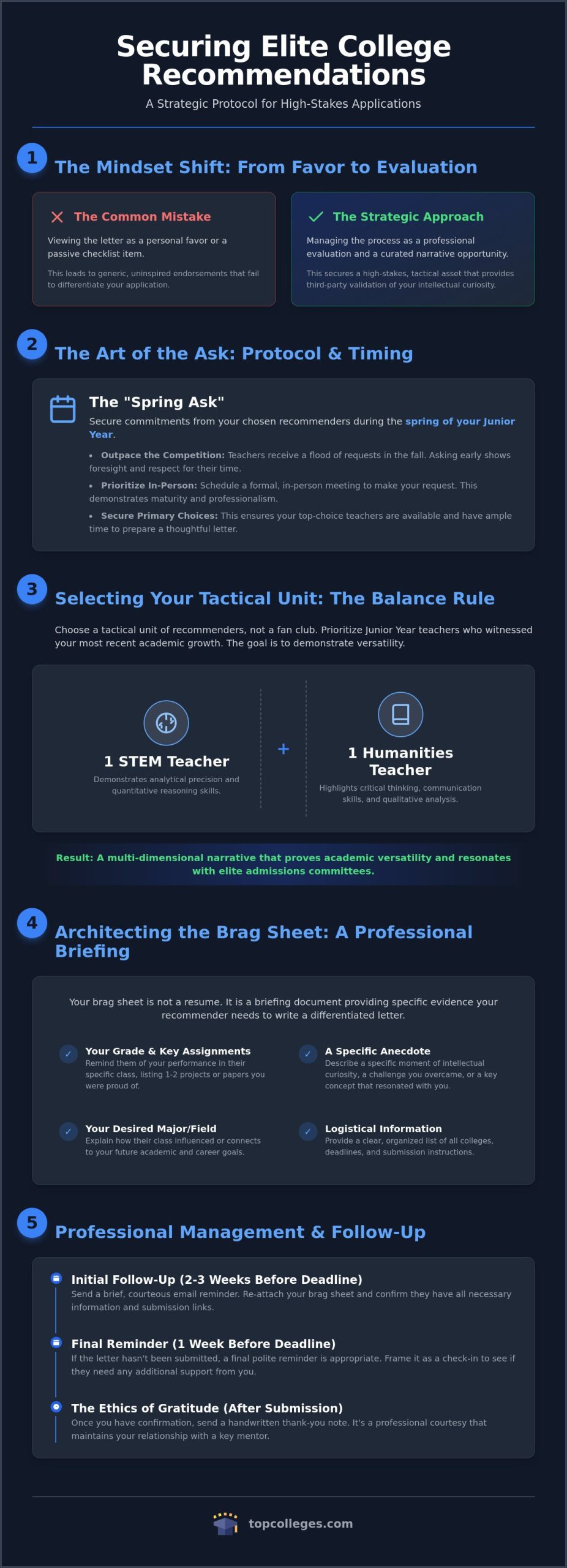
A letter of recommendation is not a courtesy; it is a high-stakes strategic asset that can either anchor your application or propel it to the top of the pile. Most students treat this requirement as a passive checklist item, yet the most successful applicants view it as a curated narrative opportunity. Understanding how to ask for letters of recommendation for college requires more than just good manners. It demands a professional protocol that aligns your academic history with the specific institutional priorities of elite admissions committees. You must move beyond the role of a student and adopt the mindset of a professional managing their own reputation.
You likely feel the weight of this responsibility and the quiet anxiety of wondering if a teacher will provide a generic, uninspired endorsement. It’s a valid concern in an environment where holistic review is the standard and every word counts. This guide will provide you with the exact framework needed to secure letters that command attention. We’ll explore a precise timeline for your requests, the architecture of a compelling brag sheet, and the professional communication strategies that demonstrate your maturity to those who hold your future in their hands.
Key Takeaways
- Reframe the recommendation process as a professional evaluation rather than a personal favor. Select a tactical unit of recommenders who can provide high-level validation of your intellectual curiosity.
- Master the precise protocol of how to ask for letters of recommendation for college by prioritizing an in-person request. Secure these commitments during the junior year “Spring Ask” to outpace the competitive applicant pool.
- Implement the “Balance Rule” to demonstrate academic versatility. Selecting one STEM and one Humanities teacher creates a multi-dimensional narrative that resonates with elite admissions committees.
- Architect a strategic brag sheet that functions as a professional briefing document. This ensures your recommenders have the specific evidence required to write a letter that differentiates you from other candidates.
- Develop a disciplined follow-up schedule that balances urgency with professional courtesy. A structured reminder system ensures your materials are submitted on time while maintaining your relationship with key mentors.
The Strategic Role of Recommendation Letters in Elite Admissions
Why does a perfect GPA sometimes fail to secure an Ivy League acceptance? The answer lies in the limitations of quantitative data. While your transcript proves you can master a curriculum, it says nothing about how you contribute to a seminar or how you respond to intellectual friction. Admissions committees at elite institutions view these letters as essential third-party validation. They aren’t looking for a simple character reference; they are searching for evidence of your intellectual curiosity and personal gravity. Before you determine how to ask for letters of recommendation for college, you must understand that these documents serve as the qualitative connective tissue of your entire portfolio.
You need to shift your mindset immediately. This process is not about “asking for a favor” from a busy teacher. It’s about managing a professional evaluation. In a competitive landscape where thousands of applicants boast near-identical test scores, the recommendation letter becomes the ultimate differentiator. It provides the admissions office with a window into your “institutional fit.” They want to know if you’ll be a leader in the classroom or a passive observer. By treating this as a strategic milestone, you ensure that the narrative provided by your teachers aligns perfectly with the persona you’ve cultivated in your essays.
Moving Beyond the Testimonial to Tactical Asset
A successful application requires more than just high marks; it requires a cohesive strategy. We treat every recommendation as a core component of your broader college admissions counseling plan. To maximize impact, each letter must corroborate the “hooks” or themes established in your personal statement. This is what we call narrative alignment. It’s the deliberate synchronization of your self-portrayal and the objective observations of your instructors. While you may already know what is a letter of recommendation in a general sense, elite admissions demand you view it as a curated tactical asset that reinforces your unique value proposition.
The Role of High-Stakes Evaluation in 2026
The admissions landscape in 2026 has introduced new complexities, specifically regarding the perceived authenticity of student work. As AI becomes more prevalent in drafting personal statements, the weight placed on teacher-written letters has increased significantly. Admissions officers now rely on these letters to screen for genuine professional maturity. They value the “quiet influence” of a mentor who has watched you struggle with a complex concept more than a generic endorsement from a high-profile figure who barely knows you. When you master how to ask for letters of recommendation for college, you’re securing a verified account of your character that no algorithm can replicate.
Selecting Your Tactical Recommender Unit
A common mistake in elite admissions is selecting recommenders based on personal affinity rather than strategic utility. You don’t need a fan club; you need a tactical unit of evaluators who can speak to different facets of your intellectual profile. Knowing how to ask for letters of recommendation for college begins with selecting the right voices to speak on your behalf. Prioritize junior year teachers. They have witnessed your most recent academic growth and can speak to your readiness for university-level rigor with contemporary evidence.
Versatility is the hallmark of a strong candidate. To demonstrate this, we recommend the “Balance Rule.” Selecting one STEM teacher and one Humanities teacher ensures that your application doesn’t feel one-dimensional. This approach proves you possess both the analytical precision required for the sciences and the critical communication skills essential for the liberal arts. Admissions experts often suggest seeking expert advice on recommendation letters to ensure your choices reflect your full potential and academic range.
Consider the narrative value of struggle. A teacher who saw you work through a difficult concept to earn a “B” often has more to say than a teacher who gave you an effortless “A.” The former can testify to your resilience and grit. These are the “soft skills” that elite committees value most. If you have a significant extracurricular commitment, you might also include an outside recommender. A research mentor, employer, or coach can provide a perspective on your leadership that a classroom teacher cannot reach. If you are struggling to identify which mentors will best support your specific goals, seeking expert admissions counseling can provide the clarity needed to finalize your tactical unit.
The Core Academic Unit: Quality Over Subject Matter
Focus your primary requests on teachers from “core” subjects: Math, Science, English, History, or Foreign Language. These instructors are accustomed to the evaluation standards of selective schools. When evaluating potential recommenders, ask yourself if they know your “academic voice.” Do they remember your specific contributions to class discussions? Choose the teacher known for writing detailed, thoughtful evaluations over the one who is popular but provides generic templates. This depth is what transforms a standard document into a tactical asset.
Strategic Fit: Choosing for Character vs. Grade
Don’t fall for the prestige trap. A letter from a famous professor or a department head who barely knows your name will always carry less weight than a glowing evaluation from a teacher who sees you daily. Intellectual vitality is the primary trait to look for. You want a recommender who can describe how you engage with new ideas and how you elevate the intellectual environment for everyone else. They should be able to speak to your professional maturity and your potential to contribute to a vibrant campus community.
The Art of the Ask: Professional Protocol and Timing
Timing is everything. Many students treat the recommendation request as a last-minute chore, but elite applicants view it as a professional negotiation. If you want a letter that truly differentiates you, you must outpace the crowd. The most effective way to do this is by adopting the “Spring Ask” strategy. By initiating the conversation in May of your junior year, you secure a place at the top of your teacher’s priority list before the summer recess begins. This foresight provides your recommenders with the luxury of time, allowing them to reflect on your contributions without the pressure of a September deadline.
Understanding how to ask for letters of recommendation for college involves navigating a specific professional hierarchy. You should never allow an automated digital invite to serve as your initial inquiry. This approach is impersonal and suggests a lack of professional maturity. Instead, an in-person request must always precede the formal digital submission. This face-to-face interaction allows you to gauge the teacher’s enthusiasm and confirm they have the capacity to write a truly standout evaluation. It demonstrates respect for their labor and acknowledges the high stakes of the admissions process.
When you approach a mentor, your initial inquiry should blend humility with strategic intent. Acknowledge the impact their teaching has had on your intellectual development. This isn’t flattery; it’s professional context. By highlighting a specific project or discussion that sparked your interest, you provide the teacher with the raw material they need for their narrative. This helps them move beyond a generic template and toward a customized evaluation that reflects your unique academic voice and your readiness for the rigors of university life.
The ‘Early Bird’ Strategic Timeline
A structured approach prevents the anxiety of missed deadlines. Follow this three-step protocol during your junior year to ensure narrative alignment:
- Step 1: Identify your top two teachers by April. Look for those who have witnessed your most significant academic growth or leadership in class.
- Step 2: Schedule a brief, professional meeting in May. Use this time to discuss your college aspirations and why you value their specific perspective.
- Step 3: Formalize the request via email within 24 hours of your meeting. Provide a clear summary of your application deadlines and the platforms you will be using.
In-person vs. Digital Etiquette
Your verbal script matters. Don’t just ask for a letter; ask for a specific type of endorsement. Use a phrase like, “Would you feel comfortable writing a supportive letter for me?” This qualifier is essential. It gives the teacher an “out” if they don’t feel they can provide a high-level recommendation. A lukewarm letter is a liability in elite admissions. Once you receive a verbal “yes,” you can then transition to the digital stage by sending the invitation through the Common App or institutional portals. This sequence ensures that the digital notification is merely a formal record of a previously established professional agreement.
Architecting the Context: The Strategic Brag Sheet
A teacher’s memory is a crowded space. Even the most dedicated instructor cannot recall every insightful comment or breakthrough moment from a semester spent with dozens of students. This is why you must view the brag sheet as a professional briefing document rather than a simple list of achievements. When you master how to ask for letters of recommendation for college, you aren’t just requesting a signature; you’re providing the raw materials for a high-level evaluation. By delivering a structured strategic asset, you equip your recommender with the specific data points they need to validate your intellectual curiosity with confidence.
Highlight specific classroom moments where your contribution shifted the intellectual environment. Did a particular paper you wrote spark a deeper interest in a field? Remind them of that. Share your extracurricular “why” so they understand your motivations outside their four walls. This context allows them to connect your academic performance to your future aspirations, giving the final letter a forward-looking momentum that elite admissions committees find compelling. You want the teacher to see the student you’ve become and the scholar you intend to be.
Essential Components of a High-Level Brag Sheet
Your briefing document should include an “Anecdote Bank.” This is a curated list of two or three specific projects, papers, or discussions where you excelled in their class. Don’t just list the assignment; describe the intellectual hurdle you cleared. This feeds into the “Growth Narrative.” If you struggled with a complex concept in the first semester but mastered it by the second, document that journey. Teachers love to write about resilience. Finally, include a list of the colleges you are targeting and a brief sentence on why. If you’re applying to a specific research program, your teacher can tailor their comments to match that institutional focus.
Narrative Synergy: Aligning Recommendations with the Portfolio
The goal is narrative synergy. Your recommendation letters should not exist in a vacuum; they must reinforce the themes established in your personal statement. If your essay focuses on your collaborative spirit, subtly suggest that your teacher touch upon your leadership in group projects. Provide them with your current resume and a draft of your personal statement to ensure they see the full picture. This allows for a tiered evaluation system. Your school counselor provides the “macro” view of your standing within the high school community, while your teachers provide the “micro” view of your daily intellectual engagement. This alignment creates a robust, multi-dimensional profile that commands respect from admissions officers.
Professional Management and the Ethics of Gratitude
Your responsibility doesn’t terminate once a teacher agrees to write on your behalf. Managing the final submission process requires the same level of tactical foresight as the initial request. This is the stage where many high-achieving students falter, allowing anxiety to replace professional discipline. You must maintain a methodical follow-up schedule that respects the teacher’s labor while ensuring your deadlines are met. Successfully executing the protocol for how to ask for letters of recommendation for college requires you to transition from an applicant to a project manager, overseeing the final delivery of your strategic assets.
Admissions committees at elite institutions value professional maturity. They expect you to handle the logistics of your application with poise. If you’ve targeted a November 1, 2026, Early Decision deadline, your management phase begins weeks in advance. This isn’t about being a nuisance. It’s about providing the necessary structure for your recommenders to succeed. By managing these relationships with care, you transform a one-time request into a long-term professional alliance.
Managing Deadlines and Digital Portals
Organization is your primary defense against deadline anxiety. Use a centralized spreadsheet to track every recommender, their specific deadlines, and the status of their uploads across various portals. This bird’s-eye view allows you to identify potential delays before they become crises. One critical technical step is the FERPA waiver. You should always waive your right to read the letter. Admissions officers view this as a signal of trust, ensuring the evaluation is seen as an authentic, unbiased “third-party validation” of your character.
- The Two-Week Reminder: Send a polite, structured email two weeks before the first deadline. Confirm that they have all the necessary briefing materials.
- The 48-Hour Protocol: If a letter remains pending two days before a deadline, a respectful in-person check-in is justified. Keep the tone helpful, not accusatory.
- Digital Confirmation: Verify that the Common App or institutional portal has registered the submission immediately after it’s uploaded.
The Strategic Value of Long-Term Mentorship
The thank-you note is a non-negotiable professional standard. Don’t skip it. While an immediate email of thanks is appropriate, a handwritten note remains the gold standard for high-stakes outcomes. It acknowledges the significant time investment your teacher has made on your behalf. Beyond the immediate application cycle, these instructors often become lifelong professional references. You may need their insight again for Transferring Colleges Consulting or graduate school applications. Closing the loop by updating them on your final admission decisions in the spring of 2027 cements the relationship, ensuring they remain invested in your long-term trajectory.
Mastering the Narrative of Recommendation
Securing a high-impact evaluation is a professional milestone that requires discipline. You’ve learned that selecting a balanced tactical unit and providing a structured brag sheet are not optional steps; they are the foundation of a differentiated portfolio. By adopting the “Spring Ask” strategy, you position yourself as a candidate of foresight and maturity. Mastering how to ask for letters of recommendation for college is ultimately about managing your reputation across the desk of an admissions officer.
At Top Colleges, we specialize in elite college and graduate school strategy. Our methodology emphasizes personalized portfolio development, guided by Steven Roy Goodman’s global admissions perspective. We replace uncertainty with a structured plan for success that addresses the nuances of high-stakes evaluations.
Your future aspirations deserve a roadmap built on expertise and precision. Take command of your application today and ensure your recommenders provide the tactical validation you need to succeed.
Strategic Guidance: Frequently Asked Questions
When is the absolute latest I can ask for a letter of recommendation?
You should secure your commitments at least four to six weeks before your earliest deadline. However, waiting until this functional limit is a tactical error that signals a lack of professional foresight. Elite applicants aim for the “Spring Ask” during their junior year to ensure they are at the top of a teacher’s priority list before the autumn rush begins.
Can I ask a teacher from 9th or 10th grade if I did really well in their class?
You should prioritize instructors from your junior or senior year. Admissions committees require contemporary evidence of your intellectual growth and readiness for university-level rigor. A teacher from your freshman year cannot speak to the professional maturity you’ve developed as you approach the end of your secondary education.
What should I do if a teacher asks me to write the first draft of the letter myself?
You must politely decline this request while offering a robust brag sheet as an alternative. Drafting your own evaluation often results in a lack of authentic narrative depth and can be viewed as a breach of institutional ethics. Instead, provide a detailed briefing document that “feeds” the teacher specific anecdotes they can use to craft a high-level evaluation in their own voice.
How many letters of recommendation do most colleges actually require?
Most selective institutions require two teacher evaluations and one counselor report. While some schools allow “optional” additional letters, you should only submit them if they provide a unique data point not captured elsewhere. Quality always outweighs quantity in a high-stakes evaluation process.
Is it okay to ask for a letter of recommendation via email if I am a remote student?
You should request a brief video meeting before sending any formal written request. Synchronous communication is essential for maintaining the professional protocol required when learning how to ask for letters of recommendation for college. Use the subsequent email only to formalize the agreement and deliver your strategic briefing materials.
Should I ask a ‘prestige’ recommender like a CEO or politician if they know my family?
You must avoid the “prestige trap” unless that individual has directly supervised your work. A hollow endorsement from a high-profile figure who cannot speak to your intellectual vitality is a strategic liability. Admissions officers value the “quiet influence” of a mentor who has witnessed your daily contributions over a celebrity who barely knows your name.
What happens if I don’t waive my FERPA rights to see the letter?
You effectively undermine the credibility of the entire recommendation. Admissions committees view a waived FERPA right as a mark of maturity and trust in your mentors. If you refuse to waive this right, evaluators may assume the letter is not an honest “third-party validation,” significantly diminishing its impact on your portfolio.
How do I ask a teacher for a letter if I wasn’t the best student in their class?
You should frame your request around a “growth narrative” rather than your final grade. Approach the teacher by acknowledging the specific challenges of their course and explaining how those hurdles forced you to develop greater resilience. This demonstrates the grit and self-reflection that elite admissions committees prioritize over effortless academic success.