

Disclaimer
Content on this page of topcolleges.com is computer generated and therefore is not guaranteed to be 100 percent accurate about various aspects of the education sector. On balance, however, many students and families seek general information about high schools, colleges and universities, graduate programs, testing, education and career planning, and job placement before beginning one-on-one admissions counseling tailored to their specific needs.
What if your perfect GPA and high test scores are actually the biggest obstacles to your Ivy League admission? In a competitive environment where every applicant possesses a flawless transcript, being “excellent” is no longer enough to secure a seat at a top-tier university. You likely feel the weight of conflicting advice and the rising anxiety of record-low acceptance rates. This guide moves beyond the basics to show you exactly how to improve your college application by shifting your focus from academic compliance to strategic positioning.
You’ve worked hard to check every box, yet the fear of remaining just another face in a sea of high achievers is real. We’ll show you how to architect a high-impact portfolio that commands the attention of elite admissions committees. This blueprint provides a clear, actionable plan to differentiate your profile through a compelling narrative. We’ll explore the nuances of the 2026 admissions cycle, from the digital SAT’s impact to the growing weight of supplemental essays. You’ll gain the foresight needed to tell a story no committee can ignore.
Key Takeaways
- Abandon the “well-rounded” trap in favor of a “strategically pointed” profile that highlights deep, undeniable excellence in one or two specific areas.
- Prioritize academic rigor over a perfect GPA, ensuring your course selection directly aligns with your intended major to demonstrate intellectual readiness.
- Apply the “Rule of Three” to your extracurriculars, moving from passive membership to high-impact roles as a founder or innovator.
- Learn how to improve your college application by treating your personal statement as a persuasive strategic document rather than a simple autobiography.
- Transition from a standard student to an “applicant-scholar” by identifying and addressing hidden blind spots in your profile through professional mentorship.
The Paradigm Shift: Moving from ‘Well-Rounded’ to ‘Strategically Pointed’
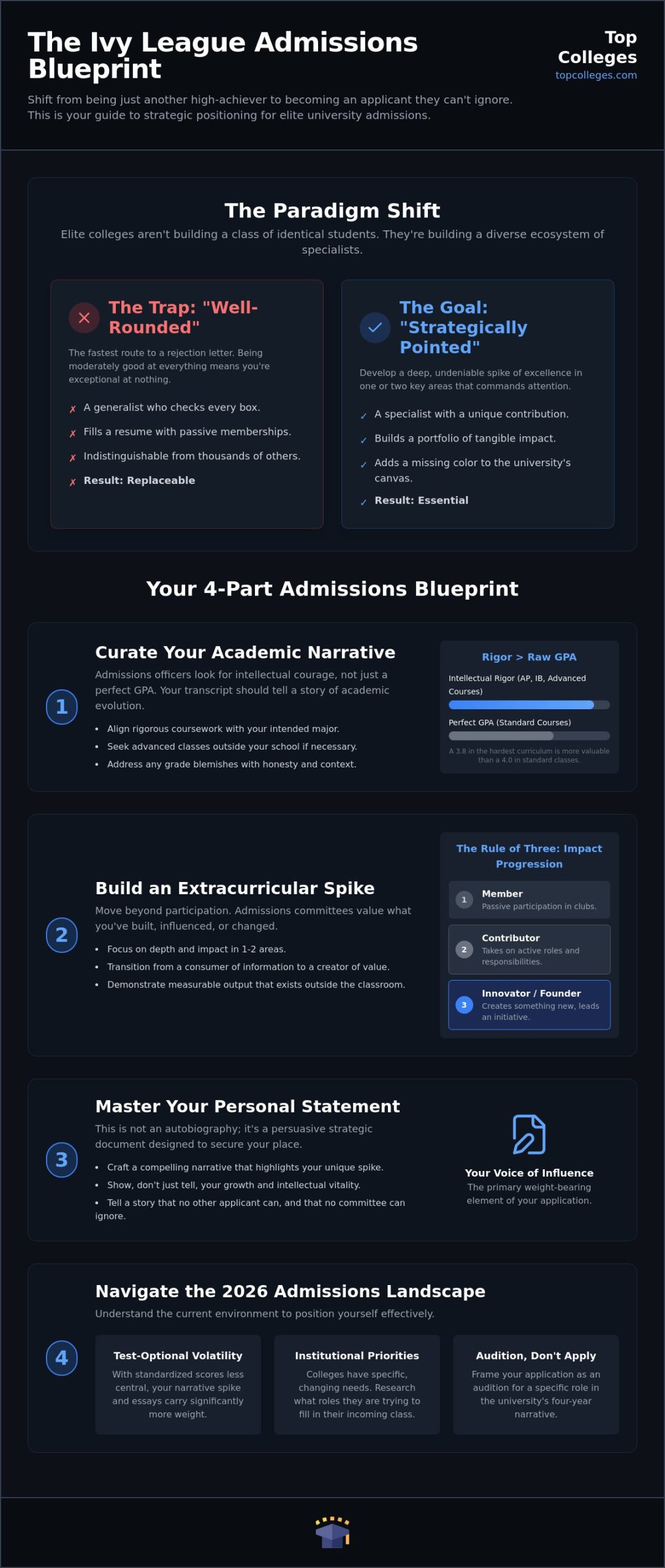
The traditional advice to be “well-rounded” is the fastest route to a rejection letter from an elite institution. A student who is moderately good at everything is rarely exceptional at anything. Admissions committees at top-tier schools aren’t looking for a class of identical, balanced students. They are looking to build a diverse, high-functioning ecosystem. They want the world-class oboist, the published math researcher, and the social justice innovator. This is the “Admissions Spike.” It represents a shift from being a generalist to becoming a specialist. When you consider how to improve your college application, you must stop trying to fill every empty slot on a resume and start deepening the grooves of your specific expertise.
The U.S. college admissions process has evolved into a search for contribution rather than mere participation. Deans of Admission can see through “resume padding” instantly. They don’t care that you joined five clubs in your junior year. They care about what you built, who you influenced, and how you changed the environment around you. Holistic review in 2026 isn’t a checklist; it’s a search for individuals who will add a specific, missing color to the university’s canvas. If you’re indistinguishable from the other 50,000 applicants, you’re replaceable. If you’re a specialist, you’re essential.
Identifying Your Intellectual Spike
Auditing your current interests requires a cold, clinical eye. You must determine which of your pursuits has the highest strategic potential for growth. A hobby is private; an Intellectual Spike is public. If you enjoy history, don’t just read books. Write a thesis, partner with a local museum, or publish an article in a niche journal. An Intellectual Spike is a unique intersection of passion and public-facing achievement. This transformation from consumer to creator is what differentiates a high achiever from a future scholar. It’s about moving from passive engagement to measurable output that exists outside the classroom walls.
The 2026 Admissions Landscape
The 2026 cycle is defined by the continued volatility of test-optional policies. With standardized scores becoming less central for some, the narrative spike has become the primary weight-bearing element of the folder. Colleges have specific institutional priorities that change annually. One year they might need more engineers with a flair for ethics; the next, they might prioritize community organizers from rural areas. Understanding these shifts allows for tactical foresight. You aren’t just applying to a school; you’re auditioning for a specific role in their upcoming four-year narrative. This level of preparation is the key to how to improve your college application and secure your place in a competitive field.
Curating the Academic Narrative: Rigor Over Raw GPA
Elite admissions committees aren’t looking for perfection; they’re looking for proof of intellectual courage. A pristine 4.0 GPA earned through standard coursework often signals a student who is risk-averse. In contrast, a 3.8 achieved within the most rigorous curriculum available demonstrates a willingness to engage with high-level challenges. This distinction is a fundamental part of how to improve your college application. Your transcript shouldn’t just be a list of grades. It should be a curated narrative of your academic evolution. Aligning your course selection with your intended major is essential. If you’re aiming for a STEM degree, your transcript must show the highest levels of math and science your school offers. If those classes aren’t available at your high school, seek them out through local colleges or accredited online programs.
According to expert advice from college admission leaders, the strength of your curriculum remains the single most important academic factor. You must meet the “Academic Rigor” threshold before your personal story can even take center stage. If there are blemishes on your transcript, don’t ignore them. Address them through strategic context in the additional information section. Explain the circumstances, such as a family relocation or a health challenge, without making excuses. Focus on the resilience you demonstrated in the aftermath. Admissions officers value honesty and growth over a manufactured image of perfection.
Beyond the Classroom: Intellectual Vitality
Intellectual vitality is the “love of learning” that exists when no one is grading you. Elite schools want to see that your curiosity doesn’t end at the classroom door. This might involve independent research projects or deep dives into niche subjects that aren’t covered in your school’s curriculum. Having these projects vetted by professionals or university faculty can significantly elevate your profile. Many students utilize College Admissions Counseling to map out a multi-year academic plan that ensures every elective and summer program contributes to this narrative of vitality. It’s about moving from being a student to becoming an applicant-scholar.
Standardised Testing Strategy in 2026
In the 2026 cycle, the decision to submit test scores is purely tactical. With many schools remaining test-optional, the SAT or ACT now serves as a “validator” for your GPA. If your scores are within or above the middle 50% range for your target school, submit them. If not, your AP and IB scores must step up as the primary indicators of your collegiate readiness. These scores provide an objective benchmark across different grading systems. Understanding these nuances is critical when deciding how to improve your college application. If you’re unsure where your profile stands, a strategic evaluation of your academic portfolio can provide the clarity you need to move forward with confidence.
The Extracurricular Spike: Building a Portfolio of Impact
Why do most high-achieving students treat their extracurricular list like a grocery receipt? They provide a long, uninspired tally of memberships that fails to demonstrate a singular, compelling value proposition. If you want to understand how to improve your college application, you must embrace the “Rule of Three.” This strategy dictates that quality of impact always trumps the sheer quantity of activities. Elite admissions committees are tired of seeing “well-rounded” applicants who participate in everything but master nothing. They are searching for the individual who has scaled their influence from a local level to a regional or even national stage. Your goal is to move from being a “member” to a “founder” or an “innovator” who leaves a measurable legacy behind.
Your summer strategy is a critical component of this professional positioning. Many students fall into the trap of generic “volunteering” trips that often appear as “poverty tourism” to discerning admissions officers. A high-level internship or a self-directed research project in your field of interest carries far more weight. It demonstrates professional readiness and a level of maturity that a standard service trip cannot match. While many websites offer helpful tips for applying to college, few emphasize the transition from a simple activity list to a “Strategic Portfolio” that documents your journey through evidence-based success.
Quantifying Your Achievements
Data is the language of authority in high-stakes admissions. Don’t simply state that you were the “Club President.” Instead, prove your impact with concrete numbers. Did you increase membership by 40%? Did you raise $5,000 for a specific initiative? This level of specificity provides the external validation that admissions officers crave. To translate a soft skill like “communication” into a hard achievement, you must document how you utilized public speaking to secure $10,000 in corporate sponsorships for your robotics team. This approach transforms vague claims into undeniable facts.
- Identify the baseline state of the organization when you arrived.
- Document the specific actions you took to drive change.
- Measure the final outcome using percentages, dollar amounts, or headcounts.
The ‘Hook’ vs. The ‘Spike’
In the how to improve your college application process, you must distinguish between institutional “hooks” and personal “spikes.” A hook is often something you are born with or into, such as legacy status or athletic recruitment. If you don’t possess a natural hook, you must build a “spike”—a pinnacle of excellence in a niche area that makes you indispensable to a class’s diversity. Whether it’s beekeeping combined with data science or linguistic preservation through app development, a well-defined spike creates a “stickiness” in the mind of the reviewer. Leveraging professional strategy can help you identify which of your interests is most marketable to an elite institution’s current priorities.
Personal Statement Mastery: Crafting a Voice of Influence
The personal statement is not a chronological list of your life events. It is a closing argument. While your transcript and activities provide the “what” of your candidacy, the essay must provide the “why.” You’re writing a strategic piece of persuasive literature designed to convince a committee that your presence will elevate their campus culture. When exploring how to improve your college application, you must identify the “unspoken” elements of your profile. What hasn’t the data told the committee yet? If your transcript shows a dip in grades during sophomore year, the essay shouldn’t just explain it; it should demonstrate the intellectual resilience you developed through that struggle.
Striking the correct tone is a delicate exercise in brand management. You must project the confidence of a leader while maintaining the humility of a lifelong learner. Avoid the trap of sounding like a finished product. Elite universities aren’t looking for students who have already achieved everything. They’re looking for students who have the capacity for explosive growth. Every paragraph must pass the “So What?” test. If a sentence doesn’t reinforce your core strategic narrative or demonstrate a specific character trait, delete it. Space is too valuable for fluff.
Narrative Architecture for Elite Essays
A successful essay often follows a “vulnerability-to-growth” arc. This isn’t about eliciting pity. It’s about demonstrating your internal processing of external challenges. You must show, not tell. Instead of saying you are a “determined problem solver,” describe the specific sensory details of the night your research prototype failed for the tenth time. Avoid the cliché traps that plague thousands of applications every year. The “big game” winning goal or the “eye-opening” mission trip have been read thousands of times. They signal a lack of original reflection. Choose a smaller, more intimate moment that reveals a larger truth about your character.
Supplement Strategy: The ‘Why Us’ Essay
Supplemental essays require a granular level of research that most applicants ignore. Generic praise for a university’s “beautiful campus” or “prestigious reputation” is a waste of ink. You must name specific professors whose work aligns with your own, mention unique traditions, and identify labs where you intend to contribute. This is how to improve your college application at the final stage. Your supplements must be consistent across the entire pool. If you’re applying to twelve schools, your core “spike” must remain visible in every single one of those responses, even as you tailor the details to each institution’s specific resources.
The Top Colleges Advantage: Architecting Your Admissions Blueprint
In a landscape defined by razor-thin margins, a standard checklist is a liability. High-stakes admissions require more than just a second pair of eyes to proofread an essay; they demand a strategic mastermind who understands the inner workings of elite evaluation. Most applicants are blind to the gaps in their own profiles. They don’t see how a specific course choice or a lack of external validation signals a lack of readiness to a Dean of Admissions. Top Colleges serves as a prestigious bridge between a student’s current state and their future aspirations, identifying these blind spots before they become reasons for rejection. Understanding how to improve your college application is not about making minor tweaks. It’s about a fundamental academic realignment.
Our approach transforms a collection of documents into a cohesive Portfolio of Excellence. This methodology, honed over Steven Roy Goodman’s 25+ years of experience, replaces the reader’s anxiety with a sense of structured preparation. We don’t just help you apply; we teach you how to think like a scholar and position yourself as a future leader. This strategic mindset creates value that lasts well beyond the 2026 cycle. The skills you develop here—tactical thinking, professional communication, and self-reflection—will serve as your foundation through graduate school and your professional career.
Professional Portfolio Development
Steven Roy Goodman’s methodology is built on the reality that elite universities are looking for professional-grade potential. We integrate intensive interview readiness and personal branding into the admissions cycle, ensuring you can articulate your “spike” with absolute clarity. This isn’t just about the first year of college. The same rigorous principles of positioning and narrative development apply if you find yourself seeking a more compatible academic environment through Transferring Colleges Consulting. Whether you are entering as a freshman or a transfer, the goal is the same: undeniable excellence.
Your Next Strategic Move
Timing is the most underestimated variable in the admissions equation. Starting early is the only way to cultivate a true intellectual spike that feels authentic rather than manufactured. If you wait until the Common App opens in August, you’ve already lost the opportunity to build the public-facing achievements that command attention. Success in this field is never accidental; it is the result of proactive planning and expert foresight. Knowing how to improve your college application starts with an honest assessment of your current trajectory. Request a strategic consultation today to evaluate your standing and begin architecting your blueprint for success. Excellence is a habit, and your admission is the logical result of that habit.
Mastering the 2026 Admissions Cycle
The transition from a standard applicant to a scholar-candidate requires a fundamental shift in perspective. You’ve learned that academic rigor and a “strategically pointed” spike are the true currency of elite admissions. Success isn’t found in a generic checklist. It’s architected through deep reflection and tactical positioning. Are you ready to replace anxiety with a structured plan for excellence? The journey toward your top-choice university demands a level of preparation that mirrors the high stakes of the process itself.
Mastering how to improve your college application means moving beyond passive participation toward measurable, public-facing impact. Steven Roy Goodman, an internationally recognized expert, has spent decades guiding students through this complex system with a strategic, portfolio-based approach. His methodology identifies the hidden strengths in your profile that command attention from Ivy League and elite committees. This level of insight transforms a standard folder into a compelling narrative of future contribution, ensuring your voice is heard in an increasingly crowded field.
The landscape of higher education is shifting, but your path to a prestigious institution can remain clear. Your future begins with the decision to move beyond the ordinary and embrace a level of preparation that reflects your highest aspirations. Take the first step toward a transformative collegiate experience today.
Frequently Asked Questions
How can I make my college application stand out if I don’t have a ‘hook’?
You must build an “Admissions Spike” by cultivating deep, undeniable excellence in a specific niche. While hooks like legacy or athletics are inherited, a spike is architected through proactive engagement and public-facing achievements. This demonstrates that you aren’t just a high achiever, but a specialist who brings unique value to a university ecosystem. Strategic differentiation is the most effective way how to improve your college application when you lack traditional institutional advantages.
What is the single most important part of a college application in 2026?
The narrative spike is the most critical element in the 2026 admissions cycle. As standardized testing remains volatile, your application’s ability to tell a cohesive story of intellectual vitality and future contribution has become the primary weight-bearing factor. Admissions officers are searching for “applicant-scholars” who have moved beyond the classroom to make a measurable impact. This narrative serves as the lens through which every other data point is evaluated.
Is it better to have a higher GPA or take more difficult AP classes?
Elite universities prioritize academic rigor over a raw, unweighted GPA. A 3.8 earned in the most challenging AP or IB curriculum available signals intellectual courage and readiness for collegiate-level work. In contrast, a perfect 4.0 in standard classes suggests a risk-averse profile. You should always choose the most rigorous path possible, as this demonstrates the “Academic Rigor” threshold that top-tier institutions require before considering the rest of your portfolio.
How do summer activities actually impact admissions decisions at elite schools?
Summer activities serve as a primary indicator of your professional maturity and commitment to your chosen field. Elite schools ignore generic volunteering trips, favoring high-level internships or independent research projects that produce measurable results. These experiences allow you to scale your influence and provide the external validation that admissions committees crave. A well-planned summer is a tactical opportunity to deepen your spike and prove you can function at an elite level.
Can a professional admissions consultant really improve my chances of getting in?
A strategic mentor provides a high-level perspective that identifies critical blind spots in your profile. Professional admissions counseling transforms a fragmented list of achievements into a cohesive “Portfolio of Excellence.” This guidance replaces the anxiety of conflicting advice with a structured, results-oriented plan. By aligning your narrative with institutional priorities, a consultant helps you navigate the nuances of high-stakes admissions that are often invisible to the average student.
What are the biggest mistakes students make on their Common App essays?
The most frequent error is treating the essay as an autobiography rather than a strategic piece of persuasive writing. Many students fall into the “cliché trap,” writing about common experiences like sports victories or mission trips that fail to differentiate their character. Your essay should find the “unspoken” truth about your intellectual vitality. If it doesn’t pass the “So What?” test by reinforcing your core narrative, it won’t command the committee’s attention.
How many extracurricular activities should I list on my application?
Focus on the three to five activities where you have made the most significant, measurable impact. While the Common App allows for ten entries, listing minor memberships often dilutes the strength of your primary achievements. Admissions officers value “Impact Scaling,” where you’ve moved from a member to an innovator or founder. It’s more effective to document deep engagement in a few areas than to provide a long, uninspired tally of passive participation. This is a key strategy for how to improve your college application.
Does demonstrated interest still matter for Ivy League admissions?
Demonstrated interest rarely carries weight at most Ivy League institutions, though it remains critical for many other highly selective universities. Elite schools assume you want to attend; they focus instead on your potential contribution to their campus culture. However, you should still engage with “granular research” for your supplemental essays. Naming specific labs or professors shows a deep alignment with the school’s resources, which is a more sophisticated form of interest that actually impacts decisions.