

Disclaimer
Content on this page of topcolleges.com is computer generated and therefore is not guaranteed to be 100 percent accurate about various aspects of the education sector. On balance, however, many students and families seek general information about high schools, colleges and universities, graduate programs, testing, education and career planning, and job placement before beginning one-on-one admissions counseling tailored to their specific needs.
Why do students with flawless academic records and top-tier test scores still find themselves rejected by their dream American universities? The reality is that US college admissions for international students has evolved into a high-stakes game of tactical narrative rather than a simple checklist of achievements. It’s an environment where a brilliant local profile often fails to translate into the specific language of US prestige. You likely feel the weight of this complexity, especially when trying to decipher the opaque differences between need-blind and need-aware policies or facing acceptance rates that often drop into the low single digits for non-citizens.
This guide serves as your strategic blueprint to master this landscape and elevate your application to elite status. We’ll replace your uncertainty with a structured, pragmatic path to success. You’ll gain a clear understanding of how to architect a compelling application narrative and navigate the final hurdles of the F-1 visa process. From decoding institutional priorities to positioning your global perspective as a distinct asset, this roadmap ensures your 2026 application stands out in a crowded field of exceptional candidates.
Key Takeaways
- Identify the specific institutional priorities within the 2026 holistic review process to align your profile with elite university expectations.
- Develop a strategic approach to US college admissions for international students by evaluating the tactical advantages of test-optional versus test-required pathways.
- Architect a unique value proposition that translates your global background into a narrative of leadership and high-level potential.
- Navigate the pragmatic realities of need-blind and need-aware financial aid policies while maintaining a rigorous timeline for F-1 visa acquisition.
- Master professional-grade interview techniques to demonstrate the maturity and foresight required for successful entry into competitive undergraduate programs.
The Global Competition: Understanding the 2026 US Admissions Landscape
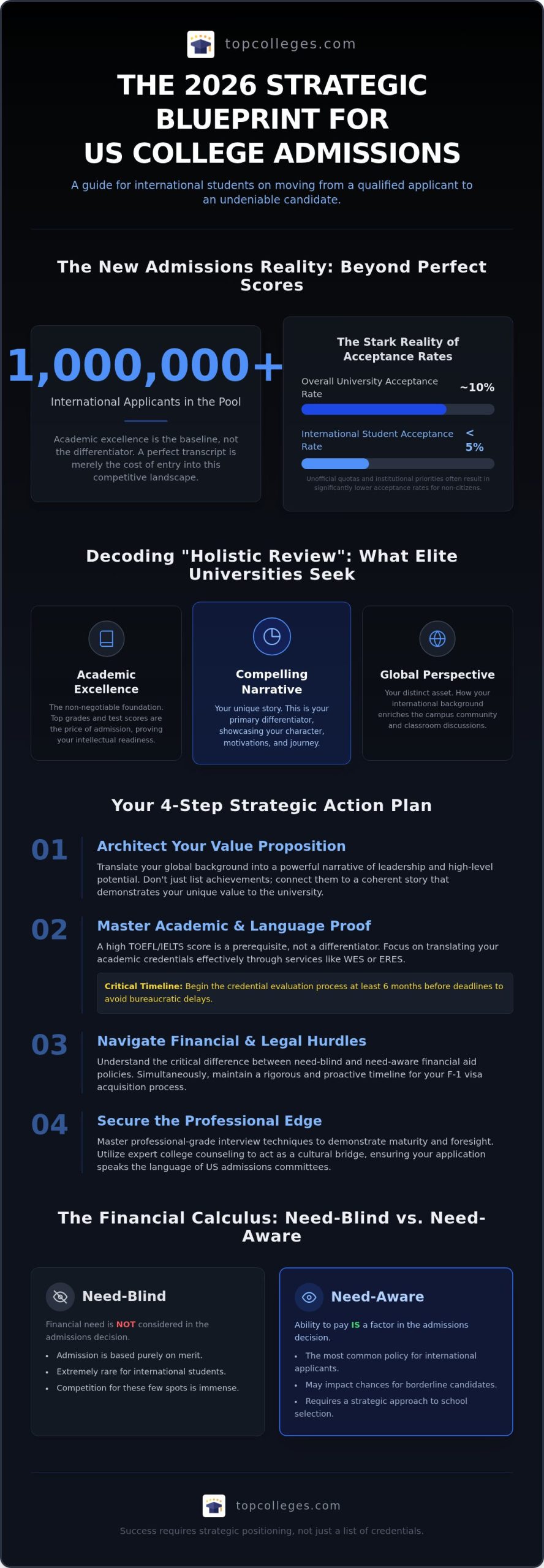
Academic excellence is no longer a differentiator. It’s the baseline. For the 2026 cycle, elite universities are evaluating a pool of over one million international applicants. This volume means a perfect transcript is simply the cost of entry. To succeed in US college admissions for international students, you must understand that your application is a tactical document. It’s a narrative designed to prove you’ll thrive within a specific institutional culture. Admissions officers don’t just want the smartest students. They want the right ones. Understanding the US College Admissions Process involves recognizing that “holistic review” is a search for character, impact, and a unique global perspective that enriches their campus. Identifying your cultural fit is more strategic than chasing a high ranking.
The Reality of International Acceptance Rates
Acceptance rates tell a sobering story. While a university might boast a 10 percent overall acceptance rate, the figure for international applicants often drops to 5 percent or lower. Institutions frequently manage unofficial quotas based on geographic diversity and financial needs. Global economic fluctuations and shifting diplomatic ties also influence these targets. You can’t afford a scattergun approach. A strategic selection of reach, match, and safety schools is essential. This selection must be based on data, not just prestige. It’s about finding where your specific background meets a university’s current institutional priority. Success requires foresight and a realistic assessment of the global field.
Defining the Role of a Professional College Counselor
How do you translate an A-level or an IB score into the context of a US liberal arts education? The nuances are often lost in translation. An expert strategist serves as a vital bridge between your local context and American expectations. By utilizing professional college admissions counseling, you replace the anxiety of the unknown with a structured, pragmatic preparation plan. A mentor doesn’t just check boxes. They help you identify your unique value proposition. They advocate for your potential. This high-level guidance ensures that every part of your portfolio, from the personal statement to the recommendation letters, speaks with a unified, authoritative voice. The goal is to move from being a qualified applicant to becoming an undeniable candidate.
Evaluating Academic Credentials and English Proficiency Standards
The 2026 landscape for US college admissions for international students requires more than just submitting a transcript. It demands a tactical translation of your academic identity. How does a registrar in California or New York weigh a 1.0 German Abitur against a 95% Indian CBSE result? Without a precise conversion, your achievements risk being undervalued or misunderstood. You aren’t just sending grades; you’re presenting a case for your intellectual standing on a global stage.
Navigating the Credential Evaluation Process
Selecting the appropriate evaluation agency is a critical strategic decision. Credential evaluation is the translation of academic potential into US institutional currency. While many institutions accept World Education Services (WES) or Educational Records Evaluation Service (ERES), some elite programs mandate specific internal reviews. For those with non-traditional or vocational backgrounds, the challenge is proving that your curriculum aligns with American liberal arts or pre-professional standards. You should prioritize these steps to ensure your documentation is recognized:
- Identify the specific agency preferred by your top-tier target schools.
- Request official transcripts from your home institution early to account for international postal delays.
- Ensure all non-English documents are accompanied by certified, word-for-word translations.
Tactical timing is essential. Beginning this process at least six months before deadlines prevents the bureaucratic delays that often derail international applications.
Beyond English Proficiency: Proving Academic Readiness
A high TOEFL or IELTS score is a prerequisite, but it rarely serves as a differentiator for elite entry. Admissions committees are looking for “English-plus” capabilities: the ability to engage in high-level research, contribute to seminar-style debates, and master complex academic writing. If your secondary school offers AP, IB, or A-Level curricula, these serve as powerful signals of your readiness for American rigor. These global standards provide a familiar metric for evaluation. While you refine your academic profile, you must also consider the Financial Aid and Scholarships for International Students that may be available based on your merit and background. Professional admissions expertise can help you determine which tests will best showcase your unique intellectual literacy.
The standardized testing environment in 2026 remains in flux. While the Digital SAT is now the global norm, many institutions have maintained test-optional policies. However, data suggests that submitting a high score remains a significant advantage. With average SAT scores declining to 1024 in recent years, a top-percentile result is a louder signal than ever before. Don’t view these requirements as hurdles. View them as opportunities to provide the “institutional currency” that American universities value most.
Architecting a Narrative: Portfolio Development for Global Applicants
How do you stand out when every other applicant also has perfect scores? The answer isn’t found in your transcript but in your narrative. In the competitive arena of US college admissions for international students, your application must move beyond a mere list of achievements to become a strategic portfolio. You aren’t just a student from abroad; you’re a future contributor with a unique value proposition that an American campus currently lacks. This requires a deliberate shift from passive reporting to active architecting. You must present yourself as a sophisticated thinker who understands their place in a globalized society.
Transcending Labels in Personal Statements
Most international applicants fall into the trap of predictable stories about cultural transitions or the excitement of travel. These clichés fail to capture the intellectual depth that elite universities demand. Instead, you must focus on tactical reflection that connects your specific cultural experiences to the future contributions you’ll make on a US campus. A compelling essay identifies the intersection of personal growth and institutional need. By following a strategic blueprint for architecting the best college essays, you ensure your voice commands respect and resonates with admissions officers. Your narrative should present you as a proactive leader who has already mastered the nuances of their local environment and is ready for the rigors of an elite American education.
Strategic Extracurricular Positioning
Quality always outweighs quantity in the eyes of a seasoned admissions committee. A long list of superficial club memberships is far less persuasive than a single project where you demonstrated significant, measurable impact. You must translate your local context into terms a US committee understands. If you won a prestigious award in your home country, explain the competitive field you surpassed and the specific criteria for success. This translation provides the necessary weight to your accomplishments. For a broader look at how these elements fit into your timeline, consult an International Student Application Guide. Developing a portfolio that showcases foresight requires you to be selective. Focus on these three pillars to solidify your positioning:
- Identify your “spike”—the one area where you are truly exceptional and distinct.
- Quantify your impact using data, specific outcomes, or organizational growth.
- Connect your extracurricular work directly to your intended field of study or personal mission.
This methodical approach replaces applicant anxiety with a sense of structured preparation. It transforms your global perspective from a vague concept into a concrete, elite asset that universities will compete to enroll.
The Financial and Legal Calculus of US Study
The financial strategy behind your application is often as critical as your academic profile. In the competitive sphere of US college admissions for international students, you must confront a pragmatic reality: the distinction between need-blind and need-aware policies. While a select group of elite institutions remains need-blind for non-citizens, the vast majority are need-aware. This means your request for financial assistance is factored into the admissions decision. It’s a high-stakes gamble. If your profile is borderline, a significant request for aid might shift the scales toward a rejection in favor of a self-funded peer. You must decide early whether to prioritize admission at a “reach” school or target institutions where your merit-based profile might command a scholarship.
Strategic Financial Planning
Success requires a clear understanding of the return on investment for an elite US degree. In the 2026 job market, the prestige of a top-tier American university remains a powerful global currency, yet the upfront costs are substantial. You should look beyond institutional aid and explore merit-based scholarships and external funding sources early. Many students overlook specialized global educational publications that list private grants specifically for international scholars. Identifying these sources allows you to apply as a self-funded candidate, which can strategically increase your probability of admission at need-aware schools. It’s about balancing your long-term career aspirations with the immediate financial hurdles of enrollment.
The Student Visa Strategy
Gaining admission is only half the battle; securing your F-1 student visa is the final, essential milestone. The process is rigorous and requires meticulous attention to detail. For the 2026 cycle, you must account for mandatory government fees totaling $535, which includes the $185 MRV application fee and the $350 SEVIS I-901 fee. Your visa interview is a high-pressure environment where you must demonstrate “non-immigrant intent.” You’ll need to prove you have strong ties to your home country and a clear plan to return after your studies. This preparation begins months before your departure date.
Managing the documentation for your I-20 issuance is equally demanding. You must provide proof of funding that typically ranges from $40,000 to over $90,000 annually, depending on the institution’s requirements for tuition and living expenses. This isn’t just about having the funds; it’s about presenting the documentation in a format that US consular officers find undeniable. Coordinating your application timeline with visa appointment availability is vital to avoid bureaucratic delays. A structured, pragmatic plan ensures that your legal status remains secure as you transition into the rigor of American academic life.
Securing the Professional Edge in International Admissions
The final stage of US college admissions for international students often hinges on a single conversation. While your portfolio establishes your capability, the interview confirms your character. It’s the moment where admissions officers verify that the voice in your essays matches the person on the screen or across the table. For international applicants, this is not a formality. It’s a critical verification of cultural fluency and intellectual maturity. You aren’t just proving you can do the work; you’re proving you belong in the room.
The Art of the International Interview
In 2026, virtual interviews remain the standard for global applicants, yet some elite institutions still favor in-person alumni meetings in major international hubs. You must master the tactical nuances of both. How do you maintain presence through a lens? You answer provocative questions with strategic poise and reflection rather than rehearsed scripts. Many successful undergraduate candidates now adopt advanced law school interview preparation techniques to handle high-pressure inquiries about ethics, global trends, and personal failures. The interview is the final opportunity to humanize the data points of your application. It transforms you from a statistic into a future colleague.
Why Elite Counseling is the Differentiator
Accessing the inner workings of the US higher education system requires more than simple research. It requires a mentor who acts as a strategic advocate. Professional counseling replaces the paralyzing anxiety of the unknown with a sense of structured confidence. An expert strategist helps you navigate the final bureaucratic hurdles while ensuring your narrative remains cohesive across all platforms. This guidance is the bridge between your current potential and your future aspirations. As you finalize your submission, use this strategic checklist to ensure elite status:
- Verify that every global achievement is translated into its US-centric impact.
- Confirm that your proof of funding aligns perfectly with the latest I-20 requirements.
- Double-check that your recommendation letters provide specific, anecdotal evidence of leadership.
- Ensure your digital presence reflects the professional persona presented in your portfolio.
Transitioning from an applicant to a successful member of elite campus life isn’t a matter of luck. It’s a matter of foresight. By following a methodical roadmap, you don’t just apply to a university. You engineer an acceptance. The stakes are high, but with a pragmatic approach and a clear strategic path, you’re positioned to thrive in the most competitive admissions cycle in history.
Mastering the 2026 Admissions Frontier
Will you be just another name in a global database, or the candidate an elite institution cannot afford to ignore? The journey to an American campus is a high-stakes strategic operation. You’ve seen how academic excellence is merely the baseline and how a compelling narrative must transcend cultural clichés to identify institutional fit. Success in US college admissions for international students depends on your ability to anticipate the nuances of the holistic review process and the pragmatic realities of the F-1 visa timeline.
Steven Roy Goodman, a high-profile mentor and strategic mastermind, brings decades of experience to this complex system. By focusing on comprehensive portfolio development and professional interview preparation, you replace applicant anxiety with structured confidence. You aren’t just submitting an application; you’re engineering a future.
The landscape of 2026 is demanding, but it’s also filled with unprecedented opportunity for those who plan with precision. Take the first step toward your aspirations with the authority of a seasoned advocate by your side. Your path to excellence begins with a single, strategic decision.
Frequently Asked Questions
Do international students have a harder time getting into US colleges?
Yes, because acceptance rates for non-citizens are statistically lower than for domestic applicants. While elite institutions seek global diversity, they manage unofficial geographic quotas and often have limited financial aid for international pools. This creates a hyper-competitive environment where academic perfection is merely a baseline. To succeed in US college admissions for international students, you must architect a narrative that demonstrates unique institutional value beyond standard metrics.
Can I get a full scholarship to a US university as an international student?
Full scholarships are available but remain exceptionally rare and highly competitive. Only a few elite universities are need-blind for international applicants and commit to meeting 100 percent of demonstrated financial need. Most institutions offer merit-based aid or partial scholarships to attract top global talent. You should identify schools with a history of supporting international scholars and apply with a portfolio that positions you as a high-impact asset to their campus community.
What is the difference between need-blind and need-aware admissions?
Need-blind admissions mean the university evaluates your application without considering your ability to pay for tuition. Conversely, need-aware institutions factor your financial request into the final decision. For most US college admissions for international students, the process is need-aware. It’s a tactical trade-off. Requesting significant aid can lower your probability of admission at schools where funding for non-citizens is finite. Strategic planning is essential to balance your financial requirements with your target school list.
How much does it cost to apply to US colleges from abroad?
The mandatory government fees for an F-1 visa total $535, comprising the $185 MRV fee and the $350 SEVIS I-901 fee. Individual college application fees typically range from $50 to $100. Standardized testing also requires investment. The international SAT registration fee is $111, while the ACT costs between $168.50 and $188.50. These costs don’t include English proficiency tests like the TOEFL, which is $270 when taken within the United States.
Is the SAT or ACT required for international students in 2026?
Standardized testing requirements vary significantly by institution in 2026. While many universities have maintained test-optional policies, others have returned to requiring the SAT or ACT for all applicants. Even at test-optional schools, submitting a high score remains a powerful differentiator for international students. It provides a standardized metric that validates your local grades. You should verify the specific policy of each target university well before the August 1 Common App opening date.
How do I prove my English proficiency if I studied in an English-speaking school?
Most universities offer waivers for English proficiency tests if you’ve completed several years of secondary education at an institution where English is the primary language of instruction. However, this waiver is not automatic. You must formally request it and provide supporting documentation. Some elite programs may still encourage a TOEFL or IELTS score to demonstrate high-level academic readiness. Always confirm the specific waiver criteria on the university’s official admissions portal to avoid delays.
What happens if I am waitlisted at a US college as an international applicant?
A waitlist decision means you’re qualified but the university has already filled its initial international quota. For non-citizens, waitlist movement is often unpredictable and linked to the financial aid budget. You should immediately secure a spot at a match or safety school by submitting a deposit. If you remain committed to the waitlisting school, submit a letter of continued interest that highlights recent achievements and reaffirms your intent to enroll if accepted.
Can I work in the US while studying on an F-1 visa?
F-1 visa regulations generally restrict international students to on-campus employment for up to 20 hours per week during academic terms. Off-campus work is typically prohibited during the first year of study. After the first year, you may be eligible for Curricular Practical Training (CPT) or Optional Practical Training (OPT) in your field of study. These opportunities require strict adherence to legal status protocols and coordination with your university’s international student office to maintain compliance.