

Disclaimer
Content on this page of topcolleges.com is computer generated and therefore is not guaranteed to be 100 percent accurate about various aspects of the education sector. On balance, however, many students and families seek general information about high schools, colleges and universities, graduate programs, testing, education and career planning, and job placement before beginning one-on-one admissions counseling tailored to their specific needs.
What if the traditional personal statement is actually the weakest link in your high-stakes application? In an environment saturated with polished data, the pressure to stand out has never been higher. You’re likely feeling the anxiety of the 2026 cycle. You fear that your narrative might sound generic or that the rise of generative AI has rendered your unique voice indistinguishable from a machine. It’s a legitimate concern. To produce the best college essays, you must stop viewing the prompt as a creative writing exercise and start seeing it as a tactical blueprint.
This article provides the strategic framework elite applicants use to transform their experiences into decisive admissions assets. You’ll gain a clear understanding of the Narrative Arc required to capture an admissions officer’s attention. We’ll explore how to balance raw vulnerability with professional confidence. By the end, you’ll have a roadmap to differentiate yourself from thousands of similar profiles, ensuring your essay portfolio acts as a cohesive strategic asset for your future.
Key Takeaways
- Learn why the best college essays move beyond simple storytelling to align your personal values with the specific institutional needs of elite universities.
- Break down the structural components and high-impact hooks that command attention in competitive, high-volume evaluation environments.
- Protect your application from the waitlist trap by identifying the risks of AI-generated content and the pitfalls of performative vulnerability.
- Master the concept of the Essay Portfolio to ensure your Common App and supplemental responses work together as a cohesive, non-redundant strategic asset.
- Explore how professional admissions counseling provides the tactical foresight necessary to navigate the complexities of the 2026 admissions cycle.
Redefining the Best College Essays: Beyond the Personal Narrative
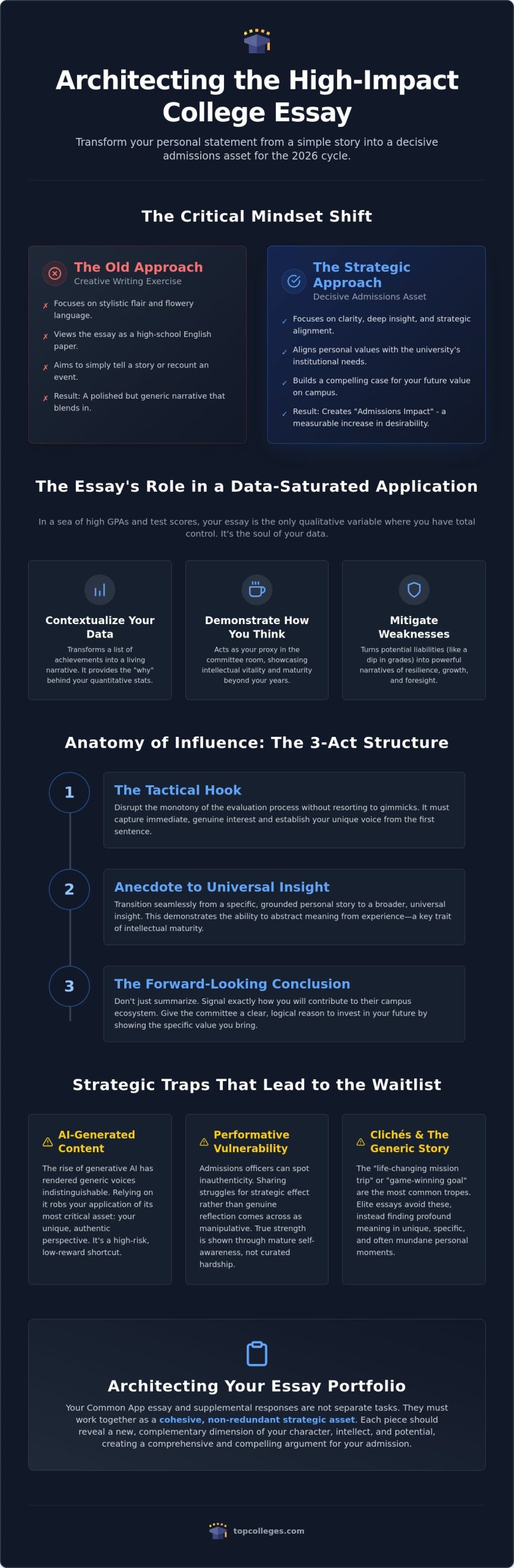
Is your essay a story or a strategy? In the 2026 admissions cycle, the answer determines your trajectory. Grammatical proficiency and a clear narrative are no longer enough to secure a seat at an elite institution; they are simply the baseline. The best college essays function as sophisticated instruments of strategic alignment. They bridge the gap between your personal values and the specific, often unspoken, institutional needs of the university. You aren’t just telling a story; you’re building a case for your future value on campus.
Consider your application as a complex data set. Your GPA, test scores, and extracurricular lists provide the quantitative proof of your capability. However, the essay remains the only qualitative variable in this equation. It’s the only space where you possess total control over the interpretation of your history. In a sea of identical high-achievers, the essay is the soul of the data. It transforms a list of achievements into a living, breathing asset that commands attention.
The Strategic Purpose of the Personal Statement
A successful essay acts as your proxy in the committee room. It shouldn’t merely recount what you did. Instead, it must demonstrate how you think. Admissions officers are looking for intellectual vitality and the ability to process complex experiences with maturity. While understanding the application essay begins with its role as a personal introduction, its true power lies in its ability to mitigate academic weaknesses or amplify existing strengths. It provides the context that numbers alone cannot provide, turning potential liabilities into narratives of resilience and foresight.
Moving from Good Writing to Admissions Impact
Many applicants mistake a high-school English paper for a professional personal statement. A classroom essay prioritizes stylistic flair and adherence to a specific prompt. An admissions essay, however, prioritizes Institutional Fit. This means demonstrating that your unique perspective will solve a specific problem or fill a specific niche for the university. We must dispel the “creative writing” myth. Clarity and deep insight are far more valuable than flowery metaphors or linguistic gymnastics. Your goal is to create a sense of inevitability around your admission.
Admissions Impact is the measurable increase in an applicant’s desirability post-reading.
Achieving this level of precision requires a transition from a student mindset to a strategic mindset. This shift is the cornerstone of effective college admissions counseling. By architecting a portfolio that aligns your personal narrative with the university’s mission, you ensure that your best college essays serve as a decisive advantage rather than a generic requirement.
The Anatomy of Influence: How Elite Essays Command Attention
Elite admissions officers don’t just read; they evaluate. In a high-volume environment where thousands of profiles look identical on paper, the best college essays must command immediate attention. This isn’t about being loud. It’s about being influential. Successful Ivy League narratives share a specific structural DNA that moves beyond simple storytelling to present a sophisticated argument for admission. They are architected to leave an indelible mark on the reader’s memory.
The “Hook” is your first tactical move. It must disrupt the monotony of the evaluation process without resorting to gimmicks. Once you’ve captured interest, the essay must transition seamlessly from a specific, grounded anecdote to a universal insight. This shift demonstrates your ability to abstract meaning from experience, a trait highly prized by top-tier committees. If you’re looking for foundational tips for a stellar college application essay, remember that the goal is to show, not just tell, your intellectual caliber. You’re proving that you possess the depth to handle a rigorous academic environment.
Your conclusion shouldn’t merely summarize your points. It must be forward-looking. Elite universities aren’t just rewarding your past; they are investing in your future. A strong finish signals exactly how you’ll contribute to their campus ecosystem. It provides a clear, logical reason for the committee to say yes by showing them the specific value you bring to their community.
The Narrative Arc of Self-Reflection
Most applicants get stuck in the “Challenge” phase. They spend 500 words describing a problem and only 50 words on the solution. Elite essays flip this ratio. The “Challenge-Insight-Growth” framework succeeds because it prioritizes the “Insight” phase. This is where you demonstrate intellectual maturity. Your choice of anecdote should be a vehicle for showing how you process complexity. It’s a diagnostic tool that reveals your character and your capacity for self-correction.
Intellectual Vitality as a Competitive Differentiator
What does intellectual vitality look like in 2026? It’s more than a high GPA. It’s a proactive, hungry curiosity that seeks out learning beyond the classroom. You must show, through specific narrative choices, that you possess the foresight to engage with global trends and diverse perspectives. This global outlook is a hallmark of the strategies developed at Top Colleges, where we help students position themselves as future leaders in a connected world. If you feel your narrative lacks this edge, professional admissions counseling can help you identify the unique threads of your experience that signal this high-level potential.
Strategic Differentiation: Avoiding the Pitfalls of Clichés and AI
Why do thousands of high-achieving applicants find themselves on the waitlist every year? Often, the culprit is a “safe” essay. In a landscape where every applicant has a near-perfect profile, safety is a liability. The best college essays refuse to hide behind generic tropes or predictable conclusions. They embrace the discomfort of genuine reflection. However, many students stumble into the trap of performative vulnerability, believing that a catalog of hardships is a shortcut to admission. It isn’t. Elite committees aren’t looking for a list of traumas; they are looking for the intellectual maturity you gained from them.
This leads to the “Vulnerability Paradox.” You must be human, yet you must maintain professional confidence. If your narrative feels like a therapy session, you’ve missed the mark. If it feels like a corporate press release, you’ve also failed. The goal is to show a grounded, self-aware individual who can process difficulty with poise. This balance is what separates a forgettable story from a decisive admissions asset. It signals to the committee that you’re ready for the high-stakes environment of a top-tier campus.
The ChatGPT Dilemma: Why AI Fails the Elite Test
Can a machine capture the nuance of your specific perspective? Large language models excel at mimicry, but they fail at authentic human insight. Admissions officers in 2026 are increasingly adept at spotting the “hollow” tone of AI-generated content. They use sophisticated detection tools and, more importantly, “voice consistency” checks. If your personal statement sounds like a generic algorithm while your supplemental essays show a different stylistic DNA, the lack of authenticity will be fatal. The same risk applies when students rely on a ChatGPT college essay grader for feedback, mistaking a high algorithmic score for genuine admissions readiness. The best college essays rely on the kind of idiosyncratic, lived detail that AI simply cannot replicate. Studying college essays that worked reveals precisely why this human specificity is the decisive factor that separates admitted students from those who are waitlisted.
Reclaiming the Cliché through Tactical Positioning
Is the “mission trip” or “sports injury” essay truly dead? Not necessarily. The problem isn’t the topic; it’s the lens. You can reclaim a common experience by applying a unique intellectual framework to it. This requires moving from what happened to why it mattered in a global or systemic context. Success depends on specific, uncopyable detail that only you can provide. For a deeper understanding of how to position your narrative within a broader application, consult the Strategic Blueprint for College Admissions Counseling. By shifting your focus from the event to the analysis, you transform a cliché into a testament of your tactical thinking and foresight.
Architecting Your Essay Portfolio for Maximum Admissions ROI
Do you view your application as a series of disconnected answers? This is a fundamental error. The best college essays don’t exist in a vacuum; they function as a synchronized portfolio. When an admissions officer reviews your file, they’re looking for a comprehensive picture of your character and intellectual depth. If your Common App essay and your supplemental responses cover the same ground, you’ve wasted valuable real estate. Redundancy is the enemy of admissions ROI. Every word must serve a unique tactical purpose.
Strategic applicants use the “Why Us?” prompt as a high-level diagnostic tool. It’s not enough to mention a high ranking or a famous professor. You must demonstrate deep, methodical research that aligns with your specific academic goals. By mapping your core brand pillars—the three or four essential traits you want to project—across the entire portfolio, you ensure no facet of your personality is left unexamined. This approach transforms a collection of responses into a cohesive strategic asset.
Mapping the Common App to Supplemental Prompts
To execute this, you must perform a Portfolio Audit before you write a single sentence. Start by listing every prompt you need to answer. Then, identify the gaps in your narrative. If your main essay focuses on leadership, use your supplements to showcase curiosity or a global perspective. This ensures each essay reveals a new facet of your profile. For a more granular look at this process, review our Admission Essay Prompts analysis for 2026. This methodical approach ensures your total output is greater than the sum of its parts.
The Role of Voice in the Evaluation Process
A consistent voice is your most powerful credibility builder. If your main essay is whimsical but your supplements are dry and technical, the reader senses a lack of authenticity. There’s a dangerous temptation to over-edit. When a student’s voice is replaced by a parent’s or a generic consultant’s, the narrative loses its human edge. You must maintain a register that’s formal enough to command respect, yet accessible enough to feel like a genuine intellectual. The best college essays strike this balance by sounding like the most polished version of the applicant, not a different person entirely.
The Top Colleges Approach: Turning Essays into Strategic Assets
Why do some applicants with identical academic profiles receive drastically different results? The answer lies in the execution of the narrative. Steven Roy Goodman’s methodology treats the best college essays as critical milestones within a long-term strategic plan. We don’t view the essay as a standalone requirement. Instead, it’s a bridge between your current achievements and your future institutional value. This approach requires a shift from simple storytelling to tactical portfolio development, ensuring every response reinforces your unique brand pillars.
Engaging in professional college admissions counseling provides the diagnostic foresight necessary to navigate these high-stakes decisions. Our process moves methodically from diagnostic brainstorming to a final, sophisticated polish. We don’t just fix grammar; we identify the specific experiences that signal intellectual vitality and global perspective. This rigorous review ensures your best college essays function as decisive assets, positioning you for success in 2026 and beyond, whether your path leads to immediate undergraduate success or eventual graduate school applications.
Personalized Strategy for the High-Stakes Applicant
Top Colleges doesn’t rely on templates or generic advice. Every student receives a custom roadmap tailored to their specific profile and aspirations. We help you identify your most “valuable” stories—those that demonstrate maturity, foresight, and an ability to contribute to a campus community. Our focus remains on long-term success. We aren’t just looking at the next four years; we’re helping you develop a professional voice that will serve you throughout your academic and professional career.
From Draft to Decision: A Seasoned Perspective
The benefit of a seasoned advisor is the ability to see your application through the eyes of the admissions committee. We understand the inner workings of elite evaluation processes and the nuances that lead to an “admit” decision. This perspective replaces the typical applicant’s anxiety with a sense of structured preparation. By following a pragmatic, results-oriented methodology, you can move away from the fear of the unknown and toward strategic execution. It’s time to stop wondering if your essay is good enough and start ensuring it’s a powerful tool for your advancement.
- Diagnostic brainstorming to uncover high-impact narratives
- Strategic alignment with institutional needs and mission
- Iterative refinement to ensure voice consistency and clarity
- Final polish to command respect in the committee room
Securing Your Position in the 2026 Admissions Landscape
The 2026 cycle demands a departure from traditional, passive storytelling. You’ve seen how the best college essays function as tactical bridges, aligning your personal history with the specific institutional needs of elite universities. Success requires more than a single polished draft; it necessitates a cohesive essay portfolio that eliminates redundancy and demonstrates intellectual vitality. By bypassing the generic traps of AI and performative vulnerability, you position yourself as a candidate of high-level foresight and maturity.
This level of strategic execution is the hallmark of the guidance provided by Steven Roy Goodman, a nationally recognized expert in higher education trends. Whether you’re navigating undergraduate applications or high-stakes admissions for MBA, Law, or Medical school, a structured, pragmatic approach is your greatest competitive advantage. For those pursuing legal education, investing in law school interview preparation is an equally critical component of your overall admissions strategy. We help you move beyond the anxiety of the blank page and toward a decisive admissions asset.
Replace your uncertainty with a methodical plan. Your future at a top-tier institution is a goal that requires precision, and you’re now equipped with the blueprint to achieve it. It’s time to transform your narrative into your most powerful advocate.
Frequently Asked Questions
What is the ideal word count for the best college essays in 2026?
You should aim for the upper limit of the specified word count without exceeding it. For the Common App, this means staying between 600 and 645 words. Precision is a signal of your ability to follow instructions while maximizing the space provided. Shorter essays often suggest a lack of depth, while exceeding the limit reflects poor self-editing. Use every available word to build your strategic narrative.
How much can a great college essay actually help if my GPA is below the average?
A great essay can significantly mitigate a lower GPA by providing qualitative context for your academic performance. It allows you to explain specific challenges or highlight an upward trajectory that numbers alone cannot capture. While it won’t erase a poor transcript, it can shift the committee’s focus toward your intellectual vitality and resilience. The best college essays act as a counterweight, humanizing the data and proving your readiness for rigorous study.
Can I write my college essay about a controversial topic to stand out?
You can write about a controversial topic only if you approach it with intellectual maturity and a focus on analysis rather than ideology. The goal is to show how you think, not what you believe. If the topic distracts from your personal growth or creates unnecessary friction with the reader, it becomes a liability. Ensure the narrative centers on your ability to engage with complex perspectives rather than the controversy itself.
Is it acceptable to use ChatGPT for brainstorming my college essay prompts?
Using ChatGPT for initial brainstorming is acceptable, but it carries the risk of producing generic, uninspired ideas. AI lacks the lived experience and idiosyncratic detail necessary for elite admissions. If your starting point is an algorithm, your final product will likely mirror thousands of other machine-generated drafts. Furthermore, relying on a ChatGPT college essay grader to evaluate your drafts compounds this risk, as algorithmic scoring cannot measure the human depth that elite committees actually seek. Use it as a sounding board, but rely on your own self-reflection to identify the stories that truly differentiate your profile. Reviewing college essays that worked for real applicants is a far more effective method for understanding what authentic, high-impact narratives actually look like.
How do I balance being humble with showing my achievements in my personal statement?
Balance humility with achievement by focusing on the process and the impact of your work rather than the accolades. Describe the specific challenges you overcame and the insights you gained during the journey. This approach demonstrates professional confidence without appearing boastful. It shows the admissions committee that you value growth and contribution over mere status, which is a key trait of successful applicants in the 2026 cycle.
What happens if an admissions officer thinks my essay was written by a professional?
If an admissions officer suspects your essay wasn’t written by you, it can lead to immediate disqualification. Consistency is your greatest defense. Your personal statement must match the stylistic DNA of your supplemental responses and your interview performance. While professional counseling is common, the final voice must remain authentically yours. Over-editing that strips away your personality is a strategic error that signals a lack of integrity. Candidates applying to law school should also recognize that this same standard of authentic voice extends to law school interview preparation, where consistency between your written application and spoken narrative is equally scrutinized.
How many supplemental essays are typically required for elite universities?
Most elite universities require between two and five supplemental essays in addition to the main personal statement. These prompts are often school-specific and demand deep research into the institution’s unique culture and resources. Don’t treat these as secondary tasks. They are critical components of your overall portfolio. To produce the best college essays, you must ensure these supplements complement your main narrative without repeating the same information.
When should I start writing my college essays for the 2026 cycle?
Start the writing process in June of your junior year to ensure you have enough time for diagnostic brainstorming and multiple rounds of refinement. High-stakes applications require a level of polish that cannot be achieved in a few weeks. Beginning early allows you to reflect on your experiences without the pressure of impending deadlines. It also gives you the space to pivot your strategy if your initial drafts lack the necessary impact.