

Disclaimer
Content on this page of topcolleges.com is computer generated and therefore is not guaranteed to be 100 percent accurate about various aspects of the education sector. On balance, however, many students and families seek general information about high schools, colleges and universities, graduate programs, testing, education and career planning, and job placement before beginning one-on-one admissions counseling tailored to their specific needs.
What if the standard checklist for your legal education was not a hurdle to clear, but the foundational architecture of your professional legacy? You likely feel the mounting pressure of the 2026 admissions cycle, perhaps staring at a static LSAT score or deciphering the nuances of the latest LSAC GPA weighting. It is natural to view these benchmarks with a sense of high-stakes urgency. The complexity of modern law school requirements can feel overwhelming when viewed as isolated tasks. We understand that the transition from a high-achieving student to a prospective legal scholar requires more than just checking boxes; it demands a sophisticated, diagnostic approach to your entire profile.
This blueprint moves beyond the surface level to transform technical law school requirements into a commanding, strategic narrative that positions you as an elite candidate. You’ll gain a clear roadmap of the current admissions landscape, alongside deep insights into how to articulate a unique “why law” story that resonates with top-tier committees. We will explore the tactical shifts in admissions criteria and provide a methodical plan to ensure your portfolio reflects the foresight and intellectual rigor expected at the highest levels of the profession. Confidence in your competitive positioning starts with structured, results-oriented preparation.
Key Takeaways
- Treat the LSAT and GPA as diagnostic benchmarks that demonstrate analytical precision rather than just static numbers on a page.
- Learn how to transform standard law school requirements into a commanding professional narrative that emphasizes your unique legal aptitude.
- Master the art of selecting recommenders based on their ability to attest to specific intellectual traits and professional reliability.
- Navigate the complexities of character and fitness disclosures to establish an ethical baseline required for both elite admissions and future bar entry.
- Execute a tactical timing strategy by balancing the advantages of rolling admissions against the high-stakes trade-offs of Early Decision applications.
Decoding the Quantitative Baseline: GPA and LSAT Realities
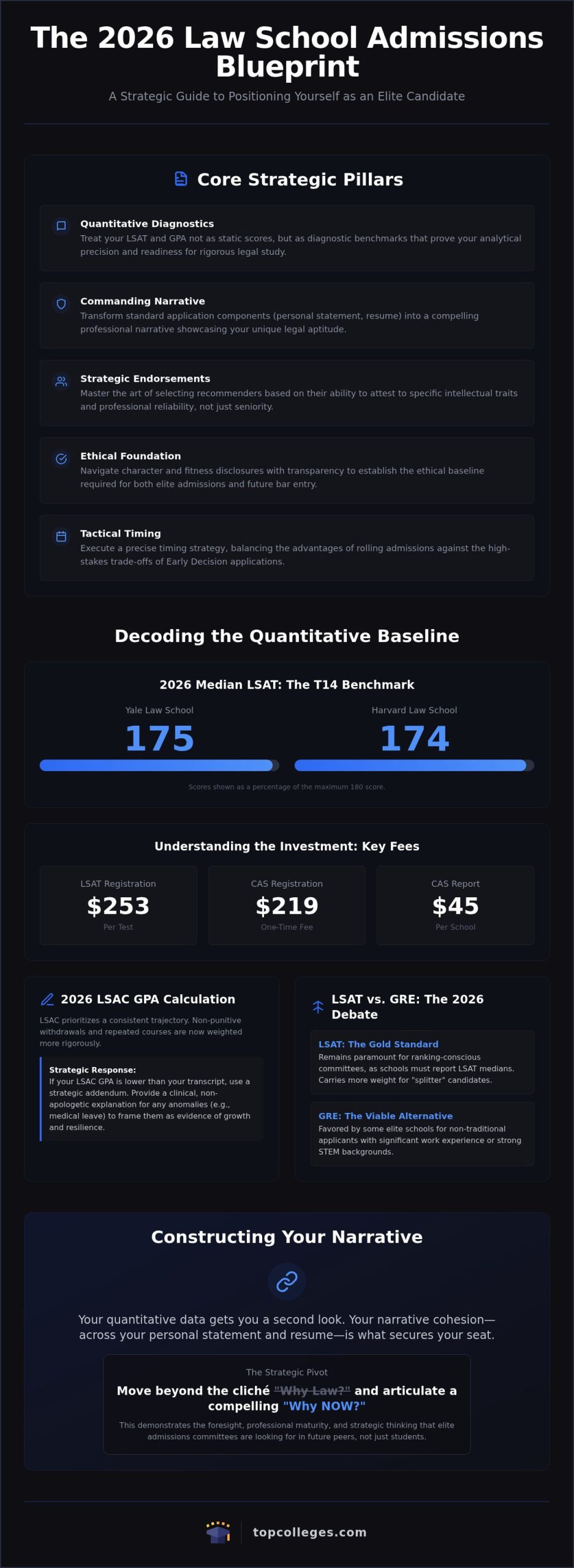
How do you quantify a mind capable of high-stakes litigation? Law school requirements begin with a cold analysis of your quantitative profile. These numbers act as the primary filter for admissions committees at elite institutions. For instance, the 2026 median LSAT for Yale Law School stands at 175, while Harvard Law School maintains a 174. Registration for this exam currently costs $253. These are not merely scores; they are diagnostic indicators of your analytical precision. While a high score provides entry, it does not guarantee a seat. You must view these metrics as the raw materials for your candidacy. A comprehensive U.S. law school admission overview confirms that while a bachelor’s degree is a prerequisite, the standardization provided by the Credential Assembly Service (CAS) is what truly levels the playing field.
The CAS, which carries a $219 registration fee and a $45 report fee per school, serves as the ultimate arbiter of your academic history. It translates diverse grading scales into a singular, comparable metric. Understanding this system is crucial because it often strips away the grade inflation benefits of your home institution. Navigating these law school requirements demands a strategist’s eye for detail. Your quantitative data is the gatekeeper. It earns you a second look, but the narrative you build around these numbers determines the final verdict.
Adjusting to the 2026 LSAC GPA Calculation Changes
The 2026 cycle introduces a more rigorous weighting of non-punitive withdrawals and repeated courses. LSAC now prioritizes a consistent trajectory over a high institutional GPA bolstered by strategic drops. Is your LSAC GPA lower than your transcript suggests? This discrepancy requires a proactive response. Use a strategic GPA addendum to provide context for academic anomalies, such as medical leaves or family emergencies. Do not apologize. Instead, provide a clinical explanation that reinforces your current academic maturity. This ensures the committee views your transcript through the lens of growth rather than inconsistency.
The LSAT vs. GRE Debate in 2026
Does the GRE offer a viable path to a T14 acceptance? Several elite institutions now favor the GRE for non-traditional applicants with significant professional experience or STEM backgrounds. However, the LSAT remains the gold standard for ranking-conscious committees. Because law schools must report LSAT medians to maintain their prestige, a high LSAT score often carries more weight for splitters than a high GRE score. Choose the test that best showcases your intellectual strengths while acknowledging the tactical reality of school rankings. The decision is yours, but it must be made with a clear understanding of your target school’s median targets.
Constructing the Narrative: Personal Statements and Professional Resumes
How do you bridge the gap between a high LSAT score and a seat at a T14 institution? The answer lies in narrative cohesion. If your quantitative data serves as the foundation, your written components are the architectural blueprint. Many applicants treat these as secondary tasks. That is a strategic error. To satisfy elite law school requirements, you must pivot from a student mindset to a professional one. Your entire application should function as a persuasive brief. It must argue that your admission is not just earned, but logical. Why should a committee invest in your future? Your answer must move beyond the “why law” cliché. Instead, focus on a “why now” strategic pivot. This demonstrates the foresight and professional maturity that admissions officers crave.
Crafting a Law School Personal Statement That Commands
A commanding personal statement identifies pivotal moments that demonstrate your capacity for legal analysis. Avoid overly sentimental or academic prose. These committees are looking for future peers, not just pupils. As highlighted in the University of Washington application process, a holistic review means every word carries weight. You aren’t just telling a story; you’re building a case for your own professional potential. For those seeking a deep-dive strategy on this specific document, mastering the law school personal statement requires a delicate balance of vulnerability and authority. It is your primary opportunity to speak directly to the dean of admissions. Do not waste it on platitudes.
The Professional Edge: Optimizing Your Law School Resume
Your resume is not a simple list of past jobs. It is evidence of your legal aptitude. Standard law school requirements often specify a resume, but they rarely explain how to optimize it for a legal audience. You must distinguish your undergraduate activities from professional achievements. Focus on highlighting “soft skills” that translate directly to the courtroom or the boardroom. These include intensive research, advocacy, and complex negotiation. Consider these formatting priorities:
- Quantify achievements: Use specific data to align with law school evaluation metrics. Did you manage a budget or lead a team of ten?
- Highlight analytical tasks: Mention specific research projects, white papers, or policy contributions.
- Show consistency: Demonstrate a long-term interest in justice or policy through your extracurricular and professional choices.
Architecting a resume with this level of precision requires an expert perspective on what elite committees value. If you find yourself struggling to articulate your unique value proposition, engaging with law school admissions consulting can help align your history with high-level expectations. Every line must serve the broader narrative of your candidacy.
The Power of Endorsement: Strategic Letters of Recommendation
Does a letter from a high-ranking politician outweigh a detailed endorsement from a junior professor? Not necessarily. Elite admissions committees see through the thin veneer of a “celebrity” recommendation that lacks substance. Your letters are not administrative formalities; they are character witnesses for your intellectual stamina. Strategic selection is paramount. You must identify recommenders who can attest to specific traits, such as logical reasoning and analytical precision, that align with the rigorous nature of law school requirements. Prestige is a secondary metric. Depth of insight is the primary currency.
Academic vs. Professional Recommendations
The ideal portfolio balances academic rigor with professional reliability. Admissions officers at T14 schools look for evidence that you can survive the Socratic method. A professor who witnessed your performance in a high-level seminar can vouch for your ability to think on your feet. Conversely, a professional supervisor provides a different dimension of value. They can vouch for your ethical judgment and your resilience under pressure. This dual approach ensures that your application covers both your capacity for scholarship and your readiness for the legal profession. This level of intentionality mirrors the strategic blueprint for college admissions counseling, where every portfolio component reinforces a singular, commanding identity.
Managing the Recommender Relationship
Don’t leave the content of your letters to chance. You’re the architect of your own narrative. Provide each recommender with a “strategic brief” or a detailed brag sheet. This document should highlight specific projects, papers, or moments of leadership you want them to emphasize. It isn’t about ghostwriting; it’s about providing the raw data they need to be your best advocate. Timing is equally critical to your success. Request your letters at least two months before the LSAC deadlines to avoid the end-of-semester rush. A rushed letter is rarely a commanding one. Consider these tactical steps for your relationship management:
- Supply the context: Remind them of the specific grade you received and include a copy of your best work from their class.
- Align the deadlines: Clearly state the submission dates for the 2026 cycle to ensure your CAS report isn’t delayed.
- Maintain the network: The “thank you” note isn’t just etiquette. It’s a professional bridge to a mentor who may support you throughout your legal career.
Your recommenders are busy professionals. By making their job easier, you ensure a more polished and persuasive endorsement. When your letters align with your personal statement and resume, you present a unified front that is difficult for any committee to ignore.
Navigating Administrative and Character Requirements
Law school requirements extend beyond academic prowess into the territory of ethical integrity. The Character and Fitness (C&F) portion of the application is a preliminary audit for your future bar admission. It is a high-stakes assessment where transparency is your greatest asset. Disclosing a disciplinary action or a legal infraction is not an automatic disqualification. However, failing to disclose one is. Admissions committees and state bar associations prioritize honesty over a spotless record. Dean’s Certification forms, often required by elite institutions, provide a third-party verification of your undergraduate conduct. Any discrepancy between your disclosure and the Dean’s report can terminate your candidacy instantly. Over-disclosure is the only safe path. If you’re wondering whether a minor noise complaint from your freshman year counts, the answer is usually yes. Consistency across your transcripts is equally vital. Committees look for patterns of behavior that suggest either a steady hand or a reckless spirit. As you prepare for the ethical and academic rigors of your future career, you can check out Jackson-Wagner LLC for specialized California Bar Exam preparation.
How do you frame a past mistake? You must differentiate between minor academic infractions and serious ethical concerns. A C&F addendum should be clinical and brief. It must demonstrate total responsibility without making excuses. Committees look for evidence of rehabilitation and growth. Demonstrating a proactive approach to personal challenges through programs like Courtney Recovered can provide the necessary evidence of the professional maturity and judgment required of a future officer of the court. If you were sanctioned for plagiarism, you must explain the steps you’ve taken to master academic integrity since that event. In 2026, your social media presence is also a component of your character evaluation. Professionalism is a 24/7 requirement. If a committee finds public content that contradicts your stated values, your narrative of maturity collapses. They aren’t looking for perfection; they’re looking for the judgment required of a future officer of the court.
Global applicants face a unique set of law school requirements. If your undergraduate degree was earned outside the U.S. or Canada, the LSAC Credential Assembly Service (CAS) will process your transcripts through specialized evaluation services. This standardizes your academic standing for American committees. English proficiency is non-negotiable. While some institutions offer TOEFL or IELTS waivers for those who attended English-speaking universities, you should verify these policies on a school-by-school basis. An international perspective is a strategic advantage in the T14 landscape. It suggests a breadth of experience that domestic applicants often lack. You aren’t just an applicant from another country; you’re a candidate with a global strategic perspective that enriches the classroom dialogue.
The Strategic Execution: Timing and Portfolio Integration
The clock is your most relentless adversary. In a rolling admissions system, law schools evaluate files as they arrive, meaning your chances are statistically higher when the class is empty. Satisfying law school requirements is not enough; you must do so with tactical speed. Waiting until the final deadline is a catastrophic error for elite applicants. By the time the January surge hits, many seats at T14 institutions are already spoken for, and the remaining spots are reserved for the most exceptional outliers. Your goal is to be part of the first wave, where your profile carries its maximum weight.
Calculating the Early Decision (ED) gamble is a high-stakes decision. This binding agreement can provide a significant boost to your admission chances at schools where you are a “splitter” or slightly below the median. However, you must weigh this against the loss of financial aid leverage. Because you are legally bound to attend if accepted, the school has no incentive to offer competitive merit-based scholarships. It is a trade-off between certainty and cost. Strategic portfolio integration ensures that every document, from your personal statement to your character disclosures, reinforces a singular, cohesive professional identity before you hit submit.
The 2026 Application Timeline
The “Goldilocks” window for submission is September through November. Submitting during this period ensures your application is reviewed while committees are still fresh and scholarship funds are at their peak. If you are taking the October or November 2026 LSAT, your registration deadlines were August 27 and late September respectively. You must align these test dates with the moment when do law school applications open to avoid being pushed into the late-cycle backlog. A late application often faces a higher bar for admission than one submitted in early autumn.
Final Portfolio Review and Interview Preparation
Once your written requirements are submitted, the focus shifts to the final evaluation phase. This is the transition from paper to persona. Many elite schools now use video components or live interviews to gauge your intellectual agility. You must ensure your on-camera presence matches the authoritative tone of your on-paper narrative. Mastery of law school interview preparation is the final step in architecting your admission. Finalizing the documentation for law school requirements requires a meticulous eye for detail. Before closing your portfolio, run through this tactical checklist:
- CAS validation: Confirm that all transcripts and letters are processed by LSAC.
- Fee management: Ensure all CAS report fees, currently $45 per school, are paid to avoid processing delays.
- Receipt confirmation: Verify that each target school has received a complete file through their applicant portal.
Precision at this stage prevents administrative errors from undermining years of preparation. You’ve built the blueprint; now you must execute the plan with confidence.
Architecting Your Legal Future
Transitioning from a checklist of law school requirements to a commanding professional portfolio is a high-stakes evolution. You’ve seen how quantitative medians serve as the threshold, yet it’s the strategic alignment of your personal narrative and character disclosures that secures an elite seat. Success in the 2026 cycle demands more than just academic diligence; it requires a diagnostic approach to every recommendation and resume line. You’ve learned to navigate rolling admissions and the complexities of LSAC weighting with tactical foresight.
With deep expertise in elite graduate admissions and a global strategic perspective, we specialize in high-level portfolio development. We replace your anxiety with a structured, methodical roadmap designed for the most competitive applicants. Our approach ensures that every component of your candidacy works in concert to project professional maturity and intellectual depth.
Your journey to the bar begins with a single, decisive step toward excellence. You possess the intellectual rigor; let’s provide the tactical foresight to ensure your candidacy is undeniable.
Frequently Asked Questions
What are the minimum GPA and LSAT requirements for top-tier law schools in 2026?
Top-tier law school requirements typically demand an LSAT score of 170 or higher and a GPA exceeding 3.8. For instance, Yale Law School currently maintains a median LSAT of 175. While these are medians rather than hard minimums, falling significantly below these benchmarks requires a powerful narrative to remain competitive. Admissions committees use these metrics to gauge your readiness for the intellectual rigor of a T14 environment.
How many letters of recommendation do I actually need for a law school application?
Most ABA-approved institutions require at least two letters, though many allow up to four. It’s vital to prioritize quality over quantity. Two detailed, substantive endorsements from professors who know your work intimately are far more effective than four generic letters from prestigious acquaintances. Ensure your recommenders can speak to your analytical precision and logical reasoning, as these are the traits most valued by elite committees.
Can I get into law school with a low LSAT score if my resume is strong?
Gaining admission to an elite school with a low LSAT score is an uphill battle, but it’s not impossible for splitters with exceptional resumes. If your score is below the median, your professional history must demonstrate high-level advocacy or research skills. You must use your personal statement to frame your score as an outlier. Strategic positioning is essential to overcome quantitative deficits and secure a second look.
What is the Credential Assembly Service (CAS) and is it mandatory?
The Credential Assembly Service (CAS) is a mandatory platform provided by the LSAC for almost all law school applications. It standardizes your academic records, letters of recommendation, and LSAT scores into a single report for admissions committees. Registration currently costs $219. Without this service, you can’t submit your materials to ABA-accredited schools. It ensures that every candidate is evaluated on a level playing field.
Do law schools care about my undergraduate major?
Law schools don’t mandate a specific undergraduate major. Whether you studied philosophy, engineering, or political science, committees focus on the rigor of your coursework and your resulting GPA. They value diverse perspectives that enrich the classroom dialogue. A STEM major might demonstrate analytical strength, while a humanities major shows writing proficiency. What matters most is your ability to excel in a demanding academic setting.
How do I handle a disciplinary record on my character and fitness disclosure?
You must handle disciplinary records with total transparency through a Character and Fitness addendum. Lead with the facts of the incident and take full responsibility without making excuses. Focus the majority of your explanation on what you learned and how you’ve grown since the event. Committees prioritize honesty and rehabilitation. Failing to disclose an infraction is often a more serious offense than the original mistake itself. It’s about integrity.
Is it better to take the LSAT or the GRE for law school admissions?
The LSAT remains the preferred choice for most applicants because it is the primary metric for law school rankings. While many elite schools now accept the GRE, they often reserve it for non-traditional candidates with extensive professional experience or STEM backgrounds. If you don’t fall into those categories, a strong LSAT score is usually the safer tactical bet. It demonstrates a direct commitment to the legal profession’s analytical demands.
When should I start preparing my law school application for the 2026 cycle?
You should begin your preparation at least 12 to 18 months before your intended start date. For the 2026 cycle, this means identifying recommenders and starting LSAT study by early 2025. It’s best to have your law school requirements finalized for a September submission. Early submission provides a strategic advantage in a rolling admissions system. This timeline allows for the deep reflection required for elite admissions.