

Disclaimer
Content on this page of topcolleges.com is computer generated and therefore is not guaranteed to be 100 percent accurate about various aspects of the education sector. On balance, however, many students and families seek general information about high schools, colleges and universities, graduate programs, testing, education and career planning, and job placement before beginning one-on-one admissions counseling tailored to their specific needs.
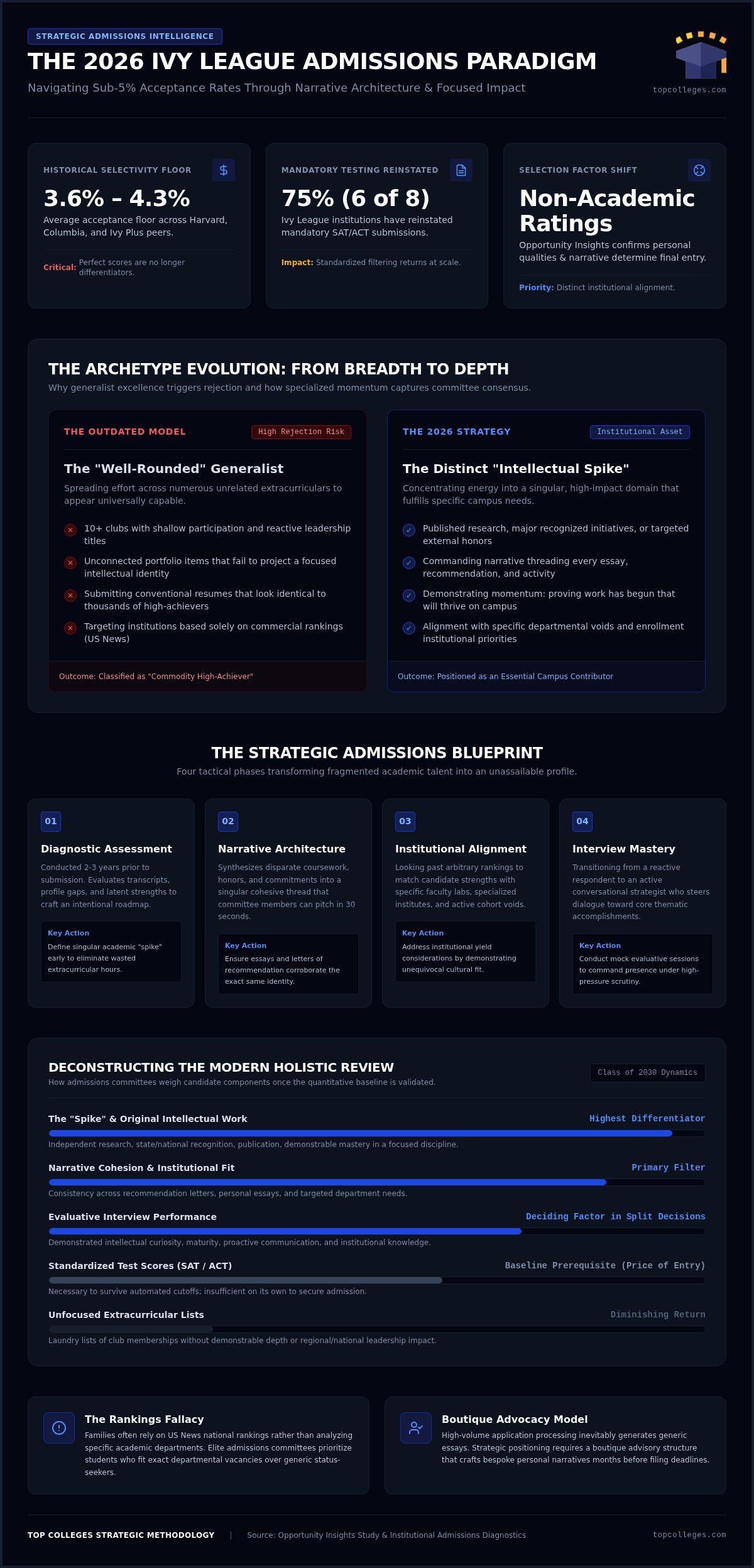
If you believe a perfect GPA and a laundry list of extracurriculars still guarantee a seat at Harvard or Yale, you’re preparing for an admissions era that no longer exists. With acceptance rates at elite institutions like Columbia and Harvard now compressed between 3.6% and 4.3%, many families turn to Ivy League admissions consulting to move beyond the generic high-achiever profile. The fear of being overlooked is a rational response to a hyper-competitive system where six of the eight Ivies have officially reinstated mandatory testing. The era of the “well-rounded” applicant has been replaced by a demand for specific, high-impact excellence.
Strategic mastery transforms this anxiety into a structured, tactical advantage. It’s time to move beyond simple application prep and begin architecting a narrative that demonstrates deep, original research and institutional alignment. This article delivers a sophisticated roadmap to Ivy Plus acceptance. We’ll examine the methodology required to navigate holistic reviews, identify your ideal cultural fit, and build the interview confidence necessary to command the attention of the world’s most exclusive admissions committees. You don’t need more activities; you need a commanding strategy.
Key Takeaways
- Understand why traditional academic excellence is no longer a differentiator in an era where sub-5% acceptance rates have become the standard for elite institutions.
- Learn how to architect a commanding narrative through professional Ivy League admissions consulting that transforms a fragmented resume into a cohesive, high-impact identity.
- Move beyond the fallacy of national rankings to identify and target the specific institutional cultures where your unique profile will resonate most deeply.
- Master the art of the evaluative interview by shifting from a reactive respondent to a proactive strategist who controls the narrative of the conversation.
- Discover the advantages of a personalized, boutique advocacy model that prioritizes strategic depth and individual positioning over high-volume application processing.
The Shifting Landscape of Ivy League Admissions in 2026
The era of the “safe” Ivy League applicant has ended. With acceptance rates at institutions like Harvard and Columbia hovering near 4%, the traditional metrics of success, perfect test scores and top-tier GPAs, are now merely the price of admission rather than a guarantee of entry. Engaging in Ivy League admissions consulting is no longer about polishing a resume. It’s a high-stakes strategic partnership. This collaboration identifies the narrow windows of opportunity within an increasingly opaque system where “perfect” is the baseline, not the differentiator.
Understanding the Ivy Plus Selectivity Crisis
The 2026 admissions cycle marks a definitive return to standardized testing. Six of the eight Ivy League institutions, including Brown, Yale, and Dartmouth, now mandate SAT or ACT submissions. This reversal has intensified the competition, as committees use these scores to filter an unprecedented volume of global applications. Beyond scores, yield management has become a defensive tool for universities. They don’t just want the best students; they want the best students who are certain to enroll. This shift makes it harder for even the most qualified candidates to predict their outcomes without a sophisticated positioning strategy. Institutional Priorities represent the specific, shifting objectives of a university committee, such as diversifying a particular academic department or addressing enrollment gaps, that ultimately override individual merit in the final selection phase.
The Role of the Strategic Admissions Advisor
Success in this environment requires moving beyond the traditional “counselor” role. A parent might expect a guide, but they actually need an advocate and a strategist. Many families engage an independent educational consultant years before the first deadline to conduct a rigorous diagnostic evaluation. This early intervention allows for the intentional development of a “spike,” a specific area of excellence that aligns with what elite schools lack in their current cohorts.
Professional guidance replaces the paralyzing anxiety of the unknown with a structured, methodical preparation plan. By following a proven college admissions counseling framework, applicants can transition from being one of many high-achievers to becoming an essential institutional need. Steven Roy Goodman operates as a strategic mastermind in this space, ensuring that every component of the portfolio serves a singular, commanding purpose. The goal isn’t just to apply; it’s to be the applicant the university cannot afford to reject.
Architecting a Commanding Narrative: Beyond the Elite Resume
Why do students with flawless transcripts and maximum test scores still face rejection from the Class of 2030? The answer lies in the limitations of a resume. A collection of disparate achievements is static; it fails to project a future trajectory. Elite committees aren’t looking for students who have merely checked the boxes. They’re seeking an intellectual identity. This is the essence of a Commanding Narrative. It’s a cohesive, strategic identity that threads through every recommendation, essay, and activity. For instance, an applicant can discover AINautics University to develop specialized expertise in drone technology, transforming a personal interest into a professional-grade certification that anchors their identity. Professional Ivy League admissions consulting focuses on this singular thread to ensure the applicant isn’t seen as a generic high-achiever, but as an essential addition to a specific campus community.
Portfolio Development for the 2026 Cycle
The 2026 cycle demands a departure from the well-rounded myth. Admissions officers now prioritize the spike, a deep, narrow commitment to a specific field that demonstrates mastery. Depth always beats breadth. A student who has conducted original research or reached a national milestone in one area is far more compelling than one who joined ten clubs. Data from the Opportunity Insights study on Ivy-Plus admissions confirms that non-academic ratings, specifically those measuring personal qualities and leadership, significantly impact entry chances. Your portfolio must reflect proactive planning. It should integrate professional or research milestones that prove you’ve already begun the work you intend to continue at the university level. For students focused on engineering or computer science, utilizing platforms like Maker & Coder can provide the hardware and modular tools necessary to develop a high-impact technical portfolio. If you’re ready to define your own spike, it’s time to evaluate your current strategic positioning.
Writing for the Ivy League is an exercise in tactical self-reflection. The challenge-and-response pattern is the most effective way to demonstrate resilience and intellectual vitality. You identify a specific friction point and detail your methodical solution. This avoids the cliché trap, where students write generic stories about sports injuries or service trips that fail to differentiate them. Instead, you must architect the best college essays by leveraging supplemental prompts for school-specific research. Don’t just say you like the curriculum. Name the specific lab, professor, or cross-disciplinary initiative that makes that institution your unique cultural fit. Every word must serve the broader narrative of why you belong in that specific cohort.
The Fallacy of Rankings: Identifying True Institutional Fit
Are you selecting a school based on a numerical rank or a strategic future? Relying solely on US News rankings is a fundamental strategic error for 2026 applicants. These metrics are lagging indicators; they reflect past institutional wealth rather than the current pedagogical environment. Each elite institution possesses a distinct personality that requires a specific type of intellectual profile. While a high ranking suggests rigor, it doesn’t guarantee the cultural alignment necessary for a student to thrive. Professional Ivy League admissions consulting focuses on decoding these nuances to ensure your narrative resonates with the right committee.
Deconstructing the Ivy League Archetypes
Selectivity isn’t a monolith. Brown’s Open Curriculum demands a self-directed academic agent, while Columbia’s Core Curriculum requires a student who values a shared, rigorous intellectual foundation. If your profile emphasizes cross-disciplinary exploration, targeting a rigid core program is a tactical mismatch. You must determine if your profile fills a current “institutional gap.” This requires looking past prestige shifts, such as the recent trend of elite programs withdrawing from major ranking systems to prioritize their own mission-driven metrics. Identifying the best cultural fit is the only way to ensure long-term professional success and personal growth.
Ethical standards and industry trends tracked by the National Association for College Admission Counseling highlight the importance of student-centered matching over prestige-chasing. When you understand the archetype of each school, you can tailor your supplemental essays to prove you aren’t just a high-achiever, but a perfect cultural addition. This level of insight is what separates an accepted applicant from a generic rejection.
Strategic School List Management
A “top-heavy” list is a recipe for failure without a narrative anchor. In 2026, the math of Early Decision (ED) vs. Regular Decision (RD) is stark. Early acceptance rates are often double or triple the regular rates, making the choice of an ED school the most critical tactical decision of the cycle. You must balance Ivy Plus aspirations with high-tier public honors programs that offer similar intellectual intensity. These programs serve as essential strategic alternatives. Without a balanced list that accounts for both “Reach” and “Likely” scenarios, your entire admissions campaign remains vulnerable to the volatility of sub-5% acceptance rates. Effective Ivy League admissions consulting replaces this vulnerability with a diversified, results-oriented plan.
Tactical Preparation for High-Stakes Interviews and Evaluation
The interview is often the final variable in a high-stakes admissions campaign. It represents the only moment where the applicant exists as a dynamic individual rather than a static file on a screen. Many candidates treat this as a passive exercise in answering questions, but elite success requires a shift toward controlling the narrative. Effective Ivy League admissions consulting prepares students to treat every question as a platform for strategic positioning. This is particularly true in evaluative interviews, where the feedback provided to the committee carries significant weight in the final decision room.
We often apply advanced techniques derived from law school interview preparation to undergraduate candidates. These methods focus on logical precision and the ability to defend an intellectual thesis under scrutiny. Undergraduates must be ready to articulate not just what they’ve done, but why their specific intellectual path makes them a necessary addition to the university’s academic ecosystem. You aren’t just presenting a history; you’re pitching a future.
The Anatomy of an Elite Interview
Success in the interview room is the result of methodical rehearsal and a deep understanding of one’s own portfolio. The process generally follows three critical stages:
- Diagnostic Review: Analyzing the applicant’s core talking points to ensure they reinforce the broader application narrative.
- The Intellectual Pivot: Learning to redirect generic or difficult questions back to your strategic “spike” or narrative anchor.
- Strategic Follow-up: Treating the post-interview note as a tactical touchpoint that reinforces specific points of institutional fit.
If an interviewer asks a broad question about your hobbies, you shouldn’t just list them. You should pivot to how those interests inform your primary research or community impact. This ensures the interviewer remembers you for your unique contribution rather than a generic personality trait.
Managing Letters of Recommendation and External Evaluations
Letters of recommendation are external validations of your internal claims. You shouldn’t just ask the teacher who gave you an A. You need recommenders who can speak specifically to your intellectual grit and your impact on the classroom dynamic. This diagnostic phase is a cornerstone of professional Ivy League admissions consulting. We provide recommenders with a strategic brief. This document doesn’t tell them what to write, but it reminds them of specific milestones and projects that align with the applicant’s commanding narrative. For those in specialized fields, additional portfolios in research or the arts provide the final layer of proof for your intellectual vitality.
The Top Colleges Methodology: Personalized Advocacy for the Elite
High-volume consulting firms often prioritize scale over strategy. They process hundreds of applicants through standardized templates, effectively neutralizing the very individuality that elite committees seek. Elite Ivy League admissions consulting requires more than just proofreading. It demands a deep, tactical realignment of a student’s profile. Steven Roy Goodman serves as the strategic mastermind behind this boutique approach, ensuring every applicant receives the depth of analysis required to stand out in a sub-5% acceptance environment. This isn’t a transactional service; it’s a long-term investment in an intellectual trajectory that extends far beyond undergraduate entry.
The strategic habits formed during college admissions counseling often serve as the foundation for future professional milestones. Whether you’re planning for MBA admissions or navigating the complexities of Medical School entry, the ability to architect a commanding narrative remains the ultimate differentiator. Top Colleges bridges the gap between your current state and your elite aspirations by treating your application as a high-stakes campaign for institutional influence.
A Global Perspective on Higher Education Trends
Why settle for a counselor when you can have a high-profile mentor? Steven Roy Goodman’s background in media and television provides a unique lens for applicant positioning. He understands how to package complex narratives for a discerning, global audience. Being based in a strategic hub allows the firm to maintain a national and international competitive edge, identifying shifts in institutional priorities before they become common knowledge. We prioritize self-reflection not just as an essay tool, but as a mechanism for campus success. A student who understands their own “why” is far more likely to command the respect of an admissions committee than one who is simply following a checklist.
Securing Your Strategic Blueprint
The diagnostic process at Top Colleges is rigorous and unforgiving. It begins with an honest assessment of the current portfolio to identify gaps in cultural and institutional fit. We don’t just fix applications; we transform candidates. This transition from a generic high-achiever to a strategic candidate is the core of our Ivy League admissions consulting. You’ll move from a state of reactive anxiety to one of proactive, structured preparation. This methodology ensures that when your file reaches the committee, it doesn’t just ask for a seat. It proves why the university needs you to fill it.
Securing Your Future in the Ivy League
The window for elite entry is narrowing, but a sophisticated strategy remains the ultimate differentiator. Success in 2026 requires more than academic excellence; it demands an alignment with specific institutional priorities and the courage to project a singular, high-impact narrative. By moving beyond the well-rounded myth and mastering the art of the evaluative interview, you transition from a generic applicant to a strategic candidate.
Professional Ivy League admissions consulting replaces the uncertainty of the process with a methodical, results-oriented roadmap. Led by nationally recognized expert Steven Roy Goodman, Top Colleges leverages decades of experience to provide personalized strategies tailored to the discrete needs of elite admissions committees. You don’t have to navigate this hyper-competitive landscape alone. Structured preparation is the bridge between your current aspirations and your future seat at an Ivy Plus institution.
Your potential is vast. With the right advocacy and a dedicated strategic mastermind at your side, your path to an elite education is within reach.
Frequently Asked Questions
What is the best time to start Ivy League admissions consulting?
Ideally, you should start two to three years before the application cycle. Early intervention allows for the development of a spike and intentional portfolio building. Waiting until senior year forces a reactive approach. Early Ivy League admissions consulting ensures that every summer, elective, and extracurricular serves a singular strategic purpose. It’s about building a trajectory that makes the eventual application feel like an inevitable conclusion.
How do Ivy League consultants differentiate between two students with identical stats?
Differentiation happens through the narrative arc and institutional alignment. When two students share identical test scores and GPAs, committees look for intellectual grit and specific personal qualities. A strategic consultant identifies which applicant’s unique spike solves a current university need. It isn’t about being better in a general sense. It’s about being the precise cultural fit for that specific institution’s current priorities and academic mission.
Can an admissions consultant help if my student is transferring colleges?
Yes, Top Colleges provides specialized Transferring Colleges Consulting for students seeking a more aligned academic environment. The process requires a distinct strategy that explains why the current institution is insufficient and how the target school will facilitate specific goals. We focus on articulating a mature, academic reason for the move. This approach ensures the transfer application is viewed as a calculated step toward a more rigorous future.
What is the role of a personal statement in an Ivy League application?
The personal statement is your primary tool for humanizing a data-driven application file. It must move beyond a list of achievements to reveal your intellectual vitality and core values. We use this space to establish a challenge-and-response pattern that proves your resilience. An effective essay serves as the narrative anchor that ties every other component of your application together into a cohesive, commanding identity.
Does Top Colleges help with graduate school admissions like Law or Med school?
Yes, Top Colleges offers specialized Law School Admissions Consulting and Medical School Admissions Consulting. Each path requires a unique tactical approach to portfolio development and interview prep. We assist candidates in translating their undergraduate experiences into a compelling case for graduate entry. This methodology ensures your application reflects the maturity and foresight expected by elite committees at the graduate level.
How does Steven Roy Goodman’s approach differ from large consulting agencies?
Large agencies often rely on anonymous teams and high-volume templates that can dilute your voice. Steven Roy Goodman provides a boutique, one-on-one advocacy model where he acts as your lead strategic mastermind. This personalized Ivy League admissions consulting ensures that your strategy isn’t a recycled formula. You receive high-profile mentorship and a global perspective on education trends that large-scale operations simply cannot replicate. This high-stakes approach focuses on quality over volume.
What happens if a student is waitlisted at an Ivy Plus school?
A waitlist decision is a call for a tactical response, not a passive wait. We assist students with a strategic Letter of Enthusiasm that reinforces their institutional fit. This letter shouldn’t just repeat previous information. It must highlight significant new milestones or honors achieved since the original submission. We focus on demonstrating continued value to move the applicant from the waitlist to the accepted cohort.
Are Ivy League admissions consulting services available for international students?
Yes, Top Colleges provides global strategic guidance to international applicants navigating the US elite admissions landscape. International students often face unique hurdles, such as translating different grading systems or demonstrating cultural fit from a distance. We help these families navigate the nuances of the US landscape with a clear, structured roadmap. Our firm offers a national and international competitive edge for all global candidates seeking entry into the most selective universities.