

Disclaimer
Content on this page of topcolleges.com is computer generated and therefore is not guaranteed to be 100 percent accurate about various aspects of the education sector. On balance, however, many students and families seek general information about high schools, colleges and universities, graduate programs, testing, education and career planning, and job placement before beginning one-on-one admissions counseling tailored to their specific needs.
Why do most transfer applications from high-achieving students fail to secure a seat at elite institutions despite perfect transcripts? The answer lies in a fundamental misunderstanding of the task. Most applicants treat the process as a second chance at their freshman essay, failing to realize that writing a college transfer personal statement is actually a high-stakes exercise in strategic positioning. It’s understandable if you feel trapped between the need to explain why you’re leaving your current school and the fear of sounding ungrateful or negative. You’re likely struggling to define academic fit without repeating the same clichés you used as a high school senior.
This article provides the tactical blueprint you need to move beyond simple requests and toward a compelling case for academic realignment. You’ll learn how to articulate institutional mismatch with professional poise and structure a narrative that commands respect from the world’s most selective admissions committees. We’ll break down the specific techniques for distinguishing your transfer goals from your initial college search, offering a clear roadmap to transform your application into a sophisticated argument for your future. From diagnostic self-reflection to the final polished draft, this is your guide to mastering the nuances of the 2026 transfer landscape.
Key Takeaways
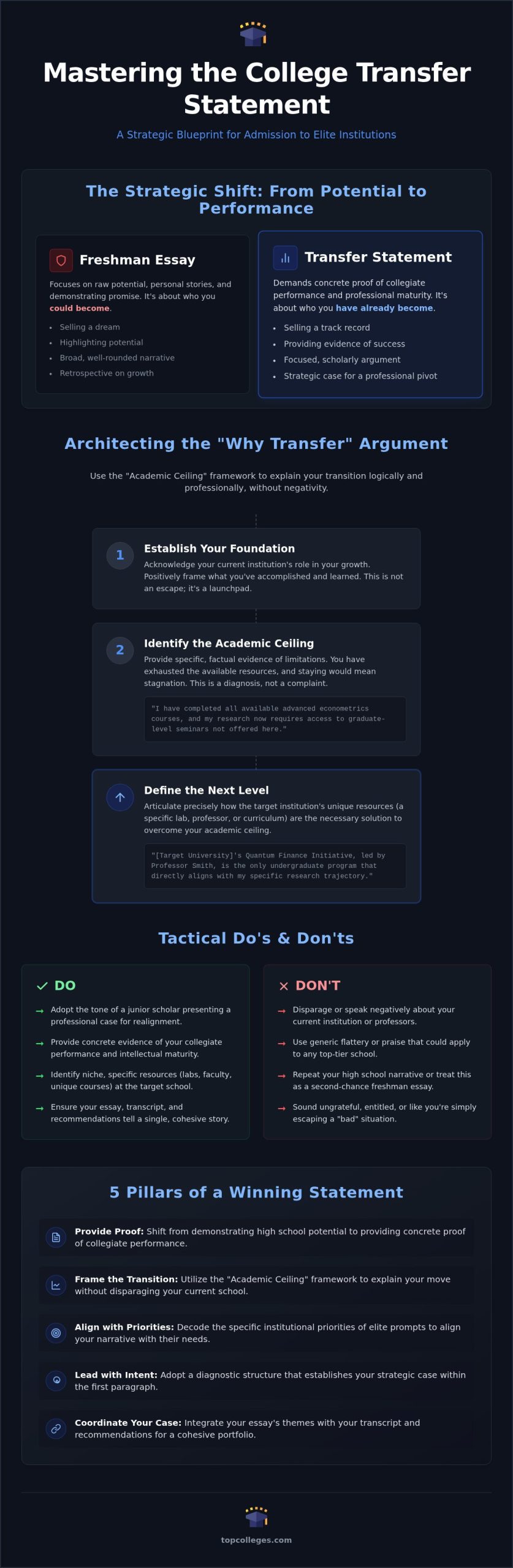
- Shift your perspective from demonstrating high school potential to providing concrete proof of collegiate performance and professional maturity.
- Master the art of writing a college transfer personal statement by utilizing the “Academic Ceiling” framework to explain your transition without disparaging your current institution.
- Decode the specific institutional priorities of 2026 elite prompts to ensure your narrative aligns with what top-tier committees are actively seeking.
- Adopt a diagnostic structure that leads with academic realignment intent, ensuring your strategic case is established within the first paragraph.
- Coordinate your essay’s core themes with your transcript and faculty recommendations to present a cohesive, authoritative case for admission.
The Strategic Shift: Why Transfer Statements Are Not Freshman Essays
Writing a college transfer personal statement isn’t a retrospective on your childhood. It’s a strategic business case for a professional pivot. While the college admissions process for freshmen focuses on raw potential, transfer admissions demand proof of performance. You aren’t selling a dream; you’re selling a track record. In the hyper-competitive 2026 environment, elite institutions have limited seats. They won’t gamble on “potential” when they can select students who’ve already thrived in a university setting. Sentiment is a liability. Strategy is the only currency that matters.
When you approach the task of writing a college transfer personal statement, your primary objective is to prove that your current institution can no longer sustain your intellectual growth. This isn’t a complaint; it’s a diagnosis. You’ve reached a ceiling, and you require a higher platform. This shift in perspective separates successful applicants from those who simply repeat their high school narrative. Admissions committees aren’t looking for well-rounded teenagers; they’re looking for focused scholars who know exactly why they need a different laboratory, library, or lecture hall.
Moving Beyond the “Why I Love This College” Trope
Generic praise signals a lack of deep research. If your essay could apply to any top-tier school by swapping the name, it’s already failed. You must identify niche resources: a specific lab, a professor’s current research, or a unique curriculum that exists nowhere else. Admissions officers see through flattery. They want to see a specific, technical need for their specific resources. Institutional fit is a symbiotic academic relationship where your specific goals align perfectly with the university’s unique resources to create mutual value.
The Professionalism of the Transfer Narrative
Adopt the tone of a junior scholar. You aren’t a “hopeful applicant” seeking validation; you’re a serious academic seeking the right tools. Show how you’ve outgrown your current environment through concrete examples of your work. Perhaps your research interests have matured beyond your current department’s scope. This requires foresight and tactical planning. A successful transfer isn’t an escape from a “bad” school; it’s a calculated move toward a more precise academic realignment. It’s a demonstration of professional maturity that elite committees demand. By framing your departure as a logical next step in a high-level plan, you command respect rather than asking for a favor.
Architecting the “Why Transfer” Argument Without Negativity
Disparaging your current institution is a fatal error. Admissions committees view negativity as a red flag; it suggests that an applicant lacks the resilience to navigate academic challenges. When you’re writing a college transfer personal statement, you must adhere to the golden rule of professional realignment: remain relentlessly positive about where you are while being specific about where you need to go. Learning how to write a college transfer essay requires a shift in mindset from “leaving a problem” to “pursuing a solution.” Your current school isn’t the antagonist in your story. It’s simply the foundation that you’ve outgrown.
Successful candidates use the “Academic Ceiling” framework. This concept positions your transfer as a logical and necessary progression for your career goals. You’ve exhausted the available resources, and staying would lead to intellectual stagnation. By framing the move as a strategic necessity rather than a personal preference, you command respect from elite committees who value ambition and foresight. It’s a diagnostic approach that identifies a mismatch between your trajectory and the institution’s capacity.
Identifying the Academic Ceiling at Your Current Institution
How do you cite curriculum limitations without sounding critical? Precision is your best tool. Instead of saying the classes are “too easy” or “boring,” point to specific course titles and sequence limits. For example, if you’ve completed “Advanced Econometrics” and your current department offers no further quantitative research seminars, you’ve hit a ceiling. This isn’t a criticism of the faculty; it’s a factual observation of a resource limit. Ground your argument in data. Mention specific research methodologies you’ve mastered and explain why your current environment can’t support the next level of your inquiry. This distinguishes “not liking a school” from “exhausting its opportunities.”
Articulating Specific Resource Gaps and Opportunity Costs
Elite institutions want to know what they have that is uniquely essential to your success. Is it a specific archival collection? A specialized laboratory? A unique interdisciplinary major? You must define these resource gaps clearly. This leads to the “Opportunity Cost” argument: staying at your current school hinders your long-term strategy because you lack access to the tools required for your intended field. This level of tactical thinking should align directly with your Transferring Colleges Consulting goals. When you articulate exactly why a specific target school is the only place you can finish your work, the “Why Transfer” question answers itself. For those seeking to refine this high-stakes narrative, consulting an elite admissions advisor can provide the diagnostic clarity needed to ensure your argument is both professional and persuasive.
Deconstructing the Elite Transfer Prompt: A Tactical Analysis
The transfer prompt is a diagnostic test, not a creative writing exercise. When elite institutions like the Ivy League or top-tier public universities ask you to “state your reasons for transferring,” they aren’t looking for an autobiography. They are looking for a justification of their investment. In the 2026 admissions landscape, every transfer seat is a scarce resource that must be defended. If your response lacks a clear, tactical objective, you’re essentially telling the committee that you’re a high-risk gamble. Success requires “Strategic Mastery,” which means knowing the answer to the university’s unstated questions before you even begin the process of writing a college transfer personal statement.
What are these unstated questions? They center on institutional needs. Schools don’t just admit students; they curate cohorts. They look for specific gaps in their current student body that a transfer student can fill. Are you a researcher who can hit the ground running in a specific lab? Are you a scholar who brings a rare interdisciplinary perspective? If you can’t articulate your value in these terms, you haven’t done enough research. You must move past the literal prompt and address the underlying institutional priorities that drive the selection process.
Decoding Institutional Priorities for 2026
To align your essay with a school’s mission, you must look at their current trajectory. Most elite universities publish a ten-year “Strategic Plan” on their provost’s or president’s website. This document is a goldmine. It tells you which departments are expanding, which research initiatives are being funded, and what kind of global impact the school is currently prioritizing. In 2026, we see a massive shift toward “interdisciplinary maturity.” Schools want students who can bridge the gap between disparate fields, such as ethics and artificial intelligence or economics and environmental policy. By referencing these specific institutional goals, you signal that your transfer is a calculated move to join a specific academic movement.
The Intersection of Personal Growth and Institutional Need
Admissions committees are fundamentally risk-averse. They prefer “low-risk, high-reward” candidates who have already demonstrated collegiate success. You must prove that you’ll be a contributor, not just a consumer, from your first day on campus. When writing a college transfer personal statement, your narrative should serve as a bridge between your past achievements and your future contributions. Consider this structure: “Having pioneered a student-led quantitative analysis group at my current institution, I am prepared to integrate these leadership skills into the Target University’s Data Science Initiative to enhance peer-to-peer technical mentorship.” This sentence proves you have a plan that only their specific resources can facilitate, transforming your application from a request into a partnership proposal.
Drafting for Influence: Tone, Structure, and Precision
The architecture of your essay must mirror the precision of a surgical strike. Why wait until the third paragraph to reveal your objective? When you begin writing a college transfer personal statement, you don’t have the luxury of a slow, atmospheric build. You must lead with a diagnostic opening that states your realignment intent immediately. This declaration of strategic purpose sets the tone for the entire document, signaling that you’re a candidate who understands exactly what is at stake.
Your draft should progress through four distinct phases to build an unassailable case for admission. After the opening, move into the evidence of performance. This section highlights your college-level successes, proving you’ve already mastered the university environment. Next, identify the strategic gap. This is where you pinpoint the specific need the target school fills, such as a requirement for greater methodological rigor or specialized intellectual synergy. Finally, conclude with your vision. Outline your intended impact at the new institution to prove you’ll contribute more than you consume.
The “Challenge-and-Response” Structural Pattern
Elite committees respond to resilience and initiative. Use a “challenge-and-response” pattern to demonstrate these traits. First, identify a specific academic challenge you faced at your current school, such as a lack of advanced quantitative research opportunities. Second, describe your proactive and successful response to that challenge, perhaps by seeking out independent study or cross-departmental collaboration. Finally, explain why the next phase of your development requires a different institutional platform. This structure proves you’ve done everything possible in your current environment and that your transfer is the only logical next step.
Refining the Vocabulary of Strategic Maturity
Word choice is a subtle but powerful indicator of professional maturity. You must replace passive, emotional language with active, tactical terms. Don’t say you “hope” to join a program; say you “intend” to contribute to it. Avoid “wanting” a better fit; instead, “aim” for strategic alignment. Every sentence should serve a diagnostic or prescriptive purpose, removing any fluff that doesn’t advance your case. For those seeking advanced stylistic techniques to elevate their prose, it’s helpful to study the principles of Architecting the Best College Essays to ensure your writing reflects the highest level of academic sophistication.
Final Review: Integrating the Essay into the Transfer Portfolio
A successful application is a cohesive ecosystem where every document reinforces a single, strategic narrative. Your essay doesn’t exist in a vacuum. It must act as the connective tissue between your past academic record and your future institutional contributions. When writing a college transfer personal statement, you aren’t just telling a story; you’re providing the “why” behind the data points in your transcript. If your narrative claims a passion for quantitative research, but your transcript shows a withdrawal from advanced calculus, your case collapses. Alignment is mandatory. Every claim you make must be verified by the evidence found elsewhere in your portfolio.
Coordination extends to your letters of recommendation. You should brief your professors on the core themes of your statement so their advocacy mirrors your self-presentation. If your essay highlights your “methodological rigor” in a specific seminar, a professor’s letter confirming that specific trait creates a powerful, multi-dimensional proof of performance. This level of tactical synchronization signals to elite committees that you’re a candidate of professional caliber. It transforms your portfolio from a collection of papers into a unified strategic maneuver that leaves no room for doubt regarding your readiness for academic realignment.
Eliminating Redundancy in the Transfer Portfolio
Don’t waste valuable word count repeating what’s already visible in your activities section. The admissions committee has your resume; they know “what” you did. Use the essay to explain the internal logic and the “why” behind those choices. Consistency is critical across all platforms. Whether it’s the Common App transfer prompt or a school-specific supplement, your reason for leaving must remain stable and professionally articulated. A clean, professionally formatted resume acts as the supporting evidence for the claims made in your narrative, providing a high-level overview of the scholar you’ve become since high school. If these elements conflict, you signal a lack of focus that elite institutions won’t tolerate.
Leveraging Professional Counseling for Elite Success
High-stakes transitions require more than just a proofreader. They demand a strategic architect. This is where professional college admissions counseling becomes an indispensable asset. A third-party review can identify diagnostic gaps in your argument that you might be too close to see. It’s the difference between a draft that sounds like a request and a statement that commands respect as a commanding admissions asset. Writing a college transfer personal statement is a complex operation; treating it with the gravity it deserves ensures that your academic realignment isn’t just a hope, but a calculated reality. A structured, elite admissions strategy provides the long-term value necessary to bridge the gap between your current state and your ultimate aspirations.
Commanding Your Academic Future
Mastering the art of writing a college transfer personal statement requires a definitive departure from the sentimental narratives of your secondary school years. You’ve learned to identify the “Academic Ceiling” at your current institution and articulate resource gaps with the precision of a seasoned scholar. By aligning your personal trajectory with specific institutional priorities and ensuring your entire portfolio speaks with a single, authoritative voice, you transform your application into an undeniable case for realignment. This is not merely a request for admission; it’s a strategic partnership proposal for your future.
Success in the 2026 elite transfer landscape demands the foresight and tactical mastery that only decades of high-stakes experience can provide. Led by elite admissions strategist Steven Roy Goodman, Top Colleges has established a national reputation for excellence in academic realignment. Our approach replaces anxiety with structured preparation, ensuring your narrative commands the respect it deserves from the world’s most selective committees.
Your aspirations deserve a platform that matches your ambition. Secure the expert guidance needed to bridge the gap between your current state and your ultimate collegiate goals. With a clear roadmap and professional poise, your next academic chapter is ready to be written.
Frequently Asked Questions
How long should a college transfer personal statement be?
Aim for 500 to 650 words unless the institution specifies otherwise. Most selective universities adhere to the Common Application’s 650-word limit. Brevity is a strategic asset; you must articulate your case for academic realignment without unnecessary fluff. Every sentence should serve a diagnostic purpose. If you exceed the limit, you risk signaling a lack of professional discipline to the admissions committee.
Can I reuse my freshman personal statement for a transfer application?
Absolutely not. Reusing a freshman essay is a tactical error that suggests intellectual stagnation. Freshman applications focus on raw potential, while writing a college transfer personal statement requires proof of collegiate performance. You must demonstrate how you’ve matured as a scholar since your initial search. Committees look for evidence that you’ve outgrown your current environment, a narrative that high school reflections simply cannot provide.
What is the most common mistake in transfer essays?
The most frequent failure is adopting a negative tone toward your current institution. Complaining about faculty or social dynamics signals a lack of resilience. Instead, you should focus on the “Academic Ceiling” framework. Explain that you’ve exhausted the available resources and require a more sophisticated platform to continue your research. Vague goals are equally damaging; elite schools demand precise, resource-driven justifications for your move.
How do I explain a low GPA in my transfer personal statement?
Address academic setbacks with directness and professional accountability. Don’t offer excuses or blame external factors. Instead, briefly explain the context and immediately pivot to the “response” phase of your narrative. Highlight a clear upward trend in your recent coursework to prove you’ve mastered the necessary methodological rigor. This diagnostic approach transforms a past weakness into a demonstration of current maturity and academic focus.
Should I mention specific professors in my transfer essay?
Yes. Citing specific professors and their research initiatives proves you’ve conducted deep institutional analysis. It moves your essay beyond generic praise and toward a case for intellectual synergy. You aren’t just looking for a prestigious name; you’re looking for specific mentors who can facilitate the next stage of your scholarly development. This level of precision distinguishes serious transfer candidates from those who are merely prestige-seeking.
Is it okay to say I am transferring for a better social life?
Never lead with social or geographic preferences. Elite admissions committees view these as secondary concerns that don’t justify the expenditure of a scarce transfer seat. Your argument must remain rooted in academic realignment and professional goals. If social factors are mentioned, they should be framed through the lens of community engagement or professional networking opportunities that directly support your long-term strategic plan.
How much weight does the personal statement carry in transfer admissions?
The personal statement is often the most critical component of a transfer portfolio. While transcripts provide the data, writing a college transfer personal statement provides the strategic logic for the move. It is the only place where you can explain the “why” behind your departure and the “how” of your future contributions. For elite institutions, this narrative serves as the final proof of your institutional fit.
What if I am transferring from a community college to an Ivy League school?
Frame this transition as a logical and necessary progression. You must prove that you’ve exhausted every resource at your current college and require the specialized tools of an Ivy League institution to finish your work. Highlight your high-level collegiate performance and leadership roles. Selective committees respect the “low-risk, high-reward” profile of successful community college students who demonstrate clear academic foresight and strategic planning.