

Disclaimer
Content on this page of topcolleges.com is computer generated and therefore is not guaranteed to be 100 percent accurate about various aspects of the education sector. On balance, however, many students and families seek general information about high schools, colleges and universities, graduate programs, testing, education and career planning, and job placement before beginning one-on-one admissions counseling tailored to their specific needs.
What if the most compelling application story isn’t a dramatic turning point, but a pattern in the choices you’ve made? Crafting a compelling personal narrative for applications doesn’t mean inventing a polished persona or forcing every experience into one neat plot. It means identifying what your real experiences reveal about your values, growth, and direction.
If you’re unsure which moments belong, or worry your story will sound generic or self-promotional, that uncertainty is understandable. A strong narrative is specific, reflective, and grounded in evidence. It shows your qualities through decisions and actions, then connects those experiences to what you hope to pursue next.
This article will help you find a meaningful theme, link past choices to academic or professional goals, and adapt your central story across essays, short answers, and other application materials without repeating yourself. You’ll also learn how to keep your voice authentic while presenting a coherent picture of who you are. The aim isn’t to sound extraordinary. It’s to help readers understand what matters to you, why your path makes sense, and where it may lead.
Key Takeaways
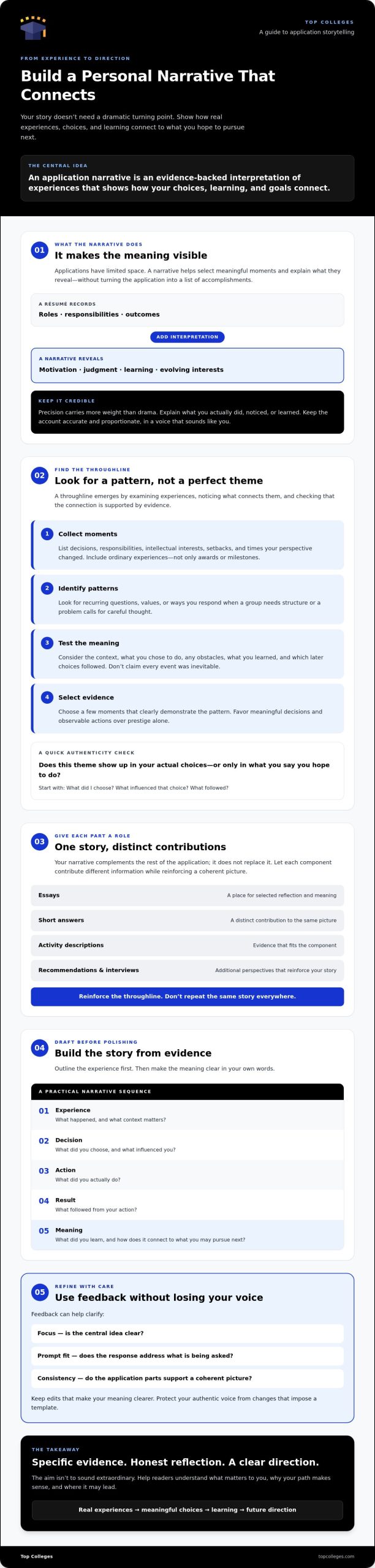
- Define your application narrative as an evidence-backed account of how your experiences, choices, and goals connect.
- Find a focused throughline by collecting meaningful moments, identifying patterns, and testing each theme against specific evidence.
- Give each application component a distinct role so essays, activity descriptions, recommendations, and interviews reinforce your story without repeating it.
- When crafting a compelling personal narrative for applications, outline the experience, decision, action, result, and meaning before polishing your prose.
- Use feedback to clarify focus, prompt fit, and consistency while protecting your authentic voice from edits that impose a template.
What Does a Personal Narrative Do in an Application?
Applicants often have more experiences than an application has room to explain. The challenge is choosing moments that reveal something meaningful, then making their significance clear without turning the application into a list of accomplishments. A personal narrative provides that interpretation: it connects selected experiences and choices to the direction you’re pursuing.
A useful definition is: A personal narrative is an evidence-backed interpretation of experiences that shows how a person’s choices, learning, and goals connect. The idea aligns with the broader function of a personal narrative: giving shape and meaning to events from an individual’s life. In an application, that meaning should be grounded in what you actually did, noticed, or learned, not in a persona constructed to impress.
Your narrative complements grades, activities, recommendations, and other application materials; it doesn’t replace them. Each component contributes different information. Together, they can help an admissions reader understand not only what you’ve accomplished, but how you think and what you may want to pursue. Crafting a compelling personal narrative for applications means making those connections clear while allowing each component to serve its own purpose.
How is a personal narrative different from an application résumé?
A résumé records roles, responsibilities, and outcomes. A narrative interprets selected evidence. For example, a list might show that you volunteered at a community center; reflection could explain how listening to families there shaped your interest in public health. The narrative reveals motivation, judgment, or an evolving interest. That doesn’t mean every essay or activity entry should repeat the same story. Choose details and examples that fit each component.
What makes an application story memorable without exaggeration?
Precision carries more weight than drama. A small but telling decision, such as revising a club’s sign-up process after noticing who was being left out, can show initiative and awareness. Ordinary experiences can be meaningful when you explain what you did and why it mattered to you. Keep the account accurate and proportionate. Credibility rests on details that ring true and a voice that sounds recognizably yours.
How to Find the Throughline in Your Application Story
A strong throughline rarely appears from trying to invent the perfect theme. It emerges when you examine a range of experiences, notice what connects them, and test whether that connection is supported by evidence. For applicants with varied interests or a nonlinear path, this process helps narrow the story without pretending every experience points in the same direction.
A useful narrative throughline is a pattern of choices and growth supported by specific examples. To find yours, move through four steps: collect moments, identify patterns, test what they mean, and select the clearest evidence.
- Collect moments: List decisions, responsibilities, intellectual interests, setbacks, and times your perspective changed. Include ordinary experiences, not just awards or milestones.
- Identify patterns: Look for recurring questions, values, or ways of responding. Do you keep seeking problems that require careful analysis, or take responsibility when a group needs structure?
- Test the meaning: Consider the context, what you chose to do, any obstacles, what you learned, and which later choices followed. The connection should explain your development, not claim that every event was inevitable.
- Select evidence: Choose a few moments that demonstrate the pattern clearly. Prioritize examples with meaningful decisions and observable actions over experiences chosen only for prestige.
Which experiences are worth exploring?
Start with what you did and why it mattered to you. A student interested in environmental policy might examine a class project, a conservation effort, and a later choice to study data on water use. The value lies not in making each activity sound exceptional, but in showing how curiosity became sustained action. Ask: What did I choose? What influenced that choice? What followed?
Include context. A responsibility taken on because a family member needed support may reveal a different kind of agency than a formal leadership title. Obstacles matter when they help explain your decisions or learning, not because hardship is required for a compelling story.
How can you test whether a theme is authentic?
Check whether the theme appears in your actual choices, not only in your stated aspirations. If you describe yourself as intellectually curious, can you point to questions you pursued beyond an assignment? Ask a teacher, mentor, or colleague whether they recognize the qualities you describe. If the theme depends on exaggeration, unsupported interpretation, or borrowed language, revise it. Your account should sound like you, at an accurate scale.
As you refine your throughline, personalized admissions counseling can offer an outside perspective on whether your interpretation is clear and grounded in evidence.
How to Match Your Narrative to Each Application Component
A coherent application doesn’t require every section to tell the same story. It requires each component to contribute a distinct piece of evidence, so the reader forms a consistent impression without encountering the same anecdote repeatedly. Before adapting material, check each institution’s current prompts, requirements, and instructions. Similar questions can call for different emphases, and your response must answer the question actually asked.
Use a simple planning grid to coordinate your materials. For each component, note its purpose, the evidence you plan to use, and the insight it should add. Then check whether any repeated experience contributes a new perspective or simply repeats information.
- Main essay: Purpose: offer a broader view of your perspective. Evidence: a selected experience. Reflection: what it changed or clarified. Overlap check: does it add context beyond your activity list?
- Supplemental responses: Purpose: address a specific prompt or interest. Evidence: a focused example. Reflection: why it answers this question. Overlap check: does it serve a different purpose from the main essay?
- Activities list: Purpose: record commitments and outcomes concisely. Evidence: roles, actions, and results. Reflection: include it only if the format requests it. Overlap check: are you using space to repeat an essay’s interpretation?
- Recommendations and interviews: Purpose: add an observer’s perspective or allow you to elaborate in conversation. Evidence: qualities others have seen or experiences relevant to a question. Reflection: your own explanation, where appropriate. Overlap check: do these add perspective rather than rehearsed repetition?
What belongs in an essay versus an activities list?
Use an activities list for concise responsibilities, commitments, and outcomes in the format requested. Use essays to interpret a chosen experience and reveal your perspective through specific detail. If both refer to the same commitment, let the list establish what you did and the essay explain a decision or change in outlook. Crafting a compelling personal narrative for applications means coordinating evidence, not making every component repeat one personal story.
How should the narrative change for different programs?
Adapt the emphasis to the program’s questions and stated evaluation criteria, while keeping the underlying account accurate. For graduate applications, connect relevant preparation and intellectual interests to the particular field. Show the basis for your interest without claiming a perfect fit. For undergraduate applications, retain the personal context that gives your experience meaning, while making sure the response directly addresses the prompt.
Think of the narrative as a consistent foundation, not a script. An application portfolio can help you track where each example appears, what it contributes, and what a reader still needs to understand.
How to Draft and Refine a Personal Narrative Step by Step
Don’t begin by hunting for a dazzling first sentence. Begin by deciding what the reader should understand about your experience and why it matters to this application. A clear process gives you a stronger foundation than polishing language before the story’s purpose is settled.
Before drafting, make a brief outline:
- Experience: What specific moment or situation are you describing?
- Decision: What choice did you face, and what informed it?
- Action: What did you do? Include details that demonstrate your role.
- Result: What changed, or what happened next?
- Meaning: What did you learn, reconsider, or choose to pursue afterward?
This sequence keeps the account focused on your agency and reflection. It also helps distinguish the event itself from the insight you draw from it. In crafting a compelling personal narrative for applications, the goal isn’t to make every moment momentous; it’s to show why a particular experience belongs in your response.
What structure helps a personal story stay focused?
Give readers enough context to understand the situation and your choices, but leave out background that doesn’t advance the story. Develop the account through actions and precise details rather than unsupported claims such as “I’m a natural leader.” Then end with reflection that clarifies what the experience means to you now. A thoughtful conclusion needn’t claim that one event changed your entire life.
How can you revise without losing your own voice?
Revise in passes. First, check that the draft answers the prompt and stays relevant. Next, look for specific evidence, accurate details, and proportion: does your interpretation match what happened? Finally, read the piece aloud. Replace phrases you wouldn’t naturally use, and ask a trusted reader to flag confusing, unsupported, or overly rehearsed passages. Keep the authorship and intended meaning yours.
Before submitting, verify the current requirements for each institution, including word limits and its rules for outside editing and generative AI. Policies vary, and some institutions explicitly restrict AI-generated content. Use tools only in ways permitted by the specific application; don’t allow outside edits to substitute someone else’s voice for your own.
When to Seek Application Narrative Feedback
Consider outside feedback when you understand the experience you want to write about but aren’t sure what a reader will take from it. A fresh perspective can reveal a missing connection between your example and your goal, or show where the narrative assumes context that an unfamiliar reader won’t have. Feedback is most useful before you’ve polished every sentence, while you can still make strategic changes.
What should you look for in feedback?
Useful feedback explains what a reader understands and where the reasoning loses clarity. Look for comments that identify:
- Context a reader needs to follow your choices.
- Claims about your qualities that need clearer evidence.
- Details that distract from the central point or make the account feel disproportionate.
- A mismatch between the response and the prompt or intended audience.
Good review helps you see options; it doesn’t take ownership of your story. You should retain final control over personal details, tone, and meaning. Be cautious of feedback that promises admission, prescribes a universal essay formula, or replaces your natural voice with language you wouldn’t use. A polished draft is not necessarily persuasive if it no longer sounds like you.
How can admissions counseling support a coherent application?
Sometimes the challenge extends beyond one essay. You may need to determine whether your narrative aligns with your goals, whether different application materials offer complementary evidence, or whether a personal statement answers the prompt directly. Personalized admissions counseling can provide feedback on these questions alongside the wider application portfolio. It’s a strategic option, not a requirement, and it can support preparation without guaranteeing an admissions outcome.
Top Colleges offers personal statement review and portfolio development for college and graduate applicants. Portfolio development can help coordinate application components so each contributes something distinct rather than repeating the same account. The aim is to clarify how the pieces work together while preserving your authorship and perspective.
Before seeking help, identify the question you want feedback to answer. Is your focus clear? Does the response fit the prompt? Do your materials present a consistent picture without sounding rehearsed? A specific question makes it easier to assess whether the advice improves the application or simply changes the wording.
Shape Your Application Story With Confidence
A persuasive application narrative isn’t a polished persona. It’s a clear, credible connection between experiences, choices, and future direction. Start by identifying a throughline supported by real evidence, then give each application component a distinct role. As you draft, prioritize specific details and reflection, and revise against each institution’s prompt and requirements. That is the strategic work behind crafting a compelling personal narrative for applications.
You don’t have to assess the full application alone. Personalized admissions counseling can help you evaluate how your narrative works across your materials. Top Colleges offers portfolio development and personal statement review, as well as interview preparation for applicants. This guidance can support your preparation, but no review can guarantee an admissions outcome.
Your experiences already hold the raw material for a meaningful story. With careful selection, honest reflection, and a voice that remains your own, you can present your direction with greater clarity and confidence.
Frequently Asked Questions
How do I start crafting a personal narrative for an application?
Begin by listing experiences that shaped your choices, interests, or responsibilities. Look for recurring patterns, then select one moment that offers concrete evidence of a pattern. Explain what you did and what you learned instead of relying on broad claims about your character. As you start crafting a compelling personal narrative for applications, check that the story answers the prompt, uses accurate details, and sounds like you.
What makes a personal narrative compelling for college applications?
A compelling narrative is specific, truthful, and relevant to the application. Give readers enough context to understand the experience, show the choices or actions you took, and reflect on why they mattered. The story doesn’t need to describe an extraordinary event. An account of an ordinary experience can be effective if thoughtful reflection and precise details reveal a genuine perspective that connects to the application.
Can I use the same personal narrative for multiple applications?
You can draw on the same underlying experiences, but each response should address its own prompt and the institution’s instructions. Reusing a draft without adapting it may leave a question unanswered or make different parts of your application feel repetitive. Review what each application asks, choose relevant evidence, and decide what distinct insight the response can add. Adapt the emphasis while keeping the experience and its meaning accurate.
How is a personal narrative different from a personal statement?
A personal narrative is the throughline connecting selected experiences, decisions, and reflections. A personal statement is a specific application document that may communicate that narrative, depending on its purpose and prompt. The terms aren’t interchangeable: not every personal statement calls for the same structure, and some applications request other formats. Read the institution’s current instructions before deciding what to include or assuming one essay approach will work everywhere.
Should my application narrative focus on a challenge or setback?
Focus on a challenge only if it genuinely helps explain your perspective, decisions, or growth. You don’t need to disclose hardship to create a meaningful application narrative, and a difficult event alone doesn’t explain what it means to you. If you include one, describe it accurately, offer necessary context, and give appropriate attention to your choices, reflection, and subsequent direction. Choose the story because it’s relevant, not because you think hardship is required.
How can I make my application story sound authentic rather than rehearsed?
Use details you can explain accurately and language you might use in a thoughtful conversation. Don’t add impressive-sounding themes that your experiences can’t support. Read the draft aloud and ask a trusted reader whether it sounds like you, where the meaning is unclear, and which phrases feel generic or overstated. Revise to clarify your perspective, not to imitate someone else’s style. The final account should preserve your intended meaning and personal voice.
Can an admissions counselor help me develop a personal narrative?
An admissions counselor can help you identify relevant experiences, assess how application materials work together, and review whether a personal statement responds to its prompt. At Top Colleges, personalized admissions counseling includes portfolio development and personal statement review, and the firm also offers interview preparation for applicants. You should remain the source and author of your personal account. Confirm that any feedback follows each institution’s current rules; counseling can support preparation, but can’t guarantee admission.