

Disclaimer
Content on this page of topcolleges.com is computer generated and therefore is not guaranteed to be 100 percent accurate about various aspects of the education sector. On balance, however, many students and families seek general information about high schools, colleges and universities, graduate programs, testing, education and career planning, and job placement before beginning one-on-one admissions counseling tailored to their specific needs.
What if the strongest application to a competitive major isn’t the one with the longest activity list? A credible college application strategy for competitive majors is built on evidence of fit: choices in coursework, meaningful experiences, and goals that make sense together. That can feel difficult when admissions policies vary by college, your interests are evolving, or you’re unsure whether applying undecided will help or hurt.
It’s reasonable to want every part of your application to stand out. But adding activities simply because they look impressive can make your story less clear, not more persuasive. A focused strategy starts with understanding how each college reviews applicants to your intended program, then presenting your preparation honestly and consistently, without forcing a fixed narrative.
This guide explains how to research major-specific admissions policies, connect academic choices and experiences to your application writing, and build a balanced college list and application plan. You’ll also learn how to address changing interests clearly, so your application reflects thoughtful preparation rather than a formula.
Key Takeaways
- Check whether admission is determined by the college, a specific school, or the major, since policies can differ within one university.
- Use official admissions and department pages to verify application routes, requirements, and deadlines, then recheck them before submitting.
- Choose experiences that genuinely help you explore your interests, and reflect on what they show about your preparation and goals.
- Build a college list that accounts for program-specific admission, academic fit, affordability research, location, and realistic alternatives.
- A sound college application strategy for competitive majors links policy research, application writing, and a workable calendar without relying on a one-size-fits-all formula.
What Makes a College Major Competitive, and Why Does Application Strategy Matter?
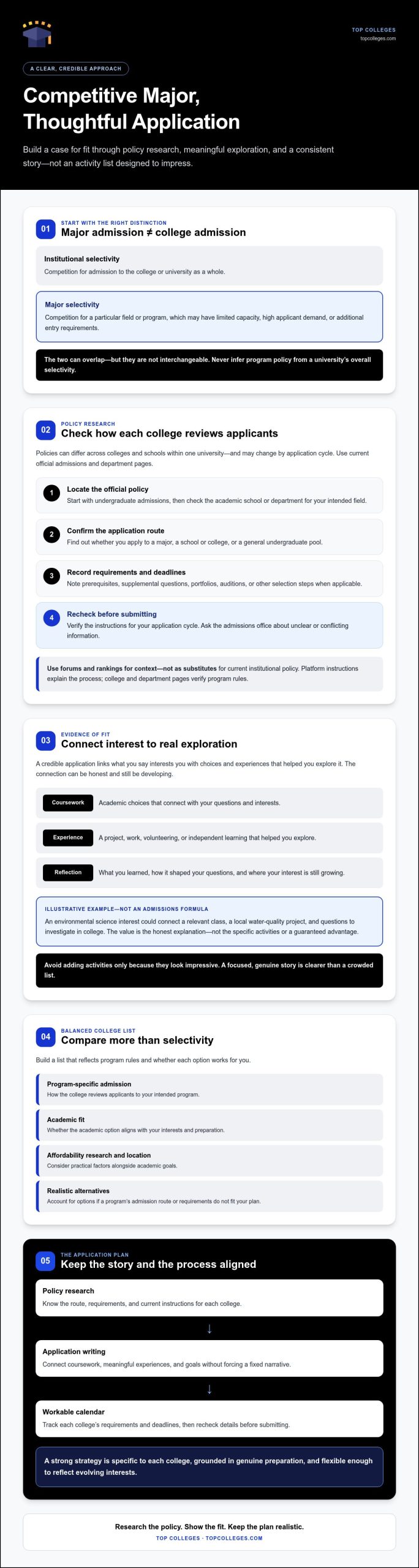
A competitive major is not necessarily a major that is difficult to study. It’s a program where admission may be more selective because of limited capacity, high applicant demand, or additional entry requirements. Major selectivity describes competition for a particular field or program; institutional selectivity describes competition for admission to the college as a whole. The two can overlap, but they aren’t interchangeable.
That distinction matters. A university may admit students to the institution first and let them choose a major later. Another may admit students directly to a school or program, or require a separate application for certain fields. The broader college admissions in the United States context helps explain why admissions approaches differ, but it can’t replace each college’s current official policy. Requirements may vary by college, school, major, and application cycle.
Your intended major can shape what you need to research and how you explain your academic interests. It doesn’t automatically change your admission odds or mean every application reader will assess you by major. A thoughtful college application strategy for competitive majors starts with confirming how each institution handles major selection, rather than assuming one rule applies everywhere.
Does choosing a competitive major change how colleges review applications?
Sometimes. Some colleges admit applicants directly to a program or school; others review students for general admission, with major selection happening later. Policies can also affect prerequisites or the process for transferring into a program after enrollment. Check the official admissions and department pages for each college, and confirm the application route, requirements, and any restrictions on changing majors. Don’t infer policy from a university’s overall selectivity.
What does a credible major-focused application actually demonstrate?
A credible application connects what you say interests you with the choices and experiences that have helped you explore it. That connection needn’t be a polished résumé theme. Sustained curiosity can show up through coursework, a personal project, work, volunteering, or independent learning. No single activity type is universally preferred; what matters is what you learned and how it shaped your questions.
Illustrative example, not an admissions formula: A student interested in environmental science might describe a relevant class, a local water-quality project, and questions they hope to investigate in college. The value isn’t that these exact activities guarantee an advantage. It’s that the student can explain the relationship between them honestly, including where their interest is still developing.
How to Research Competitive-Major Admissions Policies Before You Apply
Start with the institution, not a forum thread or ranking. Admissions rules can differ across schools within the same university, and a policy that applied in one application cycle may change. Verify each college’s current official instructions before deciding how to apply or what to list as your intended major.
Use a repeatable sequence for every college on your list:
- Locate the official policy. Begin with the undergraduate admissions site, then find the academic school or department page for your intended field.
- Confirm the application route. Identify whether you apply to a major, a school or college, or a general undergraduate pool.
- Record requirements and deadlines. Note prerequisites, supplemental questions, portfolios, auditions, or other selection steps, where applicable.
- Recheck before submitting. Confirm the information on official pages for your application cycle, and ask the admissions office about unclear or conflicting instructions.
Forums, rankings, and broad claims about a major’s competitiveness can provide context, but they’re not substitutes for current institutional policy. Common App or Coalition for College instructions can help explain the application platform and process; use the college’s own admissions and department pages to verify program rules.
Which official pages answer the most important major-admission questions?
Admissions pages typically explain application choices, program-specific requirements, and supplemental materials. Department pages can clarify prerequisites, curriculum, portfolio expectations, or additional selection steps. Check both: admissions guidance describes how to apply, while department information may explain what preparation or progression in the program involves.
Keep a comparison record for each institution. Include whether admission is direct to a major or broader pool, prerequisites, rules for declaring a major, and policies for changing majors after enrollment. Write “not stated” when you can’t find an answer; don’t treat missing information as confirmation that no restriction exists.
How should students compare direct admission and later declaration?
First, distinguish admission to the university from admission to a particular school, program, or major. Then check whether students may change majors and whether that process depends on available capacity, grades, prerequisites, or a separate application. If published pages disagree, or leave a consequential question unresolved, contact the institution’s admissions office and keep a record of the guidance.
This policy research also supports a balanced list. MEFA’s Build a Balanced College List offers additional guidance on considering a range of options. A disciplined college application strategy for competitive majors turns each school’s rules into a planning decision, rather than relying on assumptions about how all colleges admit students. If you’d value individualized help connecting institutional policies to your application plan, explore college admissions counseling.
How to Show Academic and Personal Fit for a Competitive Major
A major-focused application doesn’t need a perfectly linear story. It should make clear how you’ve explored an interest and what you’re curious about next. Relevant evidence might come from coursework, a personal project, paid work, volunteering, family responsibilities, or independent learning. No single activity type is universally preferred, and access to advanced classes or extracurricular programs varies by school, family circumstances, finances, and community resources.
Use what’s available to you. A student without a specialized club or formal internship can still show exploration through class assignments, books, conversations, or a project they pursued independently. The goal isn’t to imitate someone else’s résumé. It’s to reflect accurately on what you did, what you learned, and which questions you want to investigate in college.
What counts as meaningful preparation when access to opportunities differs?
Depth is about engagement, not prestige or duration alone. Consider whether an experience led you to ask a new question, revise an assumption, or pursue a topic further. For example, an illustrative student interested in architecture might connect geometry coursework to sketching accessible spaces, then identify questions about how design affects the people who use a building. That’s one possible account, not a required admissions pattern.
How can essays and activities form one coherent application?
Give each part of the application a distinct role. The activity list can show what you did and the responsibilities you held; an essay can explore a specific decision, challenge, or learning moment; academic choices can provide further context. Together, they should clarify your thinking rather than repeat the same claim about being “passionate.” For broader context on application components, see The Princeton Review’s strong application plan guidance.
To plan an essay, ask: What moment changed how I understood this subject? What did I do next? What remains unresolved? For deeper essay planning, use this strategic college essay portfolio guide.
The distinction is useful: specific evidence gives readers something to understand; unsupported declarations ask them to accept a conclusion without context.
| Evidence of authentic exploration | Unsupported claim of passion |
|---|---|
| Describes a project, choice, or question and what the student learned from it. | Calls an interest lifelong without explaining how it developed. |
| Connects an experience to a next question the student hopes to explore. | Lists activities as proof of commitment without showing their meaning. |
| Reflects honestly on limits, changes, or new directions in the interest. | Presents a polished major-focused narrative that the record doesn’t support. |
A sound college application strategy for competitive majors makes room for genuine development. Coherence comes from explaining real choices clearly, not manufacturing a résumé theme.
How to Build a Balanced College List When Majors Are Selective
A balanced list should reflect more than a college’s overall reputation or admission rate. Compare each institution’s academic fit, major-specific admission policy, affordability, location, and realistic alternatives. Crucially, an offer of admission to a university may not include admission to the specific school, program, or major you want. Treat those as separate outcomes when assessing your options.
Reach, target, and likely categories can help organize a list, but they aren’t promises, especially when a program has limited capacity or separate selection criteria. Review each college’s policy for your intended major, and consider how you’d feel about attending if you were admitted to the institution but not that program.
How can applicants compare alternate pathways without treating them as loopholes?
An alternate major is worth listing only if it genuinely interests you and fits your academic record. Applying to a less competitive field solely as a route into a selective major isn’t a reliable strategy. Before considering a pathway that involves changing majors later, check the institution’s official rules for eligibility, timing, prerequisites, and capacity. Don’t assume internal transfer will be available.
What should students do when their interests may change?
It’s normal for academic interests to evolve. Answer application questions accurately, then compare colleges for flexibility: how and when students declare a major, whether they can explore related fields, what advising is available, and how interdisciplinary study works. A college that supports thoughtful exploration may be a stronger fit than one chosen only for a single major’s name.
Before finalizing your list and intended-major selections, use this checklist:
- Academic fit: Would you want to study at the college even if your first-choice major isn’t available to you?
- Admission pathway: Are you applying to the university, a school, or a specific program, and are those decisions separate?
- Alternatives: Are your other program or major choices genuinely appealing and consistent with your interests?
- Flexibility: Have you checked the rules and conditions for declaring or changing majors?
- Practical fit: Have you considered affordability research, location preferences, and other factors that matter to you?
For a broader framework for organizing application decisions, see this college admissions counseling strategic blueprint. A considered college application strategy for competitive majors keeps options open without misrepresenting your interests or treating admission categories as guarantees.
How to Turn Your Competitive-Major Strategy Into a Strong Application Plan
Turn your research into a sequence of manageable decisions. Start by reviewing your transcript and current course choices, then reflect on experiences that shaped your academic interests. Use those reflections to plan application writing, leaving time to tailor responses to each institution. Before submitting, check every program’s current instructions and deadline. A strong college application strategy for competitive majors is organized around the actual requirements, not a last-minute attempt to make every application look identical.
For the 2026 to 2027 cycle, the Common Application opened on August 1, 2026. Many Early Action and Early Decision deadlines fall on November 1 or November 15, while Regular Decision deadlines are typically in January or February 2027. Treat these as planning context, not a substitute for checking each college’s calendar. Build in time to revisit official pages, since program-specific instructions may differ from general application deadlines.
What should an applicant review before submitting each application?
Review each application on its own. Confirm that you selected the intended major, school, or program correctly and completed any required supplemental materials. Then read essays and activity descriptions for accuracy and clarity. Your experiences should support your stated interests where relevant, but they don’t all need to serve one narrative.
- Match your intended-major selection to the institution’s current official instructions.
- Check program-specific requirements, supplemental questions, and deadlines.
- Make sure essays and activities describe your experiences honestly and consistently.
- Proofread each institution’s application separately before submission.
Leave space in the calendar for a final review, not just writing. A response that works for one college may not answer another college’s prompt or reflect its application route.
When can personalized admissions guidance add value?
Some students and families benefit from an outside perspective when policies are complex, application components feel disconnected, or a student wants structured feedback. Personalized college admissions counseling can include guidance on strategy, portfolio development, personal statements, and interview preparation. Its role is to help clarify decisions and strengthen preparation, not to guarantee an outcome or replace the student’s own judgment.
Consider support if you’re finding it difficult to translate institution-specific requirements into a workable plan, or to present your academic interests and experiences accurately and coherently. It’s one option, not a prerequisite; students can also use official college resources and guidance from people they trust.
Move Forward With a Strategy That Reflects You
A thoughtful college application strategy for competitive majors begins with verified information, not assumptions about how every college evaluates applicants. Research each program’s current policies, build a list that accounts for fit and flexibility, and present experiences that genuinely reflect your interests. Your application can show direction without suggesting that your goals have never changed.
Planning is also an opportunity to make each part of your application more intentional. Personalized admissions counseling can help students connect their academic choices and experiences to an overall strategy. Top Colleges offers support with portfolio development, personal statement review, and interview preparation. This guidance can strengthen preparation and clarify decisions, but no counseling can guarantee an admission outcome.
Stay curious, verify the details, and focus on presenting an honest account of how you think and learn. A clear, well-prepared application is a meaningful step toward finding the right academic environment.
Frequently Asked Questions
Is it harder to get into college as a competitive major?
It depends on the institution and program. Some colleges admit students directly to a major or school, while others admit students more broadly and let them declare a major later. A program can be more selective than its university overall, but that distinction alone can’t predict an individual applicant’s chances. Check current policies on the college’s official admissions and department pages before drawing conclusions.
Can I apply to a less competitive major and switch later?
That isn’t a dependable admissions workaround. Colleges set their own rules for changing majors, including when students may apply to switch and whether capacity, prerequisites, or academic requirements apply. Choose an intended major honestly, and research the institution’s internal-transfer policy before applying. An alternate major should be a real academic interest that fits your goals, not simply a perceived route into a different program.
How do I show interest in a competitive major on my college application?
Connect relevant classes, projects, responsibilities, or activities to specific questions you want to explore. A thoughtful description of what you learned can be more informative than a long list of activities chosen to look impressive. Let essays and activity descriptions contribute different details, and represent your experiences accurately. There’s no universal checklist, so check whether the program publishes particular preparation expectations before deciding what to emphasize.
What happens if I am undecided about my major when I apply?
Being undecided is not automatically an advantage or disadvantage across colleges. Some institutions welcome broad academic exploration, while others require applicants to select a school or intended program. Research each college’s major-declaration rules, flexibility, and advising options. Answer application questions truthfully, and describe your current interests where requested. You don’t need to claim certainty you haven’t reached, but you should understand what each application choice means.
Do competitive majors require specific high school classes?
Course expectations vary by college and program, so there isn’t one set of prerequisites that applies to every competitive major. Review current admissions and department guidance for each institution, and take a rigorous, appropriate course load within the options available at your school. If instructions are unclear, contact the college directly. Don’t assume a course pattern recommended by one institution is required by all others.
Should I apply to a different college within a university to improve my chances?
Not unless that college genuinely fits your academic interests. Schools within one university may have separate admissions processes, curricula, and rules for accessing or transferring into majors. Applying to a different school is not a guaranteed route to university admission or a later transfer. Compare official information about coursework, eligibility, major access, and transfer requirements before selecting the option that best reflects your plans.
When should I start planning a college application strategy for a competitive major?
Start early enough to understand course options and program policies, then revisit your plan as your interests develop. There’s no start date that guarantees an advantage. You can research colleges, reflect on experiences you already have, and prepare application writing before deadlines approach. Since requirements and calendars can change, verify current instructions with each institution and leave time to check them again before submitting.