

Disclaimer
Content on this page of topcolleges.com is computer generated and therefore is not guaranteed to be 100 percent accurate about various aspects of the education sector. On balance, however, many students and families seek general information about high schools, colleges and universities, graduate programs, testing, education and career planning, and job placement before beginning one-on-one admissions counseling tailored to their specific needs.
The university with the stronger name may be the wrong choice for you. When choosing between two top universities, rankings and reputation can make both options look equally compelling, while differences in financial aid, academic experience, and campus life are harder to weigh. It’s reasonable to worry that one missed detail could lead to regret.
The answer isn’t to ignore prestige, but to put it in perspective. A deliberate comparison can show which university better supports your goals, fits your finances, and offers an environment where you’re likely to thrive. This guide will help you assess both options using your own priorities and reliable evidence, rather than relying on reputation alone.
You’ll compare academic opportunities, student support, social and career fit, and the full cost of attendance, including how grants and scholarships affect net price. You’ll also learn how to verify key details and organize your findings into a decision you can explain with confidence. The aim isn’t to find the “best” university in the abstract. It’s to identify the stronger choice for you.
Key Takeaways
- Set your priorities before scoring either school to reduce the pull of prestige and hindsight bias.
- Build a weighted comparison that records each university’s evidence, your priorities, and unanswered questions.
- When choosing between two top universities, distinguish verified facts from personal impressions and assumptions before weighing trade-offs.
- Use a practical decision process, and confirm your response deadline directly with both institutions.
- Write down the evidence behind your choice so you can revisit it with confidence, even if some uncertainty remains.
Why choosing between two top universities requires more than comparing rankings
Two excellent offers can make a consequential choice feel harder, not easier. Each university may have an impressive reputation, strong programs, and appealing opportunities. The right decision depends on how those strengths align with your plans. Choosing between two top universities isn’t about finding the school that wins every category. It’s about identifying which option best supports your academic goals, financial realities, and day-to-day preferences.
Overall rankings offer context, but they don’t predict what your classes, advising, community, or costs will be like. Rankings combine measures that may not reflect your intended major or preferred learning environment. Use them as one reference point, then investigate details that will affect your experience, such as which courses you can take, how students access academic support, and what aid is included in your own offer. For broader context on how admissions decisions are made, you can understand the admissions landscape, then focus on what each university offers you.
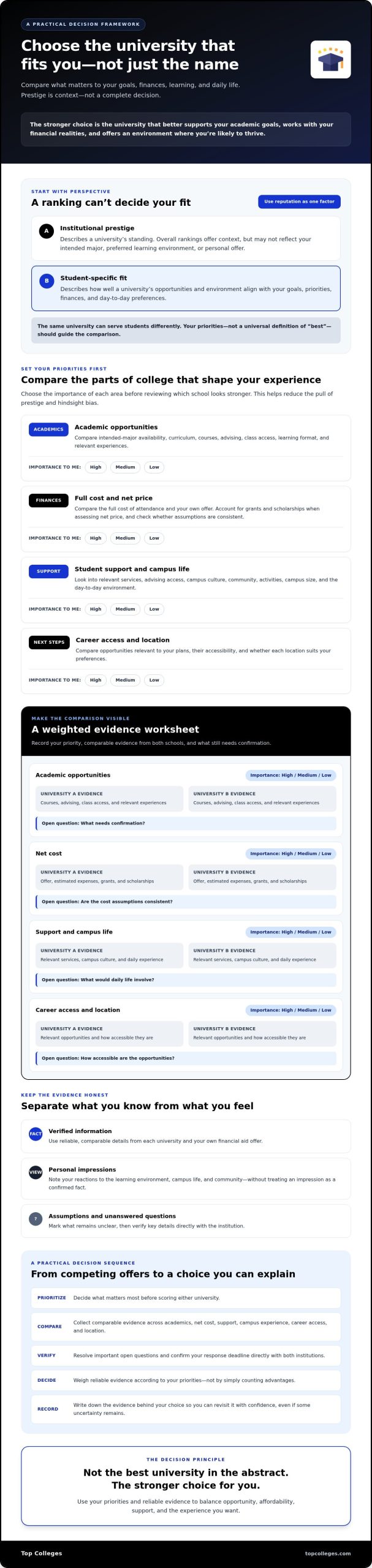
Institutional prestige describes a university’s standing; student-specific fit describes how well its opportunities and environment align with an individual student’s goals. Reputation can be meaningful, but it can’t make that assessment for you.
What does a strong university fit actually mean?
A strong fit brings together academic opportunity, learning environment, student support, affordability, and personal priorities. Consider whether the courses and advising suit your interests, whether the teaching format works for how you learn, and whether the full cost is manageable for your family. Then account for daily preferences, such as campus size, location, and the communities or activities you hope to join.
The same university can serve two students differently. A student seeking a particular research opportunity may prioritize access to relevant faculty, while another may value smaller discussion-based classes or a lower net price. Neither preference is universally superior. The question is which one matters more to you.
How prestige can complicate an otherwise clear decision
Brand recognition can dominate family conversations because it feels like a simple way to distinguish two strong options. Pause and ask what that reputation means for your intended field and goals. Does it connect to opportunities you plan to pursue, or is it standing in for evidence you haven’t gathered yet?
Prestige may matter to you, and you don’t need to dismiss it. Weigh it alongside program-level strengths, likely costs, support, and the experience you want. A respected name is one factor, not a complete decision framework.
Build a weighted comparison of academics, cost, support, and campus experience
A structured comparison turns competing impressions into evidence you can examine. Before scoring either university, decide which criteria matter most to you. The order matters: if you see one school’s strengths first, you may be tempted to shift your priorities to favor it. Rate the importance of each criterion, then collect comparable information from both institutions.
A useful comparison doesn’t just count advantages; it weighs reliable evidence according to the student’s priorities. Use a table to keep facts, questions, and judgments visible, so one memorable feature doesn’t dominate the decision.
| Criterion | Importance to me | University A evidence | University B evidence | Open question |
|---|---|---|---|---|
| Academic opportunities | High, medium, or low | Courses, advising, experiences | Courses, advising, experiences | What needs confirmation? |
| Net cost | High, medium, or low | Offer and estimated expenses | Offer and estimated expenses | Are assumptions consistent? |
| Support and campus life | High, medium, or low | Relevant services and culture | Relevant services and culture | What would daily life involve? |
| Career access and location | High, medium, or low | Relevant opportunities | Relevant opportunities | How accessible are they? |
Which academic factors deserve a closer comparison?
Look beyond the university’s overall reputation. Confirm that your intended major is available and compare curriculum structure, current course listings, class access, and academic advising. If hands-on learning matters, investigate relevant research, internships, or other experiential opportunities. Check official department materials and ask each institution to clarify anything that isn’t clear. A ranking can’t tell you which courses you’ll be able to take or what opportunities will be available to you.
How should families compare affordability and student support?
Review each written aid offer and estimate net cost using the same assumptions for grants, scholarships, housing, travel, and other expenses. A university’s net price calculator can provide a planning estimate, not a final aid commitment. For support, verify which services you may use, such as tutoring, advising, accessibility resources, wellness services, and career guidance. Ask how students access those services and whether there are requirements to use them.
Once the table is complete, score each school against the priorities you set in advance. Keep evidence separate from impressions, and mark unknowns rather than treating them as advantages or drawbacks. If you’d like an outside sounding board to help clarify your college priorities, personalized college admissions counseling may be one option to consider.
Test the differences between two top universities against your real priorities
A comparison is more useful when you separate what you know from what you sense and what you still need to verify. Label each note as a verifiable fact, such as a published course schedule; a personal impression, such as how you felt during a visit; or an assumption, such as what you expect campus life or access to be like. This makes it less likely that a strong impression will be mistaken for confirmed information.
Record the trade-off as well as the benefit. A university may offer a campus culture that appeals to you but be farther from a support network you rely on. An opportunity may sound attractive, but its availability or access requirements may need confirmation.
| University | Advantage and evidence | Importance to me | Trade-off or open question |
|---|---|---|---|
| A | Relevant courses listed by the department | High, medium, or low | Can students enroll as planned? |
| B | Career advising described by the university | High, medium, or low | What support is available to this program? |
Student perspectives can add useful context, especially when they come from current students in the program or community you’re considering. Still, one person’s experience isn’t universal evidence. Look for patterns across multiple conversations, then verify important claims with official university sources. A tie in reputation doesn’t mean a tie in daily experience, affordability, or access to opportunities.
How can you evaluate campus culture before committing?
If possible, attend an admitted-student event, sit in on a class, or speak directly with students. Ask focused questions: How easy is it to participate in class? What does community feel like? How accessible are advisers? If a visit isn’t feasible, use official virtual events and seek perspectives from more than one student. Record what you observe separately from what you infer.
How can you compare career opportunities without overpromising?
Review internship access, career advising, alumni resources, and opportunities tied to your intended program. Ask each university’s career office and relevant academic department for current details, including eligibility and how students learn about openings. Treat resources as possibilities to investigate, not promises of placement or a particular career outcome.
When choosing between two top universities, test your findings against the life and goals you actually have, not an imagined ideal student. A clear advantage matters most when it supports a high-priority need. A trade-off deserves attention when it could affect your experience or plans.
Follow a practical decision process before accepting one university’s offer
Once you’ve assembled comparable evidence, move from analysis to action. A short, sequenced process can keep family discussions focused and prevent open questions from turning into last-minute pressure. Use the response date in your official admission materials to set your decision deadline, then verify it with both institutions. Don’t assume the dates or enrollment steps are identical.
- 1. Set priorities. Identify what matters most to the student, such as a particular academic path, affordability, support, or location.
- 2. Gather evidence. Use current university materials and direct answers from relevant offices to fill gaps in your comparison.
- 3. Compare offers. Review admission details and written aid offers using consistent assumptions about expenses and support.
- 4. Resolve open questions. Contact both schools with comparable questions, and record answers, sources, and dates.
- 5. Decide and complete the required steps. Choose the school that best aligns with the student’s priorities, then follow its official instructions before the stated deadline.
Family input can surface useful questions and practical considerations. Keep the student’s goals and needs at the center, however. The person who will attend should have a meaningful role in weighing the trade-offs. For a broader view of how planning and application choices connect, consult this college admissions counseling strategy guide.
What questions should you resolve before making the choice?
Confirm program details, aid terms, enrollment requirements, and housing information directly with each university. Ask the same questions in similar language so the responses are easier to compare. Keep a simple record of what you asked, who responded, and when. Details can change between admission and enrollment, so dated notes help you distinguish current confirmation from older information.
How can you use a decision matrix without letting it decide for you?
Agree on criteria and their importance before assigning scores. Treat the totals as prompts for reflection, not a verdict. If one result surprises you, check whether it comes from strong evidence, an untested assumption, or a weighting that no longer reflects the student’s priorities. When choosing between two top universities, the matrix should clarify your judgment, not replace it.
If you’ve worked through the comparison and would value a personalized sounding board, explore college admissions guidance.
Make a confident final choice, and plan for the transition
A sound decision doesn’t require certainty that one university is better in every respect. It requires a clear account of why your chosen option fits your priorities. Write a short explanation you can revisit: “I chose this university because its academic opportunities, expected cost, and support align most closely with what matters to me.” Add the specific evidence behind those reasons, such as confirmed program details or terms in your written aid offer.
Choosing between two top universities can still bring doubt. That doesn’t mean the decision is flawed. You don’t need to prove the other school was wrong for you; you need to understand why your selected option is the stronger fit for your goals now.
How do you distinguish ordinary doubt from a real unresolved concern?
Ask what prompted the doubt. Is it new information, pressure from someone else, or the discomfort of closing off another attractive path? Return to your original priorities and identify whether an important question remains unanswered. If family disagreement is clouding the student’s reasoning, a trusted, impartial perspective can help separate practical concerns from competing expectations.
What if the student later considers transferring?
Don’t treat transfer as an expected outcome or as permission to choose casually now. Academic and personal circumstances can change, but transfer options involve a separate evaluation of requirements, credit policies, timing, and fit. If that question becomes relevant, explore strategic guidance on transferring colleges rather than assuming a future move will be simple or guaranteed.
Once you’ve decided, shift from comparison to preparation. Confirm enrollment steps and deadlines directly with your chosen university, and promptly raise any remaining financial-aid questions with its financial-aid office. Keep copies of important communications and follow the institution’s instructions. If second thoughts arise, return to the evidence, then focus on what needs to happen next.
A reasoned choice isn’t a promise that every part of college will be predictable. It’s a deliberate starting point, made with the best information available and grounded in the student’s own priorities.
Choose with clarity, then move forward
Choosing between two top universities becomes more manageable when you look beyond rankings and compare each offer against your own priorities. Weigh academic opportunities, net cost, student support, campus experience, and career access using current evidence. Give more weight to the factors that matter most to you, and mark assumptions or unanswered questions for follow-up.
A strong decision doesn’t require certainty that the other university was the wrong choice. It requires a clear rationale you can revisit, plus prompt confirmation of enrollment steps, deadlines, and any remaining financial-aid questions with your chosen school. Some doubt may remain, but it doesn’t erase the care behind your decision.
If another perspective would help you clarify your priorities, Top Colleges, led by educational consultant Steven Roy Goodman, offers personalized admissions counseling, portfolio development, and interview preparation.
You’ve done the work to make a thoughtful choice. Now take the next step with confidence and focus on the opportunities ahead.
Frequently Asked Questions
How do I choose between two universities with similar rankings?
Compare the schools against your academic goals, finances, support needs, and preferred day-to-day experience. Choosing between two top universities takes more than comparing their positions on a list. Set your priorities before scoring either option, then verify details such as courses, advising access, written aid terms, and relevant career resources. Consider rankings as context, not a prediction of which university will suit you best.
Should I choose the more prestigious university?
Not automatically. Reputation can be relevant, particularly if it connects to opportunities in your intended field, but it shouldn’t outweigh factors that matter more to your education and well-being. Compare the program, total expected cost, student support, and campus environment alongside name recognition. Ask what specific advantage the prestige offers for your goals, and look for evidence rather than assuming the most recognized name is the stronger personal choice.
How should I compare financial aid offers from two colleges?
Compare the written offers side by side and estimate each school’s net cost using consistent assumptions about tuition, housing, food, travel, and other expenses. Separate grants and scholarships from loans, since they affect future borrowing differently. Check whether awards are renewable and whether the terms depend on conditions you need to understand. Use each college’s net price calculator as an estimate, then direct questions about your specific offer to its financial-aid office.
What if my parents and I disagree about which university is best?
Start by identifying the concern behind each person’s preference. Parents may focus on affordability or security, while the student may emphasize academic interests, independence, or community. Put those concerns beside the student’s priorities and compare them with current evidence from both universities. A respectful discussion should give the student’s goals a central role, since the student will live with the decision. If needed, ask a trusted, impartial person to help clarify the disagreement.
Can campus visits help me decide between two universities?
Yes. A visit can help you assess details that websites and rankings may not convey, such as classroom dynamics, campus routines, and how students describe the community. Attend an admitted-student event, sit in on a class, or speak with current students if possible. Ask focused questions about advising access and the aspects of daily life that matter to you. If travel isn’t feasible, use official virtual events and seek perspectives from several students.
What should I do if I still cannot decide between two colleges?
Return to your priorities and identify what is driving the uncertainty. Is there an unanswered question about your program, aid offer, housing, or enrollment requirements? Contact both institutions with the same questions, note the responses, and verify your official response deadline. Then review your comparison and make a decision based on the evidence and your most important needs. You don’t have to prove the other college was wrong for you to choose with confidence.