

Disclaimer
Content on this page of topcolleges.com is computer generated and therefore is not guaranteed to be 100 percent accurate about various aspects of the education sector. On balance, however, many students and families seek general information about high schools, colleges and universities, graduate programs, testing, education and career planning, and job placement before beginning one-on-one admissions counseling tailored to their specific needs.
The application platform that looks more familiar isn’t automatically the right one for your college list. In the Coalition Application vs Common Application decision, the key question isn’t which route gives you an admissions advantage. Colleges that accept both don’t prefer one over the other; the substance of your application matters more.
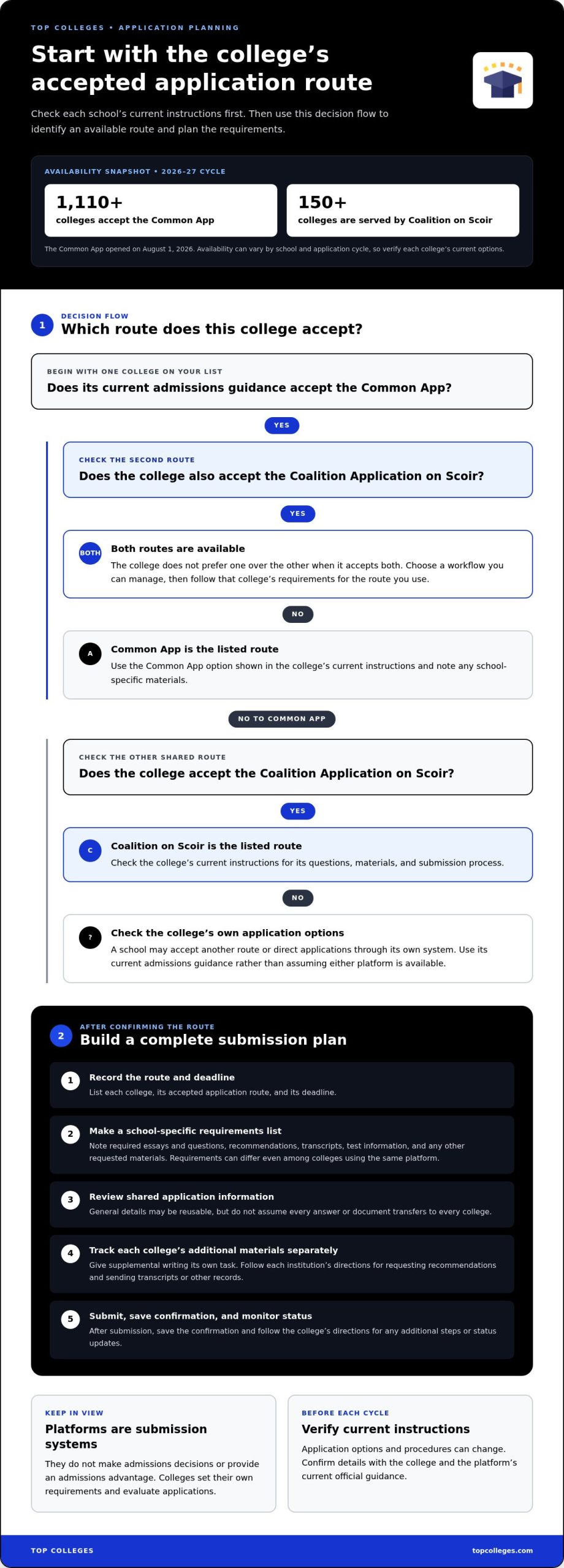
It’s understandable to worry that choosing the wrong platform could hurt your chances, especially when essay prompts, recommendations, and submission steps differ. Start with your college list, then confirm which application routes each school accepts. The Common App is accepted by more than 1,110 colleges, while Coalition on Scoir serves over 150, so availability is an important first filter.
This guide compares college availability, application requirements, and workflow for the 2026 cycle, including accounts, essays, recommendations, and school-specific supplements. You’ll learn how to verify each college’s current instructions and build a manageable plan around your deadlines without relying on platform myths.
Key Takeaways
- Use your finalized college list to identify each school’s accepted application route before setting up a submission workflow.
- The Coalition Application vs Common Application comparison is most useful when you assess requirements and processes for your specific schools, not platform myths.
- Separate information you can reuse across applications from each college’s own questions, essays, and supplemental materials.
- Track platform tasks and school-specific requirements in one place, alongside their deadlines.
- Keep your central application themes consistent while tailoring responses to each institution’s prompts.
Coalition Application vs. Common Application: What Are You Comparing?
The Common Application and the Coalition Application are online systems applicants can use to submit applications to participating colleges. They provide a way to send information and materials; they don’t make admissions decisions or confer an admissions advantage. Each college’s admissions office sets its requirements and evaluates applications.
You’re comparing submission systems, while colleges set admissions requirements. Keeping that distinction in mind makes the Coalition Application vs Common Application decision more manageable. A school may accept one platform, both, or direct applications through its own system, and its options can change by application cycle. Start with your college list rather than a general ranking of platforms.
What is the Common Application?
The Common Application, often called the Common App, is a shared application platform used by participating colleges. For the 2026-27 cycle, it is accepted by more than 1,110 colleges and universities, and the application opened on August 1, 2026. Applicants complete shared sections, then submit to each college along with its own questions and any required supplemental materials. The Common Application also has a longer history as a centralized application route.
Shared information can reduce repetitive entry, but it doesn’t make every submission identical. Each institution decides which sections, essays, recommendations, and other materials it requires. Confirm those details on the college’s current admissions pages, especially before assuming a response or document will be used for every school.
What is the Coalition Application?
The Coalition Application is another shared route for applying to participating colleges. For 2026-27, it is commonly identified as the Scoir x Coalition Application or Coalition on Scoir, reflecting the platform’s partnership with Scoir. It serves more than 150 colleges and universities, a smaller group than the Common App, so check whether it’s an option for each school on your list.
As with the Common App, this route doesn’t replace a college’s instructions. Institution-specific questions and submission requirements still apply. Don’t rely on older descriptions of Coalition tools or features without checking current official guidance. The practical comparison is how each platform works for the schools on your list and the requirements they set.
How the Coalition Application and Common App Work in Practice
The platform is only the starting point. Build a reliable workflow by listing your colleges, confirming each school’s application route and deadline, and then identifying every required material. This makes the Coalition Application vs Common Application comparison less about general features and more about coordinating accurate, complete submissions.
- Confirm each college’s accepted route. Check its admissions website for the application options for your intended cycle. Record whether the school accepts the Common App, the Coalition Application, or another route.
- Review school-specific instructions. Note the deadline and any required essays, questions, recommendations, transcripts, test information, or other materials. Requirements can differ even among colleges using the same platform.
- Complete the shared application sections. Enter general applicant information and other requested details in the platform account. Review shared information before each submission, and don’t assume every answer transfers to every college.
- Prepare each college’s additional materials. Complete its questions and supplemental writing. Follow its directions for requesting recommendations and sending transcripts or other records.
- Submit and track status. Save the confirmation after submitting. Then follow the college’s instructions for any additional steps or application-status updates.
For a broader perspective on the platform’s purpose and intended audience, the University of the People offers an overview of the Coalition Application. Use current platform and college guidance for cycle-specific requirements, since procedures and options can change.
Which application materials may be shared or repeated?
Basic profile details and other general information may appear in shared application sections, while college-specific questions and supplemental essays need separate attention. Recommendations and transcripts also require planning. A college may specify how these materials should be requested or submitted, so don’t assume one procedure applies across your list. Follow each institution’s current instructions and give recommenders and school staff enough time to provide materials.
How do application accounts and submissions differ?
Set up an account on the platform each college accepts, then create a tracker with the institution, application route, deadline, required materials, and submission status. For example, record a supplement as its own task rather than marking the application complete when you finish the shared sections. This makes missing essays or recommendations easier to spot before the deadline. At the start of a new cycle, review official platform guidance along with each college’s admissions instructions.
Applicants coordinating deadlines, application themes, and institution-specific requirements may benefit from a structured planning approach. Learn how personalized college admissions counseling can support your application planning.
Coalition Application vs. Common App: The Differences That Matter
A side-by-side comparison is useful when it distinguishes platform features from college policies. The Common App and Coalition on Scoir differ in their participating-college networks and application setup, but requirements such as recommendations, supplements, and deadlines are often determined by each institution.
The important difference is whether a college accepts the route and what it requires. Use the table as a starting point, then verify the details for every school on your list.
| Comparison point | Common App | Coalition on Scoir |
|---|---|---|
| Accepted colleges | Available only for participating colleges. Check the current Common App directory and each college’s admissions instructions. | Available only for participating colleges. Check current Coalition on Scoir listings and each college’s admissions instructions. |
| Application components | Includes shared application sections and a personal essay with seven 2026-27 prompts; the essay limit is 650 words. Individual colleges may add questions or supplemental essays. | Includes application sections and five 2026-27 essay prompts. The recommended essay length is 500-550 words, though longer responses may be submitted. College-specific questions and supplements may also apply. |
| Recommendations and records | Requirements and submission procedures vary by college. Follow each school’s directions. | Requirements and submission procedures vary by college. Follow each school’s directions. |
| Deadlines and workflow | Use the platform for participating schools, while tracking each college’s deadline and additional steps separately. | Use the platform for participating schools, while tracking each college’s deadline and additional steps separately. |
| Current-cycle check | Confirm prompts, requirements, and participating colleges for the application cycle you’re entering. | Confirm prompts, requirements, and participating colleges for the application cycle you’re entering. |
Do colleges accept both application platforms?
Some colleges may offer more than one application route, while others list only specific options. Acceptance can change between cycles, so don’t rely on an older article or a previous year’s list. Check the college’s official admissions page for the cycle you’re applying to, then compare its information with the relevant platform’s current directory. A broader Common App vs. Coalition App comparison can provide context, but your schools’ current instructions should guide your decision.
Are essays, recommendations, and deadlines different?
Platform essay prompts and recommended lengths can differ, but college supplements, recommendation procedures, and deadlines are institution-specific. A school may ask for additional writing through either route, so build your essay plan around its prompts rather than assuming the platform’s main essay is the only one required. List each essay by school and prompt, then track its draft and review status separately.
Interface familiarity or personal preference may make one system feel easier to organize. That’s a workflow consideration, not an admissions advantage. For support coordinating essays and school-specific requirements, explore personalized college admissions counseling.
Does Choosing One Application Platform Improve Admission Chances?
No application platform inherently improves your admission chances. If a college accepts both the Coalition Application and Common App, it doesn’t prefer one route over the other. The platform is a submission system, not a shortcut through the college’s review process. What matters is submitting an accurate, complete application that follows the institution’s requirements.
That’s the central point of the Coalition Application vs Common Application decision: choose based on your schools’ instructions and the workflow you can manage reliably. A familiar interface may feel more comfortable, but familiarity isn’t an admissions advantage. A missed supplement or late submission, on the other hand, can leave your application incomplete.
How should you choose a platform for each college?
Use this decision process for every school on your list:
- Read the official instructions. Find the college’s admissions requirements for the application cycle you’re entering.
- Identify accepted routes. If the college specifies one platform, use it. If it accepts more than one, choose the route that lets you complete the application accurately and on time.
- Record every requirement. Track the deadline, essays, recommendations, transcripts, and any other materials the institution requests.
- Check the full submission. Before submitting, review the college-specific questions and supplements, not only the shared application sections.
This school-by-school approach prevents platform preference from overriding a college’s instructions. It also helps you coordinate application themes while tailoring each response to the institution.
How can you avoid duplicate work and missed requirements?
Keep one tracker for all colleges and platforms. Include each school’s accepted route, deadline, required materials, and submission status. Store final essay drafts and applicant information in a secure, clearly organized location, and label versions so you can distinguish a shared essay from a school-specific response.
After submitting, save the confirmation and review the college’s application portal for status updates or outstanding items. Submission is a milestone, not a reason to stop checking. A final review helps you catch missing materials while there’s still time to respond.
Personalized planning can help you coordinate deadlines, application themes, and school-specific requirements while keeping each college’s instructions in view.
Build a Cohesive Application Plan Across Both Platforms
A strong application plan turns the Coalition Application vs Common Application comparison into a sequence of manageable decisions. Finalize your college list first, then confirm each school’s accepted route and current requirements. If your list uses both platforms, organize the work around institutions and deadlines rather than treating each platform as a separate strategy.
Your application should present a coherent picture of your interests, experiences, and goals. That doesn’t mean every response should sound the same. A personal statement can establish central themes, while a college’s supplemental essay or questions can show how those themes connect to that particular institution. Consistency comes from an authentic throughline, not from repeating identical language.
What should your application tracker include?
Create one tracker for every college, regardless of application platform. Include the accepted route, deadline, required materials, and the status of each task. Add essay drafts, recommendation requests, transcript tasks, submission dates, and confirmation messages. Review the tracker regularly so shared platform tasks don’t distract from school-specific supplements or other requirements.
- Before drafting: Confirm the application route, deadline, and required materials for each institution.
- During preparation: Track essay versions, recommendations, transcripts, and outstanding questions.
- After submission: Save confirmation messages and review each college’s application portal for updates or missing items.
Assign clear next steps to yourself and anyone helping with your applications. For example, if one supplement is due before another school’s deadline, put its drafting and review milestones on the calendar instead of relying on memory.
When can admissions counseling help with the comparison?
Personalized admissions counseling can connect platform logistics with the larger application plan. Top Colleges provides support with portfolio development, personal statement review, and interview preparation, while keeping the focus on presenting your experiences clearly and authentically. This planning can be useful when several deadlines, essay prompts, and application routes need to work together.
For a broader framework for organizing the process, explore college admissions counseling with Top Colleges. Thoughtful planning won’t guarantee an admissions result, but it can help you approach each requirement with greater clarity and care.
Choose Your Route, Then Build a Strong Plan
The Coalition Application vs Common Application choice comes down to your college list: which routes each institution accepts, what materials it requires, and which workflow helps you submit a complete application on time. Neither platform is an admissions advantage. Focus on the quality, accuracy, and completeness of your application.
Start by confirming each college’s current instructions, then map deadlines, essays, recommendations, and submission steps in one tracker. Keep your broader application story coherent while tailoring responses to each school’s questions. A clear plan can help you manage both platforms without losing sight of what makes your application distinct.
Top Colleges offers personalized college admissions counseling, including support with portfolio development, personal statement review, and interview preparation. Strategic guidance can help you coordinate those elements with school-specific requirements and present your experiences clearly.
Take the next step by organizing your college list, confirming each application route, and building a plan for the materials each school requires.
Frequently Asked Questions
Is the Coalition Application better than the Common App?
Neither platform is universally better. The right choice depends on which application routes your colleges accept and which workflow you can manage effectively. The Common App is accepted by more colleges, while the Coalition Application, now commonly called Coalition on Scoir, is available at a smaller group of institutions. Compare your actual school list, then check each college’s current requirements. Platform preference alone shouldn’t drive your application strategy.
Can you use both the Coalition Application and the Common App?
Yes, you can use both platforms to apply to different colleges if those schools accept the respective routes. For example, you might submit some applications through the Common App and others through Coalition on Scoir. If a college accepts both, choose the route that best fits your workflow and follow its instructions. Avoid submitting duplicate applications to the same college unless its admissions office specifically directs you to do so.
Do colleges prefer the Coalition Application or the Common App?
Colleges that accept both platforms don’t prefer one over the other. The application route is a way to submit your materials, while the college sets its own admissions requirements and evaluates your application. Focus on submitting accurate, complete information and addressing every required question or supplement. If you’re deciding between routes for one school, check its current instructions and select one accepted method rather than trying to gain an advantage through platform choice.
Does applying through one platform improve your admission chances?
No platform inherently improves your admission chances. The Coalition Application vs Common Application decision affects how you submit, not the strength of your academic record, experiences, essays, or other application materials. A platform can help organize submissions, but it can’t compensate for missing requirements or inaccurate information. Prioritize the route accepted by the college, follow its instructions carefully, and give yourself enough time to submit a complete application by the deadline.
How do you know which application platform a college accepts?
Check the college’s official admissions website for the application cycle you’re entering. Look for its list of accepted application routes and any school-specific instructions. You can also consult current platform directories, then compare those listings with the college’s own guidance. Record the accepted route, deadline, required essays, recommendations, and other materials for each school. Don’t rely on an old list or assume last year’s options are still available.
What happens if a college accepts both application platforms?
If a college accepts both, you can generally choose either route. Compare the school-specific requirements and consider which platform makes it easier for you to complete and track the application accurately. The college’s admissions process remains the same regardless of the accepted platform, so there’s no inherent admissions advantage to selecting one. Submit through one route and keep a record of your confirmation and any follow-up steps in the college’s application portal.
Are the essay prompts the same on the Coalition Application and Common App?
No, the main essay prompts differ. For the 2026-27 cycle, the Common App has seven prompts and a 650-word limit. Coalition on Scoir has five prompts, with a recommended length of 500-550 words; students may submit longer essays. Colleges may also require their own supplemental essays or questions, so review each institution’s current instructions and plan for both platform essays and school-specific writing.