

Disclaimer
Content on this page of topcolleges.com is computer generated and therefore is not guaranteed to be 100 percent accurate about various aspects of the education sector. On balance, however, many students and families seek general information about high schools, colleges and universities, graduate programs, testing, education and career planning, and job placement before beginning one-on-one admissions counseling tailored to their specific needs.
What if the college with the lowest published tuition isn’t the safest choice for your family? Sticker price can differ sharply from what you may pay after grants and scholarships, while an affordable option may still be too selective to count as a realistic admissions choice. Identifying financial safety schools to add to your list takes more than comparing tuition figures.
It’s understandable to want clear answers before investing time and application fees. But no school guarantees admission or an affordable outcome, and loan offers aren’t discounts. A sound shortlist weighs your student’s admissions profile alongside your family’s likely net cost, including housing, meals, and other expenses.
This article explains how to assess both sides of the decision, use net price calculators, and compare aid estimates and offers using consistent figures. You’ll learn how to identify colleges worth investigating, account for your family’s circumstances, and build a balanced list based on evidence rather than assumptions.
Key Takeaways
- A financial safety must be both a realistic admissions option and affordable for your family, not merely a school with a low published price.
- Use each college’s Net Price Calculator, then consider whether the estimated cost remains manageable if expenses or aid change.
- Explore Berea College and the College of the Ozarks as distinctive tuition-model examples, while verifying current policies and total attendance costs.
- Use a consistent checklist to review admission fit, aid terms, direct and indirect expenses, residency status, and backup plans.
- Identify financial safety schools to add to your list by balancing academic fit, admissions likelihood, and estimated family cost across multiple options.
What makes a college a financial safety school?
An admissions backup isn’t automatically affordable. A college may be likely to admit a student but still leave the family with a net cost that doesn’t fit its budget. A financial safety is a school that appears both attainable and affordable based on evidence specific to the student and family, not reputation, sticker price, or assumptions about aid.
That assessment has two parts: likelihood of admission and likely cost after grants and scholarships. Neither is certain. Admission decisions and aid offers can change, so no college should be considered a guaranteed safety. Families looking at financial safety schools to add to your list should treat estimates as a starting point for research, not as promises.
How is a financial safety different from an admissions safety?
An admissions safety addresses one question: does the student appear likely to be admitted? A financial safety adds another: can the family manage the expected cost without relying on an unsustainable amount of borrowing? A likely admit can still be unaffordable if grants are limited, housing costs are high, or the remaining bill exceeds the family’s resources.
Admission estimates also need context. A student’s academic profile matters, but so do a college’s selectivity, program, and application requirements. Grades or scores above a school’s typical range don’t guarantee admission. Understanding the broader college admissions process helps families place each school among reach, match, and likely options, while recognizing that these categories are estimates, not assurances.
What does “affordable after aid” actually mean?
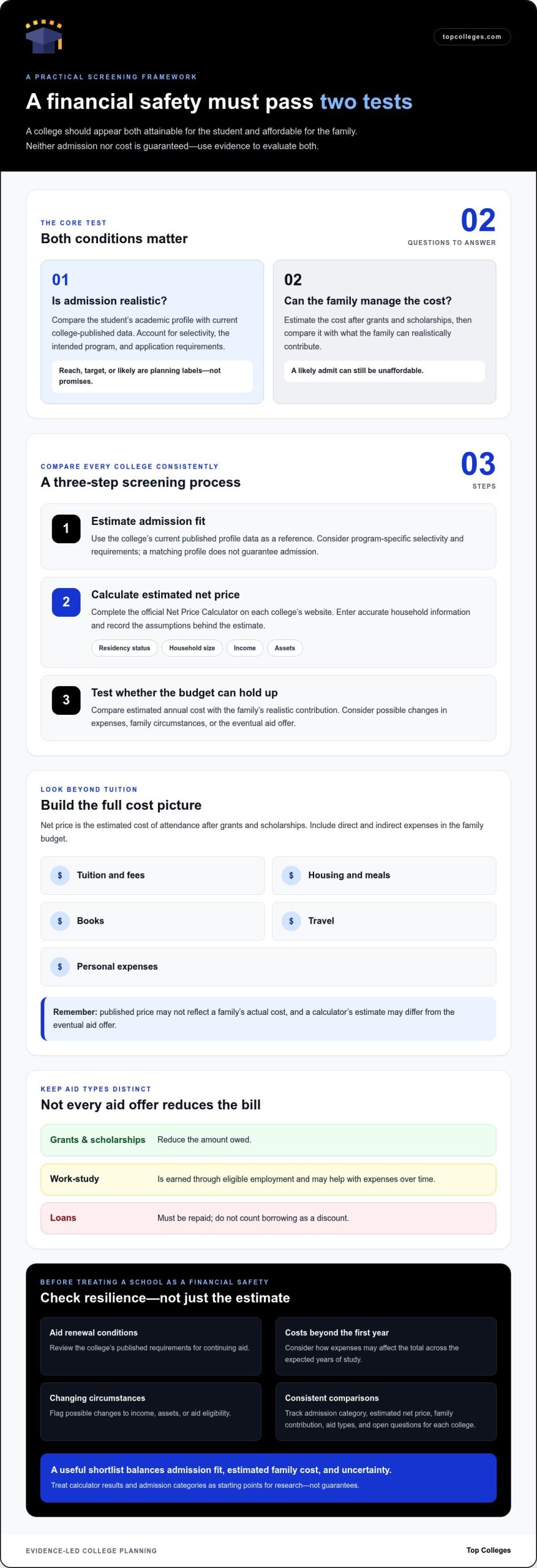
Net price is the estimated cost of attendance after grants and scholarships are subtracted. It is not the amount left after loans. Grants and scholarships reduce the bill; work-study is earned through eligible employment and may help with expenses over time; loans must be repaid. Keep each type of aid distinct when comparing offers.
Compare the full cost, not tuition alone. Include fees, housing, meals, books, travel, and personal expenses. Some costs may be indirect or vary with the student’s choices, but they still affect the family’s budget. A college’s published price may be a poor guide to one family’s actual cost, and an aid estimate can differ from the eventual offer.
The strongest assessment combines an admission estimate with an individualized cost estimate and a realistic budget. That approach turns a list of appealing colleges into a more intentional shortlist, while leaving room to update assumptions when official information becomes available.
How to assess admission chances and net price together
A useful screening process examines admission and cost side by side, then tests whether the plan can withstand uncertainty. Use the same method for every college so your comparisons reflect meaningful differences rather than inconsistent assumptions.
- Estimate admission fit. Compare the student’s academic record with the college’s current published profile data, such as the ranges it reports for admitted students. Classify the school as a reach, target, or likely option for planning purposes, not as a promise. Consider whether the intended program has its own selectivity or application requirements.
- Calculate estimated net price. Complete the official Net Price Calculator on each college’s website using accurate, current household information. Record the estimate and the assumptions behind it, including residency status, household size, income, and assets.
- Test budget resilience. Compare the estimated annual cost with what the family can realistically contribute. Then consider whether that amount remains manageable if expenses rise, financial circumstances change, or the eventual aid offer differs from the estimate.
How should families estimate admission likelihood?
Use college-published profile data as a reference point, not a prediction. A student’s grades and course history may align with a school’s reported profile, but selectivity, program-specific criteria, and the application as a whole still matter. Label each school reach, target, or likely to structure the list; don’t treat any category as guaranteed admission.
How do you compare net price and the family budget?
Run each institution’s calculator with accurate household details, updating only information that genuinely differs, such as residency. Calculators provide estimates, and results are only as useful as the information entered. If income, assets, or aid eligibility may change before enrollment, flag that uncertainty instead of relying on a single figure.
In your comparison, keep grants and scholarships separate from work-study and loans. Grants and scholarships reduce the amount owed; work-study is earned through employment, and loans require repayment. Don’t count borrowing as a discount or assume a student can cover the full remaining cost through work.
Look beyond the first year. Review the college’s published aid renewal conditions and consider how tuition, housing, meals, books, travel, and personal expenses may affect the total across the expected years of study. A simple comparison table can track admission category, estimated net price, family contribution, aid types, and open questions. This makes it easier to identify which financial safety schools to add to your list merit further investigation.
Personalized admissions counseling can help align a student’s academic profile and application strategy with the colleges under consideration. Top Colleges offers this guidance to help make school selection and application planning more coherent. Learn about personalized college admissions counseling.
Financial safety schools to investigate, with important caveats
The colleges below are research leads, not universal recommendations or guaranteed financial safeties. A school’s tuition model may look promising, but eligibility, admission likelihood, residency, aid terms, and non-tuition expenses determine whether it works for a particular student. Treat each profile as a prompt to review current official information and estimate the full cost for your family.
Which colleges have distinctive affordability models?
Berea College and College of the Ozarks are worth examining for their distinctive tuition approaches. Berea’s tuition model has eligibility and admission considerations to understand; College of the Ozarks combines education with a work-based model, so families should review participation expectations and related expenses. Neither model should be assumed to cover every cost. Housing, meals, travel, books, and personal spending may still affect affordability.
When might public universities be financial safety candidates?
Public universities can be more affordable for state residents, while nonresident costs may differ substantially. The University of Florida, University of Wyoming, and Truman State University are useful comparison examples, not blanket endorsements. For each, compare current admission data and program costs with the net price estimate for the student’s residency status. Review scholarship eligibility and renewal terms as well.
Use each school’s official calculator or financial-aid information as a starting point, and review current policies directly through the institution’s published information.
| School | Affordability feature to investigate | Eligibility caveat | Official calculator or aid source |
|---|---|---|---|
| Berea College | Its tuition model and available aid | Review current admission, eligibility, and remaining-cost requirements | Berea official tuition and aid information |
| College of the Ozarks | Work-based education model | Confirm participation expectations and expenses beyond tuition | College of the Ozarks official cost and aid information |
| University of Florida | Resident pricing and institutional aid | Check residency, program costs, and scholarship terms | UF Student Financial Aid and Scholarships |
| University of Wyoming | Cost and aid estimates by residency | Compare resident and nonresident estimates | UW Student Financial Aid |
| Truman State University | Net price and scholarship options | Verify admission fit, award eligibility, and renewal conditions | Truman official financial aid information |
Before adding any of these financial safety schools to your list, use the current official calculator where available and compare its estimate with the full annual budget. A distinctive tuition policy can make a college worth investigating, but only individualized admissions and cost evidence can show whether it is a realistic option for your family.
A practical checklist for verifying a financial safety
An estimate is useful only when its assumptions match your likely college experience and your family’s current circumstances. Use this checklist for every candidate, then record the estimated annual family contribution and anything you still need to clarify.
- Check the calculator inputs. Confirm household income and assets, family size, enrollment status, academic program, residency, and housing selection. An incorrect residency or living arrangement can materially distort the estimate.
- Account for the full cost. Include tuition and fees as well as housing, meals, books, travel, and personal expenses. Note which items the estimate includes and which the family needs to budget separately.
- Separate aid by type. Record grants and scholarships apart from work-study and loans. Borrowing is not a discount, and work-study earnings may not be available upfront to pay the initial bill.
- Review aid conditions. Check scholarship renewal criteria, the duration of awards, and any academic or enrollment requirements. Note program-specific fees that could raise the cost beyond the general estimate.
- Identify changing assumptions. Flag possible shifts in household income, assets, family circumstances, residency, or enrollment plans. Revisit the estimate if a major change makes the original inputs inaccurate.
- Write down the result. For each college, document the estimated annual family contribution, what the figure includes, and unresolved questions or assumptions. Consistent notes make comparisons easier and help prevent an estimate from being mistaken for a final aid offer.
How can families stress-test affordability?
Compare each estimate with an annual contribution your family can sustain, not an amount that works only under ideal conditions. Consider whether travel, books, personal expenses, or other likely costs could strain the budget, and whether there’s room to absorb an unexpected expense.
Then plan for an aid offer that differs from the estimate. Decide in advance what the family would do if grants are lower, costs rise, or an award isn’t renewed. A backup might mean prioritizing another affordable option or revisiting the college choice before committing to a cost the family can’t sustain. This helps determine which financial safety schools to add to your list remain viable under more than one scenario.
A thoughtful college list connects admission strategy with the student’s academic goals and the family’s real budget. Keep the checklist with your application planning notes and update it as information changes.
Turn financial safety research into a balanced college list
A strong college list isn’t simply a collection of schools labeled reach, target, and likely. Each option should also make sense for the student’s academic goals and the family’s verified cost. Use admission categories to organize possibilities, then assess whether the programs, campus experience, and estimated expenses are a workable fit.
How should students balance financial safety, target, and reach schools?
Evaluate admission likelihood and affordability separately for every school. A likely option isn’t automatically affordable, just as a promising net price estimate doesn’t make a college an attainable admission choice. Treat categories as planning judgments, not assurances.
Then compare what each college offers academically and personally with what the family can sustain. For example, a school may look financially promising but lack the student’s intended program, while another may offer a strong academic fit but leave a budget gap. Keep more than one affordable option on the list, and revisit estimates as application and aid information develops. There’s no fixed number that works for every student.
For each candidate, bring together three pieces of evidence: the student’s admission fit, the academic and campus match, and the family’s estimated cost after grants and scholarships. This helps identify which financial safety schools to add to your list deserve a closer look without treating any admission or aid outcome as certain.
When can admissions counseling strengthen the planning process?
Personalized admissions counseling can help students shape a coherent application strategy around their academic profile, interests, and goals. That work can make school selection more intentional, connecting the colleges on the list with the student’s strengths and the story their applications need to communicate. Top Colleges offers strategic college admissions counseling to support planning across application choices and preparation.
Admissions guidance can strengthen how a student approaches the application process, but it can’t guarantee admission, scholarships, or affordability. Families should continue to use each college’s official cost tools and aid information to assess their own finances and evaluate actual offers. Keep admissions strategy and cost verification connected, but distinct.
The result is a list built around fit, realistic planning, and family-specific research, not a label or a published tuition figure alone.
Build a College List You Can Approach with Confidence
A well-planned list connects three questions: Is the student a realistic candidate? Does the college fit their academic goals? Can the family manage the estimated cost? Use official net price estimates, distinguish grants from loans, and keep multiple financially workable options in view. Examples of affordability models can guide research, but no school guarantees admission or a particular aid offer.
As you decide which financial safety schools to add to your list, treat each estimate as a starting point and document its assumptions. Revisit the numbers if family finances, residency, or enrollment plans change. A balanced shortlist pairs careful cost research with an application strategy that reflects the student’s strengths and priorities.
Personalized college admissions counseling can help bring those choices into focus, from application strategy to portfolio development, personal statement review, and interview preparation. The aim is a more coherent plan, not a promised admissions or financial outcome.
With thoughtful preparation, families can move forward with clearer priorities and a list grounded in both possibility and affordability.
Frequently Asked Questions
What is a financial safety school?
A financial safety school is a college where a student appears likely to be admitted and the family has credible reasons to believe the full cost will be manageable. Assess both parts using individualized evidence: compare the student’s academic profile with published admission information, then estimate family cost after grants and scholarships. Include housing, meals, books, travel, and other expenses. No college guarantees admission or a particular aid offer, so treat estimates as planning tools.
How many financial safety schools should I add to my list?
There’s no fixed number that suits every student. Aim to include multiple colleges that appear both attainable and affordable, so the list doesn’t depend on one admission decision or estimated aid package. The right number depends on the student’s goals, application capacity, and which schools pass your family’s cost review. For each candidate, confirm academic fit and record the estimated annual contribution, aid assumptions, and unresolved questions.
Can a college be an admissions safety but not a financial safety?
Yes. A student may appear likely to be admitted to a college whose remaining cost is still beyond the family’s sustainable budget. Admission likelihood and affordability are separate assessments. Use the college’s published admission profile and program requirements to estimate fit, then use its Net Price Calculator to estimate family-specific cost. A school should count as a financial safety only if both assessments look favorable, and neither is a guarantee.
How do I find out what a college will cost my family?
Start with the college’s official Net Price Calculator and enter accurate household information, including income, assets, family size, residency, and expected housing. Review what the estimate includes, then account for expenses such as travel, books, and personal costs if they aren’t captured. Treat the result as an estimate, not a final aid offer. Once admitted, compare the actual financial-aid offer and separate grants and scholarships from work-study and loans.
Are colleges with no tuition automatically financial safety schools?
No. A tuition policy doesn’t automatically make a college affordable or attainable for a particular student. Families still need to review admission likelihood, eligibility rules, required participation, and costs beyond tuition, such as housing, meals, travel, books, and personal expenses. Review current official policies and estimate the full cost for the student’s circumstances. A school becomes a financial safety candidate only when both admission fit and sustainable total cost appear realistic.
Should I count student loans as financial aid when comparing colleges?
List loans separately, but don’t treat them as discounts that reduce the college’s cost. Grants and scholarships lower the amount owed; loans must be repaid, and work-study earnings come from employment rather than an upfront reduction in the bill. Compare each school’s estimated net price with what the family can realistically contribute, then consider any borrowing separately. This gives a clearer picture of affordability and the financial commitment after graduation.
Do public universities make good financial safety schools?
They can, particularly when a student qualifies for resident pricing, but public status alone doesn’t establish affordability or admission likelihood. Resident and nonresident costs may differ, and program expenses or scholarship conditions can affect the total. Compare current admission information with the student’s academic profile, then use the university’s official calculator with the correct residency and housing assumptions. Consider the complete estimated cost and aid terms before treating a public university as a safety.