

Disclaimer
Content on this page of topcolleges.com is computer generated and therefore is not guaranteed to be 100 percent accurate about various aspects of the education sector. On balance, however, many students and families seek general information about high schools, colleges and universities, graduate programs, testing, education and career planning, and job placement before beginning one-on-one admissions counseling tailored to their specific needs.
What makes a strong letter of continued interest: more updates, or better-chosen ones? If you’ve been deferred or waitlisted, it’s natural to wonder whether a college welcomes another message, what’s worth sharing, and how to express commitment without repeating yourself. Learning how to write a letter of continued interest starts with a clear principle: add focused evidence of fit, not a second version of your application.
A thoughtful letter can reaffirm your interest and give admissions readers meaningful new information, but only if it follows the college’s instructions. Some colleges invite a formal letter, others require a portal update, and some ask applicants not to send additional materials. This guide explains how to check what’s allowed, select updates that strengthen your application narrative, and show why the college remains a genuine fit. It also covers how to keep your message concise, authentic, and professional, while avoiding generic praise, repeated accomplishments, and pressure for a decision. The goal isn’t to say more. It’s to make every detail relevant.
Key Takeaways
- Before drafting, confirm whether the college accepts updates and follow its required submission process.
- Use a five-step approach to how to write a letter of continued interest, from gathering meaningful updates to reviewing the final draft.
- Choose new information that strengthens your application narrative, and leave out details that add length without value.
- Make your reasons for wanting to attend specific and consistent with the goals and interests in your original application.
- A strategic review can help you decide which updates to emphasize and which may distract from your message.
What a Letter of Continued Interest Does, and When to Send One
A “deferred” or “waitlisted” decision leaves your application under consideration, but changes what a useful next step looks like. A letter of continued interest (LOCI) is a concise update that reaffirms your interest and, when appropriate, shares relevant developments since you applied. It supplements the application already on file. It doesn’t replace a required form, update request, or other step specified by the college.
A LOCI isn’t an appeal arguing that the admissions office made the wrong decision. It isn’t simply a thank-you note, and it shouldn’t repeat your personal statement in a new format. Its purpose is narrower: confirm that you remain interested and provide information that may help readers understand your candidacy now. Keeping that purpose in mind is the foundation for how to write a letter of continued interest that feels professional rather than repetitive.
Waitlisted or deferred: how the situation shapes your message
If you’re waitlisted, your message should confirm your continued interest while the college considers whether to offer you a place. If you’re deferred, your application moves into another round of review, so an update should follow the school’s process and focus on relevant developments since your original submission. The situations differ, but neither automatically means a letter is welcome.
Start with the decision notice and admissions portal. Look for instructions about whether to send an update, which channel to use, and any timing guidance. Some colleges accept a letter through a portal, some request a form, and others ask applicants not to submit additional materials. Follow the college’s directions rather than assuming an email or extra document will help.
What a LOCI can, and cannot, accomplish
A well-judged letter can add context to your application, clarify why the institution remains a strong fit, and share meaningful new information. It cannot guarantee admission or compel a different decision. Admissions outcomes depend on the institution’s review and the places available in its entering class.
A LOCI is a focused supplement to an application, not a second application or a promise of admission. Keep that limit in view as you decide what to say. A useful update helps readers connect recent developments and your interests to the application they’ve already reviewed. Unsupported claims, pressure for a decision, or repeated material can distract from that purpose. The strongest next move is the one the college has invited you to make.
How to Write a Letter of Continued Interest in Five Deliberate Steps
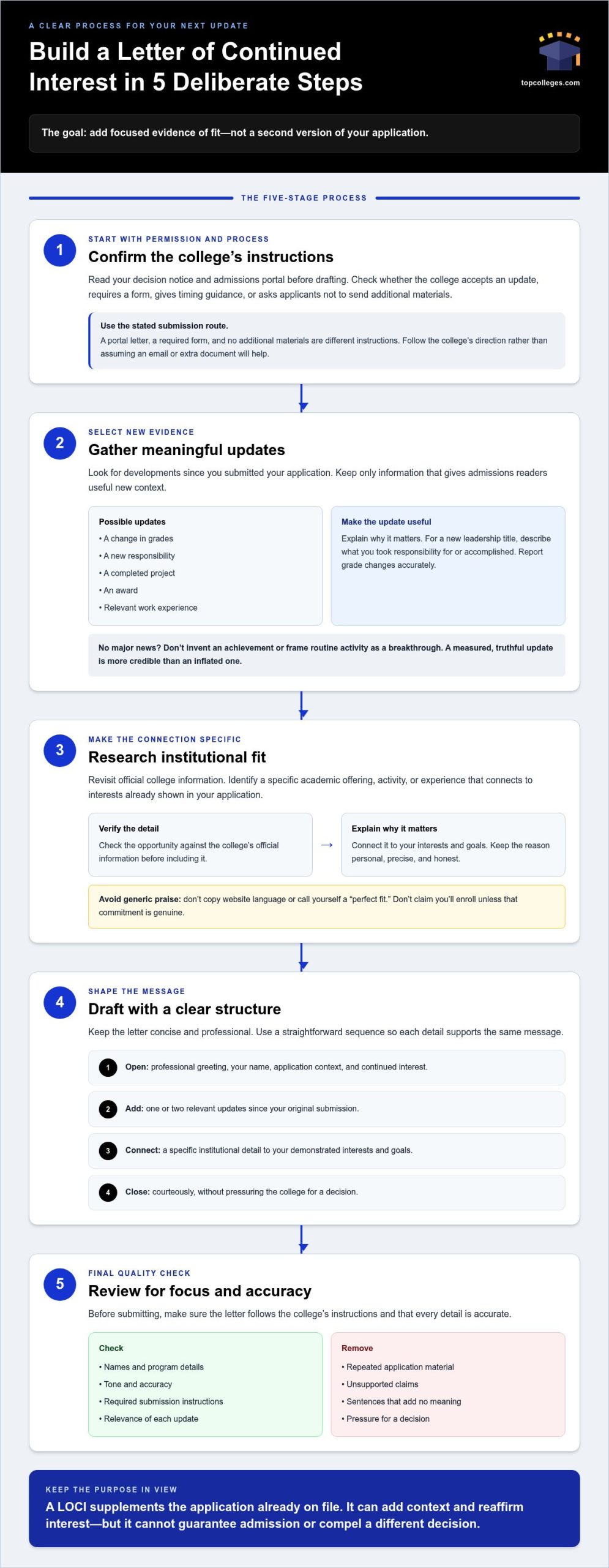
A strong LOCI is built through careful selection, not sheer volume. Use these five steps to decide what belongs in your message and how to present it clearly. They make how to write a letter of continued interest less about finding impressive language and more about choosing relevant evidence.
- 1. Confirm the instructions. Read the decision notice and admissions portal before drafting. Note whether the college accepts a letter, requires a form, sets a deadline, or asks applicants not to send extra materials. Use the stated submission route.
- 2. Gather meaningful updates. Identify developments since you submitted your application, such as a change in grades, a new responsibility, a completed project, an award, or relevant work experience. Keep only updates that give the admissions office useful new context.
- 3. Research institutional fit. Revisit the college’s official information and identify a specific academic offering, activity, or experience connected to interests already shown in your application. Verify the details, then explain why the connection matters to your goals.
- 4. Draft with a clear structure. Use a professional greeting, then open with your name, application context, and continued interest. Develop one or two relevant updates, connect your interest to a specific aspect of the institution, and close courteously.
- 5. Review for focus and accuracy. Check names, program details, tone, and compliance with the college’s instructions. Remove repeated application material, unsupported claims, and sentences that don’t add meaning.
Choose updates that add useful information
Explain why an update matters instead of simply listing it. For example, alongside a new leadership title, briefly describe what you took responsibility for or accomplished. If your grades improved, state the change accurately and, if relevant, mention the work behind it. If you have no major news, don’t invent an achievement or present routine activity as a breakthrough. A measured, truthful update is more credible than an inflated one.
Connect continued interest to specific institutional fit
Generic praise could apply to any college. Identify an accurately researched opportunity and explain how it relates to interests you’ve already demonstrated, rather than copying language from the school’s website or calling yourself a “perfect fit.” The University at Buffalo School of Law’s guide to a powerful letter of continued interest offers further guidance on components and examples. Keep your own connection personal, precise, and honest. Don’t claim you’ll enroll unless that commitment is genuine.
The letter should add relevant information, not repeat the application. If you’re unsure which updates advance your broader application narrative, personalized college admissions counseling can help you review how your materials work together.
What to Include in a LOCI, and What to Leave Out
A useful letter gives the admissions office a clear reason to keep your application in view: you remain interested, your candidacy has relevant context, and your interest connects to the institution in a specific way. Before drafting, check the school’s instructions about accepted materials and length. Use the framework below to make deliberate choices.
| Include | Use selectively | Leave out |
|---|---|---|
| A direct statement of continued interest, meaningful updates, a specific reason the school fits your goals, and a concise, courteous closing. | Brief context about an update, a reflection on recent learning, or an additional document, only when it adds relevant information and the college permits it. | Demands for a decision, repeated essays or résumé details, excessive attachments, unsupported claims, and generic praise that could describe any school. |
How to write when you have no major new achievement
No headline-worthy update doesn’t mean you need to manufacture one. Reaffirm your interest with a truthful, specific reason tied to your goals, such as how an academic opportunity connects with an interest already present in your application. A short reflection on recent learning can add context if it shows a genuine development in your thinking. If it doesn’t, leave it out. A focused letter with little new information is more credible than one padded with routine activity.
Tone, length, and details that shape credibility
Keep the message concise and polished, following any length guidance the college provides. If there’s no guidance, prioritize clarity over a word-count target: each paragraph should have a clear purpose. Write with confidence and respect, not urgency or pleading. Avoid overstatement, including calling yourself a “perfect fit” without evidence. For additional advice on how to write a letter of continued interest, the University at Buffalo School of Law offers guidance and examples.
Before submitting, check details that can undermine an otherwise thoughtful note:
- Confirm the college and program names, especially if you’re preparing letters for more than one school.
- Check dates, application identifiers, and contact details where relevant.
- Remove repeated content and verify every factual claim about the institution.
- Make sure any attachment is requested or allowed by the school’s process.
If your application has no major news, don’t add words to fill space. A concise, accurate message that clarifies your continued interest is stronger than an update that distracts from it.
When and How to Send a Letter of Continued Interest
Use the submission method the college specifies, not necessarily the one that feels most direct. Re-read your decision notice and check the admissions portal for current instructions before sending. A college may ask you to use a form, upload a document, or refrain from sending additional materials. Submit only what’s permitted, through the stated channel.
Timing calls for the same discipline. Respond promptly enough to share relevant information while it’s current, but don’t rush past the school’s directions or send repeated messages to signal urgency. If the college gives no deadline, general guidance often suggests sending an update within one to three weeks of receiving a waitlist or deferral decision. Treat that as a practical reference, not a universal rule; the school’s instructions take priority. After submitting, follow up only if the college requests it or provides a process for doing so.
A final review checklist before submission
Before sending, verify that the letter follows the college’s current instructions and any stated format or length limits. Make sure each update is accurate, relevant, and not already fully explained in your application. Check the school and program names, dates, and contact details. A trusted reader can flag unclear sentences, proofreading errors, or an overly forceful tone, while helping preserve your voice rather than rewriting it. These checks are a final safeguard in how to write a letter of continued interest responsibly.
Mistakes that can weaken an otherwise strong letter
Once your update is submitted, restraint matters. Repeated emails, unsolicited calls, or requests for special treatment can distract from the substance of your application. Avoid promises meant to pressure the admissions office, such as claiming you’ll enroll if that isn’t a genuine commitment. Don’t criticize another institution or suggest the college owes you a decision. A carefully prepared letter can clarify your continued interest, but it can’t override the college’s review process or available places, and it can’t guarantee an outcome.
- Before sending: Confirm the approved channel and permitted materials.
- After sending: Keep a copy for your records and wait unless the school gives you a reason to act again.
For individualized guidance on aligning an update with your broader application strategy, explore college admissions counseling.
Turn Your LOCI into a Coherent Part of Your Admissions Strategy
A letter of continued interest is most persuasive when it feels like a natural next chapter in the application already submitted. It should reinforce the student’s goals and priorities, not introduce a conflicting story just to sound impressive. Before sending it, compare each update with the academic interests, extracurricular commitments, and future direction presented in the original materials. Does the new information deepen that picture, or draw attention to something unrelated?
Align the letter with the application already submitted
Consider whether a new responsibility or recent project adds perspective to an interest the student has already demonstrated. For instance, a development may show how academic curiosity has grown through hands-on work. The letter doesn’t need to repeat the personal statement or résumé; it should give the admissions reader a useful new lens. Keep the student’s own voice and circumstances central. A polished message that sounds unlike the applicant can weaken the connection it is meant to strengthen.
Useful review isn’t about making every detail fit a predetermined narrative. It’s about checking that the letter remains consistent with the student’s stated interests while allowing room for genuine growth. For broader context on individualized planning, see this guide to college admissions counseling strategy and this resource on college essay strategy.
Know when thoughtful review can help
A second perspective can help when you’re unsure which developments deserve emphasis, whether the letter’s tone feels measured, or how it fits with the application as a whole. Personalized admissions counseling can help clarify those choices and refine structure, tone, and strategic coherence while keeping the student’s perspective intact. At Top Colleges, educational consultant Steven Roy Goodman leads personalized admissions strategy and portfolio development, helping students connect their materials to a broader application narrative.
This kind of review is especially useful when several updates compete for space. The goal isn’t to make the letter sound more elaborate; it’s to identify what genuinely adds value and remove what distracts. A focused review can clarify the student’s reasoning without replacing the student’s voice.
To consider how to write a letter of continued interest as part of a thoughtful application strategy, ask whether each update supports the same clear picture of the applicant. If you’d like individualized help assessing that picture, explore personalized admissions guidance.
Make Your Next Update Count
A letter of continued interest works best when it strengthens the application already on file. Follow the college’s instructions, share only relevant developments, and connect your continued interest to specific goals and institutional fit. That’s the core of how to write a letter of continued interest: add useful context without repeating your original materials or trying to control the decision.
Before sending, consider whether every detail advances the same clear picture of the applicant. If you’re uncertain which updates deserve emphasis, personalized admissions guidance can help align the letter with the broader application strategy. At Top Colleges, admissions counseling led by educational consultant Steven Roy Goodman includes personalized admissions strategy and portfolio development.
You can’t determine the admissions outcome, but you can make your communication thoughtful, focused, and true to your goals. Take the next step with care and confidence.
Frequently Asked Questions
Is a letter of continued interest the same as a letter of appeal?
No. A letter of continued interest generally confirms that you remain interested after a deferral or waitlist decision and may share relevant updates. An appeal asks the institution to reconsider a decision and typically follows a separate, specific process. Read the decision notice and the college’s instructions carefully. Sending a LOCI doesn’t substitute for an appeal, and an appeal shouldn’t be treated as a continued-interest update.
Can I send a letter of continued interest if I have no new achievements?
Yes, if the college accepts additional correspondence. You can explain honestly why the school remains a strong fit for your goals, even without a major new accomplishment. If you’re considering how to write a letter of continued interest in this situation, keep it concise and avoid inventing achievements or inflating routine activities. Don’t repeat details already clear in your application, and follow the institution’s submission instructions.
How long should a letter of continued interest be?
There’s no universal length that applies to every college. Follow any word-count or format limits in the school’s instructions, then focus on continued interest and meaningful information. A concise letter is usually more effective than a long one that repeats application materials or adds unrelated background. Review each paragraph and remove details that don’t explain your interest or provide useful context.
When should I send a letter of continued interest?
Check the decision notice and admissions portal first for timing instructions. If the college permits a letter but doesn’t provide a deadline, send it in a timely, considerate manner rather than relying on a universal date. Timing can differ by institution and decision type. After submitting, don’t send repeated messages simply because you haven’t received an immediate response. Follow up only if the school requests it or gives specific guidance.
What should I include in a letter of continued interest?
Include a professional greeting, a clear statement that you remain interested, relevant updates since applying, and a concise closing. Explain how a meaningful update connects to your goals, and refer to specific school offerings only when you’ve researched them accurately. Keep the tone respectful and appreciative. Proofread names, program references, dates, and contact details, then submit through the channel the institution specifies. Don’t add attachments unless requested or permitted.
Can a letter of continued interest get me off a college waitlist?
A thoughtful letter can communicate genuine interest and add relevant context, but it can’t guarantee admission or control the outcome. The college makes decisions through its own review process and according to its circumstances, including available places. Treat the LOCI as a permitted supplement to your application, not a promise of admission. Make it accurate, concise, respectful, and consistent with the school’s instructions.
Should I send a letter of continued interest after being deferred?
You may send one if the college accepts updates from deferred applicants. Read the deferral notice and portal instructions first, since the school may specify a form, submission channel, or schedule for additional information. Use an accepted update to share meaningful developments and reaffirm genuine interest. Don’t restate your application in different words, and don’t send extra materials if the college asks applicants not to do so.