

Disclaimer
Content on this page of topcolleges.com is computer generated and therefore is not guaranteed to be 100 percent accurate about various aspects of the education sector. On balance, however, many students and families seek general information about high schools, colleges and universities, graduate programs, testing, education and career planning, and job placement before beginning one-on-one admissions counseling tailored to their specific needs.
What if the strongest college admissions interview answer isn’t the most polished one, but the most thoughtful and genuinely yours? Preparing for a college admissions interview can feel uncertain when you don’t know what you’ll be asked, what you should ask in return, or how much the conversation may influence your application. A focused plan helps you prepare without memorizing a script.
An interview is one part of an admissions process, and its format, purpose, and weight vary by college. Some conversations help admissions teams learn more about you; others give you a chance to understand the school. Find out which kind of conversation to expect so you can prepare without treating the interview as a performance or a guaranteed turning point.
This guide explains how to understand the interview’s role, develop specific answers grounded in your interests and experiences, and prepare questions that show genuine curiosity. You’ll also learn how to approach in-person and virtual conversations. Use preparation to connect your story to your broader application strategy, then enter ready to have a real conversation.
Key Takeaways
- Start preparing for a college admissions interview by clarifying its purpose and checking the college’s official guidance.
- Research academic interests and campus opportunities, then connect what you learn to your own reasons for applying.
- Shape answers around a clear point, a specific example, and what the experience means to you.
- Practice aloud and refine your ideas without memorizing a word-for-word script.
- Use interview examples to add context to your application while keeping your interests, experiences, and goals consistent.
Preparing for a College Admissions Interview Starts with Knowing Its Purpose
Feeling nervous before an admissions interview is understandable. The uncertainty can make it tempting to script every answer, but a practical plan is more useful than a polished performance. Start by finding out what the interview may contribute, who might conduct it, and what the college expects from you.
A college admissions interview is a conversation that may give an interviewer additional context about an applicant’s interests, experiences, and perspective. It can also give you a chance to ask questions and learn about the institution. Its role sits within the broader college admissions process, not apart from it.
What does a college admissions interview assess?
There’s no universal interview format or scoring rubric. Depending on the college, the conversation may involve an admissions representative, an alumnus, or another interviewer, and its purpose may differ. An interviewer may learn how you communicate, what you’re curious about, and how thoughtfully you reflect on your experiences. You don’t need a perfect answer to every question; a specific example and a clear explanation of what you learned are more useful than a rehearsed response.
A college admissions interview is a conversation that may help a college understand an applicant beyond the written application, while giving the applicant a chance to learn about the school.
How much does a college interview matter?
An interview’s significance depends on the institution and, in some cases, the application cycle. Interviews may be available to some applicants but not others, offered in person or virtually, or omitted altogether. Even when a college provides an interview, its place in the decision process can vary. Don’t assume it’s required, equally available, or weighted the same at every school.
Check the college’s current official admissions instructions before making plans or interpreting an interview invitation. Look for whether interviews are offered, whether you need to request one, and what the school says about the interview’s purpose. Policies can change, so use guidance for your application cycle rather than advice based on another year or institution.
Preparing for a college admissions interview can help you communicate your experiences clearly and take part in a more thoughtful exchange. It can’t control the admissions decision, and no single conversation should be treated as a guarantee. Focus on what you can influence: understand the format, decide which experiences you want to discuss, and arrive ready to listen as well as respond.
Research the College and Interview Format Before You Practice
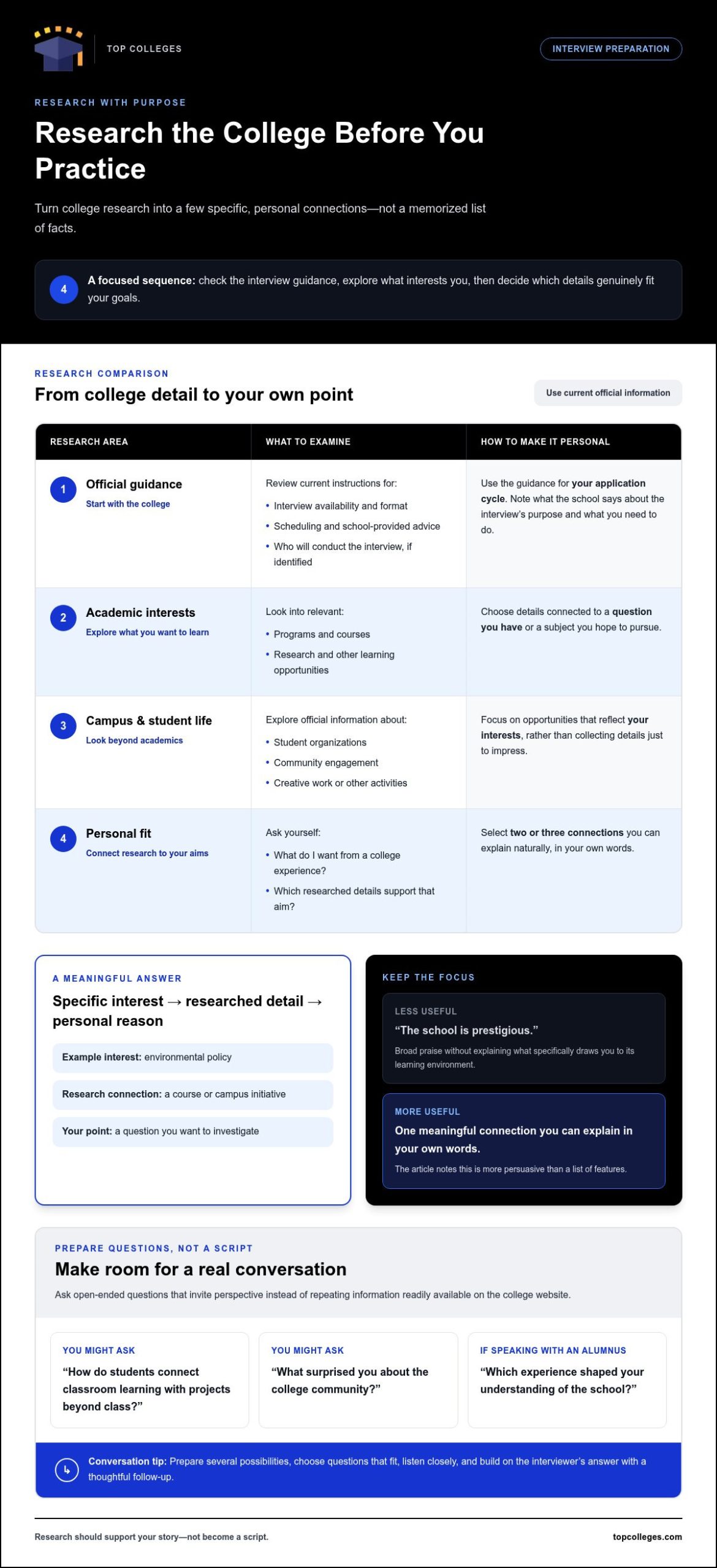
Once you understand the interview’s possible role, research the specific college and the format you’ll encounter. This shifts preparation from generic answers to a grounded conversation about why the school interests you and what you hope to explore there. Use this sequence to focus your research:
- 1. Read the official admissions guidance. Review current instructions for interview availability, format, scheduling, and any advice the college provides. Note who will conduct the conversation if the school identifies the interviewer.
- 2. Explore academic interests. Look into relevant programs, courses, research, or other learning opportunities. Choose details connected to questions you have or subjects you hope to pursue.
- 3. Examine campus opportunities and student experiences. Explore official information about student organizations, community engagement, creative work, or other activities that reflect your interests.
- 4. Assess personal fit. Ask what you want from a college experience and which researched details support that aim. Select two or three connections you can explain in your own words.
What should you research about the college?
Choose details that help you explain your interests, not facts you’ve collected simply to impress. For example, if you’re curious about environmental policy, a course or campus initiative may prompt you to describe a question you want to investigate. Avoid broad praise such as “the school is prestigious” unless you can explain what specifically draws you to its learning environment. One meaningful connection is more persuasive than a list of features.
Your research should support the larger application narrative, not sit apart from it. A thoughtful college admissions counseling strategy can help you connect your goals, experiences, and college choices into a coherent picture.
How do you prepare questions for an interviewer?
Prepare open-ended questions that invite perspective rather than repeat information readily available on the college’s website. You might ask how students connect classroom learning with projects beyond class, or what surprised the interviewer about the college community. If speaking with an alumnus, ask which experience shaped their understanding of the school. Prepare several possibilities, then choose questions that fit the conversation. Listen closely and build on the interviewer’s answer; a thoughtful follow-up is often more engaging than moving through a prepared list.
Preparing for a college admissions interview is easier when your research gives you a few meaningful ideas, not a script. Top Colleges offers personalized college admissions guidance to help students connect interview preparation with the rest of their application planning.
Build Authentic Answers to Common College Interview Questions
Interview questions often explore familiar ground: what interests you, which experiences have shaped you, why you’re considering the college, how you’ve handled a challenge, and what you hope to pursue. You don’t need to predict every question. Instead, identify experiences you can discuss thoughtfully and adapt to the conversation.
Use a flexible structure: make a point, give a specific example, and reflect on what it means. If you’re asked about an interest, name what draws you to it, describe a project or moment that deepened your curiosity, then explain what you’d like to explore next. This gives your answer substance without turning it into a memorized speech.
How should you answer “Tell me about yourself”?
Think of this as an invitation to offer a brief introduction, not a request to recite your résumé. Choose one or two details that reveal an interest, a meaningful experience, or a question you’re exploring academically. An applicant interested in history, for example, might mention researching how a particular event is represented in different sources and explain what questions the project raised. End with a natural opening for follow-up, such as what you hope to investigate next.
Preparing for a college admissions interview means knowing which parts of your story you want to share while leaving room for the interviewer’s questions. Aim for a response that sounds considered, not overproduced.
How do you discuss challenges, strengths, and college fit?
For a challenge, choose a real experience you’re comfortable discussing. Focus on the choices you made, what you learned, and how your perspective changed. When describing a strength, support it with evidence: instead of simply calling yourself collaborative, explain how you helped a group organize its work or respond to differing ideas.
For “Why this college?” connect a genuine academic or campus interest to what you hope to do there. Avoid declaring that the school is perfect or forcing every answer into a fit narrative. If you’re developing the personal stories behind your application, the college essay strategy guide offers related perspective. Keep your responses conversational, and use follow-up questions to add context rather than repeating an essay aloud.
Top Colleges’ personalized college admissions counseling can help you refine interview answers around your experiences and goals, then connect those answers to the broader application.
Practice Your College Interview Without Sounding Rehearsed
Practice should make you more responsive, not more scripted. A useful routine helps you organize your thoughts while leaving room to listen, pause, and answer the question actually asked.
- Outline key ideas. For likely topics, jot down a few themes and examples rather than writing full responses.
- Rehearse aloud. Explain each idea in your own words. Try different phrasings so the answer feels conversational.
- Get feedback. Ask a trusted listener to flag answers that are unclear, too long, or missing reflection. Recording yourself can also reveal habits you may not notice in the moment.
- Refine, then repeat. Keep the central point, but adjust the wording and level of detail. Practice follow-up questions by considering why each example matters to you.
How can you practice answers naturally?
Don’t aim to reproduce the same sentence every time. If you’re discussing a meaningful project, be ready to explain what drew you to it, what you did, and what you learned. That preparation makes it easier to respond when an interviewer asks a different question about the same experience. During practice, focus on concise answers, attentive listening, and a brief pause to gather your thoughts. A pause is fine. You can also ask for clarification if a question is genuinely unclear.
What should you do on interview day and afterward?
Before the conversation, review the college’s instructions for timing, location or meeting access, clothing expectations, and any materials to bring. For a virtual interview, follow the school’s directions and test your setup in advance. For an in-person meeting, confirm the location and plan how you’ll get there. Expectations can differ by format, so use the current official guidance rather than assuming every interview works the same way.
During the interview, listen through the question, answer its central point, and let the conversation develop naturally. You don’t need to fill every quiet moment. If appropriate, send a brief, courteous thank-you afterward. Then note what you discussed, questions that came up, and anything you’d handle differently next time. These reflections can help you carry useful insights into the rest of your application process.
Preparing for a college admissions interview is about building readiness, not memorizing a performance. Individualized preparation can help you shape your approach around your experiences and goals.
Turn Interview Preparation into a Coherent Admissions Strategy
An interview is one part of an application, not a separate story to invent. It can add dimension by showing what motivated an activity, how your thinking developed, or why a particular academic interest matters to you. Aim to deepen the picture your application already presents rather than repeat it line by line.
How should interview answers connect with the application?
Review your essays, activities, and stated academic interests before the interview. Note the themes that already come through clearly, then choose an example that offers a fresh angle. If an essay describes a research project, for instance, you might talk about the question that first caught your attention or what you would investigate next. Keep the underlying facts and motivations consistent, but let the conversation add context that written materials may not capture.
Consistency doesn’t mean giving identical answers everywhere. It means your interests, experiences, and reasons for applying make sense together. If you’re considering environmental policy, your activities, academic curiosity, and explanation of college fit should reflect a genuine connection to that interest, not a claim assembled for the interview. For a wider view of how application components work together, explore this college admissions counseling strategy.
When can individualized interview preparation help?
Sometimes students have meaningful experiences but aren’t sure which ones best illuminate their priorities. Guided reflection can help identify examples that show how they think, what they value, and what they hope to pursue. Feedback can sharpen an answer’s focus, clarify its meaning, or help a student speak more concisely without dictating their personality or turning the conversation into a script.
Preparing for a college admissions interview as part of a broader application strategy can also reveal gaps between what you say in conversation and what your written materials communicate. Treat that as useful information: refine the connection so it reflects your real goals, rather than forcing a perfect-sounding narrative. Top Colleges’ personalized admissions counseling helps students bring their experiences and application materials into clearer alignment, with interview preparation tailored to their individual goals.
Approach Your Interview with Purpose and Confidence
A strong interview doesn’t depend on a flawless performance. It grows from preparation that helps you understand the college, choose meaningful examples, and respond thoughtfully instead of reciting memorized answers. Check the school’s current instructions, then use practice to clarify your ideas and stay present in the conversation.
Keep your interview connected to the rest of your application. Your answers can add perspective to your essays and activities while reinforcing the interests, experiences, and goals that genuinely matter to you. Preparing for a college admissions interview can help you communicate that story with greater confidence, even though no preparation can control an admissions decision.
Top Colleges, led by educational consultant Steven Roy Goodman, provides personalized admissions counseling and interview preparation for families across the United States and for international students developing their broader admissions strategy.
Take the next step with a clear plan, an authentic perspective, and confidence in the story only you can tell.
Frequently Asked Questions
What questions are commonly asked in a college admissions interview?
Common questions invite you to discuss your interests, experiences, reasons for applying, challenges, and future goals. You might be asked, “What do you enjoy learning about?” or “Why are you interested in this college?” Prepare examples that help explain your thinking, but don’t assume every interviewer will use the same questions. The format and focus can differ by institution and interviewer, so practice adapting your ideas to the conversation.
How should I prepare for a college admissions interview?
Prepare by reviewing the college’s current official interview instructions, researching academic and campus opportunities that genuinely interest you, and reflecting on experiences you may want to discuss. Outline key points rather than writing a script. Rehearse aloud with a trusted listener or record yourself, then refine answers that feel unclear or overly long. Prepare a few open-ended questions for the interviewer and check practical arrangements before interview day.
Is a college admissions interview required?
Not always. Interview availability and requirements vary by institution and application cycle, and some colleges may not offer interviews to every applicant. Review the current admissions instructions on each college’s official website to find out whether an interview is required, optional, or unavailable, and whether you need to request one. Don’t rely on another applicant’s experience or older advice, since procedures can differ between schools and change over time.
How important is a college admissions interview?
The interview’s importance varies by college, so there’s no single measure that applies everywhere. Some institutions use it to learn more about an applicant, while others may frame it as a chance for the student to learn about the school. A thoughtful conversation can help you communicate your interests and experiences, but it can’t control an admissions decision or guarantee an outcome. Focus on preparing clearly and participating attentively.
Can I bring notes to a college admissions interview?
You may be able to bring brief notes, but expectations depend on the interview format and the college’s instructions. Notes can help you remember questions or key topics, but reading prepared answers can make the conversation feel less natural. Check official guidance first. If notes are appropriate, use a short list of prompts, such as a question about an academic opportunity, rather than a written script.
What should I wear to a college admissions interview?
Choose neat, comfortable clothing that suits the setting, and follow any specific guidance from the college or interviewer. There isn’t one universal dress code for every interview, especially across different formats and institutions. For a virtual conversation, consider how your clothing and background appear on screen; for an in-person meeting, plan an outfit that lets you focus on the discussion. Check the instructions rather than guessing about formal expectations.
Should I send a thank-you note after a college interview?
A brief, courteous thank-you is a thoughtful follow-up when appropriate, though you should follow any instructions the college provides. Refer to a specific part of the conversation, such as an insight the interviewer shared, rather than sending a generic message. Keep it concise and professional. Afterward, note what you learned and any questions the conversation raised for your application planning. For personalized help connecting interview preparation with your broader application, explore Top Colleges’ admissions counseling.