

Disclaimer
Content on this page of topcolleges.com is computer generated and therefore is not guaranteed to be 100 percent accurate about various aspects of the education sector. On balance, however, many students and families seek general information about high schools, colleges and universities, graduate programs, testing, education and career planning, and job placement before beginning one-on-one admissions counseling tailored to their specific needs.
If a chatgpt college essay grader awards your personal statement a perfect score, you have likely failed the most critical test of elite admissions. It is a seductive trap. When you are facing the immense pressure of a November deadline and lack immediate access to high level counsel, a high numerical grade feels like a strategic lifeline. You want certainty that your story is compelling, yet you fear that your writing might disappear into the sea of generic, polished applications. We understand that anxiety. It is the natural byproduct of a system where the “correct” answer is often the most forgettable one.
This article reveals the strategic risks of relying on algorithmic feedback and explains how to preserve the human spark required for Ivy League acceptance. You will discover why a machine can measure syntax but never the depth of your character. We will examine the gap between “correct” writing and “competitive” writing, providing a clear roadmap to ensure your narrative stands out from thousands of other high achieving applicants. It is time to move beyond the illusion of accuracy and embrace the tactical vulnerability that wins seats at the world’s most prestigious institutions.
Key Takeaways
- Understand why a chatgpt college essay grader often encourages a “regression to the mean” that can make elite applications appear dangerously generic.
- Learn the critical difference between “balanced” writing that satisfies an algorithm and the “spikes” of brilliance that Ivy League admissions officers prioritize.
- Discover how to utilize generative tools for structural brainstorming without sacrificing the authentic, vulnerable voice essential for a successful personal statement.
- Identify the unspoken requirements of elite admissions that require human strategic blueprinting rather than simple grammatical correctness.
- Explore why high-level portfolio development and interview preparation remain the true differentiators in a landscape saturated with AI-assisted essays.
The Allure and Illusion of the ChatGPT College Essay Grader
A chatgpt college essay grader is essentially a sophisticated interface for Automated Essay Scoring (AES). These tools use Large Language Models to evaluate text against a set of inferred admissions rubrics. They offer a seductive promise. To a student facing the immense pressure of the 2026 admissions cycle, instant and quantifiable validation feels like a strategic lifeline. A high numerical score provides a momentary reprieve from the weight of uncertainty. However, this clarity is often a dangerous mirage. It replaces genuine self-reflection with a hollow metric that lacks the nuance of an Ivy League admissions committee.
The data gap is the primary reason these scores fail. AI models are trained on historical datasets; they are reflections of what has worked in the past. They cannot account for the real-time shifts in institutional priorities that define the current year. Elite admissions is not a static game of checking boxes. It is a dynamic environment where “objective” perfection often results in a generic rejection. When an algorithm gives you a perfect score, it is usually because you have followed the most predictable path possible.
Why Students Are Turning to AI Feedback
The democratization of feedback has led to a widespread dilution of quality. According to research from August 2026, 95% of students now use AI to assist with assessed work. Many turn to a chatgpt college essay grader to overcome the paralysis of the blank page. They seek the comfort of a numerical rubric to confirm they are on the right track. This creates a false sense of security. A rubric might reward a clear structure while ignoring the fact that the essay lacks the “human spark” required for a top tier acceptance. It prioritizes the safe over the significant.
The Fundamental Flaw of Algorithmic Evaluation
Algorithms function by predicting the most statistically probable next word. This mathematical necessity leads to prose that is inherently predictable. AI does not have lived experience. It cannot recognize genuine emotional resonance or the subtle intellectual risk taking that catches an admissions officer’s eye. Instead, AI often “hallucinates” strengths in essays that are syntactically correct but substantively empty. It praises the “flow” of a narrative that has been sanitized of its unique personality. In the competitive landscape of 2026, sounding like a high quality average is the fastest way to be forgotten.
Why AI Scores Often Miss the Elite Admissions Mark
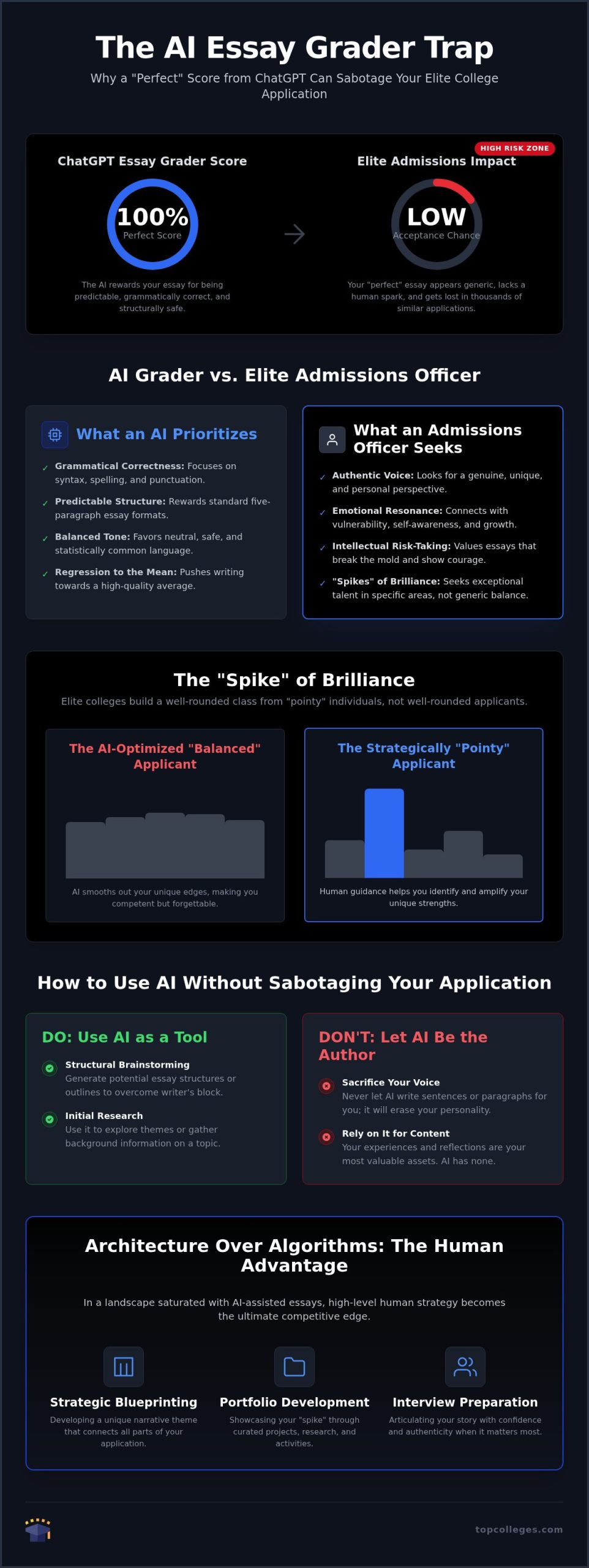
Elite admissions is a game of outliers, not averages. A chatgpt college essay grader functions on the principle of regression to the mean. It identifies linguistic patterns that are statistically safe, effectively smoothing over the jagged edges of a student’s personality to fit a predictable model. While this might result in a high score from a machine, it’s often a death sentence in a competitive admissions office. Admissions officers at institutions like Princeton or Stanford aren’t looking for a well-rounded applicant. They’re looking for a well-rounded class composed of “pointy” individuals. AI optimizes for balance, while the Ivy League rewards the “spike.”
This push toward the middle creates “AI-isms.” You’re left with blocks of prose that are grammatically flawless yet emotionally sterile. Because these models are trained on existing data, they cannot produce truly innovative narrative arcs that break traditional molds. They favor the expected. Elite institutions reject essays that sound perfect but feel hollow because they lack the specific, lived vulnerability that defines a singular human perspective. If your essay doesn’t take a risk, it isn’t doing its job.
The Difference Between Grammar and Narrative
AI is excellent at syntax but blind to subtext. It can fix a misplaced comma, but it cannot feel the weight of a silence or the irony in a self-deprecating joke. Some of the best college essays ever written contain minor technical imperfections that actually serve to heighten the reader’s sense of the author’s authenticity. A technically flawed but emotionally raw essay often beats a “perfect” AI-graded one because it demonstrates a level of self-awareness that a machine cannot simulate. Narrative is about the “why,” not just the “how.” While a machine verifies that your subject-verb agreement is correct, it cannot understand the cultural context of your metaphors or the subtle pacing of a revelation.
Rubrics vs. Holistic Review
Admissions committees don’t just check boxes; they build a class “mosaic.” They’re looking for specific institutional fits, diversity of thought, and program-specific needs that no chatgpt college essay grader can account for. The algorithm doesn’t know that a particular department is looking for more collaborative leaders this year or that a specific life experience is currently underrepresented in the applicant pool. Admissions committees are building a community. They aren’t just looking for high achievers; they’re looking for specific characters who will interact in a dynamic way. This level of curation is entirely invisible to a machine. Most importantly, AI can never answer the “So What?” factor. It can tell you if your writing is clear, but it cannot tell you if your story actually matters to the human being reading it. Developing that level of resonance requires expert admissions counseling that transcends simple proofreading.
Human Strategic Insight vs. Algorithmic Feedback
Human strategy is proactive; algorithmic feedback is reactive. A chatgpt college essay grader can only evaluate the words you have already committed to the page. It cannot tell you what you have omitted or identify the hidden strengths you haven’t yet dared to share. Professional admissions counseling functions as a strategic mastermind, identifying the “unspoken” requirements that Ivy League committees use to filter thousands of qualified applicants. While an AI might provide a score based on general clarity, a human mentor uses decades of experience to push you toward the profound self-discovery that truly moves an audience. This level of insight is not found in a database; it is earned through years of seeing the inner workings of competitive systems.
High-level reflection is the cornerstone of a successful application. It replaces the mechanical “check-box” mentality with a methodical blueprint for success. A seasoned mentor asks the difficult, probing questions that lead to a narrative only you can tell. This is the fundamental difference between a technically proficient essay and a transformational one. Machines optimize for what is common, but we optimize for what is exceptional.
The Cultural Nuance of Top-Tier Schools
Every elite institution possesses a distinct institutional DNA. An essay that resonates with the intellectual playfulness of the University of Chicago might fall flat against the civic-minded pragmatism of Harvard. No chatgpt college essay grader can quantify these cultural nuances. Strategic counseling identifies the specific “intellectual spark” that a particular committee craves. We look for the subtle alignment between your personal values and the university’s contemporary mission, a task that requires deep industry foresight rather than statistical probability.
Portfolio Integration
Integrating your narrative into a larger portfolio requires a holistic view that machines simply lack. An AI sees only the text you paste into its interface. It cannot see how your narrative complements your letters of recommendation or balances your extracurricular resume. We ensure your voice remains consistent across all admission essay prompts, creating a cohesive story that feels intentional and authoritative. To see how this human-centered approach translates into acceptance, you can analyze college essays that worked in previous cycles. These examples demonstrate that the most successful applicants are those who prioritize strategic blueprinting over algorithmic validation.
How to Use AI Without Sabotaging Your Application
Total avoidance of generative tools is an impractical strategy in the current admissions landscape. With nearly universal adoption of these platforms, the challenge isn’t whether to use them, but how to do so without eroding your competitive edge. You must adopt a disciplined framework that treats technology as a diagnostic assistant rather than a creative architect. The goal is to leverage efficiency while shielding the specific character traits that elite institutions demand. It’s a delicate balance that requires tactical foresight. You don’t want to be the applicant whose voice was flattened by a machine.
Rule 1: Use AI for structural brainstorming, never for the final “voice.” Your personal statement must sound like you, not a statistically probable version of you. Rule 2: Treat any feedback from a chatgpt college essay grader as a “generic reader” test. If the algorithm loves your essay, it is likely because you’ve written something too safe for an elite committee. Rule 3: Always verify AI claims. Hallucinations regarding school-specific requirements or historical facts can disqualify an otherwise strong application. Finally, employ the “Reverse AI Test.” If an AI can easily replicate your narrative arc, you haven’t shared enough specific, lived experience to be memorable.
Safe Applications for Large Language Models
This tactical use of technology extends beyond writing; for example, students can utilize Neuronity to master complex academic subjects through personalized, AI-generated courses, helping them build the intellectual depth that elite admissions committees value in a ‘pointy’ applicant profile.
The “Red Zone” of AI Usage
The most significant risk occurs when you allow a machine to “rewrite for tone.” This is where the human soul is lost. AI-generated metaphors and personal anecdotes feel hollow because they lack the weight of actual experience. Admissions officers are trained to spot the sterile language that signals a lack of authenticity. Equally dangerous is relying on a chatgpt college essay grader to predict your chance of admission. This is a dangerous and baseless metric. It ignores the holistic “mosaic” building that defines elite selection processes. True strategic positioning requires a human mastermind who understands the unspoken priorities of the current cycle. To sharpen your instincts for what genuinely resonates, reviewing examples of college essays that command attention in 2026 can provide a diagnostic framework for understanding the narrative architecture that elite committees actually reward.
The Top Colleges Approach: Architecture Over Algorithms
Elite admissions is an exercise in architectural precision, not just grammatical correctness. While a chatgpt college essay grader can verify the integrity of your sentences, it cannot construct a comprehensive strategic blueprint for your future. Steven Roy Goodman brings over 25 years of experience to this high-stakes process, focusing on the nuances that an algorithm is programmed to ignore. We don’t just check boxes. We build a narrative that positions you as a singular candidate within a global applicant pool. This is a high-stakes investment in your long-term trajectory. The goal is not merely acceptance; it’s the realization of your highest aspirations.
Admissions is ultimately about connection. You cannot connect an algorithm to a committee. You can only connect a person to a mission. In an era where every applicant has access to “perfect” syntax, the true differentiators are the elements that a machine cannot replicate. This is why we prioritize high-level portfolio development and sophisticated interview preparation. These components ensure that your human spark is undeniable and that your narrative remains consistent across every touchpoint of the application. You are more than a score on a rubric; you are a strategic asset to an elite community.
Strategic Mastery for 2026
How do you navigate a post-AI landscape where admissions officers are increasingly skeptical of over-polished prose? You do it through active movement and careful positioning. We translate your unique history into a command-level personal statement that captures the attention of the world’s most selective committees. This requires a deep understanding of institutional priorities that no chatgpt college essay grader can provide. We move beyond the “what” of your accomplishments to articulate the “how” and “why” of your future contributions. It’s about demonstrating the intellectual depth and foresight that define a true leader.
Your Next Tactical Step
Self-reflection is the most powerful tool in your admissions arsenal. It is the bridge between being an anxious applicant and becoming a strategic candidate. You must move beyond the illusion of accuracy provided by automated tools to embrace the tactical vulnerability that Ivy League institutions reward. This transition requires a shift in mindset from passive participation to proactive planning. It’s time to replace uncertainty with a methodical roadmap for success. You have the story; we have the strategy to ensure it is heard.
Mastering the Human Element in Elite Admissions
The path to a prestigious institution is paved with authenticity, not automation. You’ve seen how relying on a chatgpt college essay grader risks sanitizing the very traits that make your application competitive. While AI provides a baseline of correctness, it lacks the foresight to navigate the shifting priorities of Ivy League, Law, MBA, or Medical school admissions. It is a mirror of the past; it’s not a map for your future. Elite committees don’t want a balanced average. They want the “spike” of brilliance that only a human narrative can provide.
True success requires a strategic mastermind who can translate your lived experience into a command-level narrative. Steven Roy Goodman brings over two decades of success to this high-stakes process, offering the specialized guidance that an algorithm simply cannot simulate. Why settle for a machine’s approval when you can have a nationally recognized expert’s strategy? It’s time to stop checking boxes and start architecting a legacy that stands out from the thousands of other high achieving applicants. Studying examples of college essays that command attention through a tactical admissions lens is one of the most effective ways to understand what separates a forgettable application from a transformational one.
Your future is too important to leave to a statistical average. Take the next tactical step toward your aspirations today and embrace the clarity of professional preparation.
Frequently Asked Questions
Can colleges detect if I used a ChatGPT college essay grader?
Yes, many elite institutions now employ sophisticated detection protocols. For example, BYU explicitly utilizes detection software, and the University of California system’s plagiarism checks are calibrated to flag AI-generated patterns. Even without technical tools, experienced admissions officers can often sense the sterile, over-polished cadence that a chatgpt college essay grader produces. Authentic human voice is exceptionally difficult for an algorithm to simulate convincingly.
Is a high AI essay score a guarantee of admission?
A high numerical score is never a guarantee of acceptance. AI evaluates linguistic correctness and structural adherence, but it cannot measure your potential contribution to a specific campus community. Admissions committees look for “pointy” candidates who offer a unique institutional fit. A machine might award you a perfect grade for syntax while a human committee sees a candidate who lacks the necessary intellectual spark.
How can I make my essay sound human after using AI for editing?
You must prioritize specific, non-obvious lived experiences that a machine cannot predict. Replace general statements with sensory details and internal monologues that reveal your unique thought process. Tactical vulnerability is your greatest asset in this process. If an algorithm can guess your next sentence with high probability, you haven’t shared enough of your true, idiosyncratic self yet.
What is the biggest mistake students make when using AI for their personal statement?
The most significant error is allowing an AI tool to “rewrite for tone.” This process strips away the subtle idiosyncrasies and linguistic “imperfections” that define your personality. When you outsource your voice, you lose the human connection that is the foundation of a successful application. It results in a regression to the mean that makes your story indistinguishable from thousands of others.
Does ChatGPT understand the specific prompts for the 2026-2027 application cycle?
While the latest GPT-5.6 models have access to current data, they lack the strategic foresight required for the 2026-2027 cycle. They cannot predict the real-time shifts in institutional priorities or the specific nuances a committee is seeking this year. A chatgpt college essay grader functions as a rearview mirror; it’s not a tactical roadmap for the contemporary admissions landscape.
What happens if two students use the same AI tool for the same prompt?
You risk submitting an essay that is statistically similar to a competitor’s. Because generative tools rely on probability, they often produce nearly identical metaphors and structures for the same prompt. This lack of differentiation is a major red flag for admissions officers. It signals a lack of effort and a failure to engage in the deep self-reflection required for elite entry.
Can AI help with the “Why This College” supplemental essays?
AI can gather basic facts about a university, but it cannot articulate why those facts matter to your specific trajectory. A successful supplemental essay requires a personal synthesis of your goals and the school’s resources. A machine provides a generic list; a strategic candidate provides a compelling vision. It is the difference between reading a brochure and presenting a personalized blueprint.
Why do admissions officers prefer “imperfect” essays over AI-polished ones?
Minor technical imperfections often signal a genuine, developing human voice. Admissions officers are looking for growth, self-awareness, and authenticity rather than robotic perfection. An essay that is too polished often feels manufactured and hollow. They would much rather read a raw, honest reflection than a sanitized piece of prose that has been flattened by an algorithmic filter.