

Disclaimer
Content on this page of topcolleges.com is computer generated and therefore is not guaranteed to be 100 percent accurate about various aspects of the education sector. On balance, however, many students and families seek general information about high schools, colleges and universities, graduate programs, testing, education and career planning, and job placement before beginning one-on-one admissions counseling tailored to their specific needs.
What if the most dangerous threat to your Ivy League aspirations isn’t a low test score or a missed deadline, but a fundamental failure in your narrative architecture? You have spent years curating a profile of excellence; yet, the anxiety remains that the “black box” of holistic review will overlook your potential because of one strategic misstep. It’s a valid concern in a landscape where the Common App has reported over 7.5 million applications and acceptance rates at elite institutions continue to tighten. You deserve more than generic checklists that fail to account for the nuances of high-level evaluation.
This guide provides the tactical mastery required to identify and neutralize the specific college application mistakes to avoid that often negate the hard work of high-achieving students. We understand the weight of these milestones and the frustration of navigating conflicting advice. Our approach replaces uncertainty with a structured, results-oriented methodology. We will move beyond simple clerical errors to explore the strategic alignment necessary for the 2026 admissions cycle. By the end of this analysis, you will possess the insight needed to build a flawless, commanding narrative that resonates with admissions committees and positions you ahead of the competition.
Key Takeaways
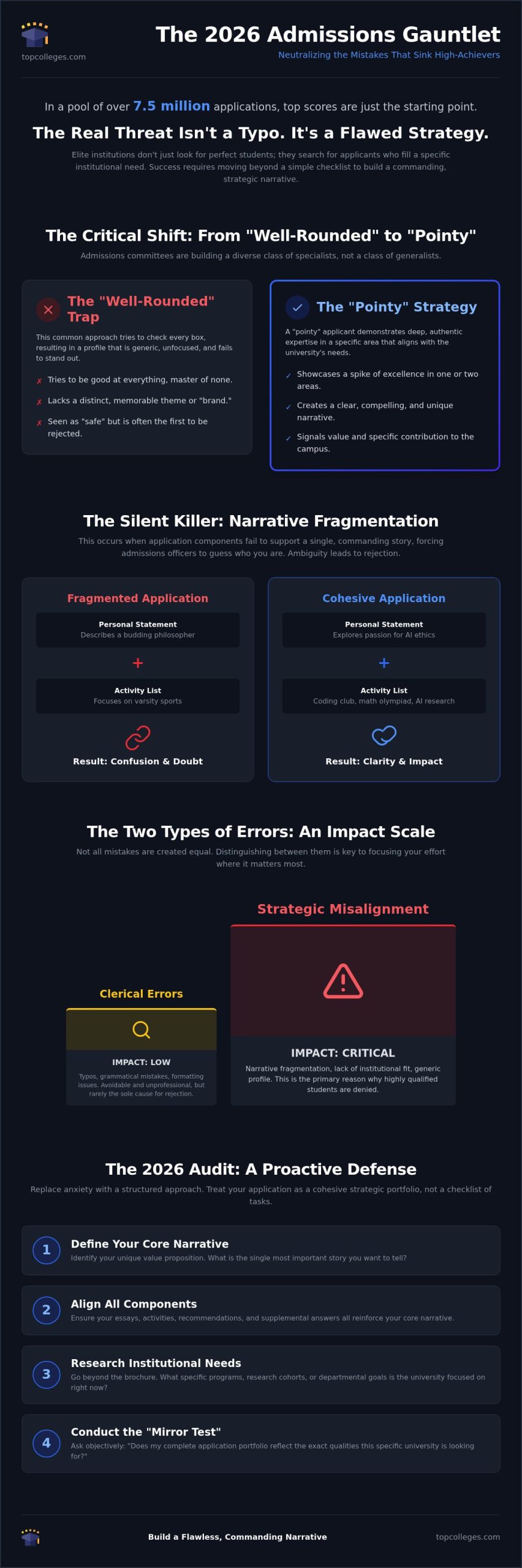
- Transition from a “well-rounded” to a “pointy” profile to meet the specific institutional needs of elite 2026 admissions committees.
- Identify the most critical college application mistakes to avoid, including narrative fragmentation where disparate application components fail to support a single, commanding story.
- Distinguish between low-level clerical errors and high-level strategic misalignment to ensure your application demonstrates deep institutional fit.
- Implement a proactive five-step audit and the “Mirror Test” to verify that your portfolio reflects the exact qualities desired by top-tier universities.
- Replace admissions anxiety with a structured, architected approach that treats your application as a cohesive strategic portfolio rather than a checklist.
The High-Stakes Landscape of 2026 Admissions
The 2026 admissions cycle has fundamentally redefined the parameters of success. High test scores and perfect transcripts are no longer the finish line; they are simply the price of admission. In a field where the Common App has reported over 7.5 million applications, standing out requires more than just a lack of errors. It requires a deliberate departure from the “safe” path. Many families fall into the trap of pursuing a well-rounded profile, fearing that specialization might limit their options. This is one of the most common college application mistakes to avoid. In reality, elite institutions are looking for “pointy” applicants who offer a specific, deep expertise that aligns with institutional needs. To help identify this focus early, students can utilize resources like Future Me, Answered to discover career paths that match their unique profile. A “safe” application that checks every box but lacks a distinct edge is often the first to be moved to the rejection pile.
The Myth of the Perfect Profile
A 1600 SAT score or a 4.0 GPA is impressive, but it isn’t a guarantee of entry. In the context of the U.S. college admissions process, these metrics are often treated as baseline qualifiers rather than points of differentiation. If thousands of applicants share your quantitative profile, how does a committee choose? The answer lies in Strategic Differentiation. This methodology involves identifying your unique value proposition and weaving it through every component of your portfolio. You must look beyond the numbers. Quantitative excellence is expected; strategic character is what secures the seat. When an application focuses solely on being “perfect” on paper, it misses the opportunity to connect with the reader on a tactical level.
Holistic Review: A Diagnostic Challenge
Admissions officers use holistic review as a diagnostic tool to identify narrative gaps and inconsistencies. They aren’t just looking at what you’ve done; they are analyzing why you did it and how your presence serves their specific goals for the incoming class. Institutional priorities, such as building a specific research cohort or expanding a specific department, often outweigh individual merit in the final tally. Holistic review is a search for institutional fit, not just student talent. This shift means that a student who is objectively qualified might still be rejected if their narrative doesn’t align with the school’s current strategic vision. For families, the emotional cost of this strategic misalignment is high, leading to a sense of betrayal after years of hard work. Success in 2026 requires understanding these invisible pressures and positioning your application as the solution to the university’s specific needs.
Narrative Fragmentation: The Silent Strategy Killer
What happens when your personal statement describes a budding philosopher, but your activity list focuses exclusively on varsity sports and community service? You create narrative fragmentation. This phenomenon occurs when different components of your application contradict one another or, more commonly, fail to reinforce a central strategic identity. Admissions committees don’t just read individual documents. They evaluate a total portfolio. If your profile lacks a cohesive thread, you force the reader to guess who you are. This ambiguity is a primary reason why high-achieving profiles fail. Mastering the tactical nuances of admissions means understanding that college application mistakes to avoid are often found in the subtle gaps between your essays and your transcripts.
Avoiding common college application mistakes requires a shift from a “submission mindset” to a “portfolio approach.” Every touchpoint, from the primary essay to the supplemental questions, must serve as a brick in a larger architectural structure. One of the most frequent errors is the “resume dump.” This happens when an applicant uses the personal statement to recount achievements already listed elsewhere. It wastes valuable real estate and signals a lack of self-reflection. Your application should function as a unified narrative where each piece adds a distinct, complementary layer to your persona.
The Personal Statement vs. The Activity List
The most common of the college application mistakes to avoid is simple redundancy. Your activity list provides the “what” and “where” of your high school career. Your essay must provide the “why.” If you spend 650 words describing your role as captain of the debate team, you haven’t added a new dimension to your profile; you’ve simply repeated yourself. Instead, use the “Additional Information” section to bridge narrative gaps or explain logistical setbacks. This leaves your best college essay free to explore your intellectual curiosity or personal evolution without the burden of listing facts.
The Recommendation Letter Disconnect
Strategic identity extends beyond your own writing. Many applicants choose recommenders based on prestige rather than proximity. This is a tactical error. A letter from a high-ranking official who barely knows you will always be less effective than a letter from a teacher who can speak to your specific contributions in the classroom. You should provide your recommenders with a “strategic brief.” This isn’t ghostwriting. It’s providing them with the context of your narrative so their external validation matches your internal claims. If you’re struggling to align these disparate pieces, seeking a strategic architect can help ensure your portfolio remains bulletproof.
Clerical Errors vs. Strategic Misalignment
Why does an applicant with a minor typo in their personal statement receive an acceptance letter while a “perfect” candidate is rejected? The answer lies in the hierarchy of errors. Admissions committees differentiate between low-level clerical mistakes and high-level strategic failures. A misspelled word is a human lapse; a lack of institutional fit is a terminal strategic error. One of the most critical college application mistakes to avoid is treating every data point on the Common App with equal weight. You must prioritize the elements that signal your readiness to contribute to a specific academic community over the minor aesthetics of the form.
A common pitfall is the failure to navigate the “TMI” vs. “Lack of Ambition” debate. Over-sharing personal trauma without demonstrating intellectual growth creates a narrative of instability. Conversely, playing it too safe by listing generic goals suggests a lack of foresight. You must position yourself as a high-value asset who has identified exactly how a program’s unique resources will catalyze your future success. This requires a deep dive into departmental white papers, research initiatives, and faculty specializations.
The “Why This School” Strategic Failure
Most applicants submit generic praise that could apply to any member of the Ivy League. This is a tactical disaster. To avoid this, you must identify “Institutional Hunger”-the specific gap in a university’s current landscape that your presence fills. Are they expanding their bioethics department? Are they investing in global infrastructure? Map your specific goals to these unique resources. If your essay doesn’t mention specific labs, professors, or unique curricula, it signals that you haven’t done your homework. You aren’t just looking for a school; you are looking for a partner in your strategic development.
Comparison: Clerical vs. Strategic Impact
Understanding the weight of your errors allows you to allocate your energy effectively. The following table illustrates how admissions officers typically weigh different types of lapses.
| Error Type | Example | Impact Level |
|---|---|---|
| Clerical | Misplaced comma or minor typo | Low: Human error is expected |
| Strategic | Misaligned major choice or generic essay | High: Signals lack of fit |
| Tactical | Failing to research “Demonstrated Interest” | Medium: Suggests school is a “safety” |
The “Safety School” mistake is particularly damaging for high-achievers. If you appear overqualified and uninterested, the institution may reject you to protect their yield rate. This same logic applies when transferring colleges. You cannot simply rehash your high school narrative; you must provide a new, sophisticated rationale for academic realignment. Whether you are a first-year applicant or a transfer candidate, your focus must remain on demonstrating how your specific profile solves an institutional need.
The 2026 Audit: A Proactive Defense
The final stage of application development is not proofreading; it is a rigorous stress-test of your strategic foundations. You must employ the “Mirror Test” to determine if your portfolio reflects the specific persona the institution is currently seeking to enroll. If an elite university is prioritizing interdisciplinary research in 2026, but your application remains siloed in a single subject area, you have failed the test. This misalignment is one of the most critical college application mistakes to avoid. You aren’t just presenting a history of your achievements; you are presenting a solution to the university’s future needs.
Falling into the “AI Trap” is a modern hazard that can dismantle years of preparation. Over-editing your essays with tools like ChatGPT often results in a sterile, predictable cadence that lacks the intellectual “spark” admissions officers use to identify high-potential candidates. These models tend to flatten your unique voice into a generic average. A sterile narrative is a rejected narrative. Authentic self-reflection cannot be outsourced to an algorithm; it must be architected through deep, personal analysis. Avoiding these digital college application mistakes to avoid ensures your narrative remains human and compelling.
Step-by-Step Narrative Audit
Before you hit submit, execute this five-step diagnostic to ensure your portfolio is bulletproof:
- Step 1: Identify your three “Core Strategic Pillars.” These are the non-negotiable traits or themes that define your unique value proposition.
- Step 2: Map every activity and essay sentence. Every component must reinforce at least one of your pillars. If it doesn’t serve the strategy, it’s noise.
- Step 3: Excise the “Fluff.” Remove any accomplishments that dilute your narrative or repeat information found elsewhere in the portfolio.
- Step 4: The Voice Verification. Read your essays aloud to ensure they sound like a sophisticated student, not a sanitized AI output.
- Step 5: The Strategic Cooling Period. Step away from the application for 72 hours. This distance allows you to identify gaps in logic that you were previously too close to see.
The Interview Preparation Audit
The written record must align perfectly with your verbal performance. A common tactical error is “Over-Rehearsal,” which leads to an inauthentic, scripted persona that fails to engage the interviewer. Whether you are navigating a standard undergraduate meeting or the high-stakes filter of a law school interview, your goal is conversational mastery. You must be able to pivot back to your core pillars naturally, providing fresh evidence of your fit without simply reciting your personal statement. The interview is your opportunity to prove that the person on the page exists in three dimensions.
Partnering for Strategic Precision: The Top Colleges Advantage
Achieving elite admission is not a matter of luck; it is a matter of architectural precision. While identifying the college application mistakes to avoid is a vital defensive measure, true success requires an offensive strategy that positions you as an indispensable asset. This is where the role of a Strategic Architect becomes critical. Steven Roy Goodman brings over 25 years of experience to this high-stakes process, acting as both a mentor and a tactical advocate for students navigating the most competitive institutions in the world. By moving beyond simple checklists, college admissions counseling replaces the paralyzing anxiety of the unknown with a methodical, structured plan for success.
The stakes are even higher for those pursuing MBA, Law, or Medical school. In these professional arenas, the “black box” of admissions is even more opaque. A single misalignment in your narrative can derail a career trajectory before it begins. We help you translate your professional and academic history into a commanding portfolio that speaks directly to the institutional priorities of top-tier graduate programs. You are no longer just a student. You are a future leader being evaluated for your potential impact on a global scale. Our methodology ensures that every component of your application reinforces this high-level identity.
Beyond the Checklist: Elite Strategic Guidance
Personalized counseling identifies the blind spots that you simply cannot see yourself. When you are deeply embedded in your own story, it is difficult to recognize where your narrative fragments or where your “pointy” profile becomes blunt. A Strategic Architect provides a national perspective on higher education trends, allowing you to anticipate shifts in institutional hunger before they are publicly announced. This foresight is what separates a qualified applicant from a compelling candidate. We don’t just help you avoid errors; we help you find the “intellectual spark” that commands attention in a sea of 7.5 million applicants. This transition from student to candidate is a deliberate, diagnostic process that requires professional oversight.
Take the Next Strategic Step
The cost of a missed application cycle is not just financial. It is a loss of momentum and a delay in your ultimate career aspirations. For high-achieving individuals, time is the most valuable resource, and just as many families partner with Pacific Empire Financial to secure their retirement, you must apply the same strategic rigor to your educational path. Entering the admissions cycle without a vetted, strategic blueprint is a risk that few can afford. Professional portfolio development ensures that your years of hard work are not negated by a single strategic misstep. It is time to move from the fear of rejection to the confidence of a masterfully architected narrative. Your future deserves the precision of a seasoned expert who has seen the inner workings of elite systems for over two decades.
Secure your future by starting your journey with Top Colleges Strategy Sessions today.
Mastering the Narrative Architecture of 2026 Admissions
Success in the 2026 admissions cycle demands a transition from a checklist mindset to a portfolio architecture. You’ve seen how narrative fragmentation and institutional misalignment can dismantle even the most impressive profiles. Identifying the high-level college application mistakes to avoid is merely the first step in a larger diagnostic process. True mastery involves aligning your unique “pointy” profile with the specific, evolving hungers of elite universities.
This high-stakes environment leaves no room for generic positioning or AI-sanitized narratives. You require a seasoned advocate who understands the nuances of holistic review. Led by Steven Roy Goodman, a nationally recognized consultant with 25+ years of experience, Top Colleges provides a pragmatic, results-oriented methodology designed for these intense cycles. We replace uncertainty with a structured roadmap for your academic future.
Your hard work deserves a narrative that commands respect and guarantees attention. Don’t leave your aspirations to chance when you can architect your success today. We look forward to helping you reach your highest goals.
Frequently Asked Questions
What is the most common mistake on college applications in 2026?
The most frequent error is submitting a “well-rounded” profile that lacks a specific, pointy edge. In 2026, high scores are merely baseline qualifiers; elite schools seek specialists who solve specific institutional needs. If your application looks like every other high-achiever’s, you haven’t given them a tactical reason to choose you. This genericism is one of the top college application mistakes to avoid if you’re targeting elite tiers.
Can a typo in my personal statement get me rejected from the Ivy League?
A single typo is rarely the sole cause of a rejection, but it signals a lack of professional rigor. Admissions officers prioritize strategic alignment over punctuation. However, if your narrative is already weak, a clerical error confirms a lack of attention to detail. It’s better to focus on the Mirror Test and institutional fit, as these high-level failures are far more terminal than a misplaced comma.
Is it a mistake to use ChatGPT or AI to write my college essays?
Yes, relying on AI to draft your narrative is a strategic disaster. While these tools assist with basic structure, they flatten your unique intellectual spark into a sterile, predictable cadence. Admissions committees are trained to identify the lack of authentic self-reflection. A sanitized, AI-generated essay fails to prove you possess the depth required for a high-stakes academic environment. Authentic voice cannot be outsourced.
How do I avoid sounding arrogant in my application while still being impressive?
Shift your focus from personal accolades to the impact of your actions and the depth of your reflection. Use a challenge-and-response framework to show how you navigated obstacles. This demonstrates maturity and intellectual curiosity rather than a mere list of trophies. When you frame your achievements as contributions to a larger community, you appear as a collaborative leader instead of a self-centered applicant.
What is “Narrative Fragmentation” and how do I fix it?
Narrative fragmentation occurs when your essay, activity list, and recommendations tell conflicting or disconnected stories. You fix this by performing a strategic audit to identify your Core Strategic Pillars. Every sentence and document must reinforce these pillars. If your components don’t work together to build a unified persona, you force the admissions officer to guess your identity, which usually leads to a rejection.
Should I mention my safety schools in my application or interview?
Never mention other institutions, especially safety schools, during your application or interview process. Your goal is to prove that the specific school you’re addressing is your primary strategic partner. Discussing other options suggests a lack of commitment or a failure to research the unique resources of the program. Every interaction must reinforce your institutional fit with the school currently evaluating your profile.
Is applying to too many colleges a strategic mistake?
Applying to an excessive number of schools often dilutes the quality of your supplemental essays. Each institution has a unique “Institutional Hunger” that requires specific research and tailored narrative positioning. When you spread your energy too thin, you risk making common college application mistakes to avoid, such as submitting generic responses that signal a lack of genuine interest to the admissions committee.
How does graduate school application strategy differ from undergraduate strategy?
Graduate strategy focuses on professional trajectory and specific departmental contribution rather than general potential. Whether you’re pursuing an MBA, Law, or Medical degree, you must prove you understand the industry’s contemporary trends. You aren’t just a student; you’re a future practitioner. Your narrative must demonstrate how the program’s specific labs or faculty will catalyze your transition into a high-level professional role.