

Disclaimer
Content on this page of topcolleges.com is computer generated and therefore is not guaranteed to be 100 percent accurate about various aspects of the education sector. On balance, however, many students and families seek general information about high schools, colleges and universities, graduate programs, testing, education and career planning, and job placement before beginning one-on-one admissions counseling tailored to their specific needs.
Does your professional history read like a mere list of duties, or does it function as a tactical argument for your entry into the legal elite? With law school applications surging by 10.3 percent for the 2026 cycle, the landscape is more crowded and competitive than ever before. You’re likely grappling with how to value non-legal experience or bridge perceived gaps in a non-traditional background. It’s a high-stakes challenge that requires more than just a clean layout; it requires a narrative that proves intellectual stamina and professional maturity. We understand the anxiety that stems from trying to strike the perfect balance between an academic and professional tone.
This article will help you master the law school resume by providing a professional framework designed specifically for elite admissions. You’ll learn how to transform your “soft” skills into tactical assets that resonate with seasoned admissions officers. We’ll begin by establishing the strategic “why” behind successful legal positioning before moving into a structured template that saves you time while maximizing your impact. This is your roadmap from your current professional state to the future aspirations you’ve worked so hard to achieve.
Key Takeaways
- Understand why your law school resume must serve as a tactical argument rather than a simple history, optimized for the critical “Three-Minute Rule” used by admissions officers.
- Learn to prioritize the education section while reframing professional duties into a narrative of transferable legal skills and intellectual readiness.
- Discover how to extract “Legal DNA” from non-legal careers by de-jargonizing corporate successes to make them legible to elite law deans.
- Access a structured 2026 framework that organizes headers and reverse-chronological data to maximize immediate visual and strategic impact.
- Recognize the critical threshold where a DIY approach fails and how specialized consulting integrates your profile into a holistic strategic blueprint.
Beyond the Chronology: Why Your Law School Resume Is a Tactical Asset
Your law school resume isn’t a passive archive of past employment. It’s a specialized academic and professional document designed to prove your readiness for the grueling nature of legal study. While The Modern Resume often prioritizes broad career summaries to attract recruiters, the version you submit to an admissions committee demands a more surgical approach. You must move from a “job hunter” mindset to a “legal scholar” mindset. Admissions committees aren’t looking for a generic employee; they’re looking for an advocate in training who possesses the discipline to thrive in a high-pressure environment.
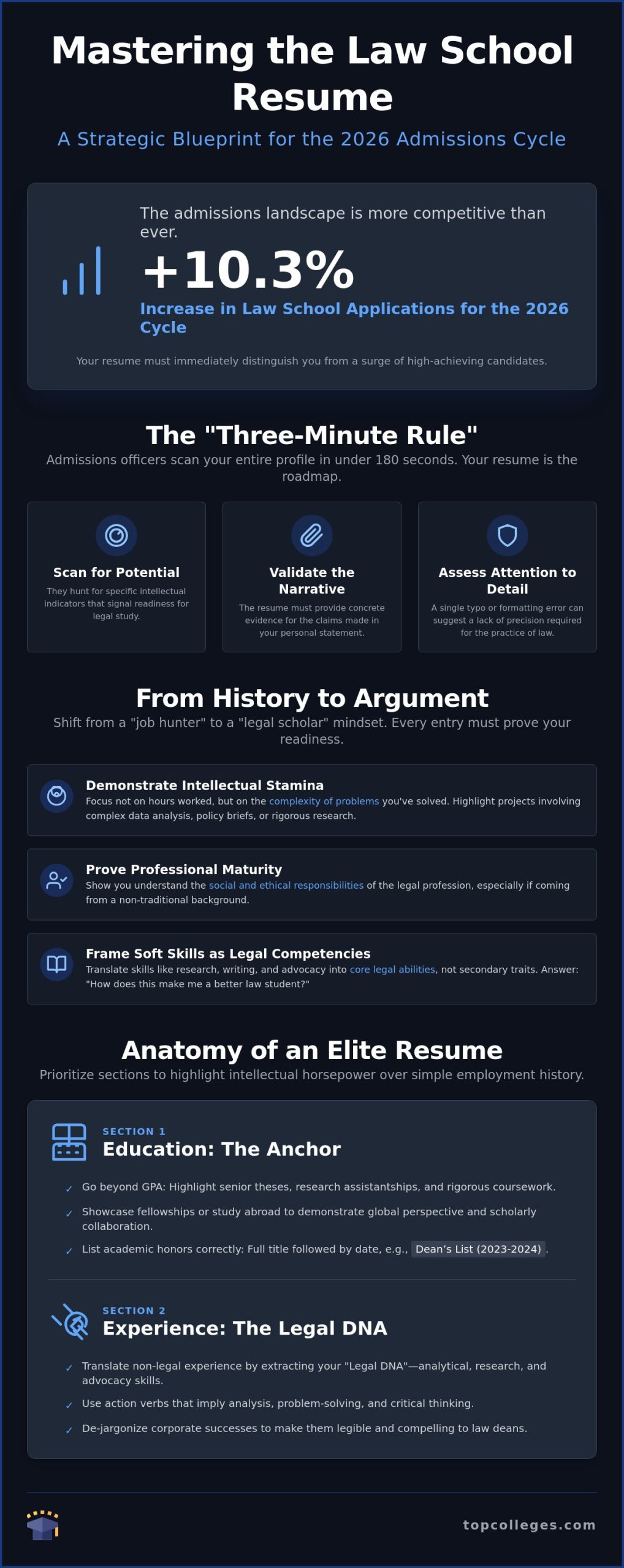
Consider the “Three-Minute Rule.” Admissions officers at elite institutions often scan a profile in less than 180 seconds. In that brief window, they’re hunting for specific intellectual indicators that signal potential. The law school resume serves as the skeletal structure of your entire application, validating the narrative claims you make in your personal statement. If you claim to be a rigorous researcher, this document must provide the evidence through peer-reviewed publications, high-level policy briefs, or complex data analysis projects.
The Strategic Purpose of the Legal CV
The core objective of this document is demonstrating “Intellectual Stamina.” This isn’t defined by the number of hours you worked, but by the complexity of the problems you’ve solved. For applicants from non-traditional or corporate backgrounds, the document proves “Professional Maturity.” It signals that you understand the social and ethical responsibilities inherent in the legal profession. You need to highlight “Soft Skills” like research, writing, and advocacy, but they must be framed as core legal competencies rather than secondary traits. Every bullet point should answer one question: how does this experience make me a better law student?
The 2026 Admissions Landscape
Competition is intensifying at an unprecedented rate. With law school application volume up 10.3 percent for the 2026 cycle, admissions offices are navigating a sea of high-achieving candidates. Following recent ranking volatility, many institutions have shifted their focus toward “Distance Traveled.” They want to see the trajectory of your growth and how your unique life perspective adds value to a diverse cohort. Because of this volume, your resume must be an exceptionally “clean” document. Precision is non-negotiable. A single formatting error or typo suggests a lack of the attention to detail required for the practice of law, potentially disqualifying you before your LSAT score is even considered. Understanding when do law school applications open for the 2026 cycle is equally critical, as submitting your polished resume in the first wave of evaluations can significantly improve your odds at T14 institutions.
The Anatomy of Influence: Essential Sections for Elite Applications
Your law school resume must adhere to a strict hierarchy that prioritizes intellectual horsepower over mere employment history. Unlike a standard corporate CV, this document functions as a blueprint of your cognitive abilities. Admissions officers look for a specific architecture that mirrors the demands of a legal career. While some generic advice suggests using pre-formatted templates, elite candidates must curate their history to align with Harvard Law School’s application components, which view the resume as a vital piece of a holistic narrative. Every section must be intentionally weighted to highlight your potential as a legal scholar.
Education: More Than Just a GPA
The education section remains the anchor of your application. It is the first area an admissions officer examines because it provides the most direct evidence of your ability to handle the Socratic method and dense case law. Don’t just list your degree; highlight senior theses, research assistantships, and rigorous coursework that signals legal aptitude. If you studied abroad or participated in specialized fellowships, place them here to demonstrate global perspective and scholarly collaboration. To list academic honors correctly, provide the full title of the award followed by the date received in parentheses, such as “Dean’s List (2023-2024).”
Experience: The Art of the Legal Bullet Point
How do you frame a corporate role or a summer internship for a law dean? You must use action verbs that imply analysis, negotiation, and synthesis. Instead of stating you “assisted with research,” explain how you “synthesized complex data sets to inform executive decision-making.” Quantify your impact whenever possible. Managing a specific budget or leading a team of five demonstrates professional responsibility that translates well to the legal field. Avoid industry-specific jargon that might obscure your actual contributions; focus instead on the transferable skills of advocacy and logical reasoning. Reframing these experiences is a core part of a strategic law school admissions strategy that sets T14 applicants apart.
Leadership and Community Engagement
Law is fundamentally a service profession. Admissions committees seek candidates who have already demonstrated a commitment to advocacy and community impact. This section shouldn’t be a laundry list of memberships. Focus on roles where you held genuine responsibility or initiated change. Whether you volunteered at a legal aid clinic or led a university organization, emphasize the tangible results of your leadership. It proves you possess the “Professional Maturity” discussed earlier, showing you’re ready for the ethical responsibilities of the bar.
The Strategic Value of the Personal Section
Should you include that you’re a competitive chess player or a marathon runner? In the context of a law school resume, the answer is yes. A brief “Interests” section provides a human element that can be a powerful tool during the interview process. It gives the admissions committee a glimpse into your discipline and personality outside of academics. These details often serve as the starting point for meaningful conversations that allow your character to shine through the data. To ensure you’re fully prepared to discuss these interests and your broader narrative under pressure, a structured approach to law school interview preparation is an essential complement to a polished resume.
The Professional Pivot: Converting a Standard CV into a Legal Narrative
If you’re applying with five, ten, or even fifteen years of professional history, you’re not just a candidate; you’re a career pivot. This transition requires a fundamental shift in how you present your history. A standard corporate CV focuses on revenue and market share, but your law school resume must isolate your “Legal DNA.” How do you translate years of software engineering or creative direction into evidence of legal aptitude? You do it by identifying the underlying analytical structures of your work. Every industry has its own dialect, yet admissions deans only speak the language of logic, ethics, and advocacy.
The “De-Jargonizing” process is your most critical tactical move. If your current resume is filled with industry-specific acronyms or internal corporate metrics, it will likely alienate an admissions reader. Your goal is to make your success legible to a law dean. For instance, instead of detailing a “successful Q3 sprint,” focus on the “collaborative problem-solving and conflict resolution” required to meet high-stakes deadlines. This strategic transparency also applies to career gaps. Don’t hide them; address them with a brief, professional note that emphasizes personal growth or intentional preparation.
Re-framing Non-Legal Experience
Turning project management into “Complex Problem Solving and Negotiation” isn’t about inflation; it’s about accuracy in a legal context. If your corporate role involved regulatory compliance, contract-adjacent work, or labor disputes, these are your most valuable assets. You are building a “Narrative Bridge.” You must show that your past success wasn’t a detour, but a foundational step toward your future legal aspirations. For a deeper look at specific formatting do’s and don’ts for these sections, the UT Dallas Pre-Law Advising Resume Guide offers an excellent baseline for standardizing these entries.
Managing the Page Count Challenge
The debate between a one-page and two-page law school resume is often misunderstood. For most applicants, one page is the gold standard of discipline. However, if you have over ten years of significant professional history, a second page is often earned. The key is prioritization. Don’t waste valuable space on entry-level roles from a decade ago. Focus on recent high-level achievements that demonstrate your current professional maturity. Ensure there’s ample white space. Readability is a courtesy to tired admissions readers who are scanning thousands of profiles.
A Strategic Framework: The 2026 Law School Resume Template
Why do most applicants treat their law school resume as a standalone document? This is a tactical error. Your resume must function as a narrative partner to your personal statement, providing the empirical evidence for the claims you make in your essays. If your statement argues that you’re a resilient advocate, your resume must show the specific milestones where that advocacy took place. A template isn’t just a container for data; it’s a strategic framework that directs the admissions officer’s attention to your most prestigious markers. In a cycle where applications have risen by over 10 percent, your document must command attention through its structural clarity.
The header should be minimalist and professional. Include your contact information and a curated LinkedIn profile only if it reinforces your legal narrative. Your education section follows, listed in reverse chronological order. For your experience, focus on the last three to five years of your history. Use high-impact bullet points that emphasize the “Legal DNA” we discussed previously. Finally, use an “Additional” section for languages, technical skills, and those critical “interview starter” interests that humanize your profile.
The Template Logic
Visual hierarchy is your silent advocate. Use bolding for institution names and italics for job titles to guide the reader’s eye toward prestige. Maintain a formal, “legalistic” aesthetic with standard one-inch margins and traditional fonts like Times New Roman or Garamond. This isn’t the place for creative flair; it’s the place for professional precision. We also emphasize a rigorous “Proofreading Protocol.” In the high-stakes world of elite admissions, a single typo can derail an otherwise flawless application. It suggests a lack of attention to detail that is disqualifying in the legal profession.
Tailoring the Template for Your Profile
Your approach should change based on your career stage. If you’re a K-JD applicant, your law school resume should emphasize academic honors, thesis work, and internships. You’re proving your potential. If you’re a professional with years of experience, shift the weight toward leadership, management, and industry expertise. This tailoring ensures your resume fits into The Strategic Blueprint for College Admissions Counseling in 2026, which views every application component as a piece of a larger, holistic strategy. Pairing this tailored document with a clear understanding of when law school applications open in the 2026 cycle ensures you submit your strongest materials at the most advantageous moment in the rolling admissions process.
Elevating Your Candidacy: How Strategic Counseling Refines Your Narrative
A template provides the skeletal structure, but it cannot provide the strategic soul of your application. Many elite candidates fall into the trap of believing that a clean layout is sufficient. It isn’t. In a high-stakes environment where every detail is scrutinized, the limits of a DIY law school resume become apparent quickly. You need an outside expert eye to identify the subtle narrative gaps that you’re too close to see. Our approach at Top Colleges moves beyond simple formatting to engage in tactical positioning. We treat your resume as a foundational element within a much broader law school application consulting strategy.
The “Goodman Method” is built on over 25 years of experience in high-stakes admissions. We don’t just list your achievements; we architect a professional profile that commands respect from the first glance. This process involves a deep diagnostic of your history to ensure every bullet point reinforces your specific brand of intellectual readiness. We replace uncertainty with a structured, results-oriented plan that transforms your background into an undeniable asset for T14 admissions committees.
The Value of an Expert Review
Professional counseling identifies the “blind spots” that often derail non-traditional applicants. Are you over-explaining a career pivot? Are you using corporate language that fails to translate to an academic setting? We optimize your law school resume for specific institutional cultures. A document that resonates with the scholarly focus of Yale might require a different tactical emphasis for the analytical rigor expected at Chicago. Ensuring this level of consistency across all application components is what separates the accepted from the merely qualified. It is about precision, foresight, and a global perspective on what elite deans actually value.
Your Next Strategic Move
Once your resume is polished, it serves as the launchpad for your personal statement and eventual interviews. It establishes the facts so your essays can focus on the “why.” If you find that your current academic path requires a more significant realignment, you might consider our specialized guidance on Transferring Colleges Consulting. Every step you take must be intentional and proactive. Don’t leave your legal future to chance or a generic template. It’s time to move from a state of preparation to a position of command. Schedule a consultation today to begin architecting your path to the legal elite.
Architecting Your Path to the T14
You’ve moved beyond the basics of formatting to understand the tactical weight of your professional narrative. A successful law school resume does more than list your past; it predicts your future success as an advocate. By isolating your “Legal DNA” and adhering to a rigorous visual hierarchy, you provide admissions officers with the intellectual indicators they demand in a competitive 2026 cycle. You now have the framework to transform a standard CV into a document that commands respect.
Steven Roy Goodman brings over 25 years of high-stakes admissions expertise to your application process. His specialized narrative positioning and national reach have helped countless T14 applicants bridge the gap between their current achievements and their elite aspirations. This level of strategic foresight is what replaces application anxiety with the calm confidence of a prepared professional. It’s time to stop guessing and start executing a plan that works.
The road to a top-tier law school is demanding, but with a structured strategy and a refined narrative, your goals are within reach. Take the next step toward your legal career with the authority your record deserves.
Frequently Asked Questions
Should a law school resume be one page or two?
Most applicants should adhere to a strict one-page limit to demonstrate the brevity and discipline required in legal writing. This constraint forces you to prioritize your most significant achievements. If you have over ten years of high-level professional history, a second page is earned. However, it must be filled with tactical milestones rather than filler. Discipline is a prestige marker that admissions officers value highly.
Do I need to include my high school information on a law school resume?
You should exclude high school information from your profile once you’ve reached the law school application stage. Admissions committees focus on your undergraduate performance and subsequent professional milestones. The only exception is a truly national or international award that established a trajectory you’ve maintained. Otherwise, use that valuable space to detail your more recent intellectual growth and professional maturity.
How should I list a gap year or time off between undergrad and law school?
List your gap year activities chronologically to ensure there are no unexplained lapses in your history. Whether you were traveling, working, or engaged in personal development, frame it as an intentional period of growth. If the time off was for a sensitive reason, a brief addendum is often more appropriate than trying to force it into the resume structure. Transparency and strategic positioning are key.
Can I include my LSAT score or GPA on my resume if they are already on my transcript?
Including your GPA and LSAT score on your law school resume is standard practice and highly recommended. While these data points appear on your transcript and CAS report, placing them in the education section facilitates the scan for intellectual indicators. It allows the reader to immediately contextualize your academic standing within the framework of your professional and leadership achievements during the review.
Should I include “Interests” or “Hobbies” on a professional law school resume?
A brief interests section is an asset because it humanizes your profile and provides a natural starting point for interview conversations. Focus on specific activities that demonstrate discipline or unique skills, such as marathon running or competitive chess. Avoid generic lists like reading and travel. These details should occupy no more than two lines at the very bottom of the document to maintain a formal register.
How do I describe non-legal work experience to make it relevant to law admissions?
Re-frame non-legal duties by highlighting the underlying cognitive skills required for the role. Instead of focusing on industry-specific tasks, emphasize your experience with complex problem-solving, negotiation, and high-level research. Your goal is to prove that you possess the intellectual stamina and professional maturity required for the rigors of a T14 legal education regardless of your previous field or creative background.
Is it better to use a chronological or functional resume format for law school?
The reverse chronological format is the only acceptable structure for an elite law school resume. Functional resumes often signal an attempt to obscure gaps or a lack of progressive responsibility, which triggers immediate skepticism from admissions deans. A clear timeline allows officers to track your growth and evaluate the distance traveled throughout your academic and professional career with diagnostic precision.
Should I include a “Summary of Qualifications” or “Objective” statement?
You should omit objective or summary of qualifications statements entirely. These are remnants of corporate job hunting that have no place in a specialized academic and professional document. Your objective is already clear through the act of applying. Use that prime real estate to strengthen your education or experience sections with more substantive, evidence-based bullet points that prove your readiness for legal study. Once your resume is complete, your next critical step is mastering the conversation it will inspire — a comprehensive guide to law school interview preparation for elite admissions in 2026 will ensure you can defend and expand upon every line of your application with confidence.