

Disclaimer
Content on this page of topcolleges.com is computer generated and therefore is not guaranteed to be 100 percent accurate about various aspects of the education sector. On balance, however, many students and families seek general information about high schools, colleges and universities, graduate programs, testing, education and career planning, and job placement before beginning one-on-one admissions counseling tailored to their specific needs.
In the high-stakes arena of elite JD admissions, the official deadline is often a polite fiction. The only date that truly dictates your trajectory is the first day you can possibly hit submit. You likely feel the mounting pressure of the 2026 cycle and the conflicting advice surrounding rolling admissions. It’s natural to worry that a delay of even a few weeks could cost you a seat at a T14 school or a significant merit scholarship.
To secure a seat in the 2026-2027 class, you must look beyond mere compliance and focus on strategic positioning. A central part of this strategy is knowing exactly when do law school applications open so you can be part of the first wave of evaluations. While most programs open their portals around September 1, 2026, others like Baylor University may open as early as August 1. This guide provides a definitive submission roadmap and explains the tactical benefits of early filing. You’ll gain the clarity needed to navigate the timeline with confidence, ensuring your application sequence is designed for maximum impact.
Key Takeaways
- Identify the primary opening window starting September 1, 2026, while preparing for early movers that open portals as soon as August 1.
- Master the tactical advantage of early submission by understanding exactly when do law school applications open for your target institutions to maximize leverage.
- Move beyond the “First-In, First-Out” myth to understand how rolling admissions actually function as a high-stakes mechanism for competitive benchmarking.
- Establish a disciplined twelve-month roadmap that prioritizes an early summer LSAT score and a finalized portfolio before the peak October volume.
- Learn how professional strategic positioning transforms a standard application into an elite narrative that commands the attention of top-tier admissions committees.
The Critical Window: When Law School Applications Open in 2026
The transition from a law school aspirant to a serious candidate begins the moment you shift your focus from “if” you will apply to “exactly when.” For the 2026 cycle, the Law School Admission Council (LSAC) remains the central nervous system of this process. It’s the platform where your narrative meets the institutional machinery. Understanding the broader landscape of Law school in the United States is essential for contextualizing why these dates carry such weight. Success isn’t found in merely meeting deadlines; it’s found in anticipating them.
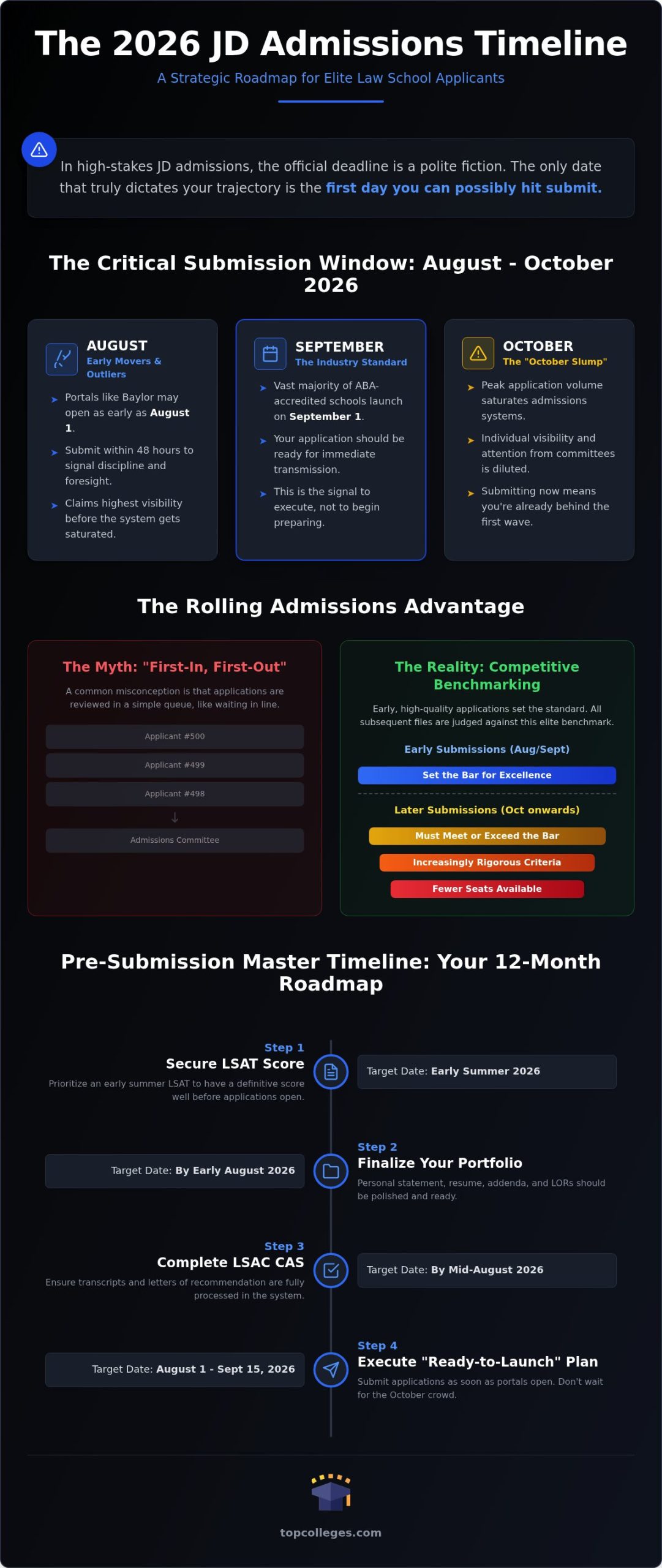
Many candidates ask, “when do law school applications open?” and expect a single, uniform answer. The reality is more nuanced. While the industry has gravitated toward a centralized rhythm, individual institutions retain the right to set their own pace. The opening window is the period between August 1 and September 15. This six-week corridor represents the most fertile ground for your submission strategy.
The September 1st Industry Standard
The vast majority of ABA-accredited programs align their systems for a September 1 launch. This convergence allows schools to manage the influx of data through the Credential Assembly Service (CAS) with predictable efficiency. You must distinguish between your CAS setup and the application launch itself. The $219 fee for the CAS is a mandatory investment in your operational readiness. Your transcripts, letters of recommendation, and LSAT scores should be fully processed within the LSAC system long before the first portal opens. If you’re still chasing a registrar in late August, you’ve already lost your lead. A finalized LSAC account by mid-August ensures that when the “Apply” button becomes active, your file is ready for immediate transmission.
August Outliers and Early Bird Programs
Elite candidates monitor the outliers. Some institutions, most notably Baylor University, frequently open their applications as early as August 1. Others may quietly go live by August 15. Submitting within the first 48 hours of a portal opening signals a level of discipline and foresight that admissions committees rarely ignore. It places your file at the top of the initial review pile before the “October Slump” saturates the system. You must monitor school-specific websites for 2026-specific deviations, as these dates can shift based on internal administrative priorities. Early submission isn’t just about speed; it’s about claiming the highest possible visibility in a cycle that only grows more crowded by the day.
Strategic Timing: The Difference Between Opening and Applying
Success in elite law school admissions is rarely a matter of luck. It is a matter of positioning. While candidates often fixate on the technicality of when do law school applications open, the most successful applicants understand that the portal opening is not a cue to begin, but a signal to execute. Waiting for the system to go live before finalizing your materials is a tactical error that places you at the mercy of the “October Slump.” This period of peak application volume occurs when the initial urgency fades and the sheer mass of submissions begins to dilute individual visibility. To avoid this, you must adopt a “Ready-to-Launch” philosophy, ensuring every component of your portfolio is polished by early August.
Defining Application Readiness
True readiness is a state of total preparation. Your law school personal statement should be finalized, vetted, and static weeks before the first portal opens. Similarly, your letters of recommendation must be secured and uploaded to the LSAC system by late summer to avoid administrative delays. A critical but often overlooked element is the law school resume, which serves as the structural foundation of your professional narrative. If you’re still tinkering with formatting in September, you’re already behind. Those who seek the highest level of precision often engage in law school admissions consulting to ensure their timing aligns perfectly with institutional expectations.
The Diminishing Returns of Late Submission
Admissions is a game of shrinking mathematical probability. As seats are filled through rolling admissions, the criteria for the remaining spots become exponentially more rigorous. Consider the application timeline for the 2025-2026 academic year at top-tier institutions; it illustrates a clear preference for early engagement. In this competitive landscape, a 170 LSAT score submitted in September often holds more strategic value than a 172 submitted in January. Why? Because by January, the committee has already benchmarked the class and is only looking for extreme outliers. Being the first file an officer reads provides a psychological advantage that no late-cycle score bump can replicate. You want to be the standard by which others are measured, not the candidate fighting for the final, narrow opening in a nearly full class.
The Rolling Admissions Advantage: Why Early Submission is Non-Negotiable
The mechanics of rolling admissions are often reduced to a simple queue. This is a mistake. In the competitive environment of T14 admissions, the system functions as a sophisticated benchmarking exercise rather than a standard line. Candidates asking when do law school applications open should realize that the answer isn’t a logistical detail; it’s a strategic mandate. While a school might accept files until March, the institutional appetite for risk and the availability of seats shift dramatically as the months pass. By submitting early, you aren’t just beating the clock. You’re ensuring your file is evaluated when the committee’s standards are still fluid and their goals for the class are yet to be met.
The First-In, First-Out myth suggests that schools simply admit the first qualified people they see. In reality, committees use the early window to anchor their class profile with high-stat candidates and compelling narratives. For splitters and reverse-splitters, this early cycle offers a rare moment of flexibility. Before the class medians begin to crystallize, admissions officers are more willing to take a calculated risk on a candidate with a non-traditional profile. Once the medians are established later in the winter, that same candidate becomes a much harder sell.
How Rolling Admissions Affects Acceptance Rates
There is a direct, measurable correlation between your submission date and the probability of your admission. Elite T14 schools use the August and September windows to secure their “sure bets,” creating a foundation for the entire class. As these spots fill, the remaining seats become exponentially harder to secure because the committee must now balance the class diversity and statistical medians. Rolling admissions makes the stated deadline effectively irrelevant for serious candidates. If you’re applying in January, you aren’t competing for a full class; you’re competing for the few remaining seats left after the strongest candidates have already been admitted.
Financial Leverage and Early Filing
Merit aid is a finite resource. Law schools operate with a specific budget for scholarships, and this money is distributed on a first-come, first-served basis. By the time the mid-cycle “median creep” sets in during January and February, much of the institutional funding has already been earmarked for early applicants. Securing an early offer of admission also provides you with significant leverage for later scholarship negotiations. Having a generous award from a peer school in October allows you to approach your top choice with a position of strength. If you wait until the funds are depleted, even an elite LSAT score may not be enough to unlock the financial support you deserve.
The Master Timeline: Milestones Before the Cycle Begins
The opening date is the finish line, not the starting gun. To understand when do law school applications open is to understand the final step of a twelve-month strategic campaign. Success in the 2026 cycle requires a reverse-engineered schedule that begins long before the portals go live. If you’re starting your preparation in September, you’ve already conceded the early advantage to more disciplined peers. Your trajectory is determined by the work completed in the preceding months.
The “LSAT Lockdown” is your first critical milestone. Aiming for the June or August 2026 test dates is mandatory for those seeking elite results. With the August 2026 LSAT scheduled for the 5th through the 8th, receiving your score by late August allows you to finalize your school list with mathematical certainty. Relying on the September 9-12 test date is a gamble. It pushes your submission into late September or early October, right as the peak volume of the cycle begins to saturate the system. Score lock-in provides the clarity needed to tailor your narrative to specific institutional benchmarks.
The 6-Month Countdown to September
A strategic roadmap ensures your narrative is cohesive and commanding. From March to May, focus on securing a competitive LSAT score and identifying recommenders who can speak to your professional potential. By June and July, your energy should shift to drafting personal and diversity statements. These documents must do more than recount history; they must project future impact. A strategically crafted law school personal statement is not merely a biography — it is a high-stakes advocacy tool that connects your past actions directly to your future legal success. August is the month for final refinement. This is when you must finalize your law school resume and polish any necessary addenda. Your goal is a static, ready-to-transmit portfolio by August 25.
Navigating LSAC Technical Hurdles
The “Transcript Trap” is a frequent point of failure for otherwise strong candidates. The Credential Assembly Service (CAS) can take several weeks to process domestic transcripts and significantly longer for international credentials. Request these documents in June. Waiting until August risks technical delays that will keep your file “incomplete” even after the portals open. The $219 CAS fee is merely the entry price. The real cost of a late transcript is a missed seat in the first wave of evaluations. Ensure your LSAC profile is “Submission Ready” by late August to avoid the system lag that often accompanies the September 1st rush. A thorough understanding of law school requirements for elite institutions will help you anticipate every document and credential needed before the portals open.
Beyond the Calendar: Navigating High-Stakes Admissions Strategy
Understanding when do law school applications open is merely the prerequisite for entry. It isn’t the strategy itself. In a cycle defined by hyper-competition, simply being “early” is no longer enough to guarantee a seat at a T14 institution. You must move beyond the calendar and focus on the high-stakes evaluation nuances that differentiate a standard applicant from a compelling candidate. This is where the value of professional law school application consulting becomes apparent. It transforms a collection of data points into a cohesive, strategic portfolio that commands respect from the first page.
Why do some candidates with perfect scores receive rejections while others with lower medians secure full scholarships? The answer rarely lies in the timing alone. While you now know exactly when do law school applications open for the 2026 cycle, the “why” behind your submission remains the most critical variable. A strategic advisor doesn’t just watch the clock. They build a narrative that justifies your presence in an elite cohort. This involves a level of self-reflection and proactive planning that most candidates overlook. Meeting the full spectrum of 2026 law school requirements for elite programs demands precisely this kind of comprehensive, forward-thinking preparation.
The Role of a Strategic Advisor
Steven Roy Goodman provides the authoritative expertise required to navigate these complex systems. He helps you transition from being a passive applicant to an active candidate. This process begins with a school list that balances your highest aspirations with a pragmatic assessment of the current landscape. He identifies the subtle shifts in institutional priorities that rankings often miss. By developing a school list that accounts for these nuances, you ensure your energy is directed toward programs where your narrative will resonate most deeply. This is the difference between a scattershot approach and a surgical strike.
Taking the Next Step
The submission of your file is only the beginning of the engagement. You must prepare for the next phase: Law school interview preparation. Elite programs increasingly use interviews to test for intellectual depth and professional maturity. If you receive a “Decision Cannot Yet Be Made” status, you don’t wait passively. You must understand how to handle waitlist management through tactical updates and professional persistence. Don’t leave your future to chance or a simple calendar date. Contact Top Colleges for a personalized admissions blueprint that navigates these complexities with precision and foresight.
Mastering the 2026 Admissions Trajectory
The window for the 2026 cycle is now visible. You understand that the answer to when do law school applications open is not just a date on a calendar; it’s a strategic opening to be exploited. By aligning your portfolio development with the August and September launch windows, you position yourself as a benchmark for the entire class. This foresight is what separates those who simply apply from those who are actively recruited with significant merit aid. Your trajectory is determined by the work you complete before the first portal even goes live.
The complexity of rolling admissions demands more than just speed. It requires a sophisticated narrative and a finalized portfolio that reflects your professional potential before the peak volume of October arrives. Led by global education expert Steven Roy Goodman, Top Colleges brings decades of experience in elite graduate admissions to your specific case. We focus on the high-stakes portfolio development that captures the attention of committees at the world’s most prestigious institutions. This methodical approach replaces anxiety with the confidence of a structured, elite preparation.
Your future at a top-tier law school is a result of preparation meeting opportunity. Take the first step toward a commanding presence in the 2026 cycle today.
Frequently Asked Questions
Is it better to apply to law school as soon as applications open?
Applying immediately is the optimal strategy if your portfolio is finalized. It ensures your file is among the first reviewed during the most flexible phase of the cycle. However, submitting a rushed narrative just to meet the opening date is a tactical error. Quality must never be sacrificed for speed. The goal is to be both first and best, securing your position before the committee benchmarks the class against later, more crowded waves.
Does applying in September really increase my chances of admission?
Submission in September significantly enhances your probability of admission and merit aid. During this period, committees have their full budget and all seats available, allowing them to take more calculated risks on compelling candidates. As the cycle progresses, their appetite for risk diminishes. By knowing exactly when do law school applications open and hitting that window, you avoid the heightened competition that defines the mid-cycle surge.
What happens if I apply to law school in January or February?
Applying in January or February places you in a defensive position. By this stage, schools have already anchored their class profile and distributed a large portion of their scholarship funds. You’re no longer competing for a full class; you’re fighting for the few remaining spots. This often leads to “median creep,” where the requirements for admission become more rigid than they were in the early autumn months.
When should I take the LSAT if I want to apply when portals open?
You should aim for the June or August LSAT dates to be submission-ready by September. The August 2026 LSAT, held between the 5th and 8th, provides a score release window that aligns perfectly with the primary application launch. Taking the test earlier allows for a potential retake in September if necessary. This ensures your numerical data is locked in before you ask when do law school applications open for your target schools.
Can I submit my law school application before my LSAT score is released?
You can submit your application before your score is released, but it won’t be considered “complete” for review. Most admissions committees wait for the official LSAT score to arrive via the CAS report before an officer opens your file. Submitting early can save a few days in administrative processing. However, it’s generally wiser to see your score first so you can adjust your school list based on actual data rather than projections.
How long does it take for LSAC to process my transcripts for the CAS report?
LSAC typically requires approximately two weeks to process domestic transcripts once they are received. This timeline can extend significantly during the peak months of August and September. International transcripts often require even more time for evaluation. You should request all academic records by June to ensure your CAS report is finalized and ready for transmission the moment the first application portal becomes active.
What is the latest date I can apply to a T14 law school and still be competitive?
Thanksgiving is widely considered the final threshold for maintaining a competitive edge at T14 institutions. While official deadlines are much later, the mathematical probability of admission begins to decline sharply after November. Applying after this point means you’re competing against a nearly full class. For elite candidates, the “real” deadline is much earlier. Aiming for a September or October submission remains the most reliable path to success.
Do all law schools open their applications on the same day?
Application opening dates vary across the institutional landscape. While September 1 is the standard for many ABA-accredited programs, some schools like Baylor University open as early as August 1. Others may wait until mid-September to launch their portals. You must verify the specific dates for each school on your list. This individualized tracking allows you to execute a staggered submission strategy that prioritizes the earliest movers.