

Disclaimer
Content on this page of topcolleges.com is computer generated and therefore is not guaranteed to be 100 percent accurate about various aspects of the education sector. On balance, however, many students and families seek general information about high schools, colleges and universities, graduate programs, testing, education and career planning, and job placement before beginning one-on-one admissions counseling tailored to their specific needs.
What if the absence of a traditional high school transcript isn’t a liability, but your student’s most potent competitive advantage? For many families, the prospect of college admissions for homeschooled students brings a sense of high-stakes urgency. The stakes are high. You likely feel the pressure of quantifying years of self-directed learning for committees that favor standardized benchmarks. It’s common to worry that a non-accredited background might obscure a student’s true intellectual caliber. This anxiety is understandable, yet it often stems from a misunderstanding of how elite institutions evaluate talent.
We’ll move past these concerns by transforming your unique educational path into a sophisticated narrative of independence and rigor. You’ll discover how to master the “homeschool counselor” role and utilize strategic portfolio architecture to command respect from the world’s most selective universities. This article provides a strategic blueprint for the 2026 application cycle, offering a clear framework for building a competitive student profile. We’ll examine the tactical steps required to translate unconventional achievements into a language of prestige and academic excellence.
Key Takeaways
- Learn why elite universities increasingly seek the intellectual vitality inherent in non-traditional paths and how to position your student accordingly.
- Discover the methodology for framing your curriculum as a deliberate strategy of self-directed mastery. It’s about moving from compliance to command.
- Master the architecture of a high-impact academic portfolio that provides the depth and context traditional transcripts lack in college admissions for homeschooled students.
- Understand how to utilize standardized testing as a tactical tool for external validation to reinforce the rigor of your student’s academic record.
- Identify the strategic gaps that professional admissions counseling can fill to ensure your student’s narrative commands respect from elite committees.
The Shifting Landscape of College Admissions for Homeschooled Students
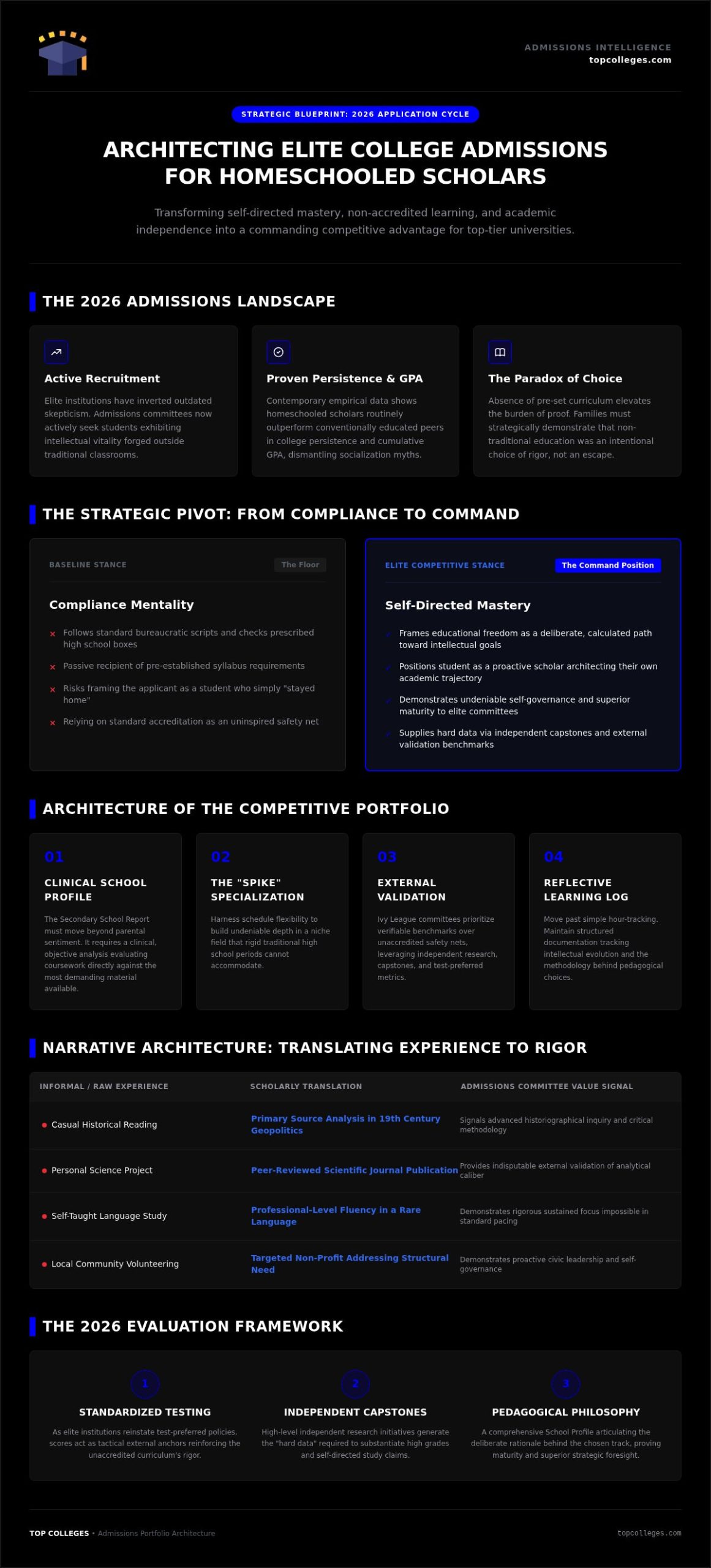
The 2026 admissions cycle has redefined the standard for excellence. For years, non-traditional education was viewed through a lens of skepticism. Today, that perspective has inverted. Elite universities aren’t just accepting homeschoolers; they’re actively recruiting them. As many top-tier institutions return to test-preferred policies, the modern applicant must demonstrate more than just a score. They must prove intellectual vitality. This shift highlights a significant trend in homeschooling in the United States, where students increasingly utilize their freedom to bypass the limitations of a standardized classroom.
Freedom isn’t just an opportunity. It’s a responsibility. The paradox of choice means that without a pre-set curriculum, your burden of proof increases. You must show that your path was a choice, not an escape. Contemporary data suggests that homeschooled students often outperform their peers in college persistence and GPA. These results effectively dismantle outdated myths surrounding socialization and academic rigor. When handled with precision, college admissions for homeschooled students becomes an exercise in demonstrating superior maturity and foresight.
Understanding the Admissions Officer’s Perspective
Admissions committees don’t see a lack of structure as a void. They see it as a canvas. When they review college admissions for homeschooled students, they’re looking for evidence of self-directed mastery. This requires a robust “School Profile” that explains the philosophy behind the pedagogy. You must translate your student’s unique experience into a language the committee understands. The Homeschool Advantage serves as a definitive metric of self-governance, signaling to committees that a student possesses the rare capacity to architect their own intellectual trajectory.
The 2026 Context: Rigour vs. Accreditation
Accreditation is a bureaucratic safety net, not a ceiling for talent. The Ivy League understands that unaccredited courses can often be more rigorous than standard tracks. What matters in 2026 is external validation through independent research or high-level capstone projects. These initiatives provide the “hard data” committees crave. When a parent acts as the counselor, the Secondary School Report must move beyond sentiment. It must provide a clinical, objective analysis of the student’s performance relative to the most challenging material available. This tactical positioning separates a non-traditional applicant from an elite one.
Strategic Differentiation: Turning the Homeschool Narrative into a Competitive Edge
Do you want your student to be seen as someone who merely “stayed home,” or as a scholar who outpaced the system? Most applicants aim for compliance. They check boxes and follow scripts. For college admissions for homeschooled students, compliance is the floor, not the ceiling. You must pivot to a stance of command. This means framing every educational choice as a deliberate, strategic move toward a specific intellectual goal.
The core of your application is Self-Directed Mastery. Traditional students are passive recipients of a syllabus. Your student is a proactive scholar. This distinction is vital. According to the National Center for Education Statistics homeschool report, many families choose this path to customize the learning environment. Use that flexibility to build a “spike.” This is a deep, undeniable specialization in a niche field that a standard high school schedule cannot accommodate. Examples of this include:
- Publishing original scientific research in a peer-reviewed journal.
- Launching a non-profit that addresses a specific community need.
- Mastering a rare language to a professional level of fluency.
- Completing a professional pilot training program to demonstrate specialized technical mastery; find out more about how these structured programs provide a unique competitive edge.
Architecting the Independent Study Narrative
Documenting a deep dive requires more than a reading list. It starts with a reflective learning log. This isn’t just a list of hours; it’s a record of intellectual evolution. You must translate what looks like a “hobby” into a “scholarly pursuit.” If a student spends hundreds of hours on historical research, it isn’t just “reading.” It’s “Primary Source Analysis in 19th Century Geopolitics.” Use the Common App to highlight these niche subjects as rigorous independent studies.
Building the ‘Homeschool Counselor’ Brand
The parent often wears the counselor hat. This is a high-stakes role. You must provide a neutral, professional evaluation that mirrors the tone of a high-profile prep school. The Counselor Recommendation is the most critical document in the package. It provides the context for the student’s achievements. If the tone is too sentimental, it loses credibility. If it’s too brief, it suggests a lack of rigor. Many families find that professional college admissions counseling provides the necessary external audit to ensure the narrative holds up under intense scrutiny for college admissions for homeschooled students.
Beyond the Transcript: Architecting a Comprehensive Academic Portfolio
A standard transcript is a skeleton. It lacks the muscle and sinew of a student’s actual intellectual journey. For college admissions for homeschooled students, a list of “A” grades provides no insight into the rigor of the material or the depth of the inquiry. You must move beyond the basic grid of credits. You need a portfolio. This is a curated collection of evidence that validates your student’s academic standing. It’s the difference between a claim and a proof.
How do you anchor home-based grades? You use external benchmarks. Community college courses, Advanced Placement (AP) exams, and Dual Enrollment (DE) programs serve as vital reference points. These third-party evaluations provide the necessary context for admissions officers who may be unfamiliar with your specific curriculum. This strategy is essential for successful college admissions for homeschooled students. It aligns with MIT admissions guidance for homeschooled applicants, which emphasizes the need for outside validation of academic excellence.
Your transcript shouldn’t exist in a vacuum. It must support the narrative found in the best college essays. If your student writes about a passion for theoretical physics, the portfolio should show the advanced calculus and physics coursework that made that passion possible. This creates a unified front. It removes doubt. It shows that the student’s narrative is backed by hard evidence.
Drafting Course Descriptions That Command Respect
A professional course description is a technical document. It should include clear learning objectives, a list of primary materials, and specific methods of evaluation. Don’t just list a textbook. Cite the specific chapters or primary sources that challenged the student. A self-designed lab science course should be documented by detailing specific experimental protocols, equipment utilized, and the quantitative analysis of findings to demonstrate a mastery of the scientific method. This level of detail signals that the student’s education was a rigorous, planned endeavor rather than a casual exploration.
The Reading List as a Strategic Asset
Elite colleges are obsessed with what students read when no one is watching. Your reading list is a window into your student’s intellectual curiosity. Don’t just list fiction. Curate a list that shows both breadth and depth. Categorize the list to show alignment with the intended major. A future political science major’s list should feature foundational texts in political theory alongside contemporary policy analysis. This demonstrates that the student is already engaging with the “great conversation” of their field.
Tactical Milestones: Standardized Testing and External Validation
Why does a standardized score often carry more weight for a homeschooler than a traditional peer? For most applicants, tests are a hurdle. For you, they’re a shield. In the 2026 environment, standardized testing provides the objective anchor your application requires. For college admissions for homeschooled students, the SAT or ACT acts as a universal translator, bridging the gap between a bespoke curriculum and institutional benchmarks. It’s not just a score; it’s a validation of your entire academic framework.
Strategic use of AP exams and CLEP provides a “standard” baseline that admissions officers find reassuring. These results prove that your internal rigor matches national expectations. Dual Enrollment at local colleges takes this a step further. It proves “classroom readiness.” It shows that your student can thrive in a lecture hall, manage a syllabus they didn’t write, and engage with diverse peers. This removes the “socialization” question from the table before it’s even asked.
Every elite homeschool application must follow the “Third-Party Rule.” You need at least three external letters of recommendation. While the parent-counselor letter is foundational, it’s inherently biased. You need external voices to confirm the student’s caliber. This is where your strategic planning pays off.
The Standardized Testing Timeline
When should you pivot from internal study to external testing? Timing is tactical. You want to demonstrate a clear trajectory of growth. Start testing early enough to allow for multiple attempts, but late enough that the student has mastered the core material. Report scores strategically. Highlight the subjects where the student’s “spike” is most evident. This reinforces the narrative of intellectual vitality you’ve built in previous sections.
Securing High-Impact Letters of Recommendation
Who can speak for your student? Look beyond traditional tutors. Identify mentors, professors, or research supervisors who have seen the student’s work in a professional or academic context. A research supervisor is often a secret weapon. They can detail the student’s ability to handle ambiguity and conduct independent inquiry. Brief these recommenders on the student’s strategic narrative. Ensure they understand the specific traits you want highlighted, such as self-governance or analytical depth. This ensures a cohesive, high-impact package that commands respect.
The Professional Advantage in Homeschool Admissions Strategy
Why risk a decade of tailored education on a generic template? The “DIY” approach to college admissions for homeschooled students often relies on simple compliance. It meets the basic requirements but fails to command the narrative. In a competitive environment where elite universities receive thousands of qualified applications, meeting the standard isn’t enough. You must exceed it. This requires a level of strategic positioning that’s difficult to achieve without an objective, expert perspective.
Professional college admissions counseling provides the necessary external audit for your student’s record. It’s a diagnostic process. An expert eye identifies inconsistencies that might signal a lack of rigor or a gap in preparation. For example, a transcript claiming advanced mastery must be supported by a portfolio that demonstrates that same level of intellectual depth. Closing these gaps ensures the final application is a polished, professional blueprint for success rather than a collection of disconnected achievements.
Interview preparation serves as the final, critical layer of humanization. For the homeschooled student, the interview is the ultimate opportunity to prove intellectual vitality. It’s where the data on the page becomes a living, breathing scholar. Professional guidance helps students articulate their non-traditional path with confidence and clarity. It moves the conversation from “why were you homeschooled?” to “how did homeschooling prepare you to lead on our campus?”
Portfolio Review and Strategic Refinement
An expert review spots the subtle narrative threads that connect a reading list to a personal statement. If your student’s primary “spike” is environmental science, every component of the application must reinforce that specialization. We refine the personal statement to highlight self-directed maturity and the capacity for independent inquiry. This strategic refinement ensures that the admissions committee sees a cohesive, high-impact profile that aligns perfectly with the institution’s values.
Ready for the Next Milestone?
The transition from a homeschool scholar to an elite university freshman requires more than just an acceptance letter. It requires a structured, proactive plan that begins years before the first application is filed. You’ve architected a unique educational journey. Now, you must ensure that journey’s recognized for the achievement it truly is. Don’t leave the final interpretation of your student’s hard work to chance. A strategic approach is the difference between an application that’s merely read and one that’s remembered.
Securing the 2026 Admissions Outcome
The path to an elite university acceptance is never paved with generic effort. It requires a diagnostic approach that transforms your non-traditional background into a signal of intellectual vitality. You’ve seen how a meticulously architected portfolio and tactical external validation can silence skepticism. Now, the challenge is execution. Success in college admissions for homeschooled students depends on your ability to present a unified, high-impact narrative that stands up to the scrutiny of the world’s most selective committees.
Top Colleges, led by international expert Steven Roy Goodman, brings decades of experience to this high-stakes process. We specialize in the deep portfolio development and strategic positioning required to bridge the gap between home-based learning and institutional excellence. Don’t leave your student’s unique legacy to the chances of a “DIY” application. It’s time to translate their potential into a polished, professional blueprint.
The future your student has worked for is within reach. With a clear roadmap and professional foresight, you can turn their independent spirit into their greatest competitive advantage.
Frequently Asked Questions
Do colleges look at homeschooled students differently during the admissions process?
Admissions committees evaluate homeschooled applicants through a lens of intellectual independence rather than standardized compliance. They look for students who’ve used their freedom to pursue deep, self-directed mastery. While the criteria for excellence remain the same, the burden of proof is higher. You must provide a clear “School Profile” that explains your educational philosophy. This ensures the committee understands the context of your student’s achievements relative to traditional benchmarks.
What should a homeschool transcript include for elite university applications?
An elite transcript is a technical document that details the student’s academic architecture. It should include exhaustive course descriptions, lists of primary sources, and specific methods of evaluation. Don’t just list a grade. You must prove the rigor of the material by citing advanced textbooks or university-level syllabi. This level of detail is essential for college admissions for homeschooled students, as it replaces the institutional trust usually provided by a traditional school.
How can a homeschooled student get a counselor recommendation letter?
The parent usually assumes the role of the “homeschool counselor” and writes the official recommendation. This letter must maintain a professional, clinical tone to be effective. It should focus on the student’s growth and the deliberate nature of their educational choices. To add credibility, many families seek an external audit from a professional counselor. This ensures the narrative is objective and aligns with what elite admissions committees expect to see.
Is standardized testing more important for homeschooled students?
Standardized tests act as a critical “universal translator” for students without traditional school rankings. While many schools maintain test-optional policies, homeschooled applicants benefit significantly from submitting strong SAT or ACT scores. These results serve as a shield against skepticism. They provide the objective data points needed to validate the high grades on a home-based transcript. In the context of college admissions for homeschooled students, a strong score is a powerful tool for external validation.
Can homeschooled students apply to Ivy League schools with an unaccredited diploma?
Ivy League institutions frequently admit students with unaccredited diplomas. These schools are more interested in the caliber of your student’s intellectual “spike” than the bureaucratic status of their graduation certificate. You must demonstrate that the student has mastered rigorous material through other means. This includes AP exams, dual enrollment, or independent research projects. Accreditation is a safety net, but it’s not a ceiling for elite-level talent.
What happens if a decision cannot yet be made about your application as a homeschooler?
If an immediate decision isn’t reached, your student might be deferred or waitlisted. This usually indicates that the admissions committee finds the student’s profile compelling but needs more evidence of their academic readiness. Use this time to submit additional “hard data.” This could include mid-year grades from a community college or a new external recommendation. It’s an opportunity to provide the missing piece of the strategic puzzle.
How do I describe extracurricular activities if they were self-organized?
Self-organized activities should be framed as “independent initiatives” or “scholarly pursuits.” Don’t describe them as hobbies. Use the Common App to highlight the tactical skills developed and the measurable impact achieved. If a student spent years on a coding project, describe it as “Software Architecture and Systems Development”; similarly, a dancer might reference addictiondance.com to contextualize their success in high-level competitions. This shift in language moves the activity from a passive pastime to a proactive demonstration of professional-level mastery.
Taking community college classes is one of the most effective ways to prove “classroom readiness.” These courses provide third-party validation that your student can thrive in a traditional academic environment. They offer a concrete grade from an outside professor, which anchors the home-based curriculum. This experience is especially valuable for lab sciences or advanced mathematics. It shows that the student’s success isn’t limited to a home setting.