

Disclaimer
Content on this page of topcolleges.com is computer generated and therefore is not guaranteed to be 100 percent accurate about various aspects of the education sector. On balance, however, many students and families seek general information about high schools, colleges and universities, graduate programs, testing, education and career planning, and job placement before beginning one-on-one admissions counseling tailored to their specific needs.
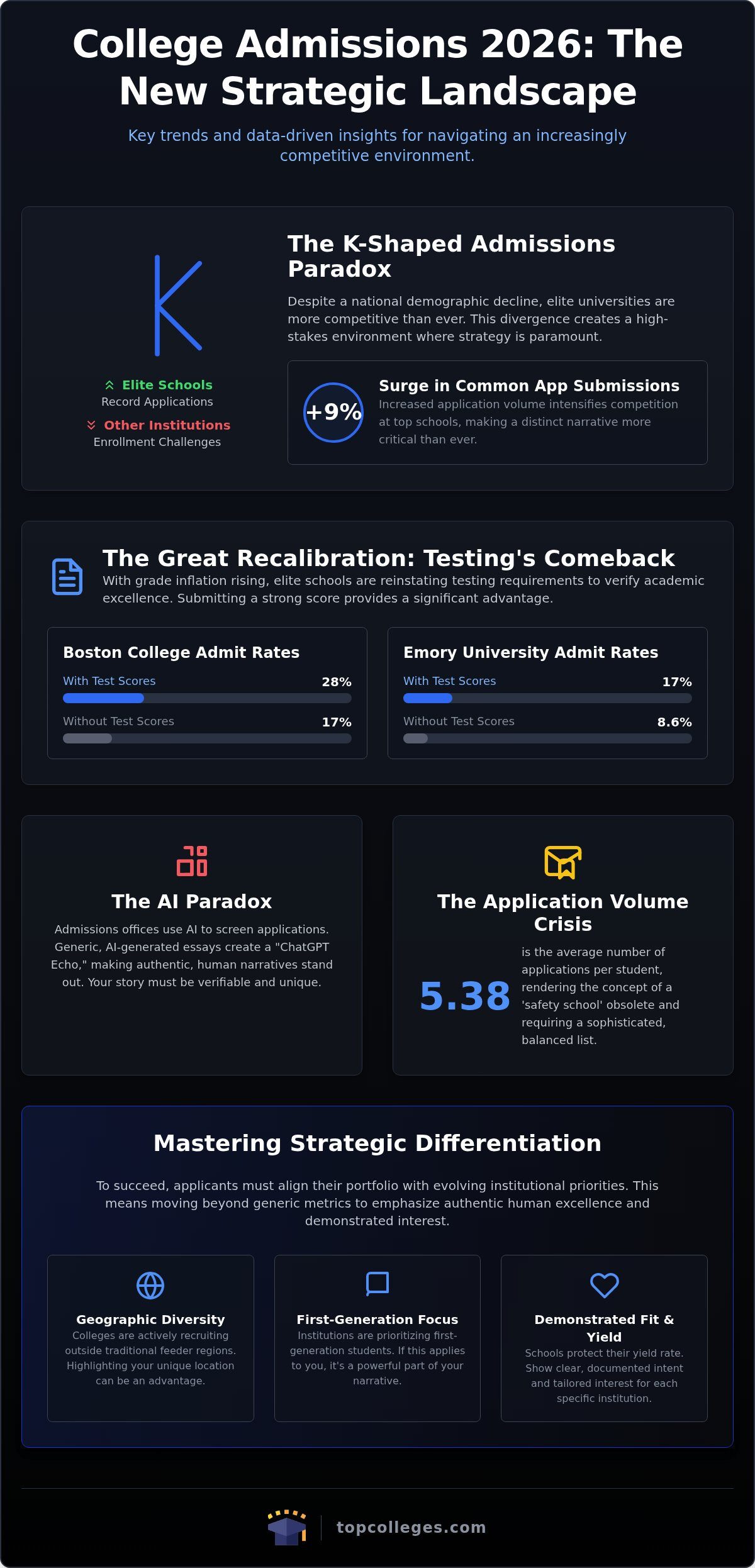
With the demographic cliff officially arriving this fall, why did the total number of applications submitted through the Common App still surge by 9%? It’s a paradox that leaves many families feeling a sense of strategic whiplash. You’ve been told the pool of applicants is shrinking, yet the gates at elite institutions have never felt more fortified or the competition more relentless. You likely feel the weight of this uncertainty, wondering if your personal narrative will be lost in a sea of AI-generated prose or if your test scores are truly optional in a landscape that increasingly rewards them.
Understanding these 2026 college admissions trends is no longer a matter of simple preparation; it’s a requirement for survival in a K-shaped market where the top tier grows more exclusive by the day. This strategic analysis replaces anxiety with a methodical roadmap. We’ll examine how to align your portfolio with current institutional priorities, from navigating AI-powered review bots at schools like Caltech to verifying extracurricular depth in an era of heightened scrutiny. You’ll gain the foresight needed to turn these systemic shifts into a distinct competitive advantage, ensuring your application commands the respect it deserves.
Key Takeaways
- Analyze the K-shaped reality where elite institutions remain hyper-competitive despite the national demographic cliff.
- Recognize why standardized testing has returned as a critical calibration tool for the most selective universities.
- Master the latest college admissions trends to ensure your personal narrative survives AI-powered screening processes and the “ChatGPT Echo.”
- Align your application with shifting institutional priorities, including geographic expansion and first-generation growth, to gain a decisive edge.
- Implement a strategic roadmap that moves beyond generic metrics to emphasize high-stakes differentiation and authentic human excellence.
The 2026 Admissions Landscape: Navigating the Demographic Cliff and Record Volume
The year 2026 marks a pivotal turning point in the college admissions process in the U.S. as the industry faces its most significant structural shift in decades. We’ve reached the edge of the demographic cliff. The demographic cliff is a structural shift in higher education supply. This phenomenon, triggered by the sharp decline in domestic birth rates during the 2008 financial crisis, has finally arrived at the gates of our universities. While headlines suggest a looming shortage of students, the reality for elite entry is far more complex. We’re witnessing a K-shaped divergence. Top-tier institutions are seeing record interest, while regional and mid-tier schools face existential threats. For the high-achieving applicant, the landscape isn’t getting easier; it’s getting more crowded at the summit.
The Paradox of the Demographic Cliff
Why are elite schools immune to this general enrollment decline? It’s a matter of global demand and prestige. While 16 nonprofit colleges announced closures in 2025, Ivy League and top-tier public universities experienced a different reality. These schools now focus heavily on yield management. They aren’t just looking for qualified students; they’re looking for students who are certain to enroll. This shift in college admissions trends means that demonstrating fit is just as important as demonstrating excellence. If a school suspects you’re using them as a “backup,” your stats won’t save you. They want to protect their yield, and they’ll sacrifice a high-stat applicant for one who shows clear, documented intent.
Application Inflation and the Volume Crisis
The volume of applications has reached a fever pitch. Data from the 2025-2026 cycle shows that the average number of applications per student rose to 5.38. This surge creates a “volume crisis” for admissions offices. When every student applies to more schools, acceptance rates naturally plummet. This environment has rendered the traditional concept of a “safety school” nearly obsolete. At schools like UCLA or UT Austin, out-of-state admit rates have dipped into the low single digits. Navigating this requires a sophisticated approach to college admissions counseling to ensure a list is truly balanced. You can’t rely on historical data when the floor is constantly shifting. A strategic list in 2026 must account for geographic shifts and institutional priorities that favor first-generation growth and specialized talents. It’s about tactical positioning, not just casting a wide net.
The Great Recalibration: Testing Requirements and the Verification of Excellence
The facade of test-optional admissions has officially fractured. While many institutions maintained flexible policies during the pandemic transition, 2026 marks a definitive return to quantitative rigor among elite universities. Why are the Ivies and top-tier publics reinstating the SAT and ACT? The answer lies in calibration. With grade inflation reaching unprecedented levels, a 4.0 GPA no longer provides the granular distinction admissions officers require. These scores serve as a vital common denominator. They validate a student’s academic standing against a global cohort. For high-achieving applicants, these college admissions trends represent a shift from “optional” to “essential” for those targeting the top 1% of schools.
The Return to Standardized Testing
Standardized tests are now the primary tool for verifying excellence. Data from recent cycles highlights a stark reality. At Boston College, applicants submitting scores were admitted at a rate of 28%, nearly double the 17% rate for those who didn’t. Emory University showed a similar disparity, with a 17% admit rate for score-submitters compared to just 8.6% for others. These authoritative government statistics on enrollment and achievement underscore the weight these metrics carry. If you’re applying to a highly selective institution, withholding a score is often interpreted as a signal of academic weakness. The strategic utility of the SAT or ACT is not just about the number; it’s about providing a verified anchor for your academic narrative.
Extracurricular Verification and Activity Audits
Beyond the testing room, we’ve entered the “Verification Era” for extracurricular achievements. Colleges are increasingly skeptical of the “founder” title that appears on every third application. They’re now conducting activity audits. They look for proof of work. This means your portfolio must provide verifiable evidence of impact. Did you lead a research project? Provide the link to the abstract. Did you run a community program? Document the specific metrics of your success. Strategic admissions counseling focuses on building these deep-dive descriptions to ensure they stand up to scrutiny. Elite schools favor one significant, documented achievement over a long, shallow list of memberships. Authentic leadership is measured by depth and the ability to withstand institutional verification. Your narrative must be grounded in tangible results that an algorithm or human reader can easily validate.
The AI Paradox: Safeguarding Human Authenticity Against Algorithmic Evaluation
Artificial intelligence has become the invisible gatekeeper of elite entry. As of 2026, over 80% of admissions offices anticipate using AI or predictive analytics in their review process. This creates a strategic paradox. While technology promises efficiency, it simultaneously devalues the polished perfection it helps create. Institutions like Caltech now utilize AI-powered voices to conduct research interviews, while Georgia Tech employs algorithms to scan transcripts for patterns of excellence. These college admissions trends represent a shift where the first hurdle isn’t a human reader, but a machine designed to filter out the generic. If your application sounds like it was synthesized by a large language model, it won’t just be ignored; it’ll be flagged as a lack of intellectual effort.
How Admissions Officers Detect AI Genericism
The “ChatGPT Echo” is the primary enemy of the modern applicant. AI writing often triggers red flags through its uncanny perfection—flawless syntax that lacks a distinct human pulse. Holistic review boards are trained to look for nuance and specific self-reflection that machines cannot replicate. They’re searching for “raw” and “vulnerable” storytelling that feels earned rather than generated. When an essay lacks the specific, sensory details of a lived experience, it fails the authenticity test. You can’t automate the way a particular failure felt or the specific logic of a personal breakthrough. These human markers are what differentiate a candidate in a sea of algorithmic noise. Elite readers don’t want a perfect essay; they want a real one.
The Human-AI Synergy Framework
Strategic applicants don’t ignore AI; they master its limitations. You might use these tools for initial research or to organize a complex structure, but the final narrative control must remain human. This is where the best college essays are forged. Professional counseling helps refine a unique personal statement that highlights a student’s specific voice while ensuring it meets institutional standards. The Authenticity Premium in 2026 admissions is the measurable advantage gained by candidates who present a verified, human-centric narrative that an algorithm cannot mimic. It’s a high-stakes game of differentiation. By leaning into the nuances of your own journey, you ensure that your voice remains the final bastion of human intelligence in an increasingly automated system.
Strategic Differentiation: Mastering the K-Shaped Admissions Curve
The K-shaped reality of 2026 isn’t just a hurdle; it’s a map. To reside on the upper arm of this curve, you must understand the hidden mechanics of institutional selection. These college admissions trends favor those who provide specific solutions to a university’s strategic needs. Elite schools aren’t just looking for the best students; they’re looking for the right pieces to complete a complex puzzle of diversity, financial sustainability, and geographic reach.
Decoding Institutional Priorities
The statistical reality of early applications is undeniable. Selective colleges now fill more than 70% of their incoming classes through Early Action and Early Decision. Institutions such as Middlebury, Bates, and Bucknell often fill four-fifths of their spots before the Regular Decision round even begins. If you wait for the January deadline, you’re competing for a fraction of the seats against the largest applicant pool in history. Early admit rates are currently two to four times higher than Regular Decision rates. ED II remains the most underutilized tool for 2026. It offers the binding commitment and yield security that colleges crave, but with the added flexibility of a later deadline. However, you must navigate these binding commitments with caution. In an uncertain economy, the strategic advantage of ED must be weighed against the long-term financial commitment it requires.
When domestic competition feels insurmountable, strategic applicants are looking elsewhere. International study has become a viable alternative for U.S. students seeking elite education without the 5.38 average application volume. Simultaneously, “Direct Admission” programs are emerging at regional campuses to bypass the traditional application process entirely. Mastering the K-shape means knowing when to double down on an elite ED target and when to pivot toward these emerging strategic alternatives.
Architecting Your Narrative: The Role of Strategic Counseling in 2026
Cross-Disciplinary Insight: MBA, Law, and Med Trends
Elite entry is no longer a siloed process. Graduate school selectivity is currently mirroring undergraduate patterns, creating a feedback loop of competitive rigor across all levels of higher education. Insight from MBA Admissions Consulting frequently informs undergraduate strategy by emphasizing executive presence and long-term professional trajectory. Similarly, the tactical mastery required for law school interview preparation serves as a vital model for high school seniors facing AI-powered screening. Building a long-term academic portfolio that spans from 12th grade to potential graduate entry ensures that every achievement is part of a coherent, verifiable legacy. This cross-disciplinary perspective allows you to anticipate how institutional priorities shift as you move through the academic hierarchy.
The Professional Edge of Top Colleges
Strategic counseling replaces paralyzing anxiety with a structured, prescriptive roadmap. At Top Colleges, we prioritize personalized portfolio development and rigorous interview prep to move your application beyond the rankings. Steven Roy Goodman’s 25+ years of experience and status as an author on higher education trends provide a global perspective that is essential in this disruptive year. We focus on the “Authenticity Premium,” ensuring your voice remains distinct in a sea of algorithmic noise. Interview preparation has become the ultimate differentiator against AI screening. It’s the only stage where your human nuance is fully visible to the committee. We don’t just help you apply; we help you command respect in a system that is increasingly automated. You’re positioning yourself for a major milestone, and that requires a mastermind who has seen the inner workings of the most competitive processes.
Securing Your Future in the 2026 Admissions Cycle
The 2026 application cycle has redefined the path to elite entry. We’ve moved beyond the era of simple metrics into a landscape where tactical positioning is the only way to survive the K-shaped curve. You’ve seen how the demographic cliff has paradoxically tightened the gates at top-tier institutions, making yield management the primary focus of admissions committees. You also know that the demand for verification now requires tangible proof for every claim, from standardized scores to extracurricular impact.
Staying ahead of these college admissions trends requires more than just high stats. It requires a narrative that an algorithm cannot replicate and a strategy that anticipates institutional needs before they’re even articulated. By prioritizing human authenticity and cross-disciplinary foresight, you transform a high-stakes challenge into a structured roadmap for success.
Led by high-profile expert Steven Roy Goodman, our team provides decades of success in Ivy League and elite admissions. We offer strategic mastery across undergraduate and graduate programs to ensure your future isn’t left to chance. You have the talent; now you need the mastermind to help you deploy it.
Frequently Asked Questions
Are colleges still test-optional in 2026?
While many schools remain technically test-optional, elite institutions like Vanderbilt, Harvard, and Caltech have reinstated requirements. Data shows a significant admission rate disparity; for example, Boston College admits score-submitters at 28% versus 17% for non-submitters. In the current college admissions trends, submitting a strong score is a vital differentiator. It provides a necessary calibration tool for admissions officers facing unprecedented grade inflation and record application volumes.
How do I prove my extracurricular activities are real?
Can I use AI to write my college essay in 2026?
You shouldn’t use AI to generate your final narrative, as elite institutions use sophisticated screening to detect the ChatGPT Echo. While algorithms at schools like Georgia Tech scan for patterns, human readers look for raw vulnerability and specific sensory details. AI often produces generic, polished prose that lacks a unique human pulse. Use these tools only for structural brainstorming, ensuring your final draft remains a human-crafted bastion of your authentic voice.
What is the demographic cliff and how does it affect me?
The demographic cliff is a structural shift in higher education supply caused by the 2008 birth rate decline. For 2026 applicants, this creates a K-shaped reality. While regional colleges struggle with enrollment, elite universities remain hyper-competitive due to global demand and increased applications per student. You face a more crowded field for fewer spots at top-tier schools, necessitating a tactical pivot from volume-based applications to high-stakes differentiation and yield management.
Is Early Decision worth it if I need financial aid?
Early Decision offers a significant statistical advantage, with some elite schools filling over 70% of their class early. However, it’s a binding commitment. If you require financial aid, you must use net price calculators to estimate your package before applying. While ED rates are often two to four times higher than Regular Decision, you should consult with an expert to ensure the binding nature of the agreement aligns with your family’s long-term financial sustainability.
How have acceptance rates changed for the Ivy League in 2026?
Acceptance rates at Ivy League and other elite institutions have reached historic lows despite the national demographic shift. This is driven by application inflation, with students now submitting an average of 5.38 applications each. As college admissions trends show a 9% increase in total submissions, top-tier schools have become even more exclusive. This volume crisis means that traditional safety schools are no longer guaranteed, requiring a more sophisticated and balanced list strategy.
What are colleges looking for in 2026 besides high grades?
Admissions officers prioritize institutional fit, authentic leadership, and verifiable excellence. Beyond a 4.0 GPA, they look for students who fill specific niches, such as geographic diversity or specialized research talents. They value deep-dive engagement over a shallow list of activities. With AI screening for genericism, a candidate’s ability to demonstrate self-reflection and a clear long-term trajectory through interview preparation has become the ultimate differentiator in a hyper-competitive, automated review process.