

Disclaimer
Content on this page of topcolleges.com is computer generated and therefore is not guaranteed to be 100 percent accurate about various aspects of the education sector. On balance, however, many students and families seek general information about high schools, colleges and universities, graduate programs, testing, education and career planning, and job placement before beginning one-on-one admissions counseling tailored to their specific needs.
What if the story you believe defines your character is actually the one sabotaging your chances at an elite university? For many high-achieving applicants, the challenge isn’t a lack of merit, but a failure of strategic positioning. You likely feel the crushing weight of the 650-word limit, trapped between the fear of sounding cliché and the paralyzing need to appear perfect. It’s difficult to strike the precise balance between authentic vulnerability and the professional confidence required for top-tier success. Mastering how to write a college personal statement requires more than just reflection; it demands a rigorous analysis of how your narrative fits into the broader institutional landscape.
We’ll move beyond basic storytelling to provide a tactical blueprint designed for the 2026 admissions cycle. This guide promises to transform your draft into a compelling case for admission by treating the essay as a solution to the admissions committee’s uncertainty. We’ll explore how to identify your unique value proposition, avoid the traps of sounding privileged, and execute a polished final draft that commands respect. By the end of this deep dive, you’ll possess a strategic roadmap that bridges the gap between your current aspirations and a seat at a prestigious institution.
Key Takeaways
- Reframe your essay as a tactical positioning document that bridges the gap between your past achievements and a university’s institutional goals.
- Learn how to write a college personal statement that bypasses overused clichés in favor of a unique, high-impact problem-solving framework.
- Master the Narrative Arc and Montage Structure to create a cohesive story that demonstrates both transformation and deep self-reflection.
- Protect your narrative’s authenticity by avoiding AI-generated prose and utilizing vocabulary that signals intellectual rigor to elite admissions officers.
- Implement the “Nameless Essay Test” to ensure your final draft is distinct enough to solve the committee’s uncertainty about your fit for their campus.
The Strategic Imperative: Reframing the Personal Statement for 2026
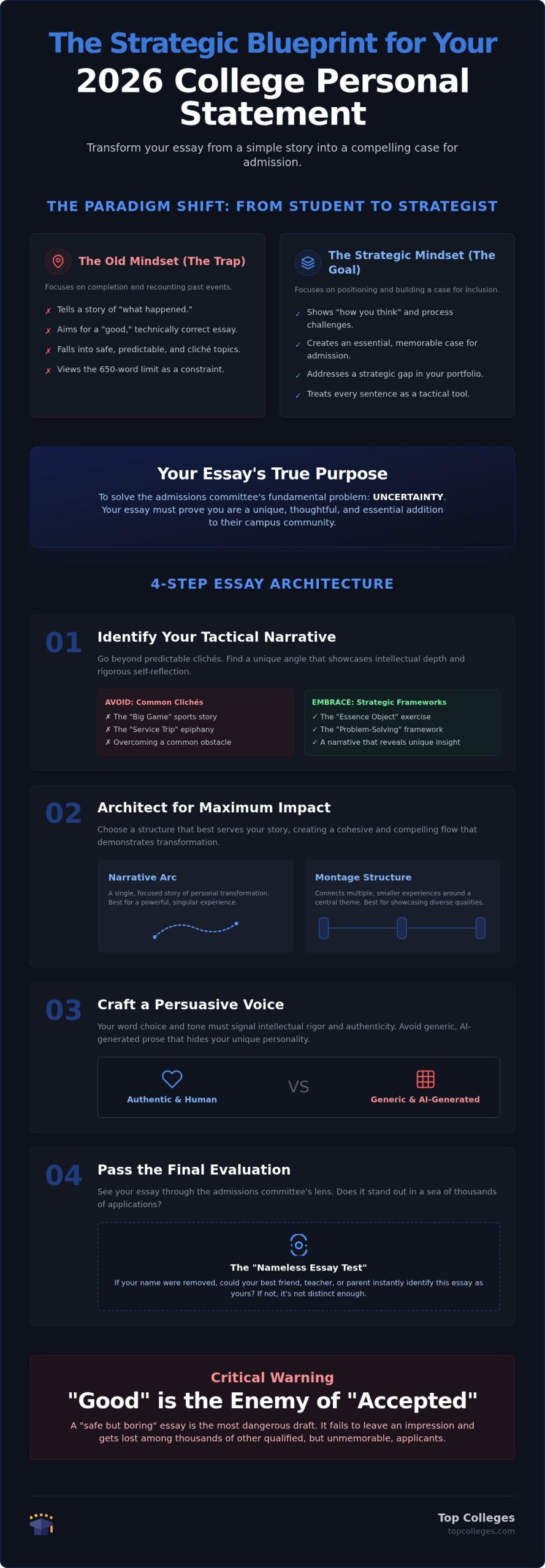
The 650-word limit is not a constraint; it is a high-stakes arena where your future is negotiated. In the 2026 admissions cycle, elite institutions have moved beyond looking for a simple narrative of overcoming obstacles. They are seeking a diagnostic window into your cognitive architecture. To understand What is a Personal Statement? in a modern context, one must view it as the cornerstone of a comprehensive college admissions counseling strategy. It functions as a bridge that connects your past achievements to the university’s specific future objectives.
The shift for 2026 is profound. Admissions officers are no longer satisfied with “what happened” in your life. They prioritize “how you think” and how you process complex challenges. This requires a transition from a student mindset, which focuses on completion, to a strategic applicant mindset, which focuses on positioning. Understanding how to write a college personal statement means recognizing that every sentence must serve a tactical purpose in your broader portfolio. You aren’t just telling a story; you’re building a case for your inclusion in a prestigious community.
Why ‘Good’ is the Enemy of ‘Accepted’
A “good” essay is often the most dangerous draft an applicant can submit. These essays are technically proficient but emotionally and strategically inert. They fall into the “safe but boring” trap, failing to leave a lasting impression on a committee that has already reviewed thousands of similar profiles. Elite institutions use this document to differentiate between identical academic records. If your essay doesn’t solve a specific problem for the reader, it remains a missed opportunity. You must move beyond being a qualified candidate to becoming an essential one who possesses the foresight and intellectual rigor the institution demands.
Identifying the Strategic Gap in Your Portfolio
Your transcript and resume provide the data, but the personal statement provides the soul and the strategy. Before you begin writing, perform a rigorous analysis of your existing materials to find what’s missing. Is there an academic anomaly that needs context? Is there a depth of character that your extracurricular list fails to capture? By using the essay to address these gaps, you create a cohesive narrative that feels both authentic and polished. This approach is central to The Strategic Blueprint for College Admissions Counseling in 2026, where the goal is to present a holistic, proactive vision of your potential rather than a mere list of previous roles.
Identifying Your Tactical Narrative: The Brainstorming Phase
Brainstorming is not a passive creative whim. It is a rigorous interrogation of your personal history to find themes that align with contemporary higher-education trends. Admissions officers loathe the “Big Game” or the “Service Trip” clichés because they are predictable and often lack intellectual depth. These narratives suggest a lack of foresight and an inability to move beyond surface-level experiences. Instead, you should utilize frameworks like the “Essence Object” exercise to find specific, evocative details or the “Problem-Solving” framework to showcase your ability to navigate complex systems. Understanding how to write a college personal statement involves identifying a narrative that functions as a tactical asset rather than a generic biography.
A hook must command immediate attention. In a high-volume environment where readers have seconds to evaluate your potential, your opening must be provocative and direct. Following Purdue OWL’s writing guidelines can help you ground these creative impulses in a structured methodology. If you find yourself stuck in analysis paralysis, a professional admissions review can help identify the unique narrative thread that separates you from the broader applicant pool. Each theme you select should be a deliberate choice that reinforces your candidacy for a high-stakes environment.
The Intellectual Rigor Test
An Ivy League narrative might emphasize groundbreaking leadership or intellectual autonomy, while an elite public honors college might value community impact or resilience. You must research these specific values to ensure your core narrative can pivot across different prompts without losing its authentic voice. Strategic timing is critical here. You should start this process months before the deadline to allow for the reflection necessary to produce a polished draft. Mastering how to write a college personal statement is a marathon of refinement; starting early ensures your narrative is a product of careful positioning rather than rushed necessity.
Architecting the Essay: Structural Frameworks for Maximum Impact
Structure is the silent architect of your admission case. It’s the difference between a collection of anecdotes and a cohesive strategic document. When considering how to write a college personal statement, you must choose a framework that highlights your intellectual agility. Most applicants view the essay as a linear biography; elite candidates treat it as a tactical positioning tool. You have two primary options for this: the Narrative Arc and the Montage Structure.
The Narrative Arc is ideal for candidates who have experienced a specific, transformative challenge. It focuses on a story of structured preparation and subsequent growth. Conversely, the Montage Structure allows you to connect disparate insights into a holistic view of your character. This is particularly effective for students with multi-faceted interests who need to demonstrate a consistent intellectual thread across various domains. Both frameworks rely on a “challenge-and-response” pattern. You identify a difficulty and meet it with a methodical solution. This diagnostic rhythm builds trust through logical progression, moving from broad observations to the specific, personal steps you took toward success.
The Anatomy of a Compelling Opening
Your opening shouldn’t rely on a generic hook. Admissions officers have seen every variation of the “alarm clock” or “rainy day” introduction. Instead, focus on a specific, concrete moment that creates high-stakes urgency within the first three sentences. This signals your status as a thought leader in your own life. You aren’t just reacting to events; you’re analyzing them. A strong opening establishes the “why” behind your narrative before the reader even reaches the “how.” It commands respect by positioning you as a high-level advisor of your own experience, replacing an officer’s skepticism with curiosity.
The Mid-Point: Building Credibility Through Evidence
The middle of your essay is where you transition from narrative to evidence. The “Show, Don’t Tell” rule is essential, but elite applicants take it further by using intellectually rigorous verbs. Don’t just “learn” or “do”; instead, choose to “synthesize,” “orchestrate,” or “interrogate.” This choice of vocabulary reinforces your professional standing. You must balance vulnerability with strategic confidence, showing that you can reflect on your flaws while maintaining a calm, authoritative expertise. For a deeper look at this process, see Architecting the Best College Essays: A Strategic Blueprint for 2026. This mid-point is your opportunity to replace the reader’s potential anxiety with a sense of structured preparation for the rigors of university life.
The Craft of Persuasion: Elevating Voice and Intellectual Rigor
Does your prose command the same level of respect as your academic record? Persuasion in high-stakes admissions is a function of register and intellectual rigor. When you master how to write a college personal statement, you aren’t just communicating facts; you’re signaling your readiness for a prestigious environment. This requires a “Diagnostic Rhythm” where sentence structure mirrors the clarity of your thought process. Short, punchy sentences highlight critical turning points. These are immediately followed by expansive, explanatory statements that detail your methodology. This flow establishes a sense of structured preparation that replaces the reader’s skepticism with confidence in your potential.
Your vocabulary must lean into the language of strategy and reflection. Favor terms that suggest tactical thinking and foresight. Instead of saying you “handled” a project, explain how you “orchestrated” or “leveraged” resources to achieve a specific outcome. This word choice reinforces your status as a thought leader who understands the nuances of high-level evaluation. You must maintain a formal register that commands respect, yet your voice must remain personal and accessible. It’s a delicate balance that separates an elite candidate from a casual peer.
Refining the Register of an Elite Advisor
Replacing passive verbs with active, strategic language is the first step in refining your register. This level of linguistic precision is a hallmark of professional communication, and institutions like the College of Media and Publishing offer courses to help writers master these advanced techniques. You should sound like a prestigious bridge to the university’s future goals. This isn’t about “thesaurus-abuse” or using impenetrable technical jargon. It’s about choosing elevated terms that signal a high degree of literacy. When you describe your experiences, use verbs that imply active movement and careful positioning. This approach ensures your narrative feels both pragmatic and results-oriented, mirroring the professional standing expected at top-tier universities.
The Limits of Tech in High-Stakes Writing
The rise of the “ChatGPT College Essay Grader” has created a new risk for applicants: the failure of the authenticity test. AI-generated prose often lacks the nuanced insight and personal reflection required for a compelling draft. While these tools can suggest basic structures, they cannot replicate the “human turning points” that define a candidate’s character. Admissions officers are trained to detect the rhythmic monotony of synthetic text. To ensure your essay passes the “global perspective” test, you must rely on deep analysis that only a seasoned mentor can provide. Authentic intellectual rigor cannot be automated; it must be cultivated through proactive planning and rigorous self-reflection.
The Final Evaluation: Seeing Your Essay Through the Admissions Committee’s Lens
The final audit of your personal statement is not a creative check; it’s a cold, diagnostic review. You must approach your draft with the same level of detachment as an admissions officer who has been reading for twelve hours. This is where you apply the “Nameless Essay Test.” If you dropped your draft on the floor of a crowded hallway and a stranger picked it up, would they recognize you from the prose alone? If the answer is no, your narrative lacks the specific, concrete details required to solve the committee’s uncertainty about your fit. Mastering how to write a college personal statement culminates in this moment of brutal honesty. You’re removing the fluff to let the architected narrative breathe.
Your conclusion should never merely summarize what you’ve already said. Instead, it must feel like a logical progression toward your future aspirations. It’s a bridge between the transformation you’ve described and the contributions you’ll make to the campus community. This document doesn’t exist in a vacuum. It must integrate seamlessly with your supplemental essays and your eventual interview preparation. A cohesive portfolio suggests a candidate who possesses both foresight and a clear sense of purpose. Every piece of the application should reinforce a single, sophisticated identity.
The Diagnostic Review Checklist
Before you consider a draft final, you must subject it to a rigorous strategic audit. This checklist ensures your document functions as a tactical asset rather than a liability. Ask yourself these critical questions:
- Does this essay replace the reader’s potential anxiety with a sense of structured preparation for university life?
- Is the tone authoritative and intellectually rigorous, yet appropriately humble for an applicant?
- Does the narrative provide context for your data points without repeating your resume?
This level of self-interrogation is equally vital for those pursuing Transferring Colleges Consulting: The Strategic Blueprint for Academic Realignment. In both cases, the goal is to present a polished, proactive vision of your academic trajectory.
The Role of Professional Admissions Counseling
There comes a point where self-reflection reaches its limit. Seeking a high-level advisor for a final strategic audit is often the difference between a “safe” essay and an acceptance letter. A professional review identifies the subtle clichés and missed opportunities that an applicant, no matter how gifted, might overlook. Professional fees translate into a methodical roadmap for success, providing you with the peace of mind that your draft is optimized for the inner workings of competitive processes. At Top Colleges, we offer the elite insights necessary to transform your narrative into a compelling case for admission. Understanding how to write a college personal statement is an investment in your future standing; ensure that investment is protected by seasoned expertise.
Executing Your Strategic Admissions Blueprint
The transition from a qualified candidate to an accepted student requires a precise alignment of your past achievements with a university’s future vision. You’ve learned to bypass generic clichés in favor of intellectual rigor and to subject your draft to the diagnostic scrutiny of the admissions committee. The stakes are high. Understanding how to write a college personal statement is a critical milestone in this journey. It transforms a simple narrative into a tactical positioning document that solves a specific problem for the reader.
Steven Roy Goodman and the Top Colleges team provide the seasoned expertise necessary for high-stakes admissions. We leverage decades of experience in strategic portfolio development to bridge the gap between your current draft and the expectations of elite institutions. Our methodical approach replaces anxiety with the confidence of structured preparation.
Your narrative is your most powerful asset. With a commitment to proactive planning and a structured roadmap, your future at a prestigious university is within reach.
Frequently Asked Questions
How long should a college personal statement be in 2026?
The standard limit for the Common App remains 650 words. While you don’t need to hit the maximum, elite applicants use this space to demonstrate intellectual depth. Every word must serve a tactical purpose. Learning how to write a college personal statement effectively means focusing on a diagnostic rhythm that moves from broad observations to specific, personal steps toward success. A concise, polished draft is always superior to a padded narrative.
Can I write about a failure or mistake in my college essay?
What is the difference between a personal statement and a statement of purpose?
A personal statement focuses on your character and internal logic, while a statement of purpose is a tactical document detailing your academic trajectory and career goals. The personal statement is a bridge between your past achievements and the university’s future goals. In contrast, the statement of purpose is prescriptive, outlining the specific research or professional milestones you intend to achieve. Both require professional review to ensure they align with high-level evaluation.
How do I start a college essay without being cliché?
Mastering how to write a college personal statement starts with avoiding the “alarm clock” or “mirror” openings. Begin in the middle of a specific, concrete moment that creates high-stakes urgency. This signals your status as a thought leader in your own life. Use provocative, direct questions or a bold statement to command respect immediately. Your first three sentences must establish a diagnostic rhythm that replaces skepticism with curiosity about your unique narrative.
Should I use AI to help write or edit my personal statement?
Using AI for high-stakes writing carries significant risks. AI-generated prose often fails the authenticity test because it lacks the nuances of personal reflection and deep analysis. While it might suggest basic structures, it cannot replicate the human turning points that define an elite candidate. Admissions officers are increasingly sensitive to the rhythmic monotony of synthetic text. Relying on professional admissions counseling ensures your essay passes the global perspective test with genuine intellectual rigor.
How many drafts does a successful college essay typically require?
A successful draft typically undergoes five to ten iterations. The first few drafts are for identifying your tactical narrative, while later versions focus on strategic polish and elevating your register. This is a marathon of refinement, not a sprint. Each revision should move you closer to a finished document that feels authentic yet strategically polished. Professional review at the final stage provides the foresight needed to ensure the essay solves a specific institutional problem.
Is it okay to use humor in a high-stakes personal statement?
Humor is effective only if it reflects a high degree of literacy and professional standing. Avoid casual jokes or sarcasm that might undermine the gravity of the milestones you face. Instead, use wit to demonstrate intellectual agility and a calm, authoritative expertise. If the humor feels forced, it becomes a liability. A successful essay uses tone to replace the reader’s potential anxiety with a sense of structured preparation and strategic confidence.
What do admissions officers look for in the first paragraph?
Admissions officers look for a diagnostic window into your cognitive architecture within the first paragraph. They want to see immediate evidence of intellectual rigor and an ability to engage with complex challenges. Your opening must function as a tactical positioning document that commands attention in a high-volume environment. It should establish the why behind your methods, providing a holistic view of the landscape you navigate before moving into the specific how of your narrative.