
Disclaimer
Content on this page of topcolleges.com is computer generated and therefore is not guaranteed to be 100 percent accurate about various aspects of the education sector. On balance, however, many students and families seek general information about high schools, colleges and universities, graduate programs, testing, education and career planning, and job placement before beginning one-on-one admissions counseling tailored to their specific needs.
Does your portfolio demonstrate a genuine mastery of craft, or is it merely a curated collection of high school hobbies? For many elite applicants, the distinction represents the difference between a definitive acceptance and a missed opportunity. You’ve likely spent years refining your technique, yet the high-stakes pressure of submitting a successful arts supplement can feel overwhelming. The fear that a mediocre submission might undermine a perfect academic profile is valid. It’s a critical turning point where technical hurdles like SlideRoom and artistic uncertainty often lead to unnecessary paralysis.
We understand that this process requires more than talent; it demands a calculated strategy. This guide provides a blueprint to master the supplemental portfolio, transforming it from a simple requirement into a commanding asset that demands respect. You’ll learn how to implement the Narrative Bridge strategy to connect your art with your academic profile. We will also demystify the technical submission landscape and define the exact threshold of excellence required by elite admissions committees. By the end of this analysis, you’ll have the clarity needed to present a portfolio that reflects your highest potential.
Key Takeaways
- Determine if your work meets the rigid “threshold of excellence” required by elite institutions or if submitting it poses a strategic risk to your profile.
- Master the art of curation by prioritizing technical depth and professor-level mastery over mere volume when submitting a successful arts supplement.
- Implement professional-grade technical standards in audio and lighting to ensure your portfolio commands immediate respect from faculty reviewers.
- Build a “Narrative Bridge” between your creative output and your academic identity to demonstrate a cohesive, high-level intellectual trajectory.
- Avoid common technical friction by mastering the SlideRoom integration and adhering to accelerated, arts-specific submission deadlines.
The Strategic Threshold: Should You Submit an Arts Supplement?
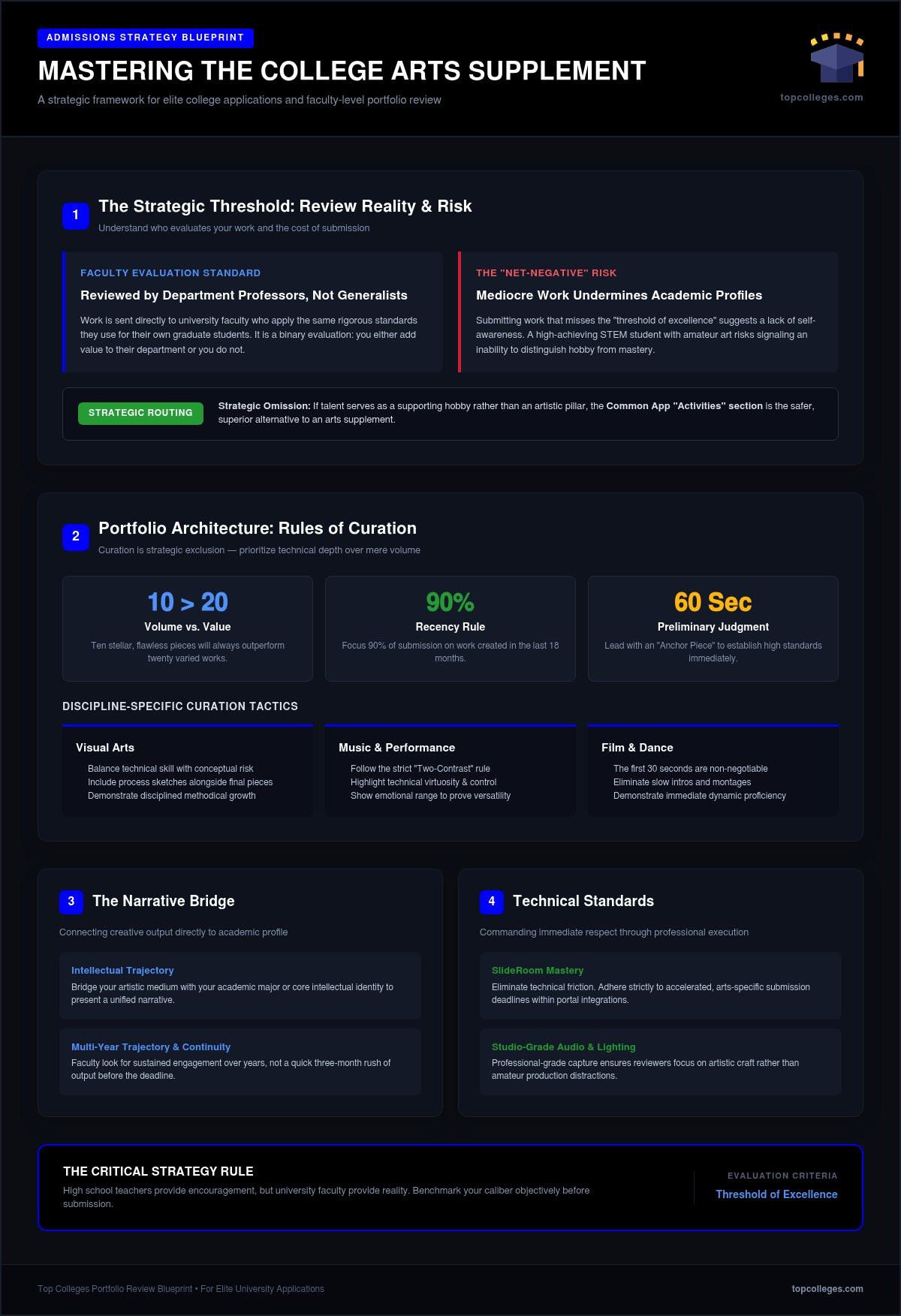
The decision to include a portfolio is one of the most consequential choices in your application strategy. It isn’t a casual add-on or a way to show “well-roundedness.” At elite institutions, your work isn’t reviewed by generalist admissions officers. Instead, it’s sent directly to department faculty. These professors apply the same rigorous standards they use for their own graduate students. If your submission doesn’t meet this “threshold of excellence,” it becomes a liability. A mediocre supplement suggests a lack of self-awareness or a failure to understand the caliber of the institution. You’re essentially asking an expert to spend their time on your work; it better be worth the effort.
Diagnosing Your Artistic Caliber
How do you determine if your talent warrants a separate showcase? You must seek objective, high-level critiques from mentors who aren’t personally invested in your success. High school teachers often provide encouragement, but university professors provide reality. Benchmark your work against previous successful portfolios in your specific discipline. Ask yourself if your art is a “pillar” that defines your identity or a “supporting detail” better suited for a brief mention. Submitting a successful arts supplement requires a level of mastery that translates across professional contexts, proving you’re prepared for the intensity of a top-tier conservatory or studio program.
The ‘Net-Negative’ Risk Assessment
The college admissions process in the United States is increasingly holistic, but that doesn’t mean more is always better. A poorly curated supplement can actively undermine your academic credibility. If you’re a high-achieving STEM student with “pretty good” paintings, a weak portfolio might signal that you can’t distinguish between a hobby and professional-level discipline. In these cases, the Common App “Activities” section is a safer, more strategic alternative. It allows you to acknowledge your passion without inviting a critique from world-class experts. Strategic omission is often the hallmark of a commanding application.
Continuity is the silent metric faculty look for during the review. They want to see a trajectory of disciplined progression over several years rather than a collection of pieces produced in a three-month rush before the deadline. Your portfolio must reflect a sustained engagement with your medium. This history of growth proves you possess the grit required to thrive in a competitive university environment. When you choose the path of submitting a successful arts supplement, you’re inviting a secondary layer of scrutiny. This faculty review is a binary evaluation; you either add value to their department or you don’t. There’s no middle ground for “talented for a high schooler.”
Architecting Your Portfolio: Curation for Maximum Impact
Curation is an act of strategic exclusion. Many applicants fail because they mistake volume for value. In the high-stakes environment of elite admissions, ten stellar pieces will always outperform twenty varied ones. Submitting a successful arts supplement requires you to be your own harshest critic. If a piece doesn’t meet the “threshold of excellence” discussed previously, it must be cut. Your portfolio shouldn’t be a chronological history of your development; it’s a showcase of your current peak performance. Focus 90% of your submission on work completed within the last 18 months to ensure your technical skills are represented accurately.
Your “Anchor” piece must lead the submission. This is your most provocative, technically complex work that signals your intellectual depth immediately. Faculty reviewers often make a preliminary judgment within the first minute. By leading with your strongest work, you establish a standard that the rest of the portfolio must support. When you prepare your materials for the Common App application portal for first-year students, remember that every inclusion must serve a specific strategic purpose.
Discipline-Specific Curation Tactics
- Visual Arts: Balance technical proficiency with conceptual risk. Include process sketches alongside finished works to demonstrate your methodical approach.
- Music and Performance: Adhere to the “Two-Contrast” rule. Select pieces that showcase both technical virtuosity and emotional range to prove your versatility.
- Film and Dance: The first 30 seconds are non-negotiable. Edit your reel to capture immediate attention; don’t save your best sequence for the finale.
The Power of Professional Presentation
Professionalism is signaled through a cohesive digital aesthetic. Use consistent lighting for visual art and high-fidelity audio for performance recordings. Whitespace is your ally; don’t clutter the screen with excessive text or complex backgrounds. Simple, precise titling allows the work to speak for itself while signaling a high degree of professional intent. High-resolution imagery isn’t just a preference; it’s a requirement to demonstrate you take your craft seriously. If you’re unsure if your curation meets the elite standard, seeking strategic portfolio development guidance can provide the objective perspective necessary to refine your submission.
Technical Standards: Commanding Respect Through Quality
Technical excellence is the baseline of credibility. You cannot expect a world-class faculty member to squint at a grainy photo or struggle with distorted audio. High production value signals that you respect the medium and the reviewer’s time. When you’re submitting a successful arts supplement, the technical quality of your files is as much a part of the evaluation as the artistic content itself. It’s the difference between being viewed as a serious practitioner and a casual student.
For musicians, a professional-grade microphone is non-negotiable. Built-in laptop mics compress sound and strip away the dynamic range that defines a virtuoso performance. Visual artists must utilize three-point lighting to document three-dimensional works, ensuring that texture and form are captured without distracting shadows. Performance videos require tight framing that eliminates domestic backgrounds. The focus should remain entirely on your movement or technique, not the clutter in your rehearsal space. To ensure your video submissions meet these high standards, learn more about Y.POST PRODUCTION.
Admissions committees now expect a professional digital standard. This means 4K resolution for video and high-bitrate audio files that ensure a lag-free experience for faculty reviewers. Following the Harvard College admissions guidelines for first-year applicants, you’ll see that supplements are integrated into a holistic review. However, technical glitches can derail that review instantly. Ensure your files are optimized for SlideRoom and university-specific portals to avoid the technical friction that plagues less-prepared applicants. Maintaining the authenticity of the performance is key; avoid over-editing that masks your true ability.
The Documentation Protocol
A methodical approach to documentation prevents last-minute disasters. Follow this three-step strategic blueprint:
- Step 1: Capture in raw format. This provides the maximum flexibility for post-production editing without losing essential detail.
- Step 2: Polish with precision. Apply color correction and audio leveling. This doesn’t mean altering the work; it means ensuring the digital file accurately represents the live experience.
- Step 3: Rigorous testing. Open your files on multiple devices and operating systems. If a file takes too long to load or looks washed out on a different screen, it isn’t ready for submission.
Strategic file management is the final hurdle. Universities often have specific naming conventions or size limits that vary between institutions. Submitting a successful arts supplement requires meticulous attention to these details. Don’t let a file size error at 11:59 PM be the reason your talent goes unseen. Your technical preparation must be as disciplined as your artistic practice.
The Narrative Bridge: Writing the Strategic Artist Statement
A portfolio without a narrative is merely a collection of data. To elevate your submission, you must construct a bridge between your technical output and your intellectual identity. The artist statement is your opportunity to move beyond the “what” of your work and articulate the “intellectual why.” Why does this specific medium serve your inquiry? What questions are you investigating through your craft? Submitting a successful arts supplement requires you to demonstrate that your creative process is driven by the same analytical rigor you apply to your academic studies.
This narrative must be part of a larger, unified strategy. Your statement should seamlessly align with the best college essays in your application, reinforcing a single, commanding persona. If your essays focus on social justice, your portfolio and statement should reflect that thematic engagement. Use the sophisticated terminology of your discipline to signal literacy. Terms like “compositional tension,” “chromaticism,” or “spatial hierarchy” prove you’ve moved past the amateur stage and are ready for professional-level discourse.
Structure of a Commanding Statement
A strong statement follows a diagnostic and prescriptive rhythm. Start with a hook that defines your creative philosophy in a single, provocative sentence. Avoid generic openings; instead, identify the core tension that drives your work. Follow this with a methodology section. Detail the specific technical challenges you overcame in your most complex pieces, proving your persistence and problem-solving skills. Finally, conclude with a synthesis. Connect your artistic discipline to your intended academic major to show how your creative insights will enhance your contributions to the campus community.
Avoiding Common Narrative Pitfalls
- Eliminate clichéd sentimentality. Phrases like “art is my passion” or “I’ve always loved to create” are placeholders for actual insight. Replace them with specific observations about your process.
- Maintain professional distance. While art is personal, your tone must remain reflective and analytical. Faculty are looking for colleagues, not diarists.
- Respect the clock. Reviewers are often evaluating hundreds of portfolios. Keep your statement concise, high-impact, and devoid of filler.
Contextualizing your journey is vital for elite admissions. Explain how mentorship or specific training has shaped your growth. This foresight demonstrates that you understand your own trajectory and have a clear vision for your future aspirations at a top-tier university. It isn’t enough to be talented; you must be self-aware.
Final Execution: Timing and Strategic Submission
Precision in the final hour is non-negotiable. Submitting a successful arts supplement requires more than artistic talent; it demands logistical mastery. Many elite programs have supplemental deadlines that precede the general application date. Missing these windows is a definitive disqualification. You must treat these dates with the same gravity as the primary application. The technical handshake between SlideRoom and the Common App often creates a bottleneck for the unprepared. You should initiate this integration weeks in advance to ensure data syncs correctly across both platforms.
Once you’ve submitted, the “Status Portal” audit becomes your primary tool for verification. Don’t assume a submission confirmation email is the end of the process. Log into each university’s specific portal to verify that the supplement has been received and, more importantly, viewed by the committee. If the portal doesn’t reflect your submission within 48 hours, proactive communication with the admissions office is required. Leveraging professional college admissions counseling for a final strategic review can prevent these technical oversights from undermining years of preparation.
The Strategic Timeline
Success is built on a three-month curation window. This period allows for the recording, re-recording, and refinement of your portfolio without the pressure of an impending deadline. The “Final Polish” week should be reserved exclusively for file integrity checks. Does every link work on multiple browsers? Is the bitrate stable? Simultaneously, you must coordinate with your recommenders. Your art teacher’s letter of recommendation must align with the themes and technical strengths presented in your portfolio. This internal consistency reinforces your narrative and proves that your talent is recognized by other experts in the field.
The Logic of the Conclusion
An arts supplement isn’t an isolated component. It’s the final piece of a strategic blueprint designed to command respect from faculty and admissions officers alike. By following a structured preparation plan, you replace the typical applicant’s anxiety with a sense of methodical confidence. You aren’t just hoping for a result; you’re engineering one. When your technical mastery, narrative bridge, and logistical execution align, your application moves from competitive to commanding.
Mastering the Final Stage of Your Admissions Strategy
The journey from a competitive applicant to a commanding one rests on the precision of your final execution. You’ve moved beyond the uncertainty of the “threshold of excellence” by curating a portfolio that prioritizes technical depth over mere volume. By implementing professional-grade technical standards and constructing a sophisticated narrative bridge, you’ve ensured your work captures the immediate respect of world-class faculty reviewers. Submitting a successful arts supplement is the definitive act of aligning your creative mastery with your academic ambitions. It’s a high-stakes process where every detail signals your readiness for the elite university environment.
Decades of success in elite university admissions have proven that a strategic approach to portfolio development is non-negotiable. With expert guidance from Steven Roy Goodman, you can replace submission anxiety with a structured blueprint for commanding admissions results. Your talent deserves a platform that reflects its true caliber and secures your place among the next generation of academic and creative leaders. You have the vision; now it’s time to execute with authority.
Frequently Asked Questions
How much weight does an arts supplement actually carry in the admissions process?
An arts supplement carries substantial weight when it validates a unique talent, acting as a strategic tie-breaker in elite pools. For some, it provides a pillar of identity that distinguishes them from thousands of high-achieving peers. However, if the quality doesn’t meet the faculty’s threshold, it carries negative weight. It signals a lack of self-awareness. You should view it as a high-stakes evidentiary piece rather than a casual hobby showcase.
Can I submit an arts supplement if I am not planning to major in the arts?
You don’t need to major in the arts to benefit from submitting a successful arts supplement. In fact, many successful STEM or humanities applicants use their creative mastery to demonstrate disciplined, long-term commitment. It serves as a Narrative Bridge, proving you possess the grit and intellectual curiosity to excel in a rigorous university environment. The key is ensuring your creative output aligns with your broader academic profile to create a cohesive application.
What is the difference between an arts supplement and a portfolio for art school?
A supplemental portfolio is a highly curated selection designed to enhance a general application, whereas an art school portfolio is the primary metric for admission. Supplements typically require fewer pieces and focus on your peak technical proficiency. Art schools demand a wider breadth of work, including sketchbooks and process-oriented pieces. While both require professional documentation, the supplement must be more concise to respect the faculty’s limited review time during the general admissions cycle.
Should I submit a supplement if I am only ‘pretty good’ at my craft?
Submitting a mediocre supplement is a strategic error that can undermine a strong academic profile. If your work is only “pretty good,” it likely won’t pass the faculty review process and could signal that you don’t understand the institution’s standards. Professional counseling often helps determine if your work meets the necessary excellence threshold. If you aren’t performing at a professor-level, it’s safer to list the activity in the Common App rather than inviting expert critique.
Is there a specific deadline for submitting an arts supplement?
Deadlines for supplemental materials often differ from general admission dates, sometimes occurring weeks earlier. You must verify these dates for every institution on your list to avoid disqualification. The technical integration between SlideRoom and the Common App requires time to process, so waiting until the final hour is a significant risk. Successful applicants usually finalize their portfolio curation at least three months before the earliest deadline to ensure every file meets professional standards.
Does every college accept supplemental materials for the arts?
Not every institution accepts supplemental arts materials. Some elite universities have shifted away from faculty reviews for non-majors, while others maintain rigid, discipline-specific portals. You must audit each college’s specific requirements before you begin the curation process. If a school doesn’t accept supplements, don’t try to bypass the system by sending unsolicited links. Instead, use your personal statement or activities list to articulate the depth of your creative engagement.
How do I know if my artistic talent meets the ‘professor-level’ threshold?
Determining if you meet the threshold requires objective, high-level critiques from experts who aren’t your personal friends or teachers. You should benchmark your portfolio against successful submissions at top-tier conservatories or winners of national-level competitions. If a university professor in your discipline would consider you a viable candidate for their advanced studio or ensemble, you’ve met the mark. This level of talent is rare and requires years of disciplined progression.
What happens if my supplement is viewed by the admissions office but not the faculty?
If your supplement is viewed by admissions but not faculty, it often means your work didn’t meet the initial technical or quality screening. Admissions officers act as gatekeepers; they only pass work to professors if it appears to meet the school’s standards for specialized review. This is why submitting a successful arts supplement requires professional-grade production. Without faculty validation, the supplement loses its strategic power and becomes a mere footnote in your digital file.