

Disclaimer
Content on this page of topcolleges.com is computer generated and therefore is not guaranteed to be 100 percent accurate about various aspects of the education sector. On balance, however, many students and families seek general information about high schools, colleges and universities, graduate programs, testing, education and career planning, and job placement before beginning one-on-one admissions counseling tailored to their specific needs.
What if the very factor you believe disqualifies you from an Ivy League seat is actually your most powerful tactical lever for admission? It’s a common anxiety to feel several steps behind peers whose families have mastered elite academic circles for decades. You might see the lack of a legacy connection as a hurdle. In reality, your perspective is a sought-after institutional asset in the 2026 admissions cycle. This college application guide for first-generation students is designed to replace that uncertainty with a rigorous, results-oriented strategy.
We’ll transform your unique narrative from a story of survival into a compelling case for intellectual vitality and leadership. You’ll learn how to manage the reinstatement of standardized testing at schools like Yale and Brown while leveraging the updated Student Aid Index to your advantage. This guide provides a comprehensive roadmap to elite spaces, ensuring you don’t just gain entry but arrive with the strategic confidence to thrive within high-support infrastructures.
Key Takeaways
- Learn how to pivot your first-generation background from a perceived disadvantage into a high-value institutional priority for elite admissions officers.
- Use this college application guide for first-generation students to decode the unwritten rules of elite admissions that legacy applicants often inherit through family networks.
- Identify which top-tier universities provide the specific support infrastructure and retention programs necessary to ensure your long-term academic success.
- Discover how to architect a personal statement that showcases strategic resilience and intellectual curiosity while avoiding common narrative pitfalls.
- Understand why professional counseling is the essential bridge that aligns your unique talent with the rigorous expectations of 2026 admissions.
Redefining the First-Generation Identity as a Strategic Asset
Why do the world’s most selective universities invest millions in identifying and recruiting students who lack a family history of higher education? It isn’t a gesture of benevolence. In the 2026 admissions cycle, your first-generation status is a high-value commodity, a tactical asset that elite institutions require to maintain their global prestige and societal relevance. This college application guide for first-generation students provides the framework to leverage your background as a strategic advantage rather than a deficit to be explained away.
You aren’t merely applying for a seat; you’re offering a university the chance to fulfill its core mission of social mobility and intellectual diversity. We call this Narrative Equity. It’s the strategic process of quantifying the distance you’ve traveled relative to your resources. When you present your journey through this lens, you stop being a statistic and start being a vital institutional priority. Successful applicants understand that elite schools aren’t just looking for high grades; they’re looking for the resilience and untapped leadership potential that first-generation talent naturally possesses.
Understanding the 2026 Admissions Landscape
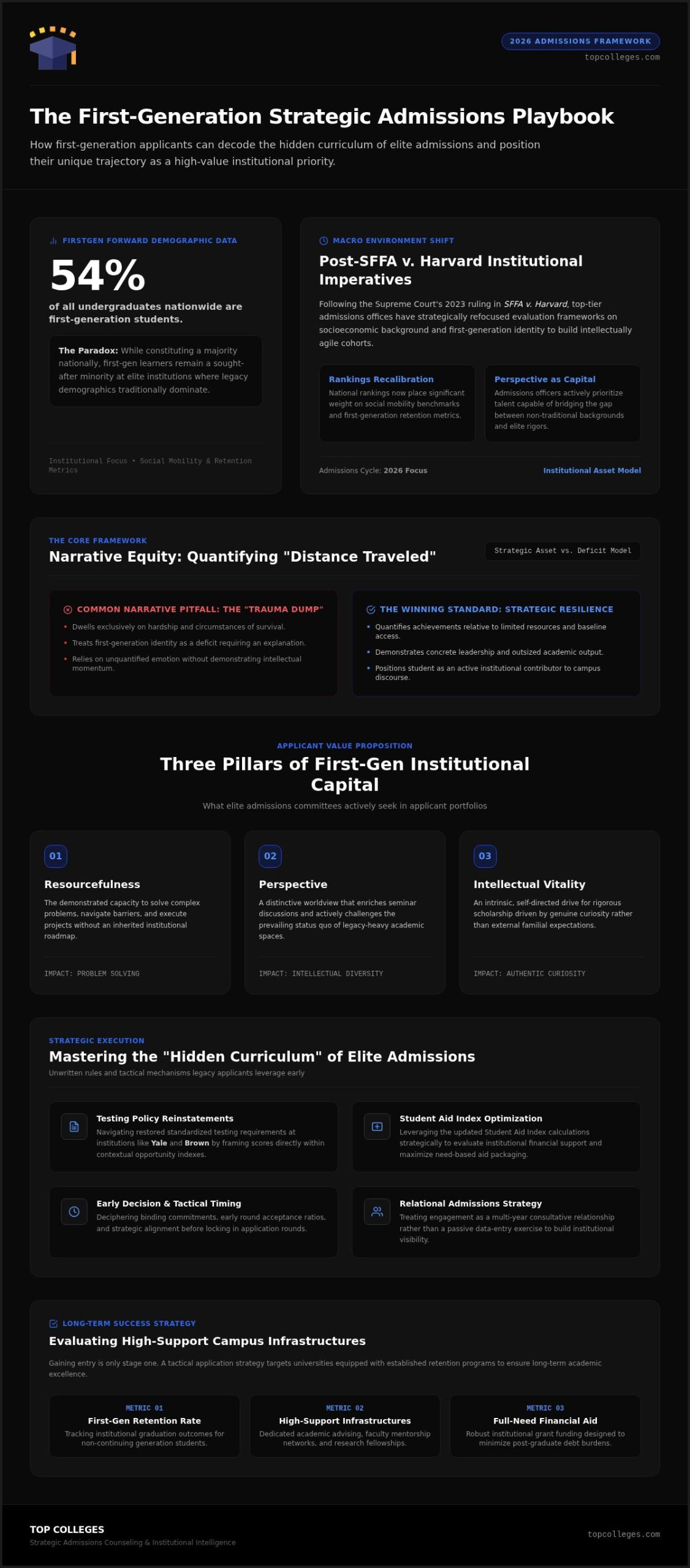
Following the Supreme Court’s 2023 decision in SFFA v. Harvard, top-tier admissions offices have shifted their focus toward socioeconomic background and first-generation status to build diverse cohorts. Institutional priorities have moved beyond simple diversity metrics to a deep evaluation of how an applicant’s character and perspective will impact the campus community. Data from FirstGen Forward indicates that while 54% of all undergraduates are first-generation, they remain a sought-after minority at elite institutions where legacy students often dominate the demographic.
This shift makes your perspective a commodity that top-tier schools are actively buying. Rankings now heavily weight social mobility and retention rates of first-gen learners. Consequently, admissions officers are tasked with finding students who can bridge the gap between their current environment and the rigorous demands of an elite university. By utilizing professional college admissions counseling, you can align your personal narrative with these specific institutional goals, ensuring your application commands the attention it deserves.
Moving Beyond Statistics to Strategic Storytelling
First-generation status acts as a catalyst for institutional growth by introducing intellectual agility and authentic leadership potential into competitive academic environments. This definition shifts the focus from what you lack to what you contribute. Elite admissions officers are weary of the “trauma dump” essay that dwells solely on hardship. They’re searching for evidence of strategic resilience.
A leadership narrative highlights how you navigated limited resources to achieve outsized results. You bring a unique value proposition to campus, including:
- Resourcefulness: The ability to solve complex problems without a pre-existing roadmap.
- Perspective: A worldview that challenges the status quo of legacy-heavy classrooms.
- Intellectual Vitality: A drive for knowledge that isn’t motivated by family expectations, but by genuine curiosity.
By following a structured college application guide for first-generation students, you can ensure these traits are the centerpiece of your portfolio, positioning you as a high-impact addition to any elite cohort.
Navigating the Hidden Curriculum of Elite College Admissions
What if the most critical rules for entering the Ivy League aren’t found in any official handbook? For many applicants, the “hidden curriculum” consists of the unwritten social codes and professional expectations that continuing-generation students inherit at the dinner table. While your peers may already understand the binding nature of Early Decision or the tactical value of alumni networking, you’re often left to decipher these nuances alone. This college application guide for first-generation students aims to bridge that information gap with clinical precision.
Execution requires foresight. Legacy students often secure a head start by engaging with admissions offices years before they actually apply. They understand that admissions is a relationship-driven process, not just a data-entry exercise. To compete at this level, you must adopt a methodical approach to your candidacy, treating every interaction with an institution as a data point in your favor.
Decoding Institutional Priorities and Recruitment
Admissions officers use a rubric that extends far beyond GPA. They’re looking for “demonstrated interest,” a metric that tracks how likely you are to enroll if accepted. For a first-gen applicant, showing interest must be authentic and strategic. Attend virtual forums, engage with regional recruiters, and apply for fly-in programs that specifically target first-generation talent. These actions signal that you’ve done the work to understand the school’s culture. If you feel overwhelmed by these unspoken requirements, seeking professional admissions counseling can provide the high-level perspective needed to prioritize your efforts effectively.
Tactical Timeline Management for First-Gen Applicants
Success is a product of timing. Without parental experience to guide the rhythm of your senior year, you must adhere to a strict strategic calendar. Legacy is a head start, not a finish line; you can outpace it with better planning.
- Identify Support Infrastructure: Prioritize schools with robust FirstGen Centers or TRIO programs. Research indicates that institutions with dedicated support have significantly higher retention rates for students like you.
- Secure Recommendations Early: Don’t wait until November. Approach mentors in September to ensure they have the time to draft a narrative that highlights your intellectual vitality.
- Master the Early Strategy: Understand the deadlines. For instance, the QuestBridge National College Match application is due October 1, 2026. Missing this window can cost you a full-ride, no-loan financial aid package. Similarly, domestic students with an annual family AGI of up to $100,000 qualify for a CSS Profile fee waiver, allowing you to submit applications to multiple elite schools at no cost.
Strategic Selection: Identifying High-Support Elite Institutions
Chasing a brand name without auditing its support infrastructure is a high-risk gamble for first-gen talent. While a university’s global ranking might signal prestige, it says little about its commitment to your specific success. You need to identify schools where your background is treated as an asset, backed by tangible resources. This college application guide for first-generation students emphasizes that true institutional fit is measured by retention rates and graduation outcomes, not just admission stickers. Prestige is only valuable if the institution provides the cultural capital necessary to leverage it.
Refining your list requires a methodical approach. You must distinguish between colleges that simply admit first-gen students and those that invest in them. Utilizing the Strategic Blueprint for College Admissions Counseling allows you to evaluate institutions through a lens of tactical positioning. It helps you determine if a school’s internal culture aligns with your professional aspirations, ensuring you don’t just gain entry, but graduate with a competitive edge. Professional guidance ensures you aren’t just looking at the name on the gate, but the support systems behind it.
Evaluating Financial Aid vs. Actual Cost of Attendance
Elite admissions are generally either need-blind or need-aware. Need-blind schools don’t consider your ability to pay during the evaluation process, which is a critical distinction for high-need applicants. For the 2026 cycle, several “no-loan” institutions, including Princeton and Amherst, have expanded policies to cover full costs for families earning under $100,000 annually. However, the sticker price isn’t the only metric. You must account for hidden costs like travel, professional attire for networking, and the financial feasibility of unpaid internships. A school that covers tuition but ignores these realities may leave you socially isolated in elite spaces.
Assessing On-Campus Support Networks
Look for evidence of intrusive advising and dedicated bridge programs. Top-tier institutions often offer “Fly-in” programs for high school seniors, providing a first-hand look at campus culture before the application deadline. Evaluate the university’s first-gen alumni network; a strong network indicates that the school successfully bridges the gap between the classroom and high-level careers. Programs that begin the summer before freshman year are essential. They provide the peer mentorship and cultural orientation necessary to navigate elite spaces with confidence. This level of scrutiny is what separates a successful applicant from one who merely hopes for the best.
Architecting a Narrative That Commands Attention
The personal statement isn’t a diary entry; it’s a strategic brief. For first-gen students, this document serves as the connective tissue between raw potential and the university’s institutional goals. While many peers rely on legacy status, you must rely on the strength of your narrative to prove your value. This college application guide for first-generation students highlights the need to move beyond the “trauma dump.” Admissions officers at elite schools aren’t looking for reasons to pity you. They’re looking for evidence of strategic resilience.
You can’t just tell a story; you must architect it. Utilizing the Architecting the Best College Essays framework allows you to structure your experience as a case study in problem-solving. High-level evaluators seek applicants who can articulate how their background has prepared them for the rigors of a globalized campus. You’re writing for an audience that values intellectual depth and foresight. Your goal is to demonstrate that you’re not just ready for college, but ready to lead within it.
Leveraging the Personal Statement for Maximum Impact
The “Pivot” technique is essential for a high-stakes essay. You start with a specific instance of navigating a resource gap, but you quickly transition to how that experience informs your future academic trajectory. Your voice must remain sophisticated and intellectually curious throughout the narrative. Don’t shy away from showcasing soft skills like code-switching or cultural navigation. These are high-level competencies that demonstrate your ability to thrive in diverse, high-pressure elite environments. A sophisticated voice signals that you already belong in the rooms where decisions are made.
Portfolio Development and the Strategic Resume
Your resume should reflect the reality of your responsibilities, even if they don’t look like traditional extracurriculars. If you spent twenty hours a week caring for siblings or working a retail job to support your household, that’s evidence of leadership. You must explain gaps in traditional clubs as a strategic choice necessitated by your first-gen constraints. Quantify non-traditional achievements by documenting the specific hours, financial contributions, or logistical complexities of family management as evidence of executive function. This approach transforms domestic responsibilities into a portfolio of high-level management skills.
Executing the Plan: Professional Guidance for High-Stakes Admissions
You’ve reached the final, most volatile stage of the admissions process. At this junction, raw talent meets institutional scrutiny. For many, the gap between a public school counselor’s advice and an Ivy League dean’s expectations is a chasm that generic checklists cannot bridge. While high school advisors are often dedicated, they’re frequently overstretched; they manage hundreds of students and focus on graduation rather than elite tactical positioning. This college application guide for first-generation students identifies professional counseling as the essential bridge to your future.
Strategic admissions counseling replaces the “hidden” knowledge of legacy families with clinical, evidence-based preparation. It transforms the final weeks of the cycle from a period of anxiety into a disciplined execution of your narrative strategy. You aren’t just submitting forms. You’re deploying a carefully architected portfolio designed to win. Professional guidance ensures that every component of your application, from the additional information section to the final essay, reinforces a consistent and compelling value proposition.
The Role of Strategic Admissions Counseling
A professional mentor provides the social capital that legacy students inherit by birthright. This is particularly evident during the interview phase. Elite interviews aren’t just conversations; they’re high-stakes evaluations of cultural fit and intellectual agility. Strategic preparation ensures you can navigate these spaces with the same confidence as a third-generation applicant. An expert advisor helps you translate your unique background into the sophisticated language that admissions committees respect. If you find yourself on a waitlist, professional strategy becomes even more vital. You’ll need to draft a Letter of Continued Interest that reinforces your institutional value without appearing desperate, a nuance that requires a deep understanding of university priorities.
Next Steps: Your Path to Elite Admission
Your first-generation status isn’t a hurdle. It’s a unique institutional priority that, when messaged correctly, provides a distinct competitive edge. You possess the resilience, the perspective, and the drive that top-tier universities need to fulfill their missions. Now, you need the strategy to ensure those traits are recognized by the world’s most selective committees. Moving from a qualified applicant to an admitted student requires more than just hard work; it requires the foresight to align your talent with the inner workings of the admissions office.
Mastering Your Institutional Ascent
The 2026 admissions cycle demands more than just standard academic excellence; it requires a tactical alignment between your unique journey and institutional priorities. By redefining your background as a strategic asset and decoding the hidden curriculum of elite spaces, you position yourself as a high-impact addition to any cohort. This college application guide for first-generation students has outlined the roadmap for navigating these unwritten rules with precision. You’ve seen that your perspective is not a hurdle, but a catalyst for institutional growth that top-tier universities are actively seeking.
Achieving success at this level requires a methodical, results-oriented approach that only decades of high-level evaluation can provide. Steven Roy Goodman, a recognized leader in higher education, offers the seasoned expertise necessary to bridge the gap between your raw talent and university expectations. You don’t have to navigate this complex system alone. Professional strategy replaces the uncertainty of the process with structured, strategic preparation.
Your journey has already proven your resilience and intellectual vitality. It’s time to transform those unique strengths into a definitive roadmap for elite admission and long-term academic success.
Frequently Asked Questions
What does it mean to be a first-generation college student in 2026?
In 2026, a first-generation student is defined as an applicant whose parents haven’t earned a four-year bachelor’s degree. Beyond the technical definition, it signifies a student navigating the admissions process without the inherited social capital of legacy peers. Institutional priorities have shifted toward socioeconomic diversity, making your perspective a sought-after commodity. This college application guide for first-generation students emphasizes that your status is a strategic asset for schools looking to build intellectually diverse cohorts.
Do elite colleges have lower admission standards for first-gen students?
Elite institutions maintain rigorous academic standards for all applicants, but they employ a contextual review process for first-generation talent. This doesn’t mean standards are lower; it means achievements are measured against available resources. Admissions officers look for “distance traveled,” assessing how you’ve maximized your environment. You must still demonstrate the same intellectual vitality as any legacy applicant, but your story of self-directed success often carries more weight in high-stakes committee rooms.
How do I explain my family background without sounding like I’m asking for pity?
Avoid the “trauma dump” by utilizing the pivot technique to focus on narrative agency. Instead of dwelling on hardship, frame your background as a case study in strategic resilience and resourcefulness. High-level evaluators seek students who can articulate how their experiences have prepared them for the rigors of an elite campus. You should describe your family context as the launching pad for your leadership rather than a deficit that requires institutional pity.
Can I apply to Ivy League schools if my high school doesn’t have many resources?
Ivy League institutions specifically seek out high-potential students from under-resourced schools through a process called contextual evaluation. Admissions officers use tools like the College Board’s Landscape to understand your high school’s grading patterns and course offerings. If you’ve excelled in the most challenging classes available to you, you’re a competitive candidate. Elite schools often have more robust financial aid and support structures for first-gen students than regional public universities.
What are ‘fly-in’ programs and how do I apply for them?
Fly-in programs are university-funded initiatives that bring high-achieving, first-generation, or low-income students to campus for an immersive visit. These programs are highly selective and serve as a recruitment tool for elite institutions. To apply, you must monitor university admissions websites in the late summer or early fall of your senior year. Acceptance into a fly-in program is often a strong indicator of your eventual admission to the university, as it signals high institutional interest.
How do I handle the ‘hidden curriculum’ during a college interview?
Navigating the hidden curriculum during an interview requires treating the exchange as a professional consultation rather than a casual chat. You should demonstrate a deep understanding of the university’s specific culture and mission. Ask sophisticated questions that highlight your foresight and proactive planning. By preparing with a high-level advisor, you can master the unspoken social codes that legacy students often inherit, ensuring you present yourself with authoritative confidence and intellectual maturity.
Is it worth hiring a college counselor if I’m a first-generation student?
Professional counseling is a vital investment for first-generation applicants because it provides the tactical positioning that overstretched public school counselors cannot offer. A high-level strategist acts as a bridge between your talent and the complex expectations of elite universities. This service replaces parental experience with methodical, results-oriented guidance. Using a college application guide for first-generation students is a start, but personalized counseling secures the social capital necessary to win in competitive admissions.
How do I translate my part-time job into a leadership role on my resume?
You can translate domestic responsibilities or retail work into leadership roles by quantifying your impact and using professional terminology. If you managed siblings, you were coordinating logistics and household operations. If you worked in retail, you were managing customer relations and financial transactions under pressure. Frame these experiences as evidence of executive function and time-management mastery. Elite resumes value these non-traditional achievements when they’re presented as evidence of strategic resilience and maturity.