

Disclaimer
Content on this page of topcolleges.com is computer generated and therefore is not guaranteed to be 100 percent accurate about various aspects of the education sector. On balance, however, many students and families seek general information about high schools, colleges and universities, graduate programs, testing, education and career planning, and job placement before beginning one-on-one admissions counseling tailored to their specific needs.
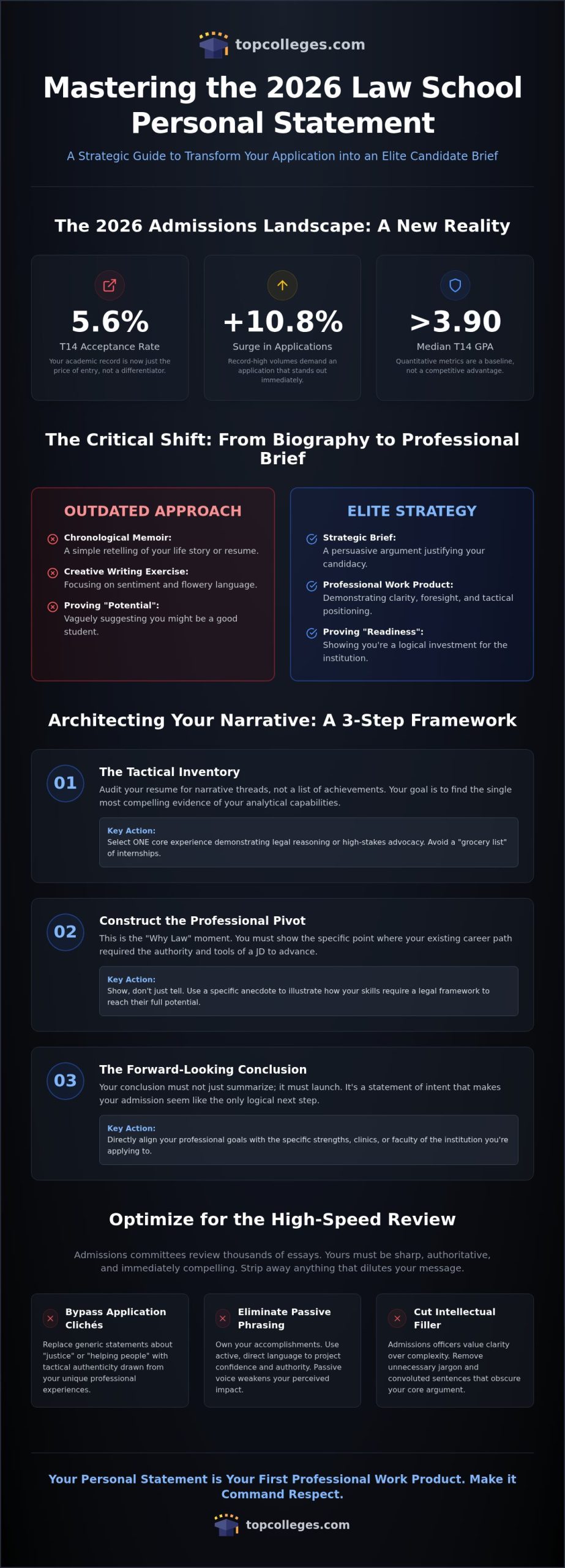
With T14 acceptance rates now plummeting to as low as 5.6%, your academic record is no longer a differentiator; it’s simply the price of entry. What if the most critical document in your folder isn’t your transcript, but a strategic brief that justifies your professional pivot into the legal elite? It’s natural to feel a sense of paralysis when staring at a blank page, fearing that your law school personal statement will disappear into a sea of clichés. You recognize that the 2026 admissions cycle is exceptionally competitive, with application volumes rising nearly 11% year over year.
This article will help you master the strategic narrative architecture required to transform your application from a standard profile into an elite candidate brief. We’ll explore the methodology of high-level storytelling, the nuances of professional positioning, and the tactical steps required to command the attention of the most discerning admissions committees. By the end of this guide, you’ll have a clear roadmap to replace anxiety with structured preparation and secure your place at a top-tier institution.
Key Takeaways
- Reframe your writing from a standard biography into a strategic brief that proves your professional readiness to elite admissions committees.
- Utilize the “Narrative Architecture” framework to transform your law school personal statement into a cohesive story with a logical, inevitable conclusion.
- Identify and bypass the top three application clichés, replacing them with tactical authenticity that highlights your unique professional maturity.
- Optimize your essay for the high-speed review process by stripping away passive phrasing and intellectual filler that dilutes your perceived authority.
- Understand why a professional strategic mentor is essential for navigating the record-high application volumes and competitive medians of the 2026 cycle.
The Strategic Weight of the Personal Statement in 2026
Numbers are static. Your LSAT and GPA tell a story of past performance, but they fail to articulate future utility. In a landscape where T14 median GPAs have climbed above 3.90, these metrics have become a baseline rather than a differentiator. The law school personal statement serves as the only qualitative variable in an otherwise quantitative process, providing the leverage needed to tip the scales. It’s the one place where you can override marginal data gaps with a compelling argument for your admission.
The 2026 Admissions Landscape
Why is the 2026 cycle so volatile? We’re seeing a significant surge in application volume, with applicants up 7.9% and total applications up 10.8% compared to the previous year. Law schools aren’t just looking for students who can survive the Socratic method. They’re looking for professionals who will protect their yield and enhance their institutional prestige. The Role of the Personal Statement has shifted from proving you’re smart to proving you’re ready. Admissions committees now prioritize “professional readiness” over raw “potential.” They want to see a trajectory that makes your admission a logical investment for the school’s global standing. If you don’t show a clear path, you’re a risk they don’t need to take.
The Personal Statement as a Tactical Asset
Don’t treat this document as a creative writing exercise or a sentimental journey through your childhood. Elite institutions view your narrative as a bridge between your undergraduate or professional history and your future legal impact. If your essay doesn’t demonstrate a sophisticated understanding of your “Why Law” pivot, it’s a wasted opportunity. You’re not just telling a story; you’re presenting a case. Your law school personal statement is a professional brief that justifies your candidacy by aligning your specific experiences with the rigorous demands of a top-tier legal education.
In 2026, a “good” essay is no longer enough to secure a seat at a top institution. When 13 of the top 14 schools have median GPAs exceeding 3.90, the standard for what constitutes a persuasive narrative has shifted. You must move beyond the creative writing mindset and adopt a strategic posture. This document is your first professional work product. It must command respect through its clarity, foresight, and tactical positioning.
Architecting the Narrative: From Biography to Professional Brief
A common failure in the application process is treating the essay as a chronological memoir. Admissions committees aren’t looking for a life story; they’re looking for a justification of your professional trajectory. You must move from a descriptive biography to a prescriptive brief. This transition requires a “Narrative Architecture” that leads the reader to an inevitable conclusion: your admission is the only logical next step in your career. Every paragraph must serve as a structural support for this final argument.
Step 1: The Tactical Inventory
Before writing, you must audit your resume for narrative threads rather than just achievements. Your resume is a map. It provides the raw data, but the essay provides the legend that makes the data intelligible to a stranger. Avoid the “grocery list” mistake of repeating every award or internship in prose. Instead, select a single experience that demonstrates legal reasoning or high-stakes advocacy. This choice should represent a microcosm of your professional value, highlighting how you handle complexity and conflict with poise.
Step 2: Constructing the Professional Pivot
The “Core Pivot” is the specific moment your experience became a legal interest. It’s the transition point where you realized that your current skills require the authority of a JD to reach their full potential. You must show, not tell, your analytical capabilities through specific anecdotes. When considering the Strategic Weight of the Personal Statement, remember that elite schools use this document to gauge how you’ll contribute to a 1L cohort. If you’re a career changer, explain how your unique background solves specific problems within the legal field. If you’re a direct applicant, demonstrate a level of maturity that suggests you’re already thinking like a practitioner.
Step 3: The Call to Action
Your conclusion shouldn’t just summarize; it should launch. It needs to be a forward-looking statement of intent that aligns your goals with the school’s specific strengths. An effective ending feels like a logical beginning for the law school. This level of planning is central to the Strategic Blueprint for College Admissions Counseling, which treats every application component as a tactical asset. For those seeking a professional narrative review, the focus remains on ensuring the law school personal statement functions as a cohesive, authoritative document that commands a seat in the class of 2029.
Navigating the ‘Why Law’ Trap: Clichés vs. Tactical Authenticity
Most applicants believe that passion is a substitute for suitability. It isn’t. When an admissions officer reads your law school personal statement, they aren’t looking for a cheerleader for the legal system. They’re looking for a future practitioner who understands the tactical reality of the profession. You must distinguish between personal passion and professional suitability by focusing on the mechanics of the law rather than just its idealistic outcomes.
Admissions committees at T14 schools see the same three clichés in every cycle. First is the “Natural Born Debater,” which suggests a lack of understanding of modern, collaborative legal practice. Second is the “Voice for the Voiceless,” which often lacks the specific grounding required to prove you understand policy or litigation. Third is the “Legal Drama Inspiration,” which relies on fictional portrayals rather than professional foresight. These narratives are safe, but they’re also invisible in a competitive pool.
The Danger of the “Lawyer as Hero” Narrative
Wanting to “help people” is a weak thesis for an elite application. It lacks analytical depth. To stand out, you must transform “help” into “advocacy,” “mediation,” or “structural reform.” If you’re interested in social justice, don’t write a brochure about the importance of equality. Instead, discuss the mechanism of the law. How does a specific statute fail? What procedural hurdle did you observe? Focusing on the mechanism proves you have the intellectual rigor for a JD. This professional posture is exactly what we emphasize in our law school admissions consulting, ensuring your narrative reflects the gravity of the career you’re entering.
Leveraging Tactical Vulnerability
There’s a significant difference between over-sharing and tactical vulnerability. Tactical authenticity involves sharing a personal struggle only to pivot immediately to the resilience it forged. This isn’t about seeking sympathy; it’s about providing evidence of your grit. Every personal detail must pass the “So What?” test. If a detail doesn’t directly serve your professional argument, delete it. Resilience demonstrated through a personal statement predicts success in the high-pressure 1L year by signaling an applicant’s ability to navigate complex, adversarial environments without faltering. By the time you reach your conclusion, the reader shouldn’t just know your history. They should trust your future performance.
The Refinement Phase: Polishing for the T14 Admissions Committee
How much time do you think a T14 admissions officer spends on the first read of your file? It’s usually under three minutes. In that high-velocity window, they must decide if your narrative warrants a deeper look or a rejection. This speed means your law school personal statement can’t afford a single wasted syllable. Every word must earn its place in what is essentially a high-stakes 500-word professional brief. If a sentence doesn’t advance your core strategic argument, it’s a liability that needs to be excised.
Eliminating passive voice is the first step toward commanding authority on the page. If situations “were handled” by you, you’re a passenger in your own career. If you “negotiated” or “structured” them, you’re a practitioner. You must also strip away intellectual filler, those empty phrases like ‘it’s my belief that’ or ‘I feel as though.’ These qualifiers only serve to dilute your conviction. Your essay shouldn’t stand alone; it should work in tandem with your law school resume. While the resume provides the skeletal facts of your history, the essay provides the muscle and the strategic direction.
Structural Precision and Flow
A compelling narrative utilizes a challenge-and-response pattern to maintain engagement. You identify a specific professional or personal difficulty and immediately meet it with a description of your methodical solution. This creates a rhythm that feels both diagnostic and prescriptive, leading the reader toward a logical conclusion about your readiness. Your transitions between paragraphs must reflect a strategic progression rather than a simple chronological one. A hook is necessary to grab attention, but it shouldn’t be a gimmick. It’s a lens that focuses the reader’s attention on your core thesis from the very first line.
Voice and Formal Register
Striking the balance between personal warmth and professional distance is a delicate operation. You want to be memorable, but you must remain respectful of the formal register that the legal industry demands. Avoid “thesaurus syndrome,” which is the tendency to use elevated terms that feel unnatural or forced. True sophistication lies in clarity and foresight. Just as Architecting the Best College Essays requires extreme precision, your law school narrative must be polished until its logic is undeniable. This level of refinement ensures that your application commands respect rather than just requesting admission.
Securing Your Seat: How Expert Strategy Outperforms Generic Advice
Why do candidates with perfect metrics still face rejection from the T14? It’s often because they relied on generic templates or the well-meaning but unqualified feedback of peers. A friend can spot a typo, but they can’t identify the structural narrative flaws that signal a lack of professional maturity to an admissions committee. In a cycle where Yale and Stanford maintain acceptance rates near 6% and median LSAT scores have reached 173-174, relying on “good enough” is a high-risk gamble. You don’t need a proofreader; you need a strategic architect.
Elite success requires a cohesive portfolio where every document reinforces a single, authoritative thesis. Your law school personal statement must be perfectly synchronized with your broader Law School Interview Preparation. If your written narrative and your verbal interview presence don’t align, you create a “narrative friction” that suggests a lack of authenticity. Expert strategy replaces this inconsistency with a structured roadmap, ensuring that your application functions as a unified candidate brief rather than a collection of disconnected essays.
The Value of Professional Perspective
An outside strategist identifies the blind spots you’re too close to see. They recognize when a story that feels personal to you actually reads as a cliché to an officer who has seen 5,000 similar drafts. Beyond mere correction, strategic consulting aligns your narrative with the specific, often unspoken ethos of individual law schools. Chicago values a different intellectual posture than Berkeley. NYU looks for a different type of professional engagement than Harvard. We move beyond “proofreading” to ensure your essay speaks the specific language of the institution you’re targeting.
Your Next Strategic Move
Mastery isn’t achieved in a single draft. The timeline for a command-level personal statement typically requires six to eight weeks of rigorous iteration. Starting early allows for the deep reflection necessary to identify your “Core Pivot” and refine your voice. Before you submit, ensure your brief meets this final checklist:
- Does the first paragraph establish a high-stakes professional theme?
- Have you replaced all “potential” language with “readiness” evidence?
- Is the passive voice completely eliminated to ensure you’re the driver of the narrative?
- Does the conclusion feel like a logical, inevitable launch into their specific 1L cohort?
The 2026 admissions landscape is too competitive for trial and error. By leveraging the Top Colleges methodology, you replace the anxiety of the unknown with the confidence of a structured, elite plan. When you’re ready to transform your application into a document that commands admission, our Law School Admissions Consulting provides the seasoned, high-profile mentorship required to secure your seat at a top-tier institution.
Command Your Place in the Class of 2029
The 2026 admissions cycle demands more than just academic excellence. It requires a tactical realignment of your professional history. Your law school personal statement is the primary instrument for this shift, moving you from a passive applicant to a future legal practitioner. By architecting a narrative that prioritizes professional readiness over mere potential, you signal to the T14 that you’re a low-risk, high-reward investment. Does your current draft command that level of authority? Success in this high-stakes environment isn’t accidental. It’s the result of methodical preparation and expert foresight.
Steven Roy Goodman, a nationally recognized admissions strategist, leads Top Colleges in providing the elite narrative architecture required for T14 success. Our results-oriented approach replaces the typical application anxiety with a structured, strategic confidence that commands respect from the most discerning admissions committees. We specialize in transforming standard profiles into elite candidate briefs that stand up to the most rigorous evaluation. You’ve done the work to reach this threshold; now you must prove you belong on the other side of it.
Take the first step toward your legal future with a partner who understands the inner workings of the most competitive systems. Your seat at a top-tier law school is waiting. The transition from applicant to advocate begins with a single, strategic choice.
Frequently Asked Questions
How long should a law school personal statement be in 2026?
Most elite institutions require a document between 500 and 800 words, typically spanning two double-spaced pages. You must respect these boundaries with absolute precision. Exceeding the limit signals a lack of professional discipline. If a school doesn’t specify a length, two pages remains the industry standard. Your law school personal statement must be concise enough to maintain high-velocity engagement while providing sufficient depth to justify your candidacy.
Can I use the same personal statement for every law school?
You should never submit an identical draft to every institution. While your core narrative remains consistent, the final paragraph must be tailored to the specific ethos and clinical offerings of each school. Admissions committees recognize generic submissions immediately. They’re looking for a tactical fit. By aligning your goals with their unique institutional strengths, you demonstrate that your interest is both researched and intentional.
Should I explain a low GPA or LSAT score in my personal statement?
No, your essay is prime real estate for highlighting strengths, not litigating weaknesses. Addressing a low GPA or LSAT score in your main essay dilutes your professional authority. Instead, utilize a separate addendum to provide a brief, factual explanation for any quantitative discrepancies. This allows your narrative to remain a forward-looking brief focused on your future legal impact rather than a defensive explanation of your past performance.
How personal is “too personal” for a law school essay?
A narrative becomes “too personal” when it focuses on raw emotion or trauma without a clear pivot to professional resilience. Admissions officers aren’t therapists; they’re gatekeepers for a rigorous professional community. If a detail doesn’t serve as evidence of your grit or analytical capability, it belongs in a private journal. Every personal anecdote must pass the “So What?” test by reinforcing your suitability for the high-stakes legal environment.
Is it okay to talk about politics or controversial topics?
What is the most common mistake in law school personal statements?
The most frequent failure is the “resume-in-prose” mistake. Many applicants simply recount their life history in chronological order, which provides no new insight to the committee. You’re not writing a biography; you’re constructing a strategic brief. A successful essay identifies a central “Core Pivot” and builds a logical argument around it. If your narrative doesn’t have a clear, tactical thesis, it will likely be forgotten in a competitive pool.
How do I start my personal statement if I have writer’s block?
Begin by conducting a tactical inventory of your professional and academic experiences. Don’t worry about the perfect opening line. Instead, identify the specific moment your current path required a legal pivot. What problem couldn’t you solve without a JD? Once you define this transition point, the narrative architecture begins to fall into place. Focus on the “Why Law” mechanism first, then refine the hook during the polishing phase.
Do law schools actually read the personal statement?
Yes, they read it with extreme scrutiny. In a cycle where median GPAs and LSAT scores are at record highs, the law school personal statement is often the only factor that differentiates two equally qualified candidates. It serves as your first professional work product. If your narrative doesn’t command respect, your metrics won’t save you. They use this document to gauge your writing ability, your maturity, and your potential contribution to their institutional prestige.