

Disclaimer
Content on this page of topcolleges.com is computer generated and therefore is not guaranteed to be 100 percent accurate about various aspects of the education sector. On balance, however, many students and families seek general information about high schools, colleges and universities, graduate programs, testing, education and career planning, and job placement before beginning one-on-one admissions counseling tailored to their specific needs.
A college rejection letter is institutional data, not an indictment of your intellectual capability. When a selective admissions portal delivers an unexpected denial after years of rigorous preparation, the immediate shock can feel paralyzing. You earned competitive scores, built a compelling portfolio, and poured relentless effort into your candidacy, leaving you wondering why the decision fell short. Learning how to handle college rejection letters isn’t about passive coping; it’s about executing a calculated, high-stakes pivot.
Dwelling on an adverse decision forfeits the leverage you still hold across your remaining options. This guide delivers an authoritative roadmap to transform institutional denials into decisive forward momentum, replacing emotional deflation with structured operational clarity. You’ll discover a disciplined 48-hour de-escalation protocol, an analytical audit to evaluate active offers and waitlists before the May 1 National Candidates Reply Date, and a strategic blueprint for executing future collegiate transfer pathways.
Key Takeaways
- Reframe denial letters as institutional cohort balancing rather than a measure of individual capability, neutralizing emotional fallout immediately.
- Deploy an operational 48-hour protocol that dictates how to handle college rejection letters through disciplined containment and an objective audit of remaining options.
- Evaluate active acceptances and waitlists pragmatically by measuring undergraduate faculty access and flagship honors programs against high-cost, mid-tier private offers.
- Transform an initial setback into decisive leverage by structuring a targeted transfer roadmap centered on precise first-year curricular positioning.
- Engage seasoned admissions counsel to pinpoint structural portfolio vulnerabilities and navigate high-stakes collegiate pivots with clarity.
Deconstructing College Rejection Letters: Why Elite Applications Get Denied
Every spring, thousands of students with pristine academic records open admissions portals to unexpected disappointment. Understanding how to handle college rejection letters begins with recognizing a fundamental reality: a denial letter reflects institutional cohort construction, not your intellectual ceiling. Selective universities routinely eliminate vast numbers of fully qualified applicants due to strict campus capacity limits. Admissions officers do not evaluate candidates in a vacuum. Instead, they balance institutional mandates, faculty departmental priorities, and predictive yield algorithms designed to safeguard matriculation rates. Realizing that systemic supply constraints drove this outcome dismantles counterproductive feelings of personal inadequacy.
The Mechanics of Holistic Admissions Selection
Behind closed doors, holistic review functions as an institutional balancing equation rather than a straightforward merit contest. Selection committees must populate specific majors, balance academic divisions, and satisfy institutional needs. For unhooked applicants, exceptional test scores and top percentiles merely grant admission to the discussion table. The final verdict often hinges entirely on narrative positioning. If an applicant’s academic focus appears diffuse or duplicates hundreds of identical profiles in the pool, committee consensus shifts swiftly toward candidates presenting clearer institutional utility.
Differentiating Between Denial, Deferral, and Waitlist Status
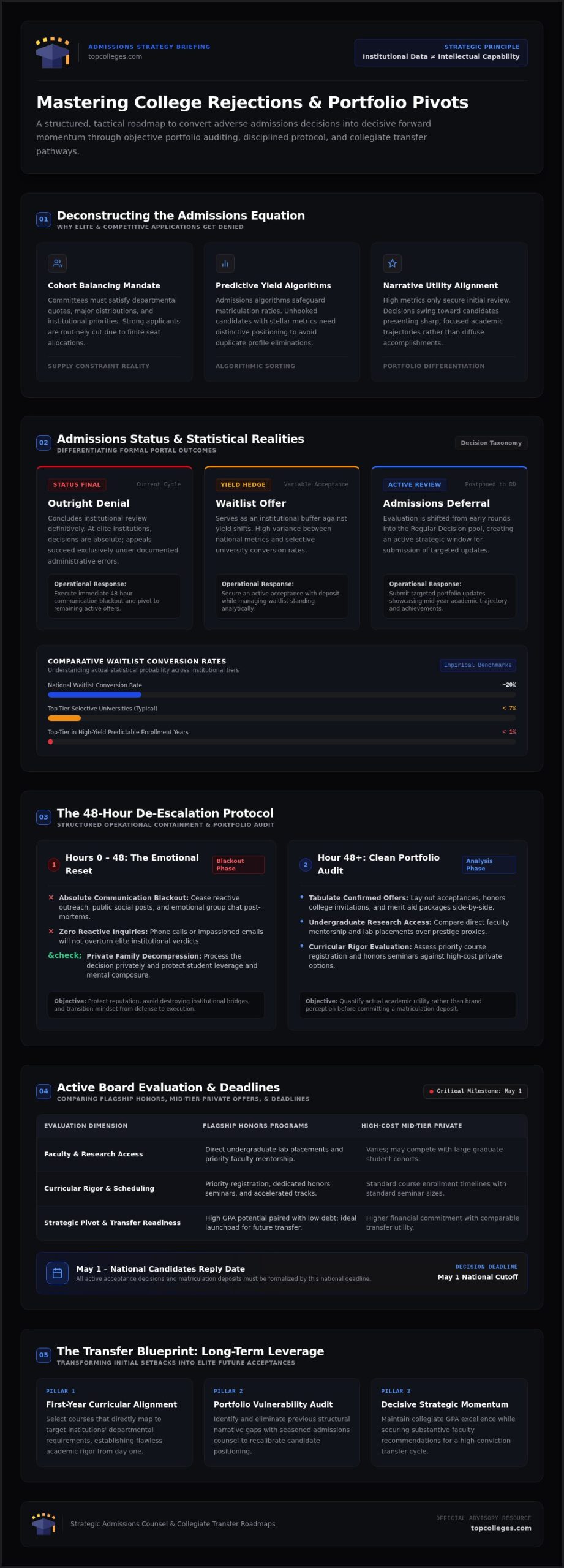
Clarity regarding your formal admissions status prevents costly strategic missteps. Each portal designation demands an entirely different operational response:
- Outright Denial: Concludes institutional evaluation for the current cycle. At top-tier universities, rejections are absolute, and appeals succeed only under documented administrative error.
- Waitlist Offer: Operates as an institutional hedge against yield variance. While national waitlist conversion rates hover near 20%, top-tier universities frequently admit under 7% of waitlisted applicants, occasionally dropping below 1% during predictable enrollment years.
- Deferral: Postpones the final evaluation from early rounds into the regular decision pool, offering an active opportunity to submit targeted updates.
Recognizing the mathematical reality of these designations clarifies how to handle college rejection letters with strategic composure. When a door closes decisively, it frees your focus to capitalize on remaining opportunities.
The 48-Hour Protocol: How to Tactically Handle College Rejection Letters
When an unfavorable decision arrives, instinct pushes many applicants toward reactive missteps. They fire off impassioned emails to admissions deans or vent across social platforms. That impulse destroys leverage. Mastering how to handle college rejection letters requires strict operational discipline during the first two days post-decision. Implementing a tactical 48-hour containment window protects your reputation, preserves options, and shifts your posture from emotional defensiveness to calculated execution.
Step 1: Implementing the Emotional Reset Period
Impose an absolute 48-hour communication blackout. Students and parents must process the initial sting privately. Avoid public announcements, group chat post-mortems, or reactive inquiries to admissions offices. Phone calls to admissions representatives will not overturn an adverse decision; elite private institutions maintain strict, non-negotiable rejection policies. Use these initial two days to step back, decompress, and redirect focus toward tangible accomplishments and existing admission offers.
Step 2: Conducting a Clean Admissions Portfolio Audit
Once the reset window closes, conduct an analytical review of your admissions landscape. Lay out your confirmed acceptances, honors program placements, and merit scholarship packages on an objective rubric. Compare these options against your core academic criteria rather than prestige proxies:
- Undergraduate Research Access: Compare the availability of faculty mentorship and direct undergraduate lab placements across your admitted institutions.
- Curricular Rigor and Focus: Assess whether honors colleges provide priority registration and small seminar formats that match or exceed mid-tier private options.
- Financial Leverage: Review institutional awards and note that merit aid appeals at private universities succeed between 40% and 75% of the time when supported by competing offers.
If reconciling conflicting priorities across diverse programs feels overwhelming, engaging seasoned college admissions counseling can clarify institutional strengths and surface strategic advantages across your active board.
Step 3: Communicating Decisions with Unified Composure
Control the narrative across your social and academic circles. Establish a unified family communication response for curious peers, teachers, and extended relatives. A concise statement works best: “We have fantastic options on the table, and we’re evaluating the best academic fit.” This disciplined approach shuts down speculative chatter, preserves personal agency, and shields your academic momentum during vital senior-year exams.
Evaluating Your Active Board: Comparing Offers, Honors Programs, and Waitlists
A comprehensive strategy for how to handle college rejection letters shifts attention immediately away from closed doors and toward real institutional assets. Applicants often measure collegiate prestige through brand visibility rather than the actual academic resources allocated to undergraduates. You must evaluate your remaining admissions board with clinical precision. High-performing students frequently discover that their strongest collegiate pathways lie within public flagship honors programs, specialized undergraduate cohorts, or calculated waitlist campaigns, rather than mid-tier private universities that demand high tuition while offering limited differentiation.
Auditing Honors Colleges and Specialty Cohorts
Public flagship honors colleges often deliver a superior undergraduate academic environment compared to mid-ranked private schools. Evaluate these verified operational advantages:
- Priority Course Registration: Securing foundational courses without administrative bottlenecks ensures timely degree completion and uninterrupted prerequisite tracks for postgraduate ambitions.
- Direct Faculty Mentorship: Honors programs frequently guarantee dedicated research stipends, smaller seminar caps, and faculty-led lab placements that mirror elite liberal arts environments.
- Dedicated Living-Learning Communities: Enrolling in a rigorous residential cohort surrounds high-achieving scholars with intellectual peers, replicating the collaborative culture of Ivy-Plus campuses.
Formulating a Strategic Waitlist Campaign
Holding a waitlist position requires a balanced tactical posture. Elite institutions keep expansive waitlists as shock absorbers against yield variance, admitting fewer than 7% of waitlisted candidates at the most selective schools. Never treat a waitlist spot as a secure fallback. You must submit a non-refundable enrollment deposit to an admitted institution before the universal May 1 National Candidates Reply Date. Double-depositing past May 1 violates institutional agreements and risks total cancellation of your admissions credentials.
If you choose to pursue an active waitlist spot, submit a disciplined Letter of Continued Interest (LOCI) within 7 to 14 days of the initial notification. Keep the submission under 500 words. Highlight concrete academic achievements earned since your regular decision submission, outline specific contributions you will make to faculty research initiatives, and state unequivocally that you will matriculate immediately if admitted.
Mastering how to handle college rejection letters means treating every active offer as a tangible business asset. Choosing an environment rich in resources positions you for undeniable intellectual leadership, whether you graduate there or pivot later.
The Transfer Strategy: Converting an Initial Rejection into an Elite Acceptance
High school rejection letters often mark the beginning of an elite academic career rather than the end of one. For driven applicants, learning how to handle college rejection letters means viewing your matriculation site as a strategic springboard. Many world-class universities admit transfer students at rates substantially higher than their first-year applicant pools. Boston University posts a transfer admit rate around 35% compared to roughly 11% for first-years, while the University of Notre Dame admits approximately 25% of transfers against an 11% freshman baseline. Executing a successful transfer reapplication requires shifting from reactive coping to rigorous, forward-looking positioning.
Freshman Year Course Selection and Academic Trajectory
Transfer admissions committees evaluate demonstrated collegiate performance rather than high school potential. Building an airtight academic record from day one neutralizes past testing deficiencies and high school missteps. Focus your first year on these tactical priorities:
- Targeted Curricular Alignment: Select courses that fulfill specific departmental prerequisite requirements at your target institutions, demonstrating seamless academic integration.
- Faculty Relationship Cultivation: Attend office hours consistently during your first semester. Transfer committees require detailed academic recommendations from collegiate instructors who can speak to your scholarly contributions.
- Uncompromised GPA Execution: Earning a near-flawless collegiate grade point average provides objective proof that you handle advanced academic rigor at the university level.
Developing a Targeted Collegiate Transfer Narrative
Transfer essays demand analytical precision. Selection committees reject candidates who complain about their current campus or submit generic platitudes about school spirit. Your narrative must articulate why your intellectual development requires distinct resources, specialized faculty research labs, or specific archival collections available only at the prospective institution. Applying proven techniques from best college essays transforms your rationale into an unassailable case for admission.
Fall transfer deadlines for top-tier universities cluster tightly between February 15 and April 15. Mastering how to handle college rejection letters through a structured transfer roadmap turns a temporary setback into a decisive credential.
Partnering with Strategic Counsel: Transforming Admissions Outcomes in 2026
Confronting an unexpected denial requires clinical diagnostic analysis rather than emotional guesswork. Generic software tools and overburdened secondary school counselors managing hundreds of files cannot unpack the subtle dynamics of selective committee votes. When evaluating how to handle college rejection letters at this level, families require experienced, high-stakes educational perspective. Steven Roy Goodman directs Top Colleges, bringing decades of nationally recognized expertise to bear on complex admissions decisions. Engaging dedicated advisory counsel replaces confusion with an aggressive, structured blueprint for success.
Diagnosing Hidden Weaknesses in Prior Applications
Why does an applicant with exceptional metrics receive an outright denial? An objective post-decision audit dissects the submitted application portfolio to locate structural blind spots. Seasoned counsel examines whether personal essays lacked distinct intellectual vitality, if activity profiles failed to project institutional utility, or if interview preparation contained unaddressed deficiencies. Identifying these friction points eliminates recurring errors, recalibrates institutional targeting, and sharpens your competitive profile for subsequent selection rounds.
Building Long-Term Academic and Pre-Professional Momentum
An undergraduate decision marks only a single milestone along an extensive academic and professional trajectory. Seasoned advisors design multi-year roadmaps governing first-year collegiate course selection, faculty mentorship acquisition, competitive research fellowships, and future graduate school admissions. A rejection from an individual university should never compromise your ultimate professional ceiling.
Mastering how to handle college rejection letters requires recognizing that elite achievement is rarely linear. With disciplined guidance, students transform an initial admissions disappointment into decisive intellectual leadership on campus. Partner directly with Top Colleges to secure the authoritative guidance and strategic clarity your educational investment demands.
Transforming Admissions Data into Strategic Forward Momentum
A collegiate denial never defines your ultimate intellectual capability or career trajectory. Deciding how to handle college rejection letters with tactical composure allows you to extract vital institutional feedback, audit your active board before May 1, and position yourself for formidable undergraduate honors programs or future transfer campaigns. The next phase of your academic career begins with decisive, proactive execution rather than lingering regret.
Navigating this high-stakes inflection point demands seasoned, authoritative counsel. Led by nationally recognized educational consultant Steven Roy Goodman, Top Colleges brings a proven multi-decade track record guiding applicants through elite undergraduate admissions and competitive transfer strategy. As a thought leader featured extensively across major national media networks, Steven Goodman provides the diagnostic precision required to convert complex admissions challenges into triumphant outcomes.
Your academic potential remains entirely intact. Move forward with confidence, clarity, and the structured strategy required to claim the elite educational future you’ve earned.
Frequently Asked Questions
Can a college rejection letter ever be successfully appealed?
Virtually all top-tier private universities enforce strict no-appeal policies, making admissions denials absolute and final. Formal appeal procedures exist primarily at select public institutions, but overturn rates historically remain below 5%. Committees only reconsider files if you prove a verifiable clerical calculation error or present catastrophic, undocumented life events that directly impacted your academic profile during high school.
Is it acceptable to call an admissions office to ask why you were rejected?
No, calling an admissions office to interrogate staff about a denial is counterproductive. Selection officers process tens of thousands of applicants and will not provide individualized post-mortem feedback over the telephone. Inbound grievances damage your reputation and reflect poorly on your composure. Instead, conduct an objective portfolio diagnostic with an independent educational consultant to identify structural blind spots.
How much do college rejection letters impact future graduate school admissions?
Collegiate rejections have zero influence on graduate school admissions. Law, medical, business, and doctoral admissions committees evaluate your collegiate GPA, undergraduate research, faculty recommendations, and professional exams. Graduate admissions boards never review your high school performance or prior undergraduate rejection history. Thriving academically at your matriculating institution fully positions you for top-tier graduate programs.
What happens if you are rejected from your early decision college?
An Early Decision rejection releases you immediately from the binding agreement, leaving you free to commit elsewhere. You cannot reapply to that institution during the active cycle. Knowing how to handle college rejection letters during early rounds requires rapid realignment. Shift your operational energy toward refining remaining Regular Decision submissions and targeting viable Early Decision II opportunities before deadlines close.
Can an applicant reapply to the same university as a transfer student later?
Yes, an initial freshman denial never precludes a candidate from applying as a transfer student. Admissions offices evaluate transfer candidates using entirely separate criteria focused on collegiate coursework, university GPA, and faculty references. Many elite institutions admit transfer cohorts at significantly higher percentages than first-year applicants, turning freshman matriculation into a strategic stepping stone.
How should parents constructively respond when their student receives a rejection letter?
Parents must model disciplined composure and avoid projecting personal frustration or anxiety onto their teenager. Acknowledge your student’s hard work, enforce an immediate 48-hour decompression window, and resist comparing results with local peers. Guiding your family on how to handle college rejection letters means actively redirecting the narrative toward celebrating confirmed acceptances and evaluating high-impact academic programs.
What is the strategic difference between being waitlisted and being rejected?
A rejection decisively concludes institutional review for the admissions cycle, requiring no further outreach. A waitlist placement acts as an institutional hedge against yield variance, leaving your application conditionally active. While a rejection requires immediate pivot toward alternative options, a waitlist offer allows you to submit a concise Letter of Continued Interest while still depositing at an admitted school before May 1.