

Disclaimer
Content on this page of topcolleges.com is computer generated and therefore is not guaranteed to be 100 percent accurate about various aspects of the education sector. On balance, however, many students and families seek general information about high schools, colleges and universities, graduate programs, testing, education and career planning, and job placement before beginning one-on-one admissions counseling tailored to their specific needs.
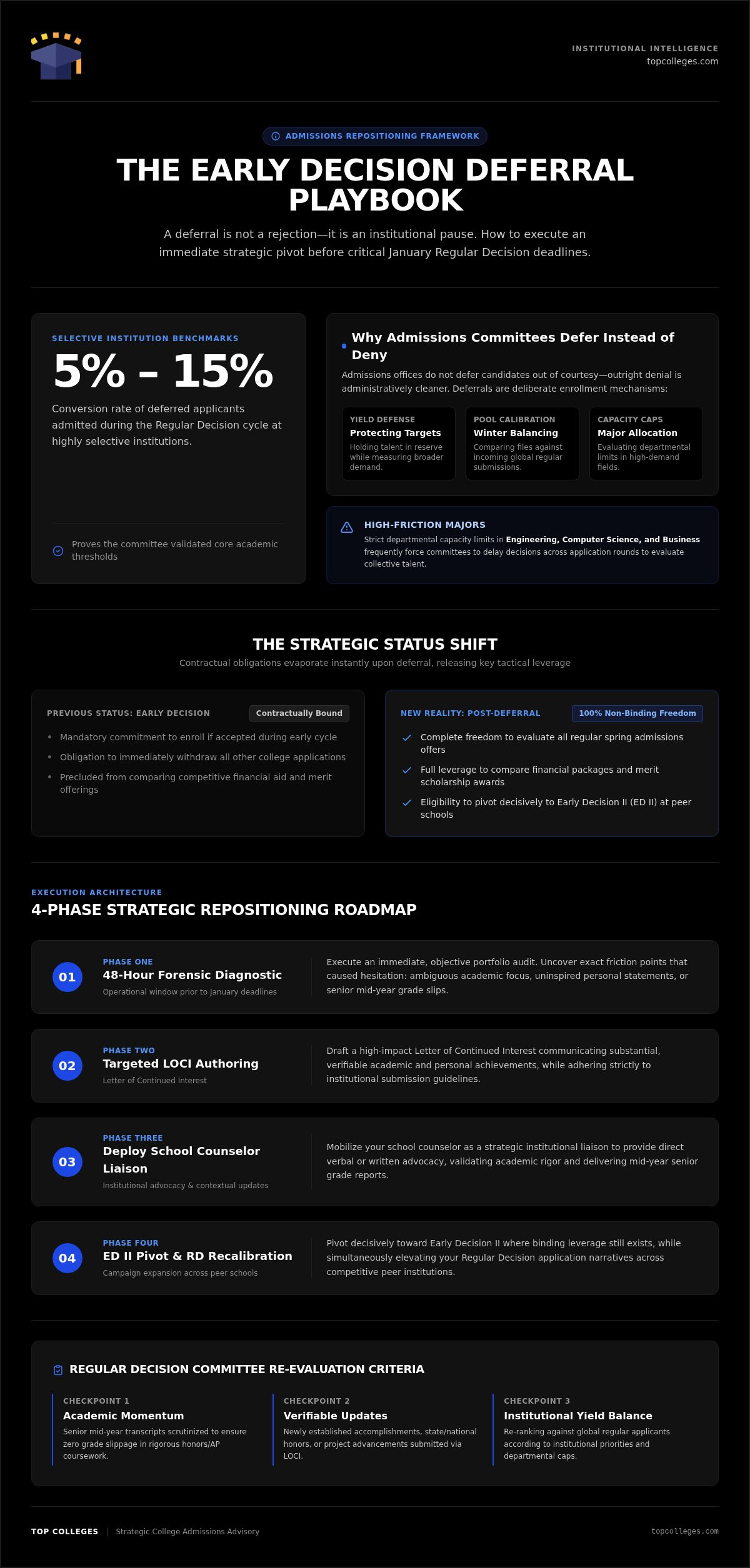
An Early Decision deferral isn’t a quiet rejection; it is an institutional reprieve. When that decision arrives, paralyzing uncertainty about where your portfolio fell short can easily derail your momentum, especially with high-stakes January deadlines rapidly approaching. Knowing exactly what to do if you get deferred from early decision separates applicants who succumb to anxiety from those who surgically reposition their candidacy. Highly selective institutions convert between 5% and 15% of deferred applicants to admitted students, which proves that the committee sees distinct promise in your file, even if your narrative requires elevation.
This guide transforms that institutional pause into an actionable tactical roadmap designed to recalibrate your entire admissions campaign for regular decision success. You’ll learn how to conduct an objective diagnostic assessment of why your application was deferred, author a compelling Letter of Continued Interest that delivers substantial updates, and execute a revitalized Regular Decision submission strategy across competitive peer institutions before critical deadlines expire.
Key Takeaways
- Reframe the deferral as an institutional pause, recognizing how selective committees balance yield priorities against the broader Regular Decision applicant pool.
- Discover what to do if you get deferred from early decision by executing an immediate 48-hour diagnostic audit to pinpoint narrative and academic vulnerabilities in your original portfolio.
- Structure a persuasive Letter of Continued Interest that communicates substantial, verifiable achievements while adhering strictly to institutional submission guidelines.
- Deploy your school counselor as a strategic institutional liaison to provide direct advocacy and contextual mid-year academic updates.
- Pivot decisively toward Early Decision II and recalibrate your Regular Decision submissions to secure a competitive advantage across top peer institutions.
Decoding the Early Decision Deferral: Institutional Realities and What It Actually Means
A deferral is institutional limbo, but it is not a denial. The admissions committee has officially reviewed your credentials, confirmed you meet their academic thresholds, and opted to hold your file for further evaluation. Understanding what to do if you get deferred from early decision begins with stripping away the emotional sting and examining the underlying enrollment mathematics.
Admissions offices do not defer candidates out of politeness; denying an applicant is administratively cleaner. Instead, colleges utilize deferrals to manage institutional yield and calibrate their class against the incoming Regular Decision applicant pool. By holding competitive candidates in reserve, deans of admission protect their target enrollment numbers while waiting to see the full scope of talent, institutional priorities, and demographic balance that the winter pool delivers.
The Mechanics of the Deferral Pool
When your application transitions to the regular cycle, committee dynamics change. Readers evaluate your file alongside tens of thousands of regular applicants, measuring your achievements against specific departmental caps, regional quotas, and academic specialties. Highly selective institutions vary widely in how they manage this cohort. While some universities deny the vast majority outright, others defer sizable percentages to maintain maximum flexibility as institutional priorities shift throughout January and February.
Your strategic objective requires recognizing that you are still in contention, but the competition has broadened dramatically:
- Academic benchmarking: The committee will scrutinize your mid-year senior grades to ensure you have maintained rigorous academic momentum.
- Institutional bandwidth: Specific majors, especially within engineering, computer science, and business, face strict capacity limits that require committees to compare candidates across both application rounds.
- Strategic positioning: Your candidacy must now stand out not merely against early applicants, but against the full spectrum of global regular decision submissions.
The Strategic Shift from Binding to Non-Binding
The moment you receive a deferral, your contractual obligations evaporate. The formal agreement that defines Early decision no longer restricts your choices. You are released from the binding mandate to enroll if admitted later in the spring.
This contractual release delivers immediate tactical leverage. You now hold complete strategic flexibility to evaluate admissions offers from peer institutions alongside their respective financial aid packages and merit scholarship opportunities. Rather than being locked into a single school regardless of the financial package, your family can recalibrate its higher-education investment across multiple competitive offers. Knowing what to do if you get deferred from early decision means capitalizing on this newfound freedom, turning an initial setback into an expansive, multi-institution campaign.
Executing the Immediate Diagnostic: Identifying Portfolio Weaknesses Within 48 Hours
Forty-eight hours. That is your operational window to diagnose why an admissions committee paused your file before you finalize your Regular Decision submissions. Instead of indulging in reflexive speculation, master the precise sequence of proactive steps after a deferral. Knowing what to do if you get deferred from early decision requires an uncompromising forensic audit of your initial materials to uncover the exact friction points that caused hesitation.
Most applicants assume their credentials were simply lost in the crowd. In reality, applications stall due to concrete vulnerabilities: an ambiguous academic focus, an uninspired personal narrative, or mid-year grade slips. Engaging expert college admissions counseling provides an objective, third-party diagnostic that exposes these blind spots while there is still time to correct course.
The Academic and Transcript Forensic Audit
Scrutinize your numbers first. Admissions officers look closely at first-semester senior grades to verify that academic intensity hasn’t flagged under senior-year pressures. Ask yourself the hard questions:
- Grade momentum: Did any core academic course drop from an A to a B, signaling premature fatigue?
- Curricular rigor: Does your schedule maintain maximum Advanced Placement, International Baccalaureate, or honors courses, or did you drop demanding electives?
- Major prerequisites: If you declared engineering, business, or biological sciences, did your quantitative transcript lack the highest-level coursework expected of elite applicants?
Deconstructing Narrative Cohesion and Essay Execution
A transcript gets you through the first screen, but the narrative earns the seat. When files are deferred, the essays often lack thematic focus. Review your core submissions using the criteria found in architecting the best college essays to detect clichés, generic gratitude themes, or laundry-list activity summaries. Your personal statement should project intellectual vitality, demonstrating clear alignment between your demonstrated leadership and your future academic trajectory.
If your early application lacked this narrative tension, do not replicate the mistake across your upcoming Regular Decision files. Pinpointing your structural shortcomings is the single most reliable path toward converting a deferral into an offer. For families seeking clarity during this critical 48-hour turn, working with an elite advisor through Top Colleges ensures your revised portfolio eliminates vulnerabilities across every peer institution on your list.
Crafting a High-Impact Letter of Continued Interest That Commands Attention
Do not confuse a Letter of Continued Interest (LOCI) with a polite thank-you card. In elite admissions, your LOCI operates as a targeted marketing memorandum designed to answer a single question: what tangible value have you generated since November? When families evaluate what to do if you get deferred from early decision, drafting this document often becomes their primary focus. Yet, writing without a structured, evidence-based framework will undermine your candidacy.
Admissions committees review thousands of these letters in January. They read past emotional platitudes and flattery instantly. To capture an officer’s limited attention, your letter must deliver demonstrable momentum, presenting fresh milestones that directly strengthen the institutional priorities of your target campus.
Strategic Structure of the Letter of Continued Interest
Every sentence must carry operational weight. Open with an unequivocal, professional statement confirming the university remains your absolute first choice, pledging your commitment to matriculate if admitted. Then, pivot immediately to substantial updates accrued since your initial submission:
- Intellectual breakthroughs: Highlight independent research milestones, advanced manuscripts submitted for publication, or regional academic competitions won.
- Leadership expansion: Document quantifiable team achievements, fundraising targets surpassed, or systemic initiatives launched within your school or local community.
- Granular institutional fit: Connect your recent intellectual evolution directly to upper-level seminars, newly funded laboratory spaces, or specific faculty scholarship.
Tactical Rules of Engagement and Common Pitfalls
Discipline dictates success here. Limit your correspondence strictly to a single page, adhering precisely to specified portal upload limits or regional counselor guidelines. Exceeding word counts signals an inability to curate information efficiently.
Avoid grievances at all costs. Never question the committee’s decision, express resentment, or mention where your peers were admitted. Similarly, do not bombard the admissions office with weekly messages; patience reflects confidence. Time your submission intentionally for early January when committees reconvene to re-evaluate files alongside the Regular Decision pool. Following these guidelines ensures your response is clear, respectful, and tactically sound.
Deploying School Counselor Advocacy and Targeted Supplemental Endorsements
Your high school counselor holds institutional capital that applicants cannot replicate alone. While direct student communication demonstrates authentic interest, professional counselor-to-admissions engagement validates academic momentum from an accredited institutional voice. When determining what to do if you get deferred from early decision, mobilizing this internal advocate immediately transforms your response from an isolated personal appeal into a coordinated institutional campaign.
Admissions offices maintain longstanding professional relationships with secondary school counselors. Regional representatives often trust these counselors to provide candid appraisals of where an applicant sits within their graduating class. However, an effective advocacy push requires deliberate coordination rather than vague requests for help.
Coordinating Strategic High School Counselor Outreach
Schedule an in-person conference with your school counselor within 72 hours of your deferral. Do not arrive empty-handed. Equip them with a concise, one-page brief outlining your mid-year grades, recent honors, and exact updates since November. Counselors manage substantial caseloads; providing structured bullet points ensures they can speak precisely to regional admissions directors during routine check-in calls or mid-year report submissions.
- Audit institutional receptivity: Have your counselor determine whether your regional admissions representative welcomes advocacy calls or strictly enforces digital-only communication.
- Contextualize academic trajectory: Ensure your counselor highlights upward grade trajectories in your most demanding senior coursework within the official mid-year school report.
- Reaffirm first-choice standing: Authorize your counselor to confirm that the college remains your unequivocal top matriculation preference if admitted.
Evaluating the Value of Supplemental Recommendation Letters
Quality easily supersedes volume. The most damaging error deferred applicants commit is overwhelming the admissions committee with redundant letters of recommendation. Before soliciting an additional endorsement, verify whether the institution accepts supplemental materials. If a university’s deferral FAQ explicitly requests that applicants refrain from sending extra recommendations, respect that directive without exception; violating explicit instructions demonstrates poor judgment.
If supplementary endorsements are permitted, select an external mentor who reveals a completely novel dimension of your profile. A research lab director, an internship supervisor, or a regional organization head can articulate your intellectual curiosity and leadership impact far better than a third classroom teacher delivering familiar praise. The letter must substantiate new achievements rather than rehash your original Common Application narrative.
Recalibrating the Broader Admissions Campaign: Early Decision II and Regular Decision
A single deferral must never compromise your entire cycle. Instead of dwelling on an incomplete outcome, treat this institutional pause as a catalyst to optimize your remaining applications. Determining what to do if you get deferred from early decision requires pivoting your focus outward to secure competitive advantages across peer institutions before early January deadlines arrive.
The strategic release from your original binding commitment opens powerful alternatives. Applying Early Decision II (ED II) allows you to target another top-choice institution with the exact same binding admissions boost you leveraged in November. While Regular Decision acceptance rates continue to plummet at highly selective universities, ED II pools offer significantly higher yield incentives for admissions committees eager to lock in their incoming classes.
Leveraging Early Decision II to Maximize Acceptance Probability
Dozens of elite universities and liberal arts colleges offer ED II pathways with deadlines typically clustered around January 1 to January 15. Committing to an ED II partner school signals absolute interest, transforming you from a passive regular applicant into an institutional priority. Evaluate this pathway through clear strategic criteria:
- Institutional peer matching: Identify institutions whose academic culture, faculty resources, and post-graduate placement mirror your original first choice.
- Yield-driven acceptance advantages: Admissions committees rely heavily on ED II to protect enrollment targets, often admitting a substantial portion of their incoming cohort through this second binding window.
- Commitment certainty: Ensure your family is prepared to matriculate immediately if admitted, using net price calculators to verify affordability beforehand.
Upgrading the Regular Decision Portfolio Across National Institutions
Beyond ED II, your Regular Decision portfolio demands aggressive revision. Never submit identical materials that resulted in a deferral. Use your forensic diagnostic findings to rewrite supplemental essays, purge generic declarations of campus interest, and align your profile directly with each target department’s research strengths.
Smart families also map out contingency academic pathways, including specialized transferring colleges consulting to preserve long-term institutional mobility if first-year outcomes require future realignment. When the stakes are this high, partnering with elite strategists at Top Colleges gives you the diagnostic clarity and narrative execution needed to command attention, secure competitive offers, and turn an early pause into regular decision success nationwide.
Transforming Deferral into Decisive Regular Decision Success
A deferral provides an invaluable strategic pause, granting you full non-binding flexibility to recalibrate your entire admissions campaign. By diagnosing original portfolio blind spots, submitting an evidence-driven Letter of Continued Interest, and leveraging high-yield Early Decision II pathways, you reclaim command over your admissions trajectory. Deciding exactly what to do if you get deferred from early decision determines whether your upcoming winter applications repeat past vulnerabilities or actively command committee respect.
Backed by decades of elite college admissions counseling experience nationwide and recognized thought leadership across national media, Top Colleges provides the rigorous diagnostic insight and bespoke narrative restructuring required to evaluate your portfolio under pressure.
Treat this moment not as a closed door, but as your campaign’s strategic inflection point. With disciplined execution and an elevated narrative, your strongest collegiate acceptances still lie ahead.
Frequently Asked Questions
Does being deferred from Early Decision mean my chances of admission are completely gone?
No, your admission chances remain active. Highly selective institutions admit roughly 5% to 15% of deferred applicants during Regular Decision. A deferral confirms that your credentials met baseline institutional qualifications. Admissions officers simply need to evaluate your file within the broader winter context. Mastering what to do if you get deferred from early decision enables you to use the intervening weeks to present compelling new academic and personal data.
What is the fundamental difference between being deferred and being waitlisted by an admissions committee?
Timing and applicant pool context mark the primary differences. A deferral occurs in December during early cycles, shifting your file into the active Regular Decision review pool for a final verdict by late March. A waitlist offer arrives in March or April after regular decisions are finalized, holding your file as an insurance policy until after May 1 National Decision Day if enrolled class targets fall short.
How long should my Letter of Continued Interest be, and what specific updates should I include?
Limit your Letter of Continued Interest to a single page, spanning roughly 350 to 500 words. Admissions committees review thousands of updates, making brevity essential. Focus exclusively on substantial developments achieved since your November deadline: published research, newly earned leadership titles, state or national awards, and tangible community impact. Anchor these accomplishments to specific institutional academic offerings to prove enduring mutual fit.
Can I apply to another college under Early Decision II after being deferred from my original Early Decision school?
Yes, you can immediately leverage Early Decision II. Receiving a deferral releases you from your original binding early agreement. If another top-choice institution offers an ED II plan with a January deadline, you can enter that binding pool to capture higher statistical admissions yield advantages. When planning what to do if you get deferred from early decision, an aggressive ED II pivot often delivers your strongest alternative pathway to an elite campus.
Should I submit additional recommendation letters or creative portfolios after receiving an Early Decision deferral?
Only submit supplementary materials if the university’s deferral guidelines explicitly allow them. Many selective schools prohibit unrequested documents, and ignoring instructions damages your standing. If permitted, submit at most one targeted recommendation from an external supervisor or research mentor who reveals a completely novel facet of your character. Redundant endorsements from current teachers who already submitted references will dilute your portfolio.
How do admissions offices treat senior mid-year grades when re-evaluating deferred applicant files?
Admissions officers treat first-semester senior grades as a critical diagnostic metric. Because early rounds lack complete twelfth-grade academic verification, committees look for continued rigor and unblemished marks across advanced coursework. Any dip in core academic disciplines raises flags regarding intellectual resilience. Conversely, straight As in challenging Advanced Placement or International Baccalaureate courses can provide the academic validation required to flip a deferral into an acceptance.
Will calling or visiting the admissions office improve my chances of admission after being deferred?
Unscheduled calls or impromptu office visits will not improve your chances. Admissions deans and regional officers view unexpected visits as disruptive oversteps that demonstrate disregard for standard institutional procedures. Instead, channel your advocacy through your official student portal, your high school counselor’s verified channels, and a single, polished update letter. Professionalism, composure, and documented achievement command far greater respect than physical lobbying.