

Disclaimer
Content on this page of topcolleges.com is computer generated and therefore is not guaranteed to be 100 percent accurate about various aspects of the education sector. On balance, however, many students and families seek general information about high schools, colleges and universities, graduate programs, testing, education and career planning, and job placement before beginning one-on-one admissions counseling tailored to their specific needs.
What if the most influential 150 characters of your life aren’t found in a viral post, but in the “Activities and Experiences” section of your college application? Mastering how to write the common app activities list is a high-stakes challenge that often triggers deep anxiety over the rigid character limits. You’ve dedicated years to building a legacy through leadership and service, yet you’re now asked to justify that impact in a space smaller than a standard text message. This compression often leads to a fear of sounding generic or failing to capture the true depth of your professional grade contributions.
This article provides a comprehensive roadmap for condensing years of achievement into a high-impact narrative that commands the attention of elite admissions committees. Strategic clarity is your greatest asset. We’ll explore the nuances of the 2026-2027 updates, including the now-optional leadership field, while providing a framework to quantify your impact with precision. You’ll learn how to move beyond a simple record of participation to create a strategic blueprint that aligns perfectly with your personal statement. This methodical approach ensures that every character serves a purpose, replacing uncertainty with the confidence of a well-prepared candidate.
Key Takeaways
- Position your activities list as a high-level executive summary to capture attention before an admissions officer even reaches your personal statement.
- Transition from a passive participant to a strategic architect by quantifying the measurable value you brought to each organization.
- Learn how to write the common app activities list using the “Rule of Three” to ensure your most significant achievements define your candidate profile.
- Utilize the Action-Impact-Scope formula to navigate the 150-character limit with professional precision and tactical clarity.
- Implement a final “Blind Read” audit to identify and eliminate narrative redundancies that could weaken your overall strategic positioning.
The Strategic Importance of the Common App Activities List
The Common App “Activities and Experiences” section is often misunderstood as a secondary logistical requirement. In reality, it functions as the executive summary of your collegiate potential. Admissions officers at elite institutions are tasked with evaluating thousands of portfolios; they frequently scan this list before even opening your personal statement. This initial scan creates a mental framework for who you are. If the list is disorganized or lacks impact, the essay has to work twice as hard to repair that first impression. In 2026, the weight of holistic review has shifted significantly. Committees are no longer impressed by “resume padding” or a long list of passive memberships. They’re looking for sustained impact and a clear trajectory of contribution.
The 150-Character Challenge: A Test of Precision
Brevity isn’t a hurdle; it’s a diagnostic tool. Elite committees use the 150-character limit to measure your ability to synthesize complex achievements into clear value propositions. When you master how to write the common app activities list, you move beyond the “what” and focus on the “so what.” The transition from “participation” to “contribution” is the hallmark of a professional-grade application. Every character must justify its presence by highlighting a specific outcome or a unique leadership insight. Viewing this constraint as a strategic opportunity allows you to showcase the discipline and clarity expected at the university level. It’s about demonstrating that you understand your own value well enough to communicate it with surgical precision.
Defining Your Strategic Narrative
Identifying the two or three core pillars of your applicant profile is essential for strategic success. Your activities list provides the empirical evidence for your “brand” claims. If your personal statement argues that you’re a community catalyst, your list should document the specific organizations you’ve transformed. Learning how to write the common app activities list through this lens creates a cohesive strategic blueprint for college admissions counseling that leaves no doubt about your institutional value. Without this alignment, your application feels like a collection of disparate facts rather than a unified narrative of excellence. High-stakes applications require this level of narrative cohesion to stand out in a crowded global field. You aren’t just listing hobbies; you’re architecting a case for your admission.
Beyond the Resume: Architecting a Narrative of Impact
Impact is the currency of elite admissions. It isn’t a list of duties; it’s the measurable change you’ve engineered within your community. When considering how to write the common app activities list, you must shift your perspective from that of a participant to that of an architect. Elite institutions have no shortage of “members”; they have a deficit of architects who identify gaps and build solutions. This alignment with institutional needs is what separates a standard applicant from a high-priority recruit. You’re not just filling a slot; you’re demonstrating how you will contribute to their specific campus ecosystem.
The Johns Hopkins University Admissions guide makes it clear that your descriptions should reflect your specific contributions rather than general club goals. This distinction is critical for establishing institutional fit. Even in non-STEM fields, impact can be quantified. Did you increase readership for the literary magazine by 30%? Did you mentor five younger students who eventually took on leadership roles? These metrics provide the concrete evidence needed for high-stakes evaluation. They transform abstract claims into verifiable achievements.
The Logic of Impact vs. Duty
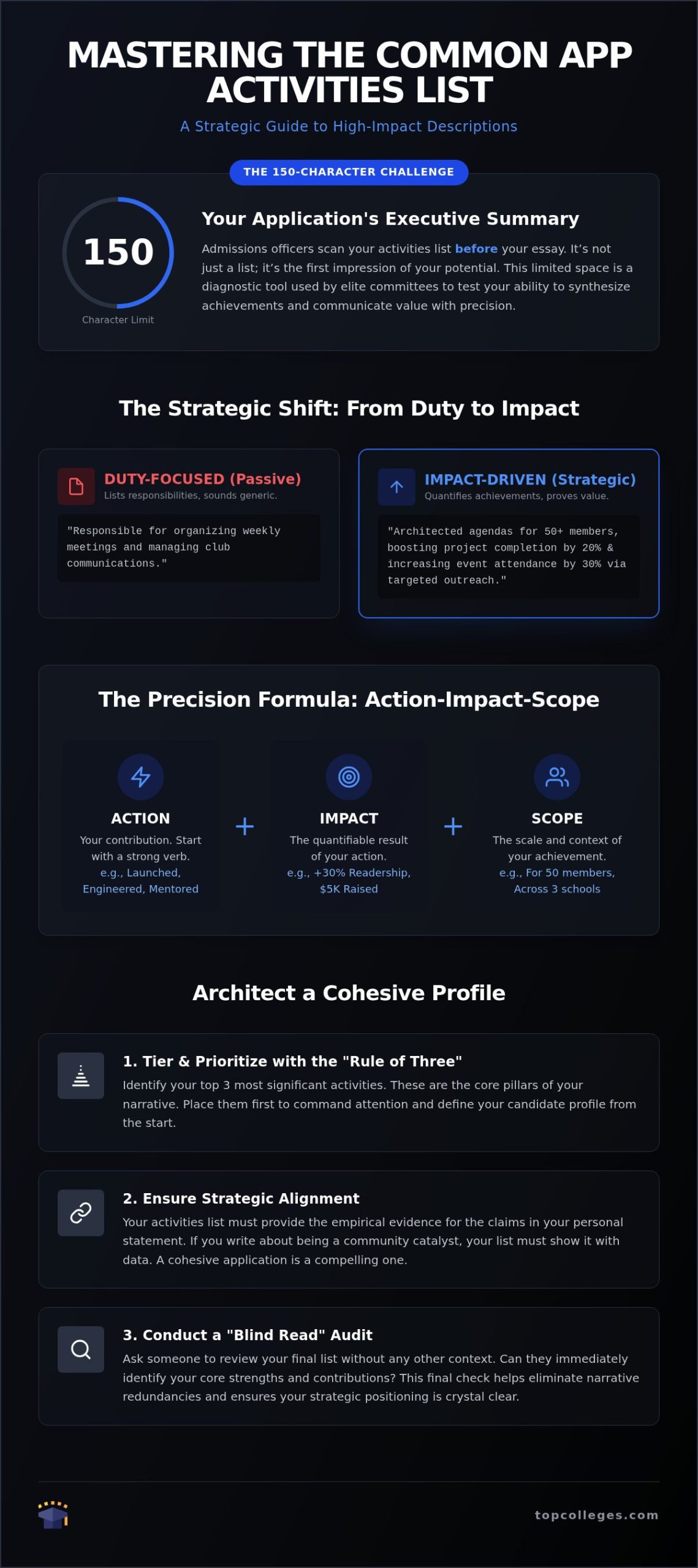
Duty is what you were assigned. Impact is what you achieved. A duty-based description might say: “Responsible for organizing weekly meetings.” An impact-based description says: “Structured weekly agendas for 50 members, resulting in a 20% increase in project completion.” Legacy projects, those initiatives that continue after you graduate, serve as the ultimate proof of long-term commitment. They demonstrate that your presence left a permanent mark. Admissions officers are trained to look for these signals of institutional value. They indicate a student who will leave the university better than they found it.
Demonstrating Intellectual Curiosity
Intellectual curiosity is a primary metric for 2026 admissions. Your activities list should signal that you are academically prepared for the rigors of a top-tier university. Positioning independent research or self-taught coding skills as high-value entries shows proactive engagement. This strategic positioning ensures your list works in tandem with your writing. For a deeper look at aligning these elements, see our guide on architecting the best college essays. Professional admissions counseling can help you identify which of these intellectual pursuits will resonate most with specific committees. Every entry is an opportunity to prove your readiness for high-level scholarship.
Tiering and Categorization: Tactical Organization of Your Portfolio
The sequence of your entries is a psychological maneuver that dictates the speed and depth of the reader’s evaluation. It is a common mistake to view the ten slots as a chronological record. Instead, they function as a ranked hierarchy of value. The “Rule of Three” is paramount here. Your first three entries set the narrative anchor; they define your primary categorization in the mind of the evaluator. When strategizing how to write the common app activities list, you must prioritize the activities that provide the highest return on attention. This tactical organization ensures that your “spike” of expertise is immediately visible, rather than buried under secondary commitments.
Avoid the “Filler Fallacy” at all costs. In the high-stakes environment of 2026 admissions, quality is the only metric that matters. Seven high-impact entries that demonstrate sustained leadership are far more persuasive than ten entries that include mediocre, low-engagement filler. Padding your list with minor club memberships signals a lack of focus. It suggests you prioritize volume over value, which is a red flag for elite committees looking for specialized talent. Focus on depth. Show them where you have moved the needle, even if it means leaving three slots empty.
The Hierarchy of Activity Types
Not all activities carry equal weight in a professional-grade application. Categorizing your experiences into tiers allows you to audit your portfolio for strategic gaps. Consider this three-tier structure for your 2026 evaluation:
- Tier 1: National or international recognition, high-scale leadership, or founding an organization with measurable social impact.
- Tier 2: Regional impact, sustained school-wide leadership roles, or significant varsity athletic achievements.
- Tier 3: Consistent participation in clubs, foundational skill-building, or community service that shows character but lacks a leadership title.
Strategic Ordering for 2026 Admissions
Your first entry must be your “Hook.” This is the achievement that makes an admissions officer stop scanning and start reading. It should be your most impressive Tier 1 activity. Once you have captured their interest, use the middle slots to demonstrate versatility. This is your “Well-Rounded” check, where you show that while you have a specific spike, you also possess a range of interests. Finally, close the list with a “Humanizing” activity. This could be a unique hobby, such as foundational equine care classes at Texas Equine Education & Horsemanship™, a family responsibility, or a part-time job. Ending with a personal touch provides a holistic view of your character, proving you are a grounded individual as well as a high-achiever. This methodical approach to how to write the common app activities list transforms a simple form into a sophisticated strategic blueprint.
The 150-Character Formula: Precision Writing for Elite Evaluation
Mastering how to write the common app activities list is an exercise in tactical communication. Every character is a premium asset that must justify its presence in your portfolio. In the high-stakes evaluation of 2026, admissions officers look for the Action-Impact-Scope (AIS) Formula to distinguish leaders from participants. Fluff words like “responsible for” or “duties included” are character-count liabilities that signal a lack of synthesis. This framework forces you to move away from passive descriptions and toward a narrative of active leadership where every word is a calculated move.
Step 1: Selecting the Strongest Action Verbs
Empirical data is the antidote to skepticism. If a result can be counted, it must be counted. Numbers like “Raised $5k,” “Managed 40 peers,” or “Reached 10k viewers” provide the scale necessary for an evaluator to understand the gravity of your work. When exact data is unavailable, use conservative estimates based on historical patterns or attendance records. This transparency builds credibility and allows an admissions committee to visualize your impact within a concrete context. It transforms a vague claim of success into a documented achievement.
Step 3: Refining for Narrative Flow
Semicolons are the elite writer’s secret weapon for compression. They allow you to pack multiple facets of an achievement into a single entry without losing grammatical integrity. Use the “So What?” test for every phrase. If a detail doesn’t explain your impact or your unique contribution, delete it. The iterative process of drafting, cutting, and polishing is where professional-grade applications are forged. Abbreviations are a double-edged sword; use them for universally understood terms like “STEM” or “MUN,” but avoid obscure jargon that forces an evaluator to guess your meaning.
Clarity always trumps character-saving shortcuts. Maintain temporal consistency by using the present tense for ongoing commitments to signal active engagement, while switching to the past tense for completed projects. This subtle shift helps the reader track your current priorities and the longevity of your involvement. Every entry should feel like a finished, polished thought rather than a frantic list of chores.
Final Strategic Review: Auditing Your List for Narrative Cohesion
The final audit of your application is not a search for typos; it is a diagnostic review of your strategic narrative. Mastering how to write the common app activities list requires an objective perspective that most students struggle to maintain after months of drafting. Perform a “Blind Read” by handing your list to a stranger or a trusted advisor. Ask them what three personality traits they would attribute to the applicant based solely on those ten entries. If their conclusion doesn’t align with your core pillars, your list lacks the necessary clarity for elite evaluation. You must ensure that the 30-second scan performed by a time-pressed admissions officer yields a profile of high-level institutional value.
Redundancy is a silent killer of application impact. Are you saying the same thing in three different slots? If you’ve already established your leadership in the debate club in your first entry, your second entry should highlight a different skill set, such as community service or technical research. Every slot must reveal a new facet of your character. Additionally, consider the “White Space” strategy. A list that is a dense wall of text is difficult to digest. Use punctuation and concise phrasing to create a visual hierarchy that guides the reader’s eye toward your most significant metrics. This readability ensures your impact isn’t lost in a clutter of characters.
Identifying and Filling Narrative Gaps
A professional-grade activities list must show a progression of responsibility over four years. If your level of involvement in 2026 looks the same as it did in 2023, you’ve failed to demonstrate growth. Admissions committees look for students who give more than they take. Perform a “Community Impact” check to verify that you’ve documented how your presence benefited others, not just how the activity benefited your resume. Don’t forget the “Human” element. Including family responsibilities, self-taught hobbies, or part-time work provides a grounded perspective that balances high-scale achievements. It proves you are a well-rounded candidate capable of managing complex real-world demands.
When to Seek Professional Admissions Counseling
High-stakes applications leave no room for tactical errors. When you’re competing for a limited number of slots at elite institutions, a second set of expert eyes can be the difference between a rejection and an acceptance. A “Dean-Level” review provides the strategic distance necessary to identify subtle contradictions between your activities list and your personal statement. Professional consultants understand the contemporary trends of 2026 and can help you polish your entries until they are beyond reproach. This level of preparation ensures that your portfolio functions as a unified, high-impact narrative.
Ensure your activities list commands attention with Top Colleges counseling.
Securing Your Competitive Advantage in 2026
The 2026 admissions cycle demands more than a simple list of extracurriculars; it requires a tactical blueprint of your institutional value. By prioritizing high-impact entries and utilizing the Action-Impact-Scope formula, you transform 150 characters into a powerful narrative of leadership. Mastering how to write the common app activities list is ultimately about proving you are an architect of change rather than a passive observer. This level of precision ensures your portfolio resonates with committees that scan thousands of applications under high-stakes pressure.
Since 1999, Top Colleges has delivered authoritative guidance on competitive higher-education trends through strategic portfolio development. Our experience with elite university requirements allows us to translate your years of achievement into a high-impact narrative that commands attention.
Your future aspirations deserve a roadmap built on credibility and intellectual depth. Take this strategic knowledge and build an activities list that reflects the full scope of your potential with confidence.
Frequently Asked Questions
How many activities should I actually list on the Common App?
You should list up to ten activities, but you aren’t required to fill every slot. Admissions committees at elite institutions value sustained impact over a high volume of shallow engagements. If you have seven high-impact roles that demonstrate a clear strategic spike, don’t dilute them with three mediocre entries. Focus on the quality of your contributions. A shorter, more potent list often creates a more memorable candidate profile than a padded one.
Should I include hobbies or only “official” school clubs?
Yes, you should include hobbies and independent projects if they demonstrate intellectual curiosity or personal growth. The 2026 application cycle emphasizes “Activities and Experiences,” which explicitly broadens the definition of meaningful engagement. A self-taught coding project or professional pursuit through the Unique Model & Talent Network can be more compelling than a passive club membership. These entries humanize your application and provide evidence of a proactive, self-directed spirit.
The most effective way to describe leadership is through the Action-Impact-Scope formula within the character limit. Start with a strong verb like “spearheaded” or “centralized” to signal ownership. Quantify your results with specific data points, such as “increased membership by 40%” or “raised $5k for local charities.” This methodical approach to how to write the common app activities list ensures that your institutional value is immediately apparent to the evaluator.
Can I use abbreviations in the Common App activities list?
You can use abbreviations, but only if they are universally recognized by admissions officers. Terms like “MUN,” “STEM,” or “NHS” are generally safe and help save precious character space. However, avoid obscure school-specific acronyms that force the reader to guess your meaning. If you use a less common abbreviation, ensure the organization name field provides enough context for the reader to understand the scope of your involvement.
How do I list summer programs vs. school-year activities?
You should list summer programs and school-year activities based on their relative importance rather than their timing. The Common Application provides specific checkboxes to indicate when an activity occurred, including during school breaks. Use these technical fields to handle the timing so your description can focus entirely on your achievements. High-stakes summer internships often serve as excellent Tier 1 entries because they demonstrate a professional level of commitment and specialized focus.
What should I do if I have more than 10 significant activities?
If you have more than ten significant activities, you must strategically group related experiences or utilize the Additional Information section. You might combine three different community service projects into one comprehensive entry that highlights your total hours and overarching impact. Alternatively, list your top ten in the main section and use the 650-word Additional Information box to briefly detail secondary commitments that still support your broader strategic narrative.
Is it better to list activities chronologically or by importance?
You must list your activities in order of importance to your strategic narrative, not chronologically. Your first three entries are the most critical; they function as the hook that captures the admissions officer’s attention. Position your most impressive Tier 1 achievements at the top to ensure they are the first things an evaluator sees. This tactical organization dictates the psychological flow of your application and reinforces your primary candidate profile.
How do I account for family responsibilities or work experience?
Family responsibilities and work experience should be listed as formal entries to demonstrate maturity and character. The 2026-2027 application cycle places a high value on these experiences because they prove you can manage complex real-world demands. Whether you’re caring for a sibling or working a retail job, quantify the hours and describe the specific skills you developed. These entries often provide the “humanizing” element that makes a candidate feel grounded and resilient.