

Disclaimer
Content on this page of topcolleges.com is computer generated and therefore is not guaranteed to be 100 percent accurate about various aspects of the education sector. On balance, however, many students and families seek general information about high schools, colleges and universities, graduate programs, testing, education and career planning, and job placement before beginning one-on-one admissions counseling tailored to their specific needs.
Most applicants view their choice of admission essay prompts as a simple matter of personal preference. This is the first tactical error of the admissions season. In an elite landscape where every component of your application must serve a specific purpose, your prompt selection isn’t just a creative starting point; it’s a strategic maneuver. You likely feel the weight of this decision. Analysis paralysis is common when you’re staring down open-ended questions and wondering how to avoid the trap of a cliché narrative. It’s frustrating to have a lifetime of achievement and feel uncertain about which window will best showcase your value to an admissions committee.
This article will transform your approach from passive response to active positioning. We’ll provide a rigorous framework to help you master the 2026-2027 prompts and turn your personal statement into a high-stakes tactical asset. By the end of this analysis, you’ll understand how to select the prompt that highlights your unique intellectual traits and aligns perfectly with your broader portfolio. We’ll begin by deconstructing the current prompts and then move into the methodology of narrative alignment. This is the roadmap for ensuring your essay doesn’t just tell a story, but instead functions as a sophisticated piece of professional advocacy.
Key Takeaways
- Analyze why the 2026 admissions cycle requires a shift from autobiographical to analytical storytelling to differentiate your profile in a competitive field.
- Master a tactical framework for evaluating admission essay prompts so your selection functions as a strategic asset rather than a simple response.
- Decode the significant weight of supplemental essays and learn to demonstrate institutional fit through research that goes beyond the standard brochure.
- Audit your “Application Persona” to identify the three essential traits you must project to command the attention of an elite admissions committee.
- Understand the methodology for transforming a standard draft into a sophisticated portfolio asset that reflects professional-level preparation and foresight.
The 2026 Admission Essay Landscape: More Than Just a Story
Why is the narrative arc of your personal statement shifting so drastically for the 2026 cycle? It’s no longer sufficient to merely recount a life event. Narrative alone is dead. Elite institutions are pivoting away from purely autobiographical accounts toward analytical reflections that demonstrate how you process complex information. You must prove you can think, not just that you’ve lived.
As more schools adopt test-optional or test-blind policies, the essay has emerged as the primary differentiator for high-achieving students. In this high-stakes environment, your response to admission essay prompts becomes a diagnostic tool for the admissions committee. They aren’t just looking for a story; they’re looking for “Intellectual Vitality.” This metric measures your curiosity and your ability to engage with the world on a deeper level. Through the “Holistic Review” process, officers use your response to measure character and institutional fit, ensuring you bring more to the campus than just a high GPA. For a broader context on how these requirements have evolved, you can review this overview of the application essay and its role in US higher education.
The goal is to move from a passive description of your past to an active demonstration of your future potential. Admissions officers are increasingly skeptical of “polished” stories that lack intellectual depth. They want to see the friction of your thoughts and the evolution of your perspective.
The Post-AI Era of Admission Essays
Essays as Strategic Portfolio Components
Stop viewing the personal statement as an isolated task. It’s the connective tissue of your candidacy. Your essay must fill the gaps left by transcripts and extracurricular lists, providing the “why” behind your “what.” When evaluating various admission essay prompts, remember that we define the strategic essay as a diagnostic tool that aligns your personal narrative with an institution’s specific cultural and academic needs. It’s about positioning yourself within the university’s specific culture. By mapping your narrative to the broader application, you ensure every word serves a tactical purpose in your admissions portfolio. For applicants ready to move beyond generic storytelling, understanding how to craft the best college essays through a strategic blueprint is the critical next step toward building a commanding candidacy.
Deconstructing the 2026-2027 Common Application Prompts
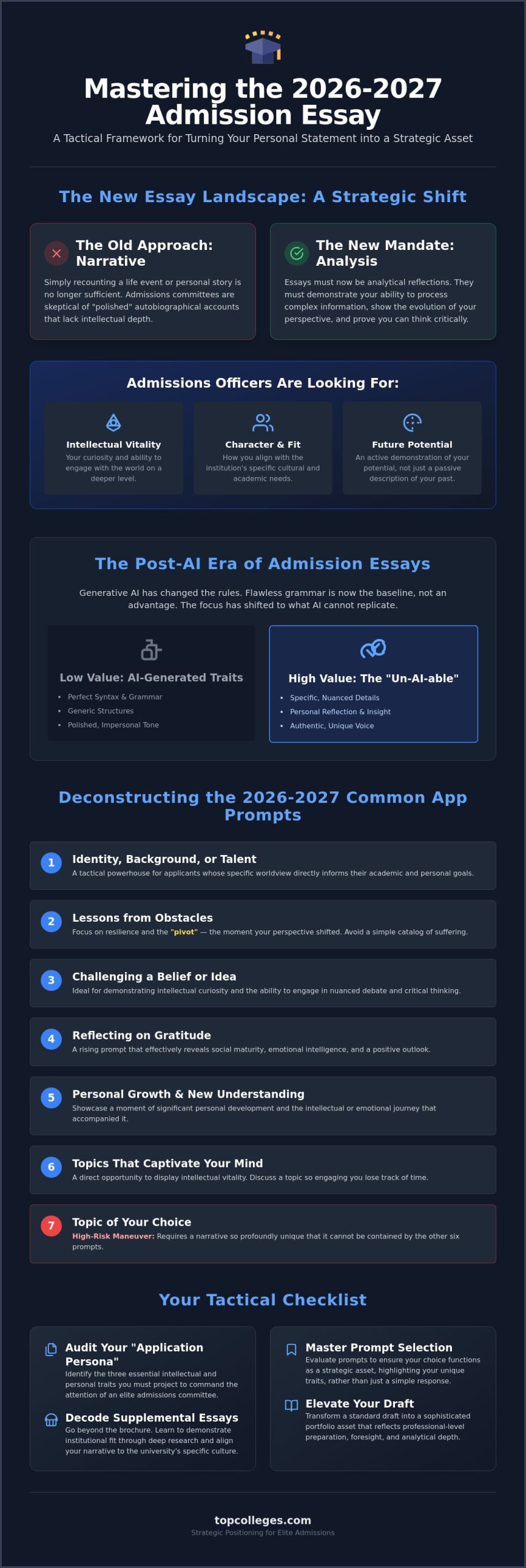
Stability in the admission essay prompts for the upcoming cycle provides a rare strategic advantage. The official 2026-2027 Common App essay prompts have been confirmed, allowing applicants to begin their strategic mapping with precision. These seven prompts are not merely questions; they are specific entry points into your intellectual portfolio. Your task is to identify which lens best magnifies your “Intellectual Vitality,” the metric elite committees use to identify students who will drive campus discourse.
- Prompt #1: Identity, background, or talent. This is a tactical powerhouse for applicants whose specific worldview informs their academic goals.
- Prompt #2: Lessons from obstacles. Use this to demonstrate resilience without falling into a “tragedy trap.”
- Prompt #3: Challenging a belief or idea.
- Prompt #4: Reflecting on gratitude. This prompt is gaining traction because it reveals social maturity and emotional intelligence.
- Prompt #5: Personal growth and new understanding.
- Prompt #6: Topics that captivate your mind.
- Prompt #7: Topic of your choice. This is a high-risk maneuver that requires a narrative so unique it defies standard categorization.
Prompt #2 often leads students toward a catalog of suffering. This is a mistake. Admissions officers are looking for the pivot. They want to see the moment your focus shifted from the difficulty itself to the analytical problem-solving that followed. For those seeking a professional review of their narrative positioning, our college admissions counseling provides the high-level oversight necessary to ensure your story remains focused on strength rather than struggle.
Prompt #3 and #5: Challenging Beliefs and Personal Growth
These prompts demand a demonstration of maturity through the analysis of intellectual or social conflict. The danger here is sounding “preachy” or morally superior. To succeed, you must focus on the evolution of your thought process. Show the committee how you process dissenting information and how that friction led to a sophisticated, new understanding. Clichés about “learning to get along” won’t suffice; you need to show a genuine, rigorous shift in your analytical framework.
Prompt #6: The ‘What Captivates You’ Strategy
This is frequently the most effective choice for STEM or niche research applicants. It allows you to showcase deep academic curiosity and self-driven learning. Don’t just describe the topic. Focus on the follow-up: what or who do you turn to when you want to learn more? This reveals your methodology for intellectual exploration. For instance, those pursuing business or finance might mention their engagement with high-impact resources like MG Affiliate to demonstrate proactive learning. It proves you have the self-starting habits required for success at a high-level research university, effectively answering the committee’s unspoken questions about your academic potential.
The Strategic Weight of Supplemental Essay Prompts
If the main personal statement is your candidate introduction, the supplemental essays are your job interview. Why do many applicants treat them as secondary? This is a critical error. In elite admissions, the main essay establishes your character, but the supplements prove your utility. These school-specific admission essay prompts are often the final deciding factor in a committee’s “yes” or “no” decision. They test your research, your alignment with institutional values, and your ability to contribute immediately to a specific campus culture.
Take the “Why Us?” prompt. Most students fail here by reciting facts from the university’s homepage. This is lazy. You must look beyond the brochure. Identify specific laboratories, particular faculty members, or unique interdisciplinary programs that align with your documented goals. Similarly, the “Community Contribution” prompt isn’t about what you’ll get from the school. It’s about what you’ll give. You must demonstrate how your presence strengthens the campus ecosystem through a specific, value-added perspective.
Short answer prompts require even more tactical precision. When you only have 150 words, every syllable must be a strategic asset. There is no room for throat-clearing. You must respond with surgical accuracy, using high-impact vocabulary that reinforces your application persona. For those refining their technical execution, these expert tips for writing a college essay provide a solid foundation for clarity and impact.
Supplemental vs. Primary: Avoiding Redundancy
Redundancy is the enemy of a successful application. We recommend the “Inventory Method”: list the three most critical traits you want to project, then map them across your admission essay prompts. If your main essay covers your leadership, your supplements should pivot to your research skills or community service. You can repurpose core stories across different schools, but the “hook” must always be tailored to the specific institution’s mission statement. Never copy-paste without a tactical adjustment of the lens.
Elite Graduate School Supplemental Trends
The stakes increase significantly at the graduate level. Law, MBA, and Medical school supplements differ from undergraduate prompts by focusing heavily on professional trajectory. They demand an answer to “Why Now?” and “Why this specific degree?” There is less room for creative flair and more requirement for professional foresight. For example, our specialized Law School Personal Statement Strategy emphasizes the need for a narrative that bridges academic excellence with future legal advocacy. These prompts are diagnostic tools used to evaluate your readiness for high-pressure professional environments.
A Tactical Framework for Prompt Selection and Narrative Alignment
Selecting from the available admission essay prompts shouldn’t be based on intuition. It is a diagnostic process. Why leave your future to a gut feeling when you can apply a rigorous framework? To transform your essay into a high-stakes tactical asset, you must move beyond simple storytelling and adopt a methodology of narrative positioning. This ensures every word serves a specific purpose within your broader application portfolio.
We utilize a five-step framework to ensure objective selection and strategic depth:
- Step 1: Audit your ‘Application Persona’. Identify the three non-negotiable traits the committee must recognize. If your transcript demonstrates quantitative excellence, perhaps your essay must project social advocacy or creative problem-solving.
- Step 2: Map potential narratives. Align your strongest personal anecdotes against the seven specific Common App prompts to see which lens provides the most clarity.
- Step 3: Evaluate for ‘Conflict and Resolution’. Ensure the prompt you choose allows for a clear arc where an intellectual or personal challenge is met with a sophisticated solution.
- Step 4: Cross-reference institutional values. Stanford seeks “Intellectual Vitality,” while UChicago rewards “Quirky Thinking.” Your choice must pivot based on the target institution’s cultural DNA.
- Step 5: The ‘So What?’ Test. Does the narrative lead to a logical conclusion about your future impact? If the story ends in the past, it’s a memoir; if it projects into the future, it’s a strategic tool.
For those who require a high-level advisor to master this alignment, our graduate program admissions consulting offers the strategic depth needed to navigate these competitive processes with confidence.
The Narrative Alignment Matrix
This matrix ensures your essay functions as the connective tissue of your candidacy. It must complement, not repeat, your letters of recommendation. If a teacher discusses your classroom performance, use the essay to reveal a facet they haven’t seen. This is also your opportunity to reframe potential weaknesses. A grade dip or a gap year isn’t a failure. It’s a data point you can contextualize by selecting admission essay prompts that allow for vulnerability while maintaining intellectual authority. Applicants who want to see this principle applied in practice can explore how best college essays are architected to balance vulnerability with professional confidence at the highest levels of competition.
Refining the ‘Hook’ and the ‘Exit’
Strategic openings must command attention within seconds. Avoid the “scenic” opening that takes too long to reach the point. Instead, start at the moment of peak friction. Your conclusion must be equally purposeful. The ‘Exit Strategy’ of an elite admission essay is a deliberate pivot from past reflection to future academic or professional contribution. It should leave the reader convinced that your presence on campus is not just desired, but necessary for the vitality of their community.
Elevating Your Response: The TopColleges Strategic Approach
A “good” essay tells a story. A “commanding” essay secures an admission. Why settle for the former when the stakes involve your entire academic trajectory? Professional consulting provides the diagnostic oversight necessary to ensure your response to admission essay prompts aligns with the hidden expectations of elite committees. It’s the difference between a student following directions and a candidate leading the conversation. Most applicants struggle to see their own narrative blind spots. We provide the external perspective required to turn a personal reflection into a piece of professional advocacy.
Our methodology at Top Colleges moves your writing through a rigorous transformation. We don’t just edit for grammar; we refine for strategic positioning. Steven Roy Goodman’s 25 years of experience in elite admissions allows us to interpret contemporary institutional trends that aren’t visible to the average applicant. We treat the essay as a high-stakes portfolio asset. This means analyzing how your narrative fills the specific voids left by your quantitative data. We move beyond the draft to ensure your final submission functions as a sophisticated piece of strategic communication.
Anxiety is often the result of uncertainty. By replacing guesswork with a structured, methodical preparation plan, we eliminate the paralysis that often comes with open-ended prompts. Expert feedback provides the calm, authoritative confidence needed to finalize a narrative that is both authentic and tactically sound. You shouldn’t be wondering if your essay is “right.” You should know it’s effective.
Beyond Undergraduate: Graduate and Professional Strategy
The transition to graduate or professional school requires a significant shift in tone. Law, MBA, and Medical school applications demand a “Professional Voice” that undergraduate prompts rarely require. You aren’t just a student anymore; you’re a future colleague. Our specialized Graduate Program Admissions Consulting focuses on this high-stakes narrative tailoring. We help you articulate a professional trajectory that feels both inevitable and essential to the target program, ensuring your personal statement reflects the maturity required for advanced study.
Next Steps for the 2026 Application Cycle
Timing is a tactical variable. For the 2026 cycle, the ideal timeline involves finalizing your prompt selection by early summer. This is followed by a rigorous drafting phase and professional review in late August. This schedule prevents the rushed, low-quality output that characterizes many late-season submissions. Don’t leave your narrative to chance. You can secure your strategic edge with Top Colleges today to ensure your application stands as a definitive statement of your value and intellectual potential.
Mastering the Narrative Competitive Edge
Success in the 2026 cycle depends on your ability to move beyond simple autobiography. You’ve learned that selecting from the available admission essay prompts is a diagnostic exercise meant to reveal your analytical depth and intellectual vitality. Every supplement and short answer must function as a coordinated part of your broader strategic portfolio. The landscape is increasingly competitive; your narrative must be impeccable.
With over 25 years of expertise in Ivy League and Tier-1 admissions, TopColleges specializes in the strategic portfolio development required for high-stakes results. Our methodology is rooted in authored resources on higher education trends, ensuring your candidacy is positioned for maximum impact. We aim to replace your anxiety with a structured, methodical solution that has guided thousands of applicants toward their target institutions. Architect your elite application strategy with TopColleges. Your future aspirations deserve a roadmap built on experience and foresight. You have the potential to lead; ensure your application reflects that truth.
Frequently Asked Questions
What are the official Common App prompts for the 2026-2027 cycle?
The official Common App prompts for the 2026-2027 cycle are identical to those used in the previous year. This continuity allows you to begin your strategic planning early. The seven prompts cover themes of identity, obstacles, belief systems, gratitude, personal growth, captivating topics, and a final “topic of your choice” option. Consistency in these prompts means you can rely on established frameworks to begin your narrative positioning.
Is there a ‘best’ admission essay prompt to choose for Ivy League schools?
No single prompt holds an inherent advantage for Ivy League admissions. The most effective choice is the one that best showcases your intellectual vitality and alignment with the institution’s specific culture. Whether you select Prompt #1 or Prompt #6, the committee is evaluating the depth of your reflection rather than the prompt itself. Your goal is to choose the entry point that allows you to demonstrate sophisticated problem-solving skills.
How long should my response to an admission essay prompt be in 2026?
The Common Application maintains a strict limit of 650 words for the personal statement. However, a high-stakes response to admission essay prompts is typically most effective when it falls between 550 and 625 words. This range provides enough space for nuanced analysis without losing the reader’s attention through excessive detail. Brevity often signals a confident, disciplined mind that can prioritize essential information.
Can I use the same essay for multiple college application prompts?
You can certainly repurpose core narratives across different applications, but a direct copy-paste is a tactical error. While the underlying story might remain the same, you must adjust the reflection to address the specific values of each institution. Every school has a unique academic DNA. If your response doesn’t acknowledge those specific nuances, it will likely fail the “fit” test during the holistic review process.
What is the most popular Common App prompt and should I avoid it?
Prompt #7 is technically the most popular due to its open nature, but Prompt #2 often leads to the most generic responses. You don’t need to avoid popular admission essay prompts if you have a unique, analytical perspective. The risk isn’t the prompt itself; it’s the tendency to rely on predictable narrative arcs. If you choose a common prompt, ensure your insights are specific and intellectually demanding.
How do I answer the ‘Why this college’ supplemental prompt effectively?
To answer the “Why this college” prompt effectively, you must move beyond superficial campus descriptions. Identify specific faculty members whose research aligns with your goals or niche interdisciplinary programs that meet your academic needs. Your response should prove that you’ve done the work to understand the institution’s inner workings. It’s about demonstrating how your presence will contribute to their specific academic and social ecosystem.
Should I address ChatGPT or AI use in my admission essay?
You shouldn’t address AI use in your essay unless a specific school requires a formal disclosure statement. Instead, focus your energy on producing a narrative that AI cannot replicate. This means including highly specific, sensory details and complex emotional reflections that demonstrate human insight. Admissions officers are trained to look for authenticity. A distinct, idiosyncratic voice is the best defense against the suspicion of generative assistance.
What do I do if none of the admission essay prompts seem to fit my story?
If your narrative doesn’t align with the first six options, Prompt #7 exists specifically to accommodate any topic you choose. This is a high-reward strategy that allows for complete creative control over your positioning. However, this freedom requires extra discipline. You must still ensure the essay meets the rigorous standards of intellectual vitality and provides a clear, logical conclusion about your future potential on campus.