

Disclaimer
Content on this page of topcolleges.com is computer generated and therefore is not guaranteed to be 100 percent accurate about various aspects of the education sector. On balance, however, many students and families seek general information about high schools, colleges and universities, graduate programs, testing, education and career planning, and job placement before beginning one-on-one admissions counseling tailored to their specific needs.
What if your thousands of clinical hours are actually working against you? Most applicants view their portfolio as a bucket to be filled, yet elite admissions committees see a surplus of hours without a clear narrative as a significant strategic failure. It’s a common trap. You likely feel overwhelmed by the sheer volume of requirements, fearing that your experiences lack the cohesion needed to stand out among thousands of high-achieving peers. This anxiety is a rational response to a high-stakes system that demands more than just participation.
This guide provides the tactical blueprint you need to master the art of selecting and presenting extracurriculars for medical school. We’ll move beyond the checklist to focus on how you can translate raw hours into measurable impact for the 2026 application cycle. You’ll gain a clear roadmap for activity selection and the confidence to articulate a professional identity that commands respect. By the end of this analysis, you’ll understand how to replace uncertainty with a structured, elite portfolio that bridges the gap between your current candidacy and your future medical career.
Key Takeaways
- Shift your focus from passive participation to active competency, ensuring every entry in your portfolio meets the rigorous standards of top-tier 2026 admissions.
- Master the strategic selection of extracurriculars for medical school by prioritizing longitudinal commitment and measurable impact over a high volume of disconnected activities.
- Implement the “Top Colleges Impact Matrix” to evaluate the scale and sustainability of your roles, maximizing your return on time during the preparation phase.
- Learn to synthesize your experiences into a powerful “Thesis Statement” that transforms a disparate list of hours into a unified, professional identity.
- Conduct a high-level portfolio audit to identify and resolve narrative gaps, positioning your application as a cohesive blueprint for future medical success.
Beyond the Checklist: The Strategic Role of Extracurriculars in Medical Admissions
Stop viewing your application as a collection of hours. Elite institutions have moved past the era where a simple tally of volunteer time sufficed. In the 2026 cycle, your activities serve as objective evidence of competency rather than just a record of time spent. Admissions committees are diagnostic; they look for proof of resilience, leadership, and emotional intelligence. Choosing the right extracurriculars for medical school requires a psychological shift from asking “what do they want to see?” to “what does this activity prove about my character?” A Strategic Portfolio is the deliberate synthesis of academic excellence and demonstrated clinical empathy, presented as a unified evidence-based argument for admission.
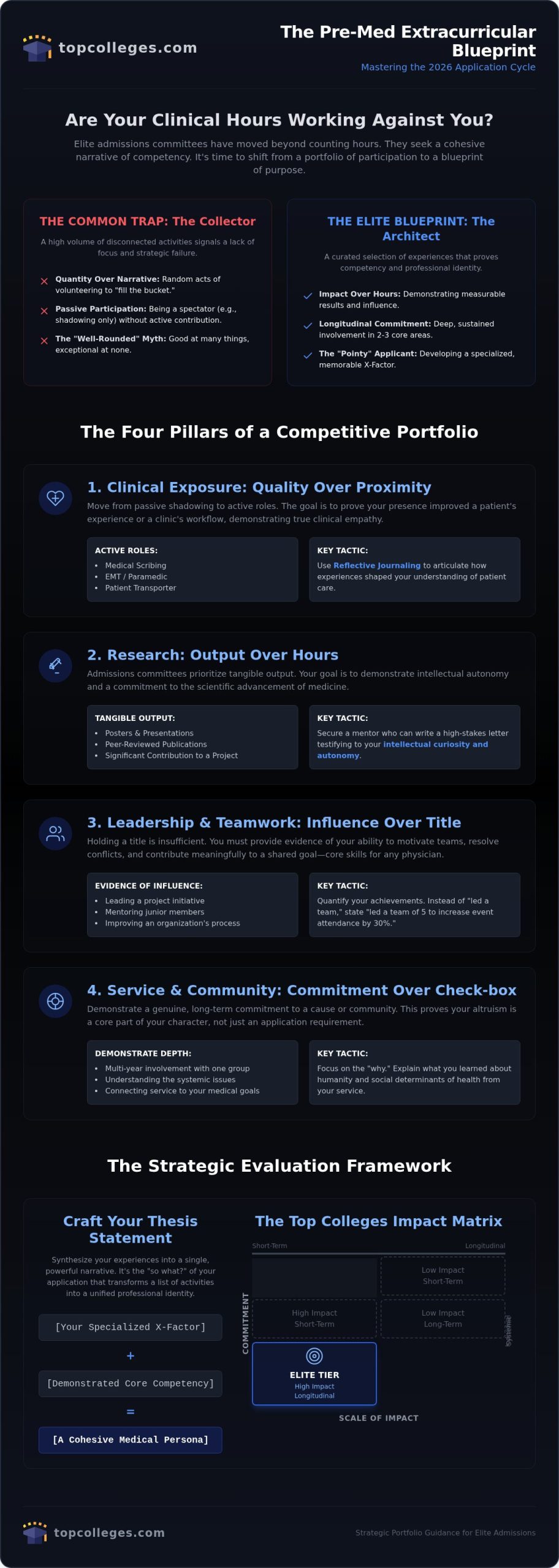
Top-tier programs prioritize longitudinal commitment over a shotgun approach of many short-term activities. Depth signals stability and a genuine interest in the profession. If your resume features ten different organizations with only twenty hours at each, you’re broadcasting a lack of focus. Strategic candidates select two or three core areas and pursue them with a level of intensity that produces measurable results. This approach transforms you from a spectator into a contributor who has actually influenced a clinical or research environment.
The Myth of the ‘Well-Rounded’ Applicant
The obsession with being well-rounded is a strategic trap. When everyone is “good” at everything, no one is exceptional at anything. To succeed in high-stakes admissions, you must be “pointy.” This means developing a specialized X-factor that makes your profile memorable. Perhaps you’re the candidate who has spent three years investigating rural healthcare disparities, the one who has published original research on pediatric oncology, or an applicant who has developed specialized expertise in physical wellness through NPTI Florida to demonstrate a unique focus on preventive medicine. Admissions officers spot “activity padding” immediately; they can sense when an applicant is frantically adding minor roles to fill space. Focus on high-impact choices that align with your specific medical interests instead.
Your GPA and MCAT scores provide the foundation, but your activities provide the context. Within the Pre-medical educational track, extracurriculars function as the “soft” data that humanizes your metrics. In the holistic review process of 2026, these experiences explain who you are when you aren’t studying. They can also serve a tactical purpose by addressing gaps. If your science GPA had a slight dip during a specific semester, a sustained and rigorous research commitment during that same period can demonstrate that your intellectual curiosity remained sharp. You’re not just a number; you’re a professional-in-training whose actions validate your academic potential.
The Four Pillars of a Competitive Pre-Med Portfolio
A superior application rests on four structural pillars. These are not independent silos; they’re integrated components of your professional blueprint. To excel, you must view extracurriculars for medical school as a tactical deployment of your time. Each activity must serve as a data point that confirms your readiness for the rigors of 2026 medical training. Without a balanced foundation across these categories, even the highest academic metrics may fail to secure an interview at an elite institution.
Clinical Exposure: Quality Over Proximity
Proximity to a physician isn’t enough. While shadowing is a necessary starting point, it’s inherently passive. In the 2026 cycle, committees demand active participation through roles like medical scribing or EMT work. Some candidates differentiate themselves by pursuing accredited healthcare certifications through Active Health Group to gain practical experience in health coaching or therapy. Use a “Patient-First” framework to evaluate your hours. Did your presence improve a patient’s experience or a clinic’s workflow? Reflective journaling is the critical tool that transforms these raw hours into the emotional intelligence required for high-stakes interviews. It allows you to articulate not just what you saw, but how those experiences shaped your clinical empathy.
Hours spent in a laboratory are a poor metric of success. Admissions committees prioritize tangible output: posters, conference presentations, and peer-reviewed publications. Whether you choose wet lab, clinical, or public health research, your goal is to prove a commitment to the scientific advancement of medicine. Securing a mentor who can write a high-stakes letter of recommendation is vital. This individual must be able to testify to your intellectual autonomy and your ability to navigate the complexities of the scientific method, rather than just your ability to follow a protocol.
Service and Leadership: The ‘Human’ Factor
The “human” factor often defines the most competitive candidates. Interestingly, non-medical community service can be more impressive than medical missions; it demonstrates a selfless dedication to underserved populations without the optics of resume-padding. Leadership is not defined by a title on a club roster. It’s defined by measurable change. Did you increase a non-profit’s reach? Did you implement a new training system? Longitudinal service proves the grit and reliability that medical schools demand, making these essential extracurriculars for medical school. If you find your current activities lack this strategic depth, medical school admissions consulting can help you recalibrate your trajectory before the next cycle.
Evaluating Impact: The Strategic Evaluation Framework
Selection is a diagnostic process. You can’t afford to waste precious hours on low-impact roles that fail to move the needle. The “Top Colleges Impact Matrix” evaluates potential commitments based on three metrics: Scale, Scope, and Sustainability. This framework allows you to calculate the Return on Time (ROT) for every potential commitment. High-yield activities are those that align with the specific mission of your target school tier. For instance, a research-heavy T20 institution will value a published paper far more than a community-focused program might. A 2-year commitment to one project outweighs four 6-month projects because it provides the longitudinal evidence of grit that admissions officers demand.
Measuring Scale and Scope
Data drives the AMCAS work and activities section. Did you help 10 people or 1,000? Quantifying your reach is non-negotiable for a competitive portfolio. Beyond the raw numbers, you must define your scope of influence. Were you a passive member or a strategic lead who orchestrated a new initiative? We apply the “Innovation Test” to every client’s portfolio: did you create something that didn’t exist before? If you simply filled a pre-existing seat, your impact is inherently capped. To stand out, you must demonstrate that you possess the agency to identify a problem and implement a solution.
Assessing Sustainability and Growth
Sustainability is the final metric of the matrix. An activity must allow for increased responsibility over time. You should be able to pivot from a foundational volunteer role to a leadership position within the same organization. This trajectory demonstrates that you are a person of value whom others trust with complex systems. Avoid the “Senior Year Surge” at all costs. Admissions committees immediately identify candidates who frantically add extracurriculars for medical school just months before submitting their applications. Starting early is a strategic imperative that signals foresight and professional maturity. By building a multi-year blueprint, you prove that your commitment to medicine is a deliberate choice rather than a last-minute scramble.
Narrative Integration: Connecting Activities to Your Medical Persona
A collection of extracurriculars for medical school without a unifying theme is merely a ledger of time. To secure a seat in the 2026 cycle, you must architect a “Thesis Statement.” This is a single, potent sentence that summarizes your professional identity and value proposition. It acts as the North Star for your entire application. By utilizing the “Thread Technique,” you link your clinical work, research, and service to a central theme, such as health equity or surgical innovation. This method ensures that your portfolio reads as a deliberate journey rather than a series of accidental encounters. Much like Architecting the Best College Essays, your activity list requires a strategic blueprint to be effective.
The ‘Most Meaningful’ Selection Strategy
AMCAS allows you to designate three activities as “most meaningful.” This is a tactical decision, not an emotional one. You should select experiences that demonstrate breadth across the four pillars while reinforcing your central thesis. Use the additional character count to prioritize reflection over simple description. What did the experience prove about your capacity for medicine? If you can’t answer that with diagnostic precision, the activity doesn’t belong in your top three. This section is your opportunity to show the admissions committee that you’ve processed your experiences and are ready for the professional responsibilities of a physician. Balancing these choices ensures you don’t appear one-dimensional, even while maintaining a “pointy” persona.
Building Your Medical ‘Persona’
Your persona acts as your professional brand. Whether you position yourself as the Physician-Scientist, the Community Advocate, or the Global Health Strategist, every entry must support this image. Conduct a narrative audit of your current list to identify gaps. If you claim to be a Community Advocate but lack sustained service to underserved populations, your story will collapse under scrutiny. A narrative gap is a red flag that suggests a lack of authenticity or poor strategic planning. You must ensure your activities align with the specific mission statements of your target medical schools. A primary care-focused institution will look for a different persona than a research-intensive university. By tailoring your narrative to the school’s values, you demonstrate that you aren’t just a qualified applicant, but the right fit for their specific culture.
Strategic Refinement: Maximizing Your Extracurricular Impact
Accumulating hours is only the preliminary phase of a successful application. The transition from accumulation to presentation represents the most critical turning point in your journey. Professional consulting transforms a disparate list of activities into a unified, strategic portfolio that speaks the language of admissions committees. Through a rigorous “Portfolio Audit,” you can identify and fill narrative gaps before the 2026 cycle begins. This diagnostic process ensures that every entry in your AMCAS or AACOMAS portal is optimized to catch an AdCom’s eye, replacing generic descriptions with evidence-based claims of competency. Refining your extracurriculars for medical school requires a move away from the “what” and a deep dive into the “how” of your professional impact.
The final polish of your application shouldn’t be left to chance. Expert oversight provides the necessary distance to see your profile as a stranger would. By aligning your experiences with the Medical School Admissions Consulting: The Strategic Blueprint for 2026, you ensure that your tactical choices today result in an elite candidacy tomorrow.
The Role of Expert Oversight
A second pair of expert eyes is critical for high-stakes medical admissions. Self-guided workbooks often lack the nuanced understanding of how elite committees evaluate contemporary trends. Steven Roy Goodman’s approach to portfolio development and strategic positioning leverages over 25 years of experience to move you beyond “checking boxes.” The goal is to command attention by highlighting your unique X-factor. This level of refinement ensures that your application doesn’t just meet the requirements but sets a new standard for what a prepared applicant looks like. You aren’t just presenting a history; you’re projecting a future.
Final Preparation for the 2026 Cycle
Timing is a strategic variable that many applicants ignore. You must know when to stop “doing” and start “writing.” With the AMCAS application opening on May 5, 2026, your narrative must be finalized months in advance. There’s a powerful synergy between your extracurricular portfolio and your medical school interview preparation. When your written descriptions are sharp and reflective, you’ve already done the heavy lifting for your verbal responses. Your next steps should involve a structured review of your trajectory. Scheduling a strategic consultation allows you to refine your extracurriculars for medical school, ensuring that your 2026 application is a cohesive, high-impact blueprint for your career in medicine.
Architecting Your Elite Medical Portfolio
The medical school admissions process is diagnostic. It identifies those who have merely followed a path and those who have architected a professional identity. You’ve learned that elite extracurriculars for medical school are defined by longitudinal commitment and measurable impact rather than a simple tally of clinical hours. By integrating the Four Pillars into a cohesive narrative, you transform a standard resume into a strategic blueprint for your future career.
Steven Roy Goodman provides the expert guidance and national perspective required to navigate these high-stakes systems. His focus on strategic portfolio development replaces uncertainty with a structured, results-oriented plan. You don’t have to face the complexities of the 2026 cycle alone. It’s time to refine your application into a portfolio that commands respect.
Your journey to becoming a physician is a significant long-term investment. Take the final step to ensure your hard work is presented with the gravity and precision it deserves. You have the potential to succeed; let’s make sure the admissions committee sees it too.
Frequently Asked Questions
How many extracurricular activities should I list for medical school?
The AMCAS application allows for up to 15 entries, but filling every slot isn’t a requirement for success. Quality and depth are far more significant than the sheer number of activities. Aim for a strategic selection that reflects your longitudinal commitment to the four pillars: clinical, research, service, and leadership. A portfolio with 8 to 10 high-impact entries often presents a more cohesive narrative than a list of 15 superficial experiences.
Is research mandatory for admission to top-tier medical schools?
While not strictly mandatory, research is a strong expectation for applicants targeting top-20 medical schools. These institutions prioritize the scientific advancement of medicine and look for candidates who demonstrate intellectual curiosity. If you lack traditional wet-lab research, you can satisfy this expectation through clinical research, public health projects, or health policy analysis. The goal is to prove you can navigate complex systems and contribute to the global body of medical knowledge.
What counts as ‘clinical experience’ for the 2026 application cycle?
Clinical experience involves any role where you’re close enough to smell the patients. For the 2026 cycle, admissions committees prioritize active participation over passive shadowing. High-yield roles include working as an EMT, a medical scribe, a certified nursing assistant, or a hospice volunteer. These positions allow you to demonstrate the interpersonal competencies and clinical empathy that are essential for medical school. Passive observation should only serve as a foundational starting point.
Can I include extracurriculars from high school on my medical school application?
Generally, you should only include activities that began or continued during your undergraduate years. High school experiences are typically considered outdated unless they represent a significant, longitudinal commitment that you maintained into college. If you started a non-profit in high school and still lead it today, it serves as powerful evidence of grit. Otherwise, focus on your most recent professional development to show the committee who you are as a contemporary applicant.
How do I describe my activities to make them stand out to admissions committees?
Focus on quantifiable impact and personal reflection rather than simple job descriptions. Use active verbs to detail your specific contributions and the measurable change you implemented. Instead of stating you “volunteered at a clinic,” explain how you improved patient intake efficiency by a specific percentage. Use the character count to articulate what an experience proved about your character and how it prepared you for the professional responsibilities of a physician.
What if I have high grades but few extracurricular activities?
High academic metrics are necessary but insufficient for admission to elite programs. If your portfolio lacks extracurriculars for medical school, you risk being viewed as a “bookworm” who lacks clinical empathy. You must bridge this gap by pursuing high-yield activities that prove your readiness for patient care. Committees need to see that you can apply your scientific knowledge in real-world settings. A strategic consultation can help you quickly identify and fill these narrative gaps before you apply.
Is it better to have many different activities or focus on just a few?
A focused, “pointy” profile is almost always superior to a well-rounded but superficial list. Elite schools look for candidates who’ve achieved a high level of mastery in a specific area. By dedicating yourself to a few core projects, you demonstrate the longitudinal commitment and resilience that medical training requires. A shotgun approach of many short-term roles suggests a lack of professional focus and can make your application feel disconnected and unconvincing.
How has the 2026 admissions landscape changed for extracurricular evaluations?
The 2026 cycle places a heavier emphasis on holistic review and situational judgment tests like Casper and AAMC PREview. Admissions committees are looking for specific evidence of the 15 core competencies identified by the AAMC. This means your extracurriculars for medical school must do more than just fill time; they must serve as objective proof of your interpersonal and intrapersonal skills. There’s also a growing focus on “fit,” requiring you to align your portfolio with each school’s unique mission.