

Disclaimer
Content on this page of topcolleges.com is computer generated and therefore is not guaranteed to be 100 percent accurate about various aspects of the education sector. On balance, however, many students and families seek general information about high schools, colleges and universities, graduate programs, testing, education and career planning, and job placement before beginning one-on-one admissions counseling tailored to their specific needs.
When deciding what to write in a thank you note after college interview, focus on a brief, sincere email that refers to something you discussed. It should not read like a sales pitch or a second application essay. Sending it within 24 hours is a useful standard, but a genuine, specific message matters more than perfect timing.
It’s understandable to wonder whether a thank-you note is expected or whether a small wording choice could affect your admission chances. Treat the note as a professional courtesy, not a strategy that can secure an offer. Its purpose is to thank your interviewer, show you were engaged, and reaffirm your interest without overdoing it.
This guide explains when to follow up, what to include, and how to choose the right format and tone. You’ll also find templates you can adapt to your conversation, with practical guidance on adding a specific detail so your message feels personal rather than copied. Interview follow-up is one part of broader application preparation. A clear framework can help you send your note with confidence instead of second-guessing every sentence.
Key Takeaways
- Use a simple structure to make your message clear, courteous, and easy to personalize.
- Make your thank you note after college interview memorable by referring accurately to one genuine point from the conversation.
- Adapt the template to the interview format and interviewer rather than sending the same generic message to everyone.
- Choose a sensible follow-up time, and let any instructions from the interviewer or admissions office guide your approach.
- Keep your note consistent with your interests and broader application story. Thoughtful follow-up supports professionalism, not an admissions guarantee.
Why Send a Thank-You Note After a College Interview?
A thank you note after college interview conversations can feel like one more high-stakes decision, but it doesn’t need to be complicated. Think of it as a brief expression of appreciation and a professional follow-up, not another opportunity to argue your case.
A concise message acknowledges the interviewer’s time and shows you listened. The most effective approach is simple: thank the person, refer to a genuine point from your conversation, and close politely. The sections ahead offer a practical framework you can adapt to your interview and your own voice.
Is a thank-you note expected after every college interview?
Expectations can vary by institution, interviewer, and format. An alumni volunteer may appreciate a short email, while an interviewer or admissions office may give specific follow-up instructions. Follow those directions first, including any request not to send additional messages. If you have the interviewer’s contact information and no instructions say otherwise, a concise, sincere note is an appropriate courtesy. Variation in etiquette is not a test you need to pass.
If you spoke with more than one interviewer, write separately to each person when you have their contact information. Include a detail from each conversation so the messages feel personal rather than copied from the same form letter.
What a thank-you message can, and cannot, do
A thoughtful note recognizes that someone took time to speak with you and continues the exchange on a professional note. It can also give you a natural way to reaffirm your interest in the college, especially if a specific conversation topic helped clarify what appeals to you. Keep that reference accurate and brief. The aim is to show engagement, not to impress through elaborate wording.
Set realistic expectations. A follow-up doesn’t replace your application, change how you performed in the interview, or override a college’s admissions criteria. It can’t guarantee that an interviewer will remember you or that an admissions decision will change. Its value is in the courtesy and care it conveys, not in a promised result.
Thoughtful follow-up supports professionalism; it is not an admissions advantage you can count on. That distinction can help you write with confidence. Focus on expressing genuine thanks and reflecting the conversation honestly. A well-considered message is one practical element of application preparation, while the full application remains the central picture of your candidacy.
What to Include in a Thank-You Note After a College Interview
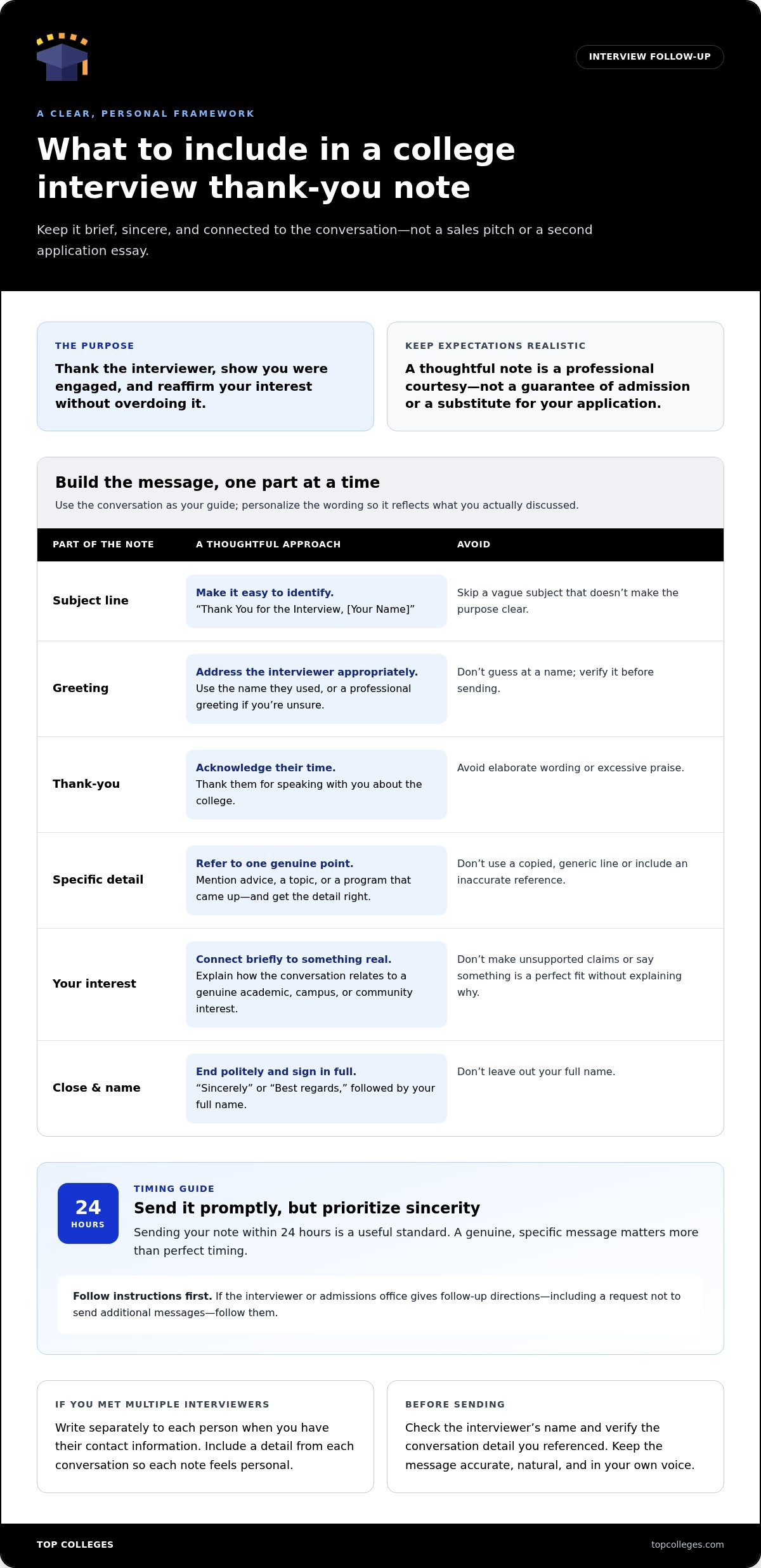
A polished follow-up doesn’t need elaborate language. For a thank you note after college interview conversations, use a clear sequence: subject line, greeting, thanks, one specific detail, courteous close, and your full name. Treat this as a framework, then adapt the wording to reflect the exchange you actually had.
A simple structure for a college interview thank-you email
Make the subject easy to identify, such as Thank You for the Interview, [Your Name]. Address the interviewer by the name they used, or choose an appropriate professional greeting if you’re unsure. After expressing thanks, add a sentence about one detail from the conversation, then close with “Sincerely” or “Best regards” and your full name. MEFA’s college interview and thank-you note guidance also emphasizes making the message specific and expressing appreciation.
An effective thank-you note is clear, appreciative, specific to the conversation, and signed with your full name.
How to personalize the note without overdoing it
Choose one point you remember accurately: advice the interviewer shared, a topic you discussed, or a program that came up. Then connect it briefly to a genuine interest. For example, if you discussed undergraduate research, you might say that hearing about the interviewer’s experience helped you think about the questions you hope to explore. Keep the reference concise, and don’t claim a program is a perfect fit unless you can explain why.
A thank you note after college interview should sound like you, not like a template. Avoid excessive praise, unsupported statements about the college, or sentences copied unchanged from a sample. Use the template to organize your thoughts, then replace any line that doesn’t feel natural or accurately reflect your conversation.
Adaptable thank-you note template
Subject: Thank You for the Interview, [Your Name]
Dear [Interviewer’s Name],
Thank you for taking the time to speak with me about [College Name]. I especially appreciated hearing your perspective on [specific topic or advice discussed]. Our conversation made me more interested in [genuine academic, campus, or community interest]. Thank you again for sharing your experience.
Best regards,
[Your Full Name]
Before sending, verify the interviewer’s name and the detail you’ve referenced. A small factual error can distract from an otherwise thoughtful message. If you’re preparing for interviews as part of a larger application plan, Top Colleges’ college admissions counseling can help you approach interview preparation and application strategy as connected parts of that process.
College Interview Thank-You Note Examples for Different Situations
The best template is a starting point, not a script. Adapt the examples below to the actual exchange, replacing every bracketed phrase with a detail you remember accurately. A useful thank you note after college interview conversations should sound like you, whether you met on campus, spoke online, or talked with an alumnus.
In-person interview with a memorable topic
Use this version when one discussion point gave you a genuine takeaway. Keep the reflection personal and brief. Don’t turn it into a second application essay.
Subject: Thank You for Meeting with Me, [Your Name]
Dear [Interviewer’s Name],
Thank you for meeting with me during my visit to [College Name]. I enjoyed hearing your perspective on [specific topic discussed]. Your thoughts about [accurate detail] stayed with me because [genuine reason it mattered to you]. I appreciate your time and the opportunity to learn more about the college.
Warm regards,
[Your Full Name]
Virtual interview with a concise exchange
If the conversation was short, don’t stretch the note to make it seem more substantial. Thank the interviewer for making time to speak and mention one real point from the exchange.
Subject: Thank You for the Virtual Interview, [Your Name]
Hello [Interviewer’s Name],
Thank you for speaking with me about [College Name]. I appreciated our conversation about [specific question, topic, or advice], especially [brief, accurate detail]. It helped me reflect on [your genuine takeaway or interest]. Thank you again for your time.
Best,
[Your Full Name]
Alumni interview with a personal perspective
An alumnus can offer a personal view of their college experience, but may not make admissions decisions. Keep your message focused on appreciation and the insight they shared. Don’t ask about your application or assume they can influence its outcome.
Subject: Thank You for Sharing Your College Experience
Dear [Interviewer’s Name],
Thank you for taking the time to tell me about your experience at [College Name]. I especially appreciated hearing about [specific experience or topic they mentioned]. Your perspective gave me a clearer sense of [genuine takeaway]. I’m grateful for your time and thoughtful answers.
Sincerely,
[Your Full Name]
If the conversation was mostly logistical, such as a discussion of the interview process or campus visit, refer to that plainly: “I appreciated your helpful explanation of [specific detail].” Before sending, remove every placeholder, check names and facts, and make sure the takeaway is truly yours. A warm, accurate close is enough. Don’t request special consideration or a decision update in a thank-you message.
When to Send the Note, and What Mistakes to Avoid
Prompt follow-up is considerate, but it shouldn’t become another source of application anxiety. For a thank you note after college interview, sending an email the same day is a sound goal; within 24 hours is a useful standard. If your schedule makes that difficult, send it as soon as you can rather than rushing out a message you haven’t reviewed. When an interview falls on a Friday, Monday morning is still a reasonable time to follow up.
How soon should you send a college interview thank-you note?
Think of timing as good etiquette, not a universal admissions deadline. Email is generally the practical format for a prompt message, but any instructions from the interviewer or admissions office take priority. If they specify a preferred method, timing, or boundary around follow-up, respect it. Send one thoughtful note, then let the exchange stand. No reply doesn’t mean you should send reminders.
Common thank-you note mistakes that weaken the message
Before sending, pause for a careful review. Errors can distract from an otherwise courteous message, and elaborate wording won’t make it more meaningful. Check the details that matter:
- Names and college references: Confirm the spelling of the interviewer’s name and the school’s name.
- Conversation details: Make sure your reference is accurate. Don’t attribute a comment or experience to the interviewer if you’re unsure.
- Tone and length: Cut generic praise, excessive flattery, and long explanations. Keep the note warm, professional, and focused.
- Contact information: Check the recipient’s email address and your own signature before sending.
Keep the message focused on appreciation. Don’t use it to negotiate, ask when a decision will arrive, seek special consideration, or introduce new claims about your qualifications. Those points belong elsewhere in the application process, if they’re relevant at all. A thank-you note is a professional courtesy, not a second interview or a chance to press for an outcome.
One accurate, courteous message is enough. Repeated follow-ups and ornate phrasing can feel less professional, not more persuasive. A final proofread helps ensure your note reflects the care you intended while respecting the interviewer’s time and communication preferences.
Make Your Interview Follow-Up Part of a Coherent Application Strategy
A thoughtful thank-you note after college interview conversations is a small part of a much larger application. Its purpose is to acknowledge the exchange and reflect your professionalism, not to introduce a new case for admission. Keep the message consistent with the interests, experiences, and goals already presented in your application. Your follow-up should sound like the same considered applicant an admissions reader encounters elsewhere.
Check that your note aligns with your application
Before sending, ask whether the interest you mention is genuine and supported by your broader story. If you refer to a program, academic subject, or campus opportunity, make sure it connects naturally to what you’ve shared about yourself. Don’t use a thank-you message as a second personal statement or add new accomplishments that would be better addressed through official application channels. For a wider view of how individual choices can fit into an application plan, see this college admissions counseling strategy guide.
The same principle applies to future applications at other levels. Applicants preparing for law school, for example, can explore guidance on law school interview preparation to consider how interview communication fits that distinct process. The details will differ, but accuracy and a consistent account of your motivations remain valuable.
When structured interview preparation may help
Preparation isn’t about memorizing a perfect answer or performing a rehearsed version of yourself. It can help you clarify what you want to ask, identify the experiences you want to discuss, and connect your interests to the questions an interview may raise. That preparation can also make follow-up easier: you’ll be better positioned to recognize a meaningful point from the conversation and refer to it accurately.
Interview preparation works best as one element of personalized college admissions counseling and broader application planning. When your interview, written materials, and follow-up reflect a coherent set of interests, each part can contribute to a clearer picture of you as an applicant. None guarantees an admission decision, and your thank-you note doesn’t need to carry that burden. Keep it sincere, specific, and professional.
If you’d like structured support with interview preparation and your broader college application, explore personalized college admissions guidance.
Send a Thoughtful Follow-Up with Confidence
A strong thank-you note after college interview is concise, specific, and sincere. Thank the interviewer, refer to one accurate detail from your conversation, and close professionally. Send it promptly, follow any instructions you were given, then let the message stand without treating it as a guarantee or admissions tactic.
The note should sound like you and remain consistent with the interests and experiences in your application. That coherence is more valuable than elaborate wording. A thoughtful follow-up is one practical part of preparing well for the interview and presenting a clear, authentic application.
For students who want a more structured approach, personalized college admissions counseling can connect interview preparation with broader application planning. Top Colleges supports interview preparation to help students clarify their talking points and prepare thoughtfully.
You’ve done the conversation and now have a clear next step. Send a note that reflects your genuine appreciation, then move forward with confidence in the rest of your application.
Frequently Asked Questions
Should you send a thank-you note after a college interview?
Yes, a concise thank-you note is generally a courteous way to recognize your interviewer’s time. Follow any instructions from the interviewer or admissions office first, since preferences can differ. If you have an appropriate contact method, send a brief, sincere message that refers to the conversation. Treat it as professional follow-up, not an additional application component or a tactic that can guarantee an admissions result.
How soon should you send a thank-you email after a college interview?
Aim to send it the same day or within 24 hours, while treating that timing as a useful guideline rather than a universal admissions deadline. Prompt follow-up shows consideration and keeps the conversation fresh in your mind. If your interview is on a Friday, Monday morning is still reasonable. If instructions specify a different method or timing, follow those directions instead of general etiquette.
What should you write in a thank-you note after a college interview?
Keep the message concise and personal. Include a clear subject line, an appropriate greeting, direct thanks, one accurate detail from the conversation, and a courteous closing with your full name. For example, mention a question you discussed or advice the interviewer shared, then briefly say why it interested you. Avoid generic praise, lengthy explanations, or new claims that belong in your application.
Can a thank-you note help you get into college?
A thank-you note shouldn’t be treated as a reliable way to change an admissions decision. It cannot replace your application, interview, or the college’s admissions criteria. Its value is primarily courtesy and professionalism: it recognizes the interviewer’s time and can reaffirm your interest. A thoughtful note is not a guarantee of recognition or admission.
Is it better to send a handwritten note or an email after a college interview?
Email is generally the practical choice because it arrives promptly and is convenient for follow-up. A handwritten note is usually unnecessary and may arrive after the interviewer has submitted feedback. It can be a thoughtful gesture if you have a reliable mailing address and a specific reason to send one, but don’t choose it simply because it seems more formal. Follow any format instructions you received.
What if you do not have the interviewer’s email address?
Don’t guess the address or search for private contact information. Review the interview instructions and any messages you received for an appropriate way to follow up. If no contact method is provided, you can use the college’s official admissions contact channel to ask whether a brief thank-you can be forwarded, provided the instructions don’t discourage it. If there’s no suitable route, you can let the interview stand.
Should you send another message if the interviewer does not respond?
No. A thank-you note doesn’t require a reply, so silence isn’t a sign that your message was unwelcome or that you should send it again. One courteous message is enough. Avoid reminders, requests for an admissions update, or repeated attempts to get a response. Follow up only if there’s a separate, necessary logistical question, and use the communication channel and boundaries the interviewer or admissions office provided.