

Disclaimer
Content on this page of topcolleges.com is computer generated and therefore is not guaranteed to be 100 percent accurate about various aspects of the education sector. On balance, however, many students and families seek general information about high schools, colleges and universities, graduate programs, testing, education and career planning, and job placement before beginning one-on-one admissions counseling tailored to their specific needs.
What if the strongest college list isn’t filled with the highest-ranked names, but gives a student thoughtful options across fit, cost, and admissions possibility? Rankings and online opinions can make schools seem easy to compare, yet they rarely show whether a college suits a student’s academic goals, preferred campus environment, or family budget. Building a balanced college list takes more than sorting schools into reach, target, and likely categories. It starts with clear priorities and a realistic view of uncertainty.
How many colleges are enough, and what makes a school a genuine likely option? This guide shows you how to create a manageable list grounded in the student’s goals, assess admissions categories without treating them as guarantees, and compare academic, personal, and financial fit before applications begin. You’ll also learn to use rankings as one reference point, not as the strategy itself, so every school on the list has a considered reason for being there.
Key Takeaways
- Evaluate colleges across academic, personal, financial, and practical dimensions, weighting each according to the student’s priorities.
- Use reach, target, and likely as provisional planning categories, not promises about admissions outcomes.
- Make building a balanced college list more evidence-based by recording why each school belongs, beyond reputation or instinct.
- Revisit choices as interests, family constraints, and research evolve, then connect each school to an application plan that reflects the student authentically.
Why Building a Balanced College List Requires More Than Rankings
A college list should do more than collect recognizable names. It should give a student a considered range of admissions possibilities while identifying schools that make sense academically, personally, and financially. A long list can still be unbalanced if every option is a high reach, or if several schools look appealing on paper but the student wouldn’t actually attend them.
A balanced college list is a manageable group of colleges the student would genuinely consider, selected for credible fit and a thoughtful range of admissions possibilities. The mix doesn’t need equal numbers of reach, target, and likely schools. Those labels are planning tools, not promises or precise probability estimates. Admissions decisions depend on more than an applicant’s academic record, and outcomes can shift with the applicant pool and each institution’s priorities. Use categories to spot potential gaps, not to predict results.
What does a balanced college list actually mean?
Balance is individual. A student with a clear academic direction may prioritize programs with relevant courses and opportunities; another may give greater weight to location, campus culture, or affordability. The student’s academic record also matters when assessing admissions range. There’s no universal formula for the “right” proportions. Instead, consider whether the list reflects the student’s priorities and includes credible options across the dimensions that matter to the family.
Apply one practical test to every candidate: if admitted, would the student seriously consider attending? If the answer is no because the program, environment, or likely cost doesn’t work, the school may add application effort without adding a meaningful choice.
Why rankings cannot decide where you belong
Rankings can offer context, but a single position can conceal important distinctions. Two colleges with similar reputations may differ in the depth of a student’s intended program, class formats, advising, campus setting, or opportunities beyond the classroom. The broader College admissions in the United States process also varies by institution, so a ranking can’t tell a family how an individual application will be evaluated.
Consider a hypothetical student interested in environmental studies. One highly ranked university may offer a large, flexible program in a busy urban setting, while a less prominent college may provide a smaller department and a campus experience the student prefers. Neither is automatically the better choice. The stronger fit depends on the student’s goals and the evidence behind each option. Compare course offerings, program structure, campus environment, and published cost information before deciding where a school belongs.
That distinction keeps prestige from becoming a substitute for strategy. A thoughtful list isn’t a contest to apply to the most selective institutions or a numbers game built around submitting more applications. It’s a set of choices the student can explain and stand behind, with enough range to plan responsibly and genuine interest in every college included.
The Four Dimensions That Make a College a Genuine Fit
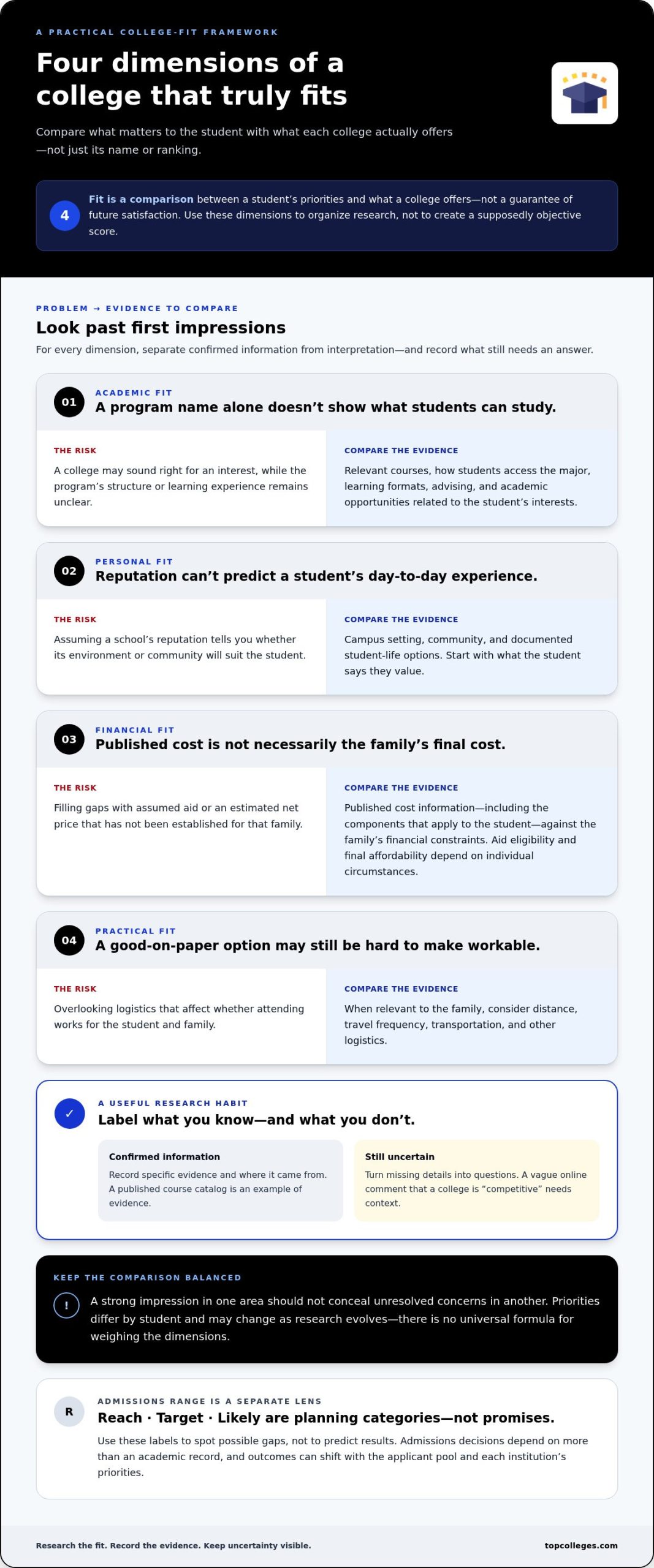
A college’s fit is easier to assess when you separate the impression it creates from the practical evidence behind it. Compare each candidate across four dimensions: academic, personal, financial, and practical. A student might prioritize a particular major and learning environment; another may give greater weight to affordability or distance from home. There’s no universal formula, and priorities may change as the student learns more.
College fit is a comparison between a student’s priorities and what a college offers, not a guarantee of future satisfaction. Use the dimensions to organize research, not to produce a supposedly objective score. A strong impression in one area shouldn’t conceal unresolved concerns in another.
Academic and personal fit: what will daily life look like?
Look beyond a program’s name. Review course offerings, how students access the major, learning formats, advising, and academic opportunities relevant to the student’s interests. Then consider the environment outside class: campus setting, community, and student life. Start with what the student says they value instead of assuming a school’s reputation predicts their experience.
Separate confirmed information from interpretation. A published course catalog is evidence; a vague online comment about a college being “competitive” needs context before it shapes a decision. Record what you know, where the information came from, and what remains uncertain.
Financial and practical fit: can this option work for the family?
Compare each college’s published cost information, including the components that apply to the student, then weigh those figures against the family’s financial constraints. Published cost isn’t necessarily what the family will ultimately pay: aid eligibility and final affordability depend on individual circumstances. Don’t fill gaps with assumed aid or an estimated net price that hasn’t been established for that family.
Practical fit deserves the same attention. Depending on the family, distance, travel frequency, transportation, or other logistics may affect whether attending is workable. These aren’t universal priorities; evaluate them when they matter to the student.
Use a simple comparison grid for every college. Keep evidence specific, and turn missing information into questions to resolve:
- Academic: Evidence: relevant courses, program structure, learning opportunities. Unresolved question: does the curriculum support the student’s current interests?
- Personal: Evidence: campus setting and documented student-life options. Unresolved question: does the environment match the student’s stated preferences?
- Financial: Evidence: published cost information and family constraints. Unresolved question: what remains uncertain about affordability for this family?
- Practical: Evidence: distance and relevant travel or logistical details. Unresolved question: can the student and family manage those demands?
As you build a balanced college list, weight each dimension according to the student’s circumstances rather than forcing every school into the same scorecard. If comparing priorities feels difficult, personalized college admissions guidance can help families turn them into a coherent application plan.
Reach, Target, and Likely Colleges: Build Range Without False Certainty
Admissions categories can help families see whether a list leans too heavily toward one kind of possibility. They aren’t forecasts. A student’s academic record matters, as can applicant context, institutional priorities, and the composition of a changing admissions pool. Treat each label as a working assessment based on available information, not a statement about what will happen.
How to interpret reach, target, and likely categories
The terms describe how an option appears relative to a student’s profile, not a fixed level of safety. A school’s category can vary from one applicant to another, and even a careful assessment can’t guarantee an outcome.
Reach
Admission may be more uncertain for this applicant, based on the college’s selectivity and the student’s academic context. A reach can still be worth considering if the school is a genuine fit.
Target
The student’s profile may align with the college’s stated academic expectations, making it a relative planning category. It isn’t a prediction, and admission isn’t assured.
Likely
Admission appears comparatively more plausible for this student than at other options on the list. “Likely” never means guaranteed.
These categories shouldn’t dictate a universal count or ratio. A student’s mix depends on their academic record, priorities, and the colleges under consideration. For a school with limited or specialized admissions data, the label may be especially tentative. Note the reasoning behind each assessment and the information supporting it. That makes the classification easier to revisit as research improves.
Why admissions categories should not replace fit
A category describes admissions range, not whether a college is a good choice. Don’t keep a school solely to fill a “likely” slot if its program doesn’t serve the student’s goals, the environment feels wrong, or the family can’t see a workable financial path. A lower-risk label has little value if the option itself isn’t credible.
Apply the same fit questions to every category. Does the college offer relevant academic opportunities? Can the family assess affordability using its own circumstances, rather than assuming aid will close a gap? Would the student genuinely consider attending? A reach still needs to justify its place on the list, and a likely school deserves the same scrutiny as any other candidate.
Keep the underlying information current. Admissions profiles and institutional priorities can change, and data from an earlier cycle may not reflect the applicant context a student faces now. Check the year and source of any figures used to classify a college. If the evidence is outdated, incomplete, or based mainly on anecdotes, mark the category as provisional and reassess it rather than treating an old estimate as fact.
That discipline is central to building a balanced college list: categories help reveal range, while fit determines whether each option belongs. Use them together, but don’t confuse a label with certainty.
How to Build and Stress-Test Your College List Step by Step
A useful list takes shape through deliberate passes, not a burst of browsing. Begin with the student’s priorities, then test each college against evidence, admissions context, and family needs. A strong college list is reviewed, not assembled in one sitting. This process shows why each school belongs and what still needs attention before applications begin.
From priorities to a first draft
Start by separating non-negotiables from preferences and flexible factors. A student might require a particular academic program, prefer a certain campus setting, and remain flexible about distance. Use those distinctions to create an initial pool of colleges worth researching. Educational research tools like GetEducated.com can help families compare degree pathways and programs across institutions. Check current institutional information, including program details and application requirements, rather than relying on a name or secondhand impression.
Then move through these steps:
- Clarify priorities. Ask the student to name what matters most academically, personally, financially, and practically.
- Research candidates. Look for colleges that align with those priorities and note the source and date of key information.
- Assess fit. Identify the evidence supporting each school’s fit, along with any mismatch or unknown.
- Assign a provisional admissions range. Use the student’s academic context and current admissions information to make a tentative reach, target, or likely assessment.
- Review the whole list. Look for gaps, redundant choices, unresolved family concerns, and schools that no longer seem compelling.
Record findings in a simple grid. Keep each note concise enough to compare, but specific enough to explain the decision:
College
[Name of candidate school]
Priorities
[Which student priorities does it meet? What evidence supports that?]
Admissions context
[Provisional range and the current information behind that assessment]
Cost research
[Published cost information reviewed; family questions or constraints]
Open questions
[What must be researched, discussed, or clarified before deciding?]
Repeat the grid for each candidate. If a choice is supported only by reputation, instinct, or an undated online comment, treat that as a prompt for more research, not a settled reason to apply.
Pressure-test the list before applications
Before finalizing, remove any college the student wouldn’t seriously consider attending. Then ask whether the remaining options offer meaningful variety in admissions uncertainty and in the qualities the student values. A list can span reach, target, and likely categories yet still be weak if the schools share the same drawbacks or fail to meet essential priorities.
Revisit cost research with the family’s circumstances in view. Published costs don’t establish what a particular family will pay, and unanswered affordability questions deserve discussion before applications are underway. Review the grid as interests, information, or constraints change. Personalized college admissions counseling can help families translate those priorities into a coherent application plan.
Refine the College List Into a Coherent Application Strategy
A college list isn’t fixed once the first round of research is complete. A student may discover a new academic interest, learn more about a program, or reconsider what kind of environment would help them thrive. Family constraints can also shift. Revisiting choices in response to meaningful new information is sound planning, not indecision.
When should a student revisit the list?
Reassess a college when the reasons for including it no longer hold or new research changes the picture. If a student’s interests move from a broad subject to a specific field, review whether each college offers relevant coursework and opportunities. If family circumstances change, return to the affordability and practical questions instead of relying on earlier assumptions.
Before applying, check each institution’s current application requirements and deadlines directly with the college. Don’t add or remove schools simply because a ranking changed or peers are applying there. Ask instead: does this option still align with the student’s priorities, and can the family explain why it remains on the list?
Make the list and application materials tell one coherent story
Each college should connect to a considered application plan. A student interested in a particular academic area can research programs, identify what genuinely draws them to each institution, and use that understanding to prepare thoughtful application materials. This doesn’t mean creating a different identity for every school. The student’s interests and experiences should guide preparation while remaining consistent with who they are.
Personal statements should reflect the student’s own perspective, choices, and lived experiences. The list can help clarify which details matter to the student, but it shouldn’t dictate a manufactured narrative or turn essays into sales pitches. As students plan their writing, a college essay strategy guide can help them approach essays with intention while preserving an authentic voice.
Families looking to connect list decisions with the broader application process can also consult this college admissions counseling strategy guide. Keep the rationale clear: why this college, why this program or environment, and what information supports the choice? Revisiting those questions helps students adapt their plans without losing sight of their priorities.
Building a balanced college list is an evolving process. Personalized support can help students and families bring changing priorities, school research, and application preparation into one thoughtful plan.
Turn Your College List Into a Confident Next Step
The purpose of building a balanced college list isn’t to eliminate uncertainty. It’s to give the student a clear, considered foundation for moving forward, one that can adapt as interests develop and new information emerges. The next step is purposeful preparation: understand what matters to each institution and how the student can present their strengths honestly.
For families seeking structure, personalized college admissions counseling led by Steven Roy Goodman can connect list decisions with the wider application process. Guidance includes portfolio development, personal statement review, and interview preparation, shaped around the student’s individual goals. The aim is thoughtful planning, not a promised admissions result.
A well-considered plan gives students room to make informed choices and approach applications with greater clarity. Explore personalized college admissions guidance to connect your student’s priorities with a thoughtful application plan.
Frequently Asked Questions
How many colleges should be on a balanced college list?
There’s no universal number; the right list is one the student can research carefully and apply to thoughtfully. When building a balanced college list, consider how much time each application will require, including school-specific writing, recommendations, and portfolio materials where relevant. A student with demanding application requirements may need a more focused list than someone whose applications share components. Add a college only when there’s a clear reason it belongs.
What is the difference between a reach, target, and safety college?
These are informal labels for how uncertain admission may be for a particular applicant. A reach may be less predictable, a target may appear more aligned with the applicant’s context, and a likely option may seem comparatively more plausible. None promises an outcome. Review current information and consider the full application context, including program-specific requirements. A college’s label can differ across applicants, so don’t treat a category as a fixed property of the school.
Can a college be both a reach and a good fit?
Yes. Fit and admissions uncertainty answer separate questions. A student may be drawn to a college’s course offerings, learning environment, or campus setting while still facing an uncertain admissions decision. Keep those assessments separate in your notes: one records why the college appeals to the student, and the other reflects how admission appears in context. That distinction helps families stay realistic without dismissing a compelling option or relying on it as the only appealing choice.
Should students include a college they would not attend as a safety?
No. A comparatively likely option should still be somewhere the student would seriously consider attending. Before keeping it, ask the student to identify a specific academic or personal reason they’d choose it, then discuss whether the family can see a workable financial path. If neither answer is convincing, look for another option that offers a stronger reason to apply. A category label alone doesn’t make a college a meaningful choice.
When should families start building a college list?
Start early enough to explore interests before application tasks take priority, with timing shaped by the student’s grade, goals, and circumstances. An early conversation might focus on subjects the student enjoys and what they want daily campus life to feel like, rather than immediately naming schools. As interests develop, research can become more specific. Later, verify deadlines and requirements on each college’s official materials, since application details can differ.
Should college rankings determine which schools make the list?
No. Rankings can provide context, but they can’t establish whether a college suits a particular student. For example, a student comparing two programs can review course sequences, academic opportunities, and learning formats instead of relying only on overall position. Families can also record why a school appeals and what evidence supports that judgment. This makes it easier to distinguish a real preference from a name that simply carries prestige.
How often should students update their college list?
Review the list whenever a meaningful change could affect a decision, such as a new academic interest, a clearer understanding of a program, or a shift in family circumstances. A scheduled check-in during research and again before applications can help catch assumptions that no longer hold. Keep a brief note explaining why each school remains under consideration. Don’t revise simply because friends chose different colleges or a ranking moved.