

Disclaimer
Content on this page of topcolleges.com is computer generated and therefore is not guaranteed to be 100 percent accurate about various aspects of the education sector. On balance, however, many students and families seek general information about high schools, colleges and universities, graduate programs, testing, education and career planning, and job placement before beginning one-on-one admissions counseling tailored to their specific needs.
What if the most expensive college consulting option isn’t the best fit for your student? Asking “how much do college consultants cost 2026” is a sensible starting point, but a fee only means something when you understand the strategy, scope, and student needs behind it.
Comparing services can be difficult when one option focuses on a specific application task and another offers guidance across a broader admissions journey. Families want to avoid paying for support their student doesn’t need, or mistaking impressive promises for clear, useful work.
This guide explains what shapes college consulting fees and how to compare hourly guidance, targeted support, and broader strategic engagements by what they cover. You’ll also learn how to weigh a student’s goals, timeline, and application needs when deciding what level of support makes sense. Top Colleges offers personalized counseling that can include portfolio development, personal statement review, and interview preparation. The right choice is not necessarily the most extensive engagement. It’s the one whose scope aligns with your family’s priorities.
Key Takeaways
- There’s no single standard fee: consulting costs reflect the scope of personalized guidance and the application decisions it covers.
- Use how much do college consultants cost 2026 as a starting question, then compare the actual work included rather than package names or headline fees.
- Separate college-list and application strategy from focused support such as personal statement feedback and interview preparation.
- Decide what your student needs with a four-step process: identify needs, prioritize tasks, compare scope, and assess fit.
- Top Colleges, led by Steven Roy Goodman, provides personalized admissions counseling and portfolio development aligned with students’ goals.
Why Do College Consultant Costs Vary So Much in 2026?
There’s no single standard fee for college admissions consulting because the scope of guidance differs. Consulting can mean paid, personalized support with one application decision or guidance across a broader process. A family seeking feedback on one personal statement is asking for a different level of involvement than a family seeking support with college choices, application planning, portfolio development, and interviews.
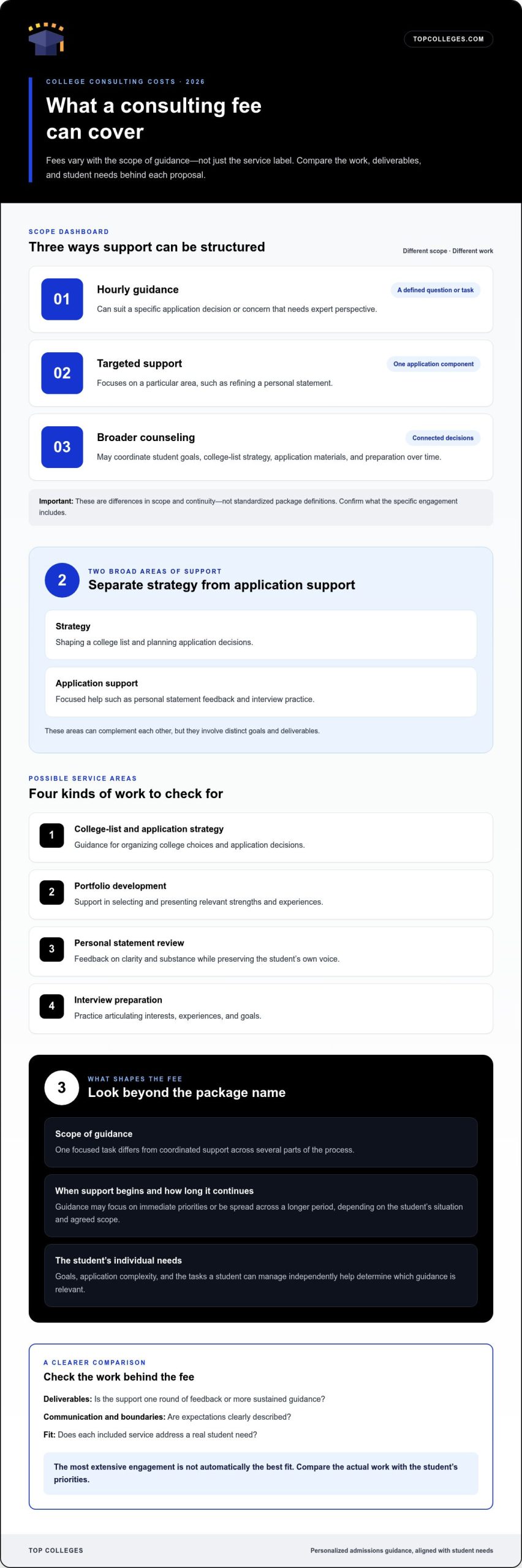
A college consulting fee reflects the scope of guidance, when it begins and how long it continues, and the student’s individual needs. That’s the most useful framework for considering how much do college consultants cost 2026: instead of looking for one universal benchmark, examine what a particular engagement is designed to do.
What does a college consultant’s fee generally reflect?
A fee generally accounts for professional time, expertise, and the agreed scope of guidance. A focused engagement might center on reviewing a personal statement or preparing for an interview. Broader support can involve helping a student clarify application priorities, develop a portfolio, and coordinate several parts of the process. These are different kinds of work, even if both are described as admissions consulting.
Deliverables matter as much as the service label. “Personal statement support,” for example, could mean one round of feedback or more sustained guidance as the student revises a draft. Likewise, “application help” might refer to a defined task or a wider strategy. Look for a clear description of the work, communication, and boundaries. Don’t assume what’s included based on a package name.
Why can two families receive different fee proposals?
Students don’t begin from the same place. One may have clear goals and need focused feedback on a particular application component. Another may still be working out how to present their interests, organize a portfolio, or coordinate multiple application requirements. The student’s goals and the complexity of the work shape what guidance is relevant.
The number and type of services also affect scope. A family seeking help with one essay is considering something narrower than a family seeking coordinated guidance across planning, statements, portfolio development, and interview preparation. More areas of support can require more professional time and a different working structure, but broader isn’t automatically better. The useful question is whether each element addresses a real need.
Timing matters, too. A student who begins with time to plan may organize guidance differently from one who seeks help close to an application deadline. Work may focus on immediate priorities or be spread across a longer period, depending on the student’s situation and agreed scope.
Before comparing proposals, write down the decisions where your student needs expert perspective and the tasks they can manage independently. Then compare each proposal against that list. This makes it easier to see whether an engagement is appropriately focused or broader than your priorities require. The aim isn’t to purchase the most extensive support available. It’s to identify guidance that addresses the student’s needs, with deliverables and expectations clearly understood.
What College Admissions Consulting Services Can a Fee Cover?
A consulting fee can cover one point of guidance or several connected parts of the application process. The service label alone won’t tell you which. One engagement may focus on a defined task, while another coordinates planning and application decisions over time. For families asking how much do college consultants cost 2026, understanding the work behind a fee is more useful than assuming every engagement includes the same services.
It helps to separate two broad areas: strategy, such as shaping a college list and planning applications, and application support, such as personal statement feedback and interview practice. These areas can complement each other, but they involve distinct goals and deliverables.
How do hourly, targeted, and comprehensive models differ?
Hourly guidance can suit a defined question or task, such as discussing an application decision or reviewing a specific concern. A targeted engagement focuses on one application component, such as refining a personal statement. Broader counseling coordinates support across multiple decisions, potentially connecting a student’s goals, college-list strategy, application materials, and preparation. These describe differences in scope and continuity, not standardized package definitions, so the work included can vary.
Which application services might be included?
Common service areas include college-list and application strategy, portfolio development, personal statement review, and interview preparation. Portfolio development can help organize an applicant’s strengths and experiences into a clear presentation. Statement review offers feedback on clarity and substance while preserving the student’s own voice. Interview preparation helps students practice articulating interests, experiences, and goals. An engagement may address one area or bring several together, depending on the student’s needs and agreed scope.
- College-list and application strategy: Guidance for organizing choices and application decisions.
- Portfolio development: Support in selecting and presenting relevant strengths and experiences.
- Personal statement review: Feedback to sharpen communication without replacing the student’s perspective.
- Interview preparation: Practice expressing interests, experiences, and goals with clarity.
What’s the difference between one-time advice and continuing guidance?
A one-time consultation can help a student think through an immediate question, while continuing guidance can provide context across stages of the process. The difference isn’t simply the number of meetings. With continuing support, advice on one decision may inform the next; a focused review addresses a specific need. Clarify the intended deliverables, communication, and boundaries so you can see how the support fits your priorities.
For a closer look at how counseling can connect individual application tasks with broader planning, explore this strategic blueprint for college admissions counseling. Families considering personalized guidance can also learn about Top Colleges’ admissions counseling, which aligns support with an applicant’s goals and needs.
How Can Families Compare College Consultant Fees and Value?
To answer how much do college consultants cost 2026 in a way that helps your family, compare the work behind each proposal, not just the total fee. Two engagements with similar labels may differ in which application tasks they address, how feedback is delivered, and where the consultant’s role ends. Put the options side by side and compare equivalent support.
What should families compare beyond the stated fee?
Start with the student’s priorities, then examine how each proposed engagement addresses them. A useful comparison makes clear which tasks the consultant guides and which remain the student’s responsibility. Check whether support covers one application component or coordinates several decisions. Also clarify how feedback is delivered and how progress discussions are structured.
| Scope | Deliverables | Communication | Engagement boundaries |
|---|---|---|---|
| Focused review of a specific application task | Feedback or guidance on the defined task | Clarify how feedback is shared and discussed | Identify what is outside the task, such as other application materials |
| Targeted support for one application component | Guidance related to that component, such as a personal statement | Understand how questions and revisions are handled | Confirm whether broader planning or other materials are separate |
| Coordinated support across multiple application decisions | Strategy and guidance across the agreed areas of work | Clarify how progress is reviewed and priorities are revisited | Define the areas covered and the student’s responsibilities |
Use the same questions for each proposal. Compare personal statement feedback with personal statement feedback, for example, rather than weighing it against broader application strategy. A package name or headline fee can conceal meaningful differences in scope. Specific deliverables make those differences visible.
How can families assess value without expecting guarantees?
Admissions counseling can strengthen preparation, clarify choices, and help a student develop more thoughtful applications. It cannot control an institution’s decisions. A responsible comparison focuses on the quality and relevance of the work, not a promised admission result. Set objectives the student and consultant can work toward, such as identifying application priorities or communicating experiences more clearly.
Student participation matters, too. Guidance is most useful when the student is prepared to reflect, respond to feedback, and take ownership of application tasks. Consider whether the proposed communication style fits the student and whether the work addresses a genuine need. A broader scope may be useful if several decisions need coordination; a focused service may be enough when the student’s needs are specific.
Value depends on fit, clearly defined work, and the student’s active participation. That’s a more reliable standard than judging support by its label or expecting it to secure a particular outcome. Families exploring personalized college admissions counseling can use these same criteria to focus on guidance aligned with the student’s goals.
How Should You Decide What Level of College Consulting You Need?
The right scope starts with the student, not a package label. Before comparing fees, identify where guidance could make a meaningful difference and what the student can handle independently. This needs-first approach helps families avoid paying for support that doesn’t match their priorities, while recognizing when several application decisions may benefit from coordinated attention.
Use this sequence to define the level of support you’re considering:
- Identify needs. List the decisions or application components where the student feels uncertain or would benefit from an outside perspective.
- Prioritize tasks. Separate areas where guidance is important from tasks the student can manage with family support or independently.
- Compare scope. Match those priorities to the proposed work, deliverables, and communication structure.
- Assess fit. Consider whether the approach aligns with the student’s goals, timeline, and readiness to participate.
This sequence gives families a practical way to approach how much do college consultants cost 2026 without assuming that more support is automatically better. A student who needs help organizing application choices may have different priorities from one who mainly wants feedback on a personal statement.
How can you identify the right scope before comparing fees?
Start with a short list of the student’s most pressing needs. Are they looking for structure around application decisions, or feedback on specific materials? Distinguishing strategic planning from targeted review makes the intended scope easier to define. Prioritize the areas where guidance could be useful rather than assuming full-service support is necessary. If essay development is a priority, this college essay strategy and portfolio guidance can help clarify the work involved.
What questions clarify the engagement and expectations?
Before settling on a scope, make sure the proposed work, boundaries, and roles are clear. Use the questions below to assess whether the approach fits your priorities and supports the student’s ownership of the process:
- Which deliverables are part of the proposed scope, and which tasks remain the student’s responsibility?
- How will the student participate in discussions, revisions, and decisions?
- How will family communication work while preserving the student’s active role?
- Does the approach fit the student’s goals and the timing of upcoming application tasks?
These conversations can reveal a mismatch early. For example, parents may want close oversight while the student expects to lead independently. A clear understanding of roles helps shape support that encourages responsibility rather than taking over the process. Strong counseling should guide the student’s thinking and preparation, not substitute for their perspective or effort.
Once priorities and expectations are clear, families can compare options based on relevant work instead of broad labels. The aim is a well-defined level of guidance that responds to the student’s needs and leaves room for them to take ownership.
How Does Top Colleges Tailor Admissions Counseling to Student Needs?
Top Colleges is an educational consulting firm led by Steven Roy Goodman. The firm provides personalized college and graduate admissions counseling for U.S. and international students. Its guidance can be shaped around an applicant’s goals and application needs, rather than treating every student as if they need the same level of support.
That distinction matters for families asking how much do college consultants cost 2026. A useful discussion starts with the student’s priorities and the areas where guidance could help, not with an assumption that every applicant needs the same services. Portfolio development, personal statement review, and interview preparation address different parts of the application process, and each can be considered in light of the student’s needs.
What does personalized admissions guidance help students work through?
Good planning begins with reflection: What does the student hope to pursue? Which experiences help communicate their interests? Which application decisions need thoughtful attention? Counseling can help students organize those questions into priorities. That strategic perspective can connect individual application components while keeping the student’s goals at the center.
Portfolio development can help organize relevant experiences and strengths into a coherent presentation. Personal statement review offers feedback on how clearly a student communicates their perspective, while interview preparation helps them articulate their interests, experiences, and goals. These are distinct forms of support, and the right focus depends on the student’s application needs.
The student remains the author of their materials and the decision-maker throughout the process. Counseling should help a student reflect, assess feedback, and express their own ideas, not replace their voice or make their choices for them. The aim is informed preparation, not a promised admissions outcome.
What is a practical next step for families considering counseling?
Before exploring an engagement, parents and students can each name their priorities. The student might identify a need for structure around application decisions or feedback on a personal statement. Parents might want to understand how support fits the student’s goals and timeline. Comparing those perspectives can help the family frame a useful conversation about scope, roles, and the student’s active participation.
Bring those priorities into the discussion. A focused request can help clarify whether the student needs guidance on a particular application component. Needs spanning several decisions may call for a more coordinated conversation about support. In either case, be specific about what the student hopes to work on and what they’re ready to manage themselves.
For families considering guidance that aligns application support with a student’s individual priorities, explore Top Colleges admissions counseling.
Make Your Next Step a More Informed One
The best next move isn’t necessarily to commit to the broadest level of support. Start with a candid conversation at home about what the student wants to manage independently, where guidance would be useful, and what a productive working relationship should look like. Those priorities can turn the question of how much do college consultants cost 2026 into a more practical one: what kind of guidance will help this student prepare thoughtfully?
With that perspective, families can approach admissions counseling as a considered decision rather than a purchase driven by uncertainty. The student’s goals and active involvement should remain central, and any support should help them move forward with greater clarity, not promise a particular admissions result.
A clear, student-centered plan can make the path ahead feel more manageable. Begin with the priorities that matter most, then explore personalized admissions counseling with Top Colleges.
Frequently Asked Questions
How much do college consultants cost in 2026?
There’s no single standard fee because consultants differ in scope, service model, and level of involvement. To understand how much do college consultants cost 2026, compare what each proposed engagement covers rather than relying on a headline figure. A review of one application component, for example, isn’t equivalent to guidance across several decisions. The appropriate scope depends on the student’s needs and application priorities.
What factors affect the cost of a college admissions consultant?
Fees can reflect the services included, the amount of guidance, how the engagement is organized, and how long support is needed. A student’s circumstances and the consultant’s expertise may also shape a proposal. None of these factors alone proves that one option is better. Compare the specific work and responsibilities involved. A student seeking feedback on one application component has different needs from one seeking help with several distinct tasks.
Is hiring a college admissions consultant worth it?
It can be worthwhile when the guidance addresses a real need and the student is ready to participate. Counseling may bring structure to planning, offer a strategic perspective, or provide feedback on application materials, but it can’t control admissions decisions or guarantee acceptance. Consider a practical objective, such as helping the student organize priorities or communicate experiences more clearly. Assess the expected work realistically, not by a promised result.
Are college consultants paid hourly or through packages?
Consultants may structure engagements around hourly guidance, targeted services, or broader packages, and terms vary. A focused session might address a specific question, while coordinated support can span several application components. Neither model is automatically the better choice. Compare the work included, what falls outside the engagement, and how communication is handled. A clear description helps families understand whether the format matches the student’s needs.
Does college consulting include essay writing or test preparation?
Service scope varies. Essay guidance can involve discussing ideas and giving feedback on a student’s draft; writing an application essay on the student’s behalf is different and doesn’t preserve the student’s authorship. Test preparation is a separate service from admissions counseling. If a student needs help with both application planning and exam preparation, treat them as distinct needs and compare each service with the support it actually provides.
When should a family hire a college admissions consultant?
The right time depends on the student’s goals, readiness, and the application areas where guidance would help. Earlier planning may leave more room to reflect on priorities and organize materials. Focused support can also address an immediate need, such as preparing to discuss application experiences in an interview. Rather than follow a universal starting point, identify upcoming deadlines and the student’s priorities, then match the scope of guidance to that timeline.
Can a college consultant guarantee admission to a specific school?
No. A consultant doesn’t control an institution’s admissions decision, so acceptance to a particular school can’t be guaranteed. A consultant can offer guidance, feedback, and strategic support within an agreed scope, helping a student approach application decisions thoughtfully. Evaluate the process and defined deliverables instead of promises about results. This keeps expectations grounded and focuses attention on the preparation the student can actively influence.