

Disclaimer
Content on this page of topcolleges.com is computer generated and therefore is not guaranteed to be 100 percent accurate about various aspects of the education sector. On balance, however, many students and families seek general information about high schools, colleges and universities, graduate programs, testing, education and career planning, and job placement before beginning one-on-one admissions counseling tailored to their specific needs.
What if your college application isn’t finished when you press submit? The mid-year report for college applications is usually an academic update, not a second application. It typically includes first-semester or first-trimester senior grades and an updated transcript, with a revised GPA or class rank when available. For regular-decision applicants and students deferred from an early round, these grades can give colleges a clearer view of academic consistency and recent progress.
It’s natural to wonder whether every college requires a report, what your counselor sends, and whether a change in grades could affect a decision. Requirements and deadlines vary by college, and a high school counselor typically submits the official report electronically once grades are available. Your role is to coordinate and track the process. This guide explains what the report communicates, how to create a college-specific submission plan, and what to do if grades have changed or school records are delayed. A clear plan helps each college receive an accurate update through the right channel.
Key Takeaways
- A mid-year report for college applications provides an official academic update, but each institution sets its own reporting expectations.
- Coordinate college requirements and deadlines with your counselor, who is responsible for transmitting official school records.
- Use a college-by-college checklist to identify whether each school requires, requests, or doesn’t expect a report.
- If grades or records are delayed, review instructions, contact your counselor, monitor application portals, and follow up through the appropriate channel.
- Consider updated grades alongside course rigor, prior performance, and academic interests. The report adds context, but it can’t predict an admissions decision.
What Is a Mid-Year Report for College Applications?
After submitting applications, students often have practical questions: Are first-semester grades ready? Has the school sent an updated record? Does each college expect the same materials? The answers depend on the high school calendar and the colleges on the student’s list. Knowing what the report is for makes it easier to plan the next steps.
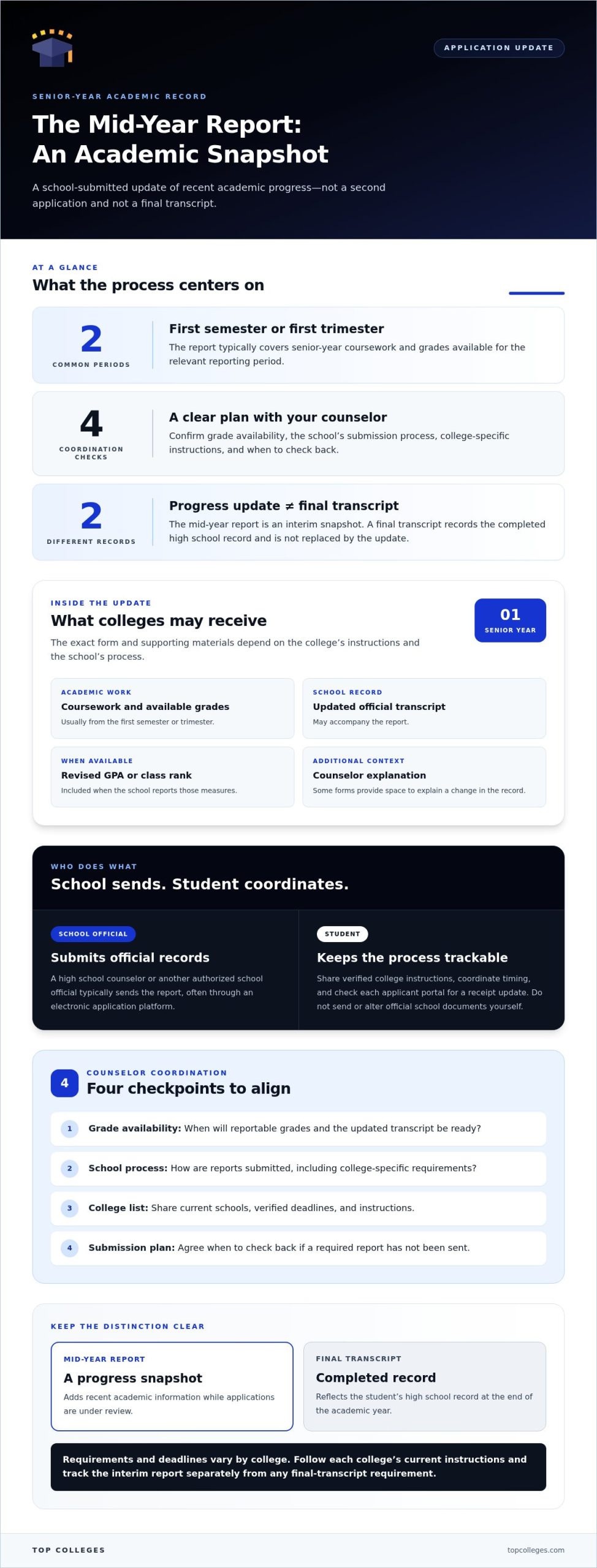
A mid-year report is an academic update that a high school counselor or other authorized school official typically sends after first-semester or first-trimester grades become available. It gives colleges current information about an applicant’s senior-year performance. It generally follows the initial application and is separate from the final transcript. Colleges set their own requirements and instructions, so don’t assume every school requests or processes the report in the same way.
The report gives admissions readers additional evidence as they review an application, including whether a student’s academic performance has remained consistent or changed during senior year. It adds to the application rather than replacing what the student has already submitted. For a broader overview of how application materials fit into College admissions in the United States, remember that colleges assess multiple elements of a student’s record rather than treating one update as the whole story.
What information does a mid-year report usually provide?
The report typically covers coursework and grades available for the relevant reporting period, often the first semester or trimester of senior year. An updated official transcript may accompany the school’s form. GPA or class rank may also be included when the school reports those measures.
Some forms give a counselor space to explain a change in the student’s record or provide updated context. The exact fields and supporting materials depend on the college’s instructions and the school’s process. Use the common elements as a guide, then follow the specific directions for each college.
How is it different from a final transcript?
A mid-year report is a progress update. It gives colleges a view of academic work completed so far while applications are under review. A final transcript reflects the student’s completed high school record at the end of the academic year.
The report doesn’t replace a final transcript if a college requires one. The documents serve different purposes and may be sent at different points, depending on the college’s instructions and the school calendar. Track both requirements so an interim update isn’t mistaken for the complete end-of-year record.
In practical terms, think of the mid-year report as a snapshot, not a second application or a final certification of graduation. It helps colleges assess new academic information in context while they continue reviewing the file. First, determine which colleges expect the update, then coordinate its delivery with the school.
Who Sends the Mid-Year Report, and What Should Students Coordinate?
The school handles official transmission. In most cases, a high school counselor or another authorized school official submits the mid-year report and any required school records, often through an electronic application platform. Students shouldn’t send or alter official school documents themselves. Their responsibility is to make the process clear and trackable: identify which colleges need an update, share the relevant instructions with the counselor, and monitor whether each college records the report as received.
Coordination matters because grade-release dates, school procedures, and college instructions can differ. An applicant portal is a useful reference, but it shouldn’t replace the college’s current application instructions. A thoughtful college admissions counseling strategy can help students align school-submitted updates with the broader application plan. For individualized support, explore college admissions counseling.
What should students ask their school counselor?
Start early enough to account for the school calendar. Confirm when first-term grades are expected to become official and when the school plans to submit reports. Then ask how the counselor handles colleges with different forms, portals, or submission instructions. Give the counselor an accurate college list with relevant deadlines and verified directions, and flag any timing constraints. One clear, consolidated request is easier to manage than a series of scattered updates.
- Grade availability: Confirm when reportable grades and the updated transcript will be ready.
- School process: Ask how the school submits reports and handles college-specific requirements.
- College list: Share your current list, including additions or changes, along with verified deadlines and instructions.
- Submission plan: Agree when to check back if a required report hasn’t been sent.
Be precise when sharing details. If a college’s portal uses a different label from the school’s form, provide both descriptions rather than assuming they refer to identical materials. This helps the counselor match the request to the college’s instructions without asking you to transmit official records.
How can applicants track delivery without sending duplicates?
After the school submits the mid-year report for college applications, check each applicant portal for a receipt update. A missing status doesn’t necessarily mean the report wasn’t sent; school and college systems may not update at the same time. Allow reasonable processing time, then follow the college’s stated process if the item remains outstanding. Before asking the counselor to resend anything, confirm the original submission status.
A simple tracking record can prevent crossed messages. For each college, note what it requires, who at school is handling the request, the expected grade-release date, the submission date, and the portal status. Update the record when the college confirms receipt or provides new instructions.
- Check each college’s current instructions and applicant portal.
- Confirm the school’s expected grade and submission dates.
- Record submission and receipt status for each required update.
- Follow up through the appropriate channel if the portal remains unclear after processing time.
Is a Mid-Year Report Required for Every College?
No. Reporting requirements and practices vary by college and, in some cases, by application plan. One school may require an official update, another may request one, and a third may not ask for it. Don’t treat a friend’s experience or a general rule of thumb as a policy for your entire college list.
Verify the mid-year report requirement separately for every college, because each institution sets its own instructions and may handle updates differently. Review the admissions website and your applicant portal, and use the most current directions from each institution. If instructions aren’t clear, seek clarification through the college’s stated admissions contact process before asking your school to send anything.
| Status | How to interpret it | Practical response |
|---|---|---|
| Required | The college explicitly says applicants must submit a mid-year report or updated school record. | Note the deadline and submission instructions, then coordinate with your counselor. |
| Requested | The college asks for the report, often as part of its review process. | Follow the directions and confirm who is responsible for sending it. |
| Not requested | The college’s current instructions say the report isn’t needed, or don’t invite this update. | Don’t assume an extra submission will help. Follow the stated policy. |
| Unclear in portal instructions | The portal doesn’t make the requirement or status clear. | Compare it with the admissions website and request clarification through the college’s designated channel. |
An unrequested report isn’t automatically an advantage. Extra material may not be part of the college’s review process, and sending documents outside the stated instructions can create avoidable confusion. An update is most useful when it reaches the institution in the format and manner it accepts. Treat the report as a targeted application update, not a document to send everywhere simply because it exists.
How should applicants interpret different college instructions?
Read the exact wording. “Required” signals a condition to fulfill; “requested” means the college is asking for the material. An optional upload isn’t the same as a requirement, and no mention of a report doesn’t prove that one is welcome. Check both the admissions website and portal, since the portal may show materials specific to your application. Another applicant may have different instructions.
What if one college requests a report and another does not?
Manage each college separately. Give your counselor a college-by-college list with each school’s status, deadline, and submission directions instead of requesting one blanket submission to every institution. Ask the counselor to follow the process for each college. Don’t send repeated or unsolicited records contrary to a school’s instructions. If a policy is ambiguous, clarify it before submitting anything.
A tracking sheet can keep requirements distinct. Record the source and date of each instruction, whether the report is required or requested, and the next action. Revisit the college’s directions before submission in case they’ve changed. This keeps the school’s work focused and helps ensure each application file receives only the updates its college has asked for.
What Should You Do About Timing, Delays, or Changed Grades?
School calendars don’t always align with college review timelines. First-semester grades may be released on different dates, and colleges set their own instructions for receiving updates. A delay calls for clear coordination, not guesswork. Don’t submit estimated grades as official information or assume a report has been sent before the school confirms it.
Use this sequence to manage the mid-year report for college applications:
- Review each college’s current instructions. Confirm whether an update is required, how it must be submitted, and what timing guidance the college provides.
- Contact your school counselor. Ask when grades will be official, when the report can be sent, and how the school handles a college deadline that comes first.
- Monitor the applicant portal. Check for receipt or missing-material updates after the school submits the report.
- Follow up through the appropriate channel. If the report remains unaccounted for after reasonable processing time, ask the counselor to verify submission. Then follow the college’s stated process if needed.
What if semester grades are not ready by a college deadline?
Compare the college’s current instructions with your school’s expected grade-release date. If the dates conflict, ask the counselor to communicate the timing through the school’s established process. Keep the message factual: grades aren’t official yet, and the school expects to send the report when they’re available. Don’t provide estimates or describe an update as submitted until the school confirms it.
For example, if a college’s requested date arrives before the school finalizes grades, alert the counselor, share the relevant college instruction, and ask how the school will address the timing. Then monitor the portal rather than sending unofficial grades independently. This keeps the record accurate while the school manages its official submission.
How should applicants respond to a difficult grade change?
First check whether the college requests an explanation or additional material. If it does, keep your response concise, specific, and consistent with the official record. Avoid excuses, inflated claims, or unnecessary personal details. If a meaningful circumstance affected your performance, discuss it with your counselor before sending a separate update so the communication is accurate and coordinated.
A lower grade may be concerning, but a rushed explanation can create confusion rather than context. Confirm that the transcript reflects the correct grade, then identify what the college actually asks applicants to provide. If an explanation is appropriate, state the relevant circumstance plainly and include information that clarifies the academic record. Don’t speculate about how an admissions team will interpret it.
Clear, coordinated communication helps maintain accuracy when timelines shift or grades change. For individualized support placing an academic update within a broader application strategy, explore college admissions counseling.
How Can Strategic Admissions Guidance Put the Report in Context?
A mid-year report adds current academic information, but it doesn’t replace the application colleges already have. Admissions readers may consider updated grades alongside previous performance, senior-year course choices, and stated academic interests. A demanding schedule with steady results may reinforce an existing pattern; a change in grades may prompt closer attention to the wider record. Neither pattern guarantees a particular decision.
Context matters. A grade is part of a transcript, not a complete explanation of a student’s preparation, priorities, or circumstances. Consider what the update shows, what the rest of the application communicates, and whether a college asks for additional information. Don’t try to make one report carry a message that belongs in the broader application.
When might an applicant need help interpreting the update?
Individualized guidance can help when grades, course choices, or school circumstances have changed substantially and a student is unsure whether or how to address the change. The report can also be considered alongside the applicant’s broader portfolio, without repeating material already submitted. Top Colleges’ portfolio development and personal statement review can help students consider how their application materials work together.
What can individualized college admissions counseling contribute?
Personalized college admissions counseling can help families interpret new academic information within the student’s overall application strategy. This may include reviewing how current coursework and grades relate to earlier academic choices and stated interests, identifying what needs clarification, and organizing communication with the school. The goal is informed planning, not predicting how a particular admissions team will respond.
Related support can include portfolio development and personal statement review. These services help students consider how application materials work together while keeping the school’s official academic update accurate and distinct from student-authored content. For example, if a student’s senior-year course load differs from earlier plans, counseling can help identify relevant context and determine whether the college’s instructions call for student follow-up. The school remains responsible for official records; the applicant’s role is to coordinate carefully and represent changes truthfully.
Before considering the process complete, use this brief action list:
- Verify each college’s current reporting requirements.
- Coordinate timing and submission with the school.
- Monitor applicant portals for receipt updates.
- Follow each college’s instructions for any additional information.
For applicant-specific help putting new grades in the context of a broader admissions plan, explore college admissions counseling.
Turn the Update Into a Thoughtful Next Step
The mid-year report for college applications is one point in a longer process of presenting an accurate, considered picture of your academic direction. Use this moment to reflect on what your current record communicates and whether college-specific follow-up is appropriate. Clear, measured decisions can help you stay focused on the work ahead without trying to control an admissions outcome.
For families seeking perspective on how an academic update fits the broader application, personalized guidance can help bring the pieces into focus. Top Colleges is led by educational consultant Steven Roy Goodman. Its college admissions counseling includes portfolio development, personal statement review, and interview preparation tailored to the student’s application strategy.
Keep moving forward with care and confidence. A well-considered next step can help you approach the rest of the admissions process with greater clarity.
Frequently Asked Questions
Can students submit their own mid-year report to colleges?
Usually, students shouldn’t submit an official school report themselves. If a college accepts a student-submitted update or provides a separate applicant form, use that channel for the information it requests. Don’t present a personal grade summary as an official transcript. For example, if you’ve received an updated mark but the school hasn’t finalized its transcript, don’t upload the mark as though it were an official record. Ask your counselor how the school handles the official document.
What happens if first-semester grades are not available before a college’s deadline?
Check the college’s current instructions, then ask your school counselor to confirm when grades will be finalized and explain the timing through the school’s usual process. Don’t estimate grades or label a report as sent before the school submits it. If the college doesn’t explain what to do in this situation, use its designated admissions contact channel to ask how applicants should proceed. Keep the message brief and factual.
Can a mid-year report include a change in courses or class schedule?
It can reflect a schedule change if the school record or college-specific form captures that information, but the report may not provide space to explain it. Tell your counselor promptly if you’ve dropped, added, or changed a course, and ask whether the updated schedule will appear on the transcript. If the college requests an explanation, follow its instructions and describe the change accurately. Don’t assume every schedule adjustment needs a separate submission.
How should international applicants handle a mid-year report?
International applicants should follow each college’s instructions for school records and reporting periods, since academic calendars and grading systems can differ. Ask the school official who manages transcripts when the current term’s results become final and what record the school can provide. If the instructions address grading scales, document language, or translations, follow them closely. Don’t convert grades yourself or assume a school calendar maps neatly onto a U.S. semester schedule.
Do transfer applicants need to send a high school mid-year report?
Not necessarily. Transfer applications generally focus on the applicant’s postsecondary academic record, but colleges set their own requirements and may request high school records as part of an individual application. Check each institution’s transfer admissions checklist for requirements such as a high school transcript or current-term grades. If you’re still completing high school or have recently started college, clarify which academic records the college expects rather than sending extra documents unprompted.
Can a college receive a mid-year report before an application decision?
Yes. A college may receive and review an update while an application is still under consideration if its instructions call for the report and the school sends it in time. The report adds to the available academic information, but it doesn’t guarantee a particular result or determine when a decision will be made. If a decision has already arrived, follow the college’s directions before sending additional grades or asking whether it will consider them.
What should applicants do if a portal still shows a missing report?
First, check with your counselor to confirm whether the school submitted the report and on what date. Compare that information with the college’s stated processing guidance and allow time for the portal to update. If the report was sent but is still marked missing, contact the college through its designated channel with your name, application identifier, and submission date. Don’t request duplicate transmissions unless the school or college advises that another submission is needed.