

Disclaimer
Content on this page of topcolleges.com is computer generated and therefore is not guaranteed to be 100 percent accurate about various aspects of the education sector. On balance, however, many students and families seek general information about high schools, colleges and universities, graduate programs, testing, education and career planning, and job placement before beginning one-on-one admissions counseling tailored to their specific needs.
What if the strongest MBA interview answer isn’t the most polished one, but the one that makes your choices make sense? It’s natural to wonder which questions you’ll face and what the admissions committee wants to learn. Effective MBA interview preparation isn’t about memorizing perfect responses. It’s about building a clear, credible story that connects your experience, career direction, and reasons for pursuing an MBA.
This guide will help you explain why an MBA makes sense now, why a particular program fits your goals, and how your experience has prepared you for what comes next. You’ll learn to shape focused examples for behavioral questions, connect past decisions to future ambitions, and practice without sounding scripted. We’ll cover common question categories, ways to structure your answers, and how to prepare for program-specific conversations. The aim isn’t to control every moment. It’s to enter ready to listen, adapt, and engage with confidence.
Key Takeaways
- Understand how an MBA interview can reveal your communication, judgment, motivation, and interpersonal awareness beyond your written application.
- Build answers with context, your actions, results, and reflection. Choose examples that show leadership, collaboration, and learning.
- Adapt your preparation to the interview format and each school’s current instructions rather than relying on assumptions.
- Use a focused MBA interview preparation routine: research the program, practice aloud, and review your answers for clarity and substance.
- Use feedback to sharpen the connection between your experience, goals, and program fit while keeping your answers genuinely your own.
Why MBA interview preparation is part of your admissions case
Your application presents a considered account of your background. The interview adds a live conversation in which a school can explore how you communicate, make decisions, understand your motivations, and engage with other people. MBA interview preparation helps you make that conversation a coherent extension of your application, not a separate performance.
Interview preparation means clarifying the evidence behind your story so you can respond thoughtfully, not recite memorized answers. A polished but inflexible script can falter when a question is phrased unexpectedly. A clear understanding of your choices lets you answer directly and adapt. Learning about the broader context of the Master of Business Administration (MBA) can help you consider how the degree fits your development, but your interview case must explain why this step makes sense for you.
What an MBA admissions interview helps a school understand
An interviewer may ask about the reasoning behind a career decision, what you learned from a demanding project, or how you hope to contribute to a particular program. These questions reveal more than a list of accomplishments. They give the interviewer a sense of your judgment, self-awareness, communication, and ability to reflect on experience. A strong response explains what happened, why it mattered, and what you took from it.
Interview formats and evaluation practices vary by school, so don’t assume every conversation follows the same script. Review each program’s current instructions and prepare for the format it describes. Whatever the structure, treat the interview as a discussion, not a second essay or résumé recital. The interviewer already has information about your experience. Your task is to give it context, answer the question at hand, and make room for genuine exchange.
Why your interview story must align with your application
Credibility comes from coherence. Your career decisions, accomplishments, reason for pursuing an MBA, and post-MBA direction should connect in a way the interviewer can follow. Developing that self-awareness often mirrors the work done with Charlie Whalley Coaching, helping professionals clarify their executive goals and personal trajectory. That doesn’t mean every answer must repeat the same pitch. Your spoken account should add depth to the application’s central narrative and make your next step feel considered.
Use your résumé and written application as evidence, not as a script. Choose meaningful experiences and be ready to explain your specific role, the choices you made, and what changed as a result. If you describe a team achievement, for example, clarify your contribution rather than implying you led every part of the work. Then connect what you learned to the capabilities or perspective you want to develop through an MBA.
Address apparent inconsistencies directly. A change in industry, a short role, or a shift in career plans may prompt a follow-up question. Give the relevant context, acknowledge what you learned, and explain how the decision fits your current direction. Evasion can make a small question feel larger. Candor and a clear rationale help the interviewer understand the person behind the application.
Build MBA interview answers around evidence, reflection, and direction
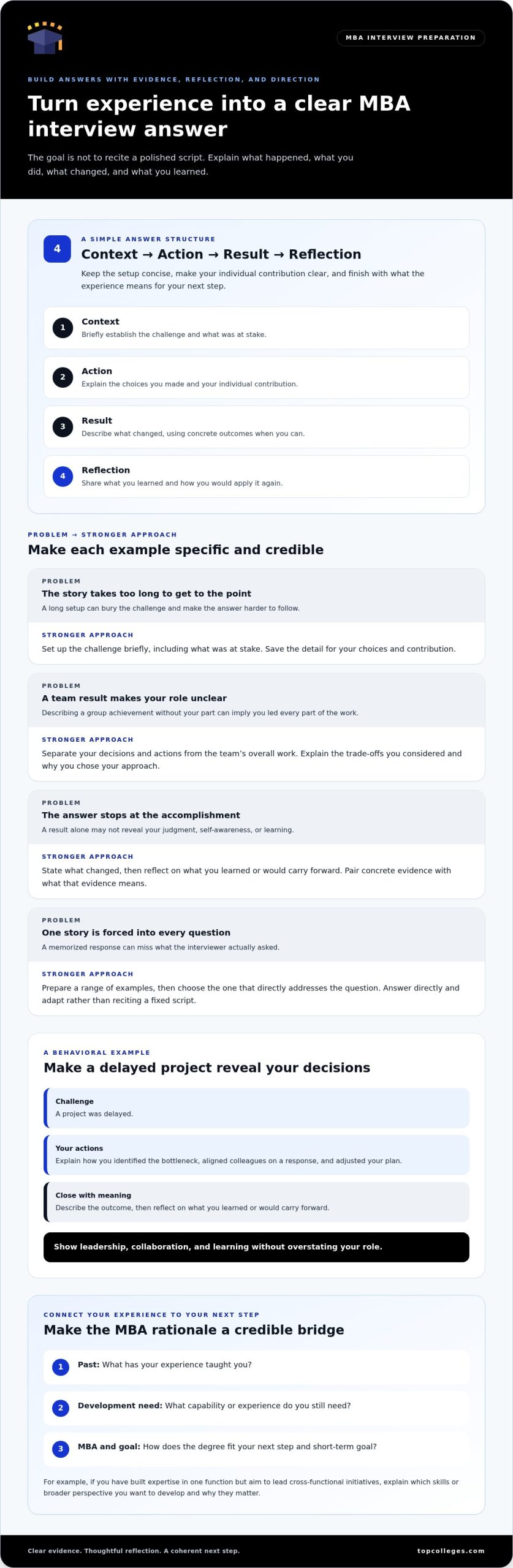
A compelling answer does more than recount an accomplishment. It shows how you assessed a situation, what you personally did, and how the experience shaped your next decision. This structure keeps your reasoning clear without making your response sound memorized:
- Context: Set up the challenge briefly, including what was at stake.
- Action: Explain the choices you made and your individual contribution.
- Result: Describe what changed, using concrete outcomes when you can.
- Reflection: Share what you learned and how you would apply it again.
Strong answers pair concrete evidence with a clear explanation of what that evidence means. That turns an anecdote into insight. Resources such as GMAC’s MBA Interview Questions can help you anticipate common themes, but your examples should come from your own experience.
Answer behavioral questions with focused examples
Choose an example that directly addresses the question and makes your role clear. If a project succeeded through teamwork, distinguish your decisions and contributions from the group’s overall work. Keep the setup concise, then focus on what you did, the trade-offs you considered, and why you chose that approach.
A story about a delayed project, for instance, becomes more revealing when you explain how you identified the bottleneck, aligned colleagues on a response, and adjusted your plan. Close with the outcome, then reflect on what you learned or would carry forward. This gives the interviewer evidence of leadership, collaboration, and learning without overstating your role. Prepare a range of examples so you can choose the best fit for each question instead of forcing one story into every answer.
Explain why an MBA and why this program
Career questions call for a credible bridge: what your past has taught you, what capability or experience you still need, and how an MBA fits your next step. Be specific about the gap. If you’ve built expertise in one function but aim to lead cross-functional initiatives—the kind of leadership capabilities often cultivated through executive coaching firms such as Simon Lead LLC—explain what skills or broader perspective you want to develop and why they matter for your short-term goal.
Connect that near-term goal to a plausible longer-term direction. You don’t need to predict every career move, but your plan should follow from your experience and priorities. Research each program with purpose. Identify learning opportunities that match your development needs, and consider how your experience could contribute to classroom discussions or the wider community. Generic praise won’t establish fit. A specific connection between your goals and the program’s offerings will.
Use this approach to guide MBA interview preparation, not to script every sentence. Practicing the reasoning behind your answers makes it easier to respond naturally when questions shift. MBA admissions consulting can provide structured feedback on your examples, goals, and program rationale while keeping your own voice at the center.
Prepare for different MBA interview formats without sounding scripted
A strong preparation strategy accounts for how you’ll be interviewed, not just what you might be asked. Schools may use one-to-one conversations, alumni-led interviews, committee discussions, group exercises, or recorded responses. These formats aren’t interchangeable, and their use can vary by program and application cycle. Read each school’s current interview instructions before practicing. Don’t assume a format used in a previous year or at another school applies to you.
The purpose of preparation is to sharpen your judgment, not manufacture a performance. Keep flexible message anchors, such as your reasons for pursuing an MBA and the contribution you hope to make, alongside a range of examples. A framework helps you stay focused. A script can make you less responsive to the conversation.
Adapt to live, video, and group interview settings
For a live one-to-one, alumni, or committee conversation, practice concise answers, listen for the question’s emphasis, and respond to follow-ups instead of rushing through a prepared speech. Alumni interviewers may have a different perspective from admissions staff, but your role remains the same: communicate clearly and engage thoughtfully.
For video or recorded interviews, follow the school’s instructions and rehearse with the setup you’ll use. Test your framing, sound, lighting, and internet connection, and practice responding within any stated time limit. In a group exercise, contribute ideas while making space for others. Build on a peer’s point, invite another perspective, and avoid treating airtime as proof of leadership.
Keep answers authentic when practice increases pressure
Practice can make you sound more natural when you rehearse ideas rather than paragraphs. Note the key points you want to convey, then answer the same question in different ways. This tests whether you understand your reasoning or have simply learned a sequence of sentences.
Pause briefly to gather your thoughts. If a question is ambiguous, ask a short clarifying question instead of guessing what the interviewer wants to hear. That shows care and composure, not a lack of preparation.
A practical rehearsal might include a behavioral question, a career-goal question, and an unexpected follow-up, asked in a different order each time. Afterward, assess whether your responses addressed the questions, sounded conversational, and left room for dialogue. Progress in MBA interview preparation isn’t about perfect wording. It’s about staying clear and credible as the exchange changes.
Use a focused MBA interview preparation plan and practice routine
Preparation is more manageable when you follow a deliberate sequence instead of trying to rehearse every possible question. This MBA interview preparation plan moves from school research to practice and final reflection, keeping your effort focused on what you can control.
- Study the program. Review its curriculum, priorities, and community. Identify learning experiences that connect to your goals and the perspective you could contribute.
- Clarify your reasons for fit. Write down why the program makes sense for your next step. Be specific about what you hope to learn and how it connects to your career direction.
- Review current interview instructions. Note the format, timing, and interviewer details where provided. Use current program information rather than assumptions or another applicant’s experience.
- Build a story bank. List experiences that illustrate leadership, collaboration, problem-solving, or learning. Note your role and the insight you gained, so you can select an example that fits the question.
- Prepare questions for the interviewer. Develop thoughtful questions about the program or community that reflect genuine curiosity. Avoid asking for information that’s readily available on the school’s website.
- Practice, review, and reset. Rehearse aloud, try timed mock conversations with follow-up questions, and record selected answers. Note what feels clear, what needs work, and what you’ll focus on next.
Run realistic practice and improve through review
Listening to a recording can reveal habits that are hard to notice while speaking, such as a long setup, an unclear point, or an answer that drifts from the question. Review for substance, not just polish. Ask whether your response is specific, coherent, concise, and responsive. Then choose one improvement for your next practice round.
Keep practice realistic but varied. Have a partner ask an unexpected follow-up, or answer a familiar question from a different angle. Include your own questions in the mock conversation, and listen closely to the responses instead of treating your questions as a closing script. The aim is readiness, not flawless delivery.
Close with a short final reflection
Before the interview, revisit your notes instead of cramming in new material. Confirm the format and logistics, choose a few message anchors, and remind yourself to listen before responding. After a practice session or the interview, record what you learned while it’s fresh. That reflection can help you refine your approach without overhauling answers that already sound like you.
Turn preparation into a composed, persuasive MBA interview
Preparation is most valuable when it helps you bring relevant evidence to the conversation and explain why it matters. You may have strong accomplishments but struggle to describe your individual contribution, or a career goal that sounds broad until you connect it to specific experience and learning priorities. Individualized feedback can help identify those gaps and align your examples, direction, and rationale with the program.
This work should strengthen your own voice, not replace it. A useful review identifies where an answer is unclear, unsupported, or overly rehearsed, then helps you make the reasoning more precise. You provide the examples and insight. The goal is not to produce someone else’s polished story, but to make your account more coherent and credible.
When personalized interview preparation can add value
Consider structured feedback if you find it difficult to explain why your goals have changed, how a past experience informs your next step, or what you personally contributed to a shared result. A listener can point out where you’ve skipped context, relied on general claims, or answered a different question from the one asked. Those observations provide a practical starting point for revision.
For example, “I led a successful project” may leave an interviewer unsure what you actually did. Feedback can help you identify the decision you made, how you worked with others, and what the outcome taught you. The facts and interpretation should remain yours. Effective preparation tests your thinking and helps you express it more clearly, rather than giving you lines to memorize.
What a strategic preparation conversation should accomplish
A focused session should leave you with a clearer central narrative and evidence to support it. Identify the experiences that best illustrate your judgment and growth, then connect them to your goals and reasons for pursuing an MBA. Your school-specific motivation deserves the same scrutiny: you should be able to explain how the program relates to your learning priorities, not simply recite its features.
Practice should also test likely themes and follow-up questions. If you explain a career pivot, for instance, be ready to discuss what prompted it, what you learned from earlier work, and why your next step follows. Refine your responses while remaining open to questions you didn’t anticipate.
End with a manageable practice plan: a few key themes to revisit, one or two answers to clarify, and a final review of program-specific details. This keeps preparation purposeful without turning it into endless rehearsal. It also connects interview readiness to the broader application strategy, so the story you tell aloud complements the choices and goals in your application.
Top Colleges, led by educational consultant Steven Roy Goodman, provides MBA admissions consulting that includes personalized interview preparation as part of a coherent admissions strategy. Explore personalized support to refine your interview approach and strengthen the connection between your experience, goals, and program fit.
Carry Your Preparation Into the Conversation
Make your preparation personal. Before your next practice session, ask yourself what you want an interviewer to understand about the choices you’ve made and what evidence would make that clear. The answer can guide your focus without narrowing your responses to a script.
Effective MBA interview preparation isn’t about controlling every exchange. It’s about entering with enough clarity to respond thoughtfully, stay present, and let your perspective come through. If your story needs greater focus, structured feedback can help you identify a useful next step.
Trust the work you’ve done, stay curious in the conversation, and take the next step with confidence.
Frequently Asked Questions
How do I prepare for an MBA interview?
Start with the school’s current interview guidance, then review your application as an interviewer might. Note claims or transitions that could invite a follow-up. Prepare brief talking points about your career choices, a challenge you handled, and what you hope to explore in the program. For effective MBA interview preparation, ask someone to pose questions in an unpredictable order. This helps you practice listening and responding rather than relying on a fixed sequence.
What questions are asked in an MBA admissions interview?
Expect questions about your background, decisions, goals, and interest in the school, though the exact mix varies by program and interviewer. You might hear, “What would your manager say is an area for growth?” or “Tell me about a decision you would handle differently now.” Prepare for follow-ups about what you personally did or learned. Reviewing your application can help you identify details an interviewer may ask you to explain.
How long should MBA interview answers be?
There’s no universal time limit for every answer. Aim to respond fully without crowding out the conversation. A straightforward factual question may need only a few sentences, while a behavioral example needs enough detail to make your role and reasoning clear. During practice, notice whether you reach the main point early or spend too long setting the scene. Follow the school’s timing instructions, especially for recorded responses.
Can I use prepared answers in an MBA interview?
Yes, prepare key ideas and examples, but avoid reciting complete answers word for word. Memorized phrasing can sound unnatural and may not fit a follow-up or a differently worded question. Identify the essential points you want to convey, then practice explaining them in more than one way. If your wording changes slightly while the facts and reasoning remain consistent, you’re preparing for a conversation rather than performing a script.
How do I answer why I want an MBA?
Explain the specific capability or perspective you want to develop, why it matters for your next career step, and why this is the right time. Avoid relying on broad claims such as wanting to “grow as a leader.” For example, describe a responsibility you’ve taken on, where you see a gap in your preparation, and how further study could help address it. Ground your rationale in your experience, not only in general praise for the degree.
What should I ask at the end of an MBA interview?
Ask questions that invite the interviewer to share a perspective you can’t get from a program webpage. For example, ask what aspect of the learning community shaped their experience, or how students connect classroom concepts with collaborative work. If you’re speaking with an alum, ask about an insight they gained after graduation. Choose questions you genuinely want answered, and listen closely so you can respond naturally.
How can I prepare for a video MBA interview?
Follow the school’s technical instructions and test your setup in advance. Check that your camera is at eye level, your face is clearly lit, and your audio is easy to hear. Close distracting tabs and silence notifications. Practice answering while looking toward the camera, but don’t fix your gaze so rigidly that you seem uncomfortable. If the interview is recorded, rehearse within its stated response limits and learn whether you can pause or restart.