

Disclaimer
Content on this page of topcolleges.com is computer generated and therefore is not guaranteed to be 100 percent accurate about various aspects of the education sector. On balance, however, many students and families seek general information about high schools, colleges and universities, graduate programs, testing, education and career planning, and job placement before beginning one-on-one admissions counseling tailored to their specific needs.
What if the strongest college search isn’t the one with the most prestigious names, but the one your student can explain with confidence? Navigating the college search process as a family can bring competing expectations to the surface: parents may focus on reputation or cost, while students are still working out what matters to them. Rankings, campus details, and admissions information can quickly make exploration feel overwhelming.
A thoughtful search doesn’t require every family member to agree on everything from the start. It does require clear roles, a shared understanding of the student’s priorities, and a process that keeps the student’s agency at its center.
This guide will help your family turn broad opinions into practical criteria, create a manageable list of colleges to research, and compare options without letting outside expectations dominate. You’ll move from reflection to exploration, then toward a plan for applications. With structure and open conversation, your family can make room for different perspectives while grounding decisions in the student’s goals.
Key Takeaways
- Keep the student’s goals at the center, with family members contributing support and perspective rather than competing expectations.
- Turn shared priorities into clear criteria, separating essential requirements from preferences where the family can stay flexible.
- When navigating the college search process as a family, use rankings as one research tool, not a final verdict on fit.
- Build a manageable research plan using official college sources, relevant events, visits when feasible, and organized notes.
- Use the refined college list to shape an application plan while leaving the student responsible for authentic choices and self-expression.
How to Start Navigating the College Search Process as a Family
Families can encounter a wide range of college choices before agreeing on what matters most. One person may begin with location, another with academic reputation, while the student may not yet know which questions to ask. You don’t need to settle every disagreement immediately. Navigating the college search process as a family becomes more manageable when you establish a shared method and let evidence, reflection, and the student’s goals guide the discussion.
A family-centered college search is structured support for student-led decisions. The aim isn’t to win a debate or assemble the most impressive list. It’s to identify colleges where the student can pursue meaningful academic and personal goals. For an overview of the admissions process and related considerations, see College admissions in the United States.
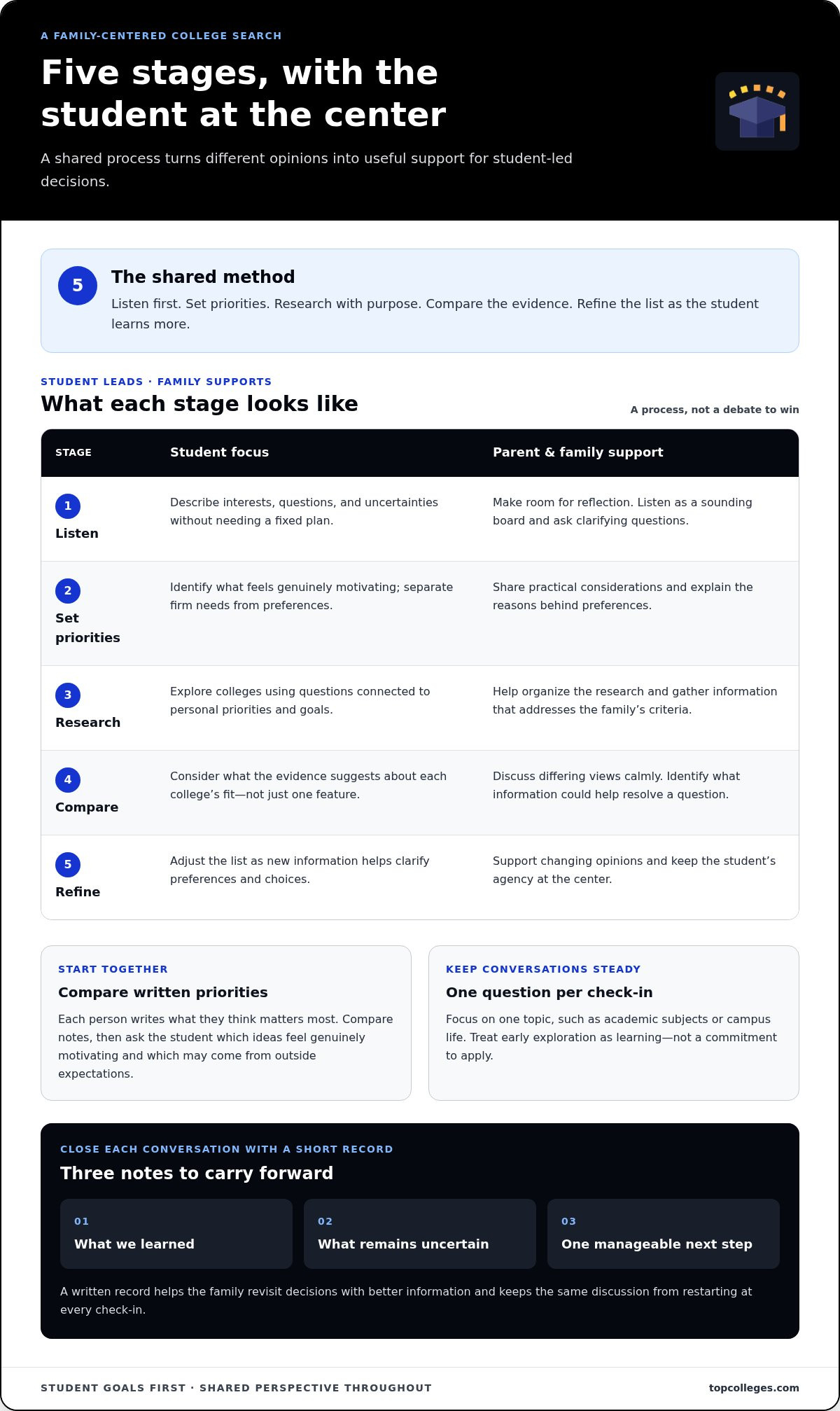
Start with a sequence that gives each conversation a purpose:
- Listen: Invite the student to describe interests, questions, and uncertainties without requiring a fixed plan.
- Set priorities: Identify the qualities that should shape the search, separating firm needs from preferences.
- Research: Gather information about colleges using sources that address those priorities.
- Compare: Discuss what the evidence suggests about each school’s fit, rather than relying on a single feature.
- Refine: Adjust the list as the student learns more and can explain their preferences more clearly.
Agree on the student’s role and the parents’ role
The student should lead reflection on subjects they want to explore, goals they’re considering, and learning environments where they might thrive. Parents can serve as sounding boards, organizers, and partners in practical planning. Before opinions diverge, agree on how to discuss them: each person can explain the reason behind a preference, then identify what information might help resolve the question. This makes disagreement useful rather than personal.
Try a simple first exercise: each person writes down what they believe matters most, then everyone compares notes. Ask the student which ideas feel genuinely motivating and which may come from friends, family, or public rankings. Parents can share practical considerations and ask clarifying questions, while giving the student room to revise an opinion as new information emerges.
Set a calm rhythm for family college-search conversations
Choose regular check-ins instead of letting college discussions surface only around deadlines or stressful moments. Keep each meeting focused on one question, such as which academic subjects to investigate or what the student wants from campus life. Treat early exploration as a chance to learn, not a commitment to apply. A steady rhythm gives the family time to stay curious, record questions, and revisit decisions with better information.
Close each conversation by noting what the family learned, what remains uncertain, and one manageable next step. That record can keep the same debate from restarting at every check-in. If personalized guidance would help the student clarify priorities and develop an admissions strategy, college admissions counseling can add structure while keeping the student’s agency central.
Turn Family Priorities Into College Search Criteria
Once everyone has shared their perspective, turn broad hopes into criteria the family can actually use. “Strong academics” or “a supportive campus” may express a real desire, but they’re too general to guide research until you define what those qualities mean for this student. Ask what a college needs to offer, then identify what would simply be a welcome extra.
College fit combines academic, personal, and practical considerations, not a single measure of prestige. Shared criteria give family members a consistent way to evaluate schools without requiring identical preferences. For broader perspectives on admission counseling and its practice, explore resources from the National Association for College Admission Counseling (NACAC) Journal.
Help the student identify what a good-fit college feels like
Invite the student to picture a typical week, not just a celebrated campus tour or a school’s reputation. Would they prefer discussion-based classes or larger lectures? More independence or a close-knit community? Which subjects do they return to out of curiosity, even if they’re not ready to choose a major? These questions reveal useful preferences without demanding a finished plan.
Ask where an opinion comes from, too. Is a college appealing because of its name, because a friend plans to apply, or because its programs and environment match the student’s interests? Record answers as working priorities, not permanent commitments. During navigating the college search process as a family, it’s reasonable for those priorities to change as the student learns more.
Translate responses into questions the family can investigate. For example, “I want professors to know me” could lead to research on class formats, advising, and academic support. “I want to explore science” might prompt a look at relevant courses and opportunities, without assuming the student must declare a science major. A criteria list could include:
- Academic interests: Areas of study, course options, and room to explore before choosing a direction.
- Learning environment: Class formats, campus scale, and the level of independence the student wants.
- Student support: Advising, tutoring, or other resources relevant to the student’s needs.
- Location and culture: Distance from home, surrounding community, and social atmosphere.
- Affordability: Information the family needs to understand whether attendance could be practical.
Make family constraints and preferences visible
Parents should explain practical constraints directly, without framing them as judgments about the student’s ambitions. Travel distance, family logistics, and affordability deserve honest discussion, as do preferences that may be flexible. Distinguish “we need to understand the financial picture” from “this college can’t be considered.” Research affordability alongside academic and personal fit rather than ruling out possibilities based on assumptions before the family has useful information.
Finish with a short shared criteria sheet. Mark each item as essential, preferred, or still uncertain, and note whose perspective it reflects. This keeps the student’s priorities visible while giving parents a clear place to raise practical considerations. If individualized support would help clarify priorities, college admissions counseling can help the student develop them into a considered admissions strategy.
Compare Colleges by Fit, Not Rankings Alone
A ranking can point your family toward colleges to investigate, but it can’t tell you whether a particular student will thrive there. Rankings use selected measures that may not reflect your student’s priorities, such as class environment, available support, or campus culture. When navigating the college search process as a family, treat rankings as one research input, not a verdict. The more useful question is how each school measures up against the criteria your family has agreed matter.
Use a manageable shortlist and compare every college against the same priorities. A simple chart helps separate what you can verify from what you still need to learn:
| Priority | Evidence | Questions | Current impression |
|---|---|---|---|
| Academic interests | Courses and programs described on the college website | Can the student explore related subjects? | Appealing, but needs more research |
| Learning environment | Class formats in official materials | What teaching settings suit the student? | Seems promising, not yet confirmed |
| Student support | Published descriptions of advising or support resources | How might these resources address the student’s needs? | Resource is listed; usefulness is still a question |
| Campus culture | Student conversations or event experiences | Does the community feel comfortable and engaging? | Personal impression to explore further |
Label notes clearly: verified for details supported by official information, impression for a reaction or interpretation, and open question for anything the family hasn’t resolved. For example, “the college lists an advising program” is verifiable; “the student will feel supported” is an assumption until explored. This distinction keeps a polished website or positive visit from being treated as evidence of more than it shows.
Build a shortlist without treating it as a final commitment
Think of the first list as a set of possibilities, not a promise to apply. Include colleges for distinct, student-centered reasons: one may offer an appealing academic path, another a preferred learning environment, and another a community or location worth exploring. As research clarifies what matters, add, remove, or reconsider options. Keep the list flexible until the family has stronger evidence about fit.
Use campus culture and academic options as comparison evidence
Compare academic offerings, teaching environment, student support, and community life using college websites, admissions materials, events, and conversations. Note what is documented and what remains a question. As the student’s interests sharpen, the shortlist can also inform application decisions. College admissions counseling can connect thoughtful college research with a deliberate admissions approach.
At each family check-in, ask the student to identify one piece of evidence that strengthens a college’s case and one unanswered question. Parents can add practical observations, but return to the student’s priorities when comparing options. A school’s reputation may justify a closer look; it shouldn’t settle the decision.
Create a Practical College Research and Visit Plan
A college search is easier to manage when research follows a clear sequence. Start with official college sources to review academic programs, campus resources, admissions information, and upcoming events. Then attend relevant events, visit campuses when feasible, and compare notes afterward. Not every family can travel to every college, so use virtual tours, online sessions, and conversations to supplement research rather than treating any one source as a complete picture.
A useful college visit tests the family’s criteria against firsthand observations. The goal isn’t to collect the most brochures or make an immediate decision. It’s to learn whether what the student experiences aligns with what the family has been investigating.
Use this sequence for each college under consideration:
- Review official sources. Read the college’s program information, admissions materials, and descriptions of student resources. Record the date and source so the family can revisit details accurately.
- Choose a relevant event. Attend an information session, college fair, or other event that can answer questions the student has already identified.
- Visit when feasible. Observe the setting and student experience in person, using the family’s criteria as a guide. If travel isn’t practical, use virtual resources and conversations to gather additional perspectives.
- Write notes soon after. Capture observations while details are fresh, then identify what needs follow-up before changing the shortlist.
Prepare questions before a college event or visit
Have the student choose questions tied to their academic interests and the kind of campus experience they want. They might ask how students explore subjects before settling on a major or what a typical class experience looks like. Parents can prepare practical questions about logistics and planning, then give the student room to lead conversations. A college fair can introduce possibilities, but a brief exchange at a booth is only one research input, not enough to determine fit.
Before an event, agree on who will ask which questions and where answers will be recorded. A shared note on a phone or a simple document can capture the source, response, and follow-up needed. As your family navigates the college search process, this habit helps distinguish a specific answer from a general impression, especially when several colleges or events begin to blend together.
Turn research notes into the next family decision
After each event or visit, ask the student what surprised them, what matched their priorities, and what remains unclear. Parents can add observations, but label them as impressions rather than facts. Compare notes against the family’s criteria: did the experience provide evidence about a priority, or simply create a positive or negative feeling? Update the shortlist only when new information meaningfully changes the family’s assessment of fit.
Close by assigning one next step, such as reviewing an official program page or seeking an answer to an unresolved question. This keeps research moving without forcing a decision after every interaction. For personalized support connecting college exploration with an admissions strategy, explore college admissions counseling.
Move From College Search to a Student-Led Admissions Plan
A refined college list is more than a set of names. It gives the student a basis for deciding where to apply and what preparation each application may require. Review each college’s official admissions information, noting application requirements, deadlines, and materials specific to that school. Then map those requirements onto a calendar so the student can see what needs attention and when.
The plan should preserve the student’s voice. Parents can help organize dates, gather information, and discuss practical choices, but the student should make informed decisions about where to apply and how to describe their interests. The priorities identified during navigating the college search process as a family can keep application choices grounded in the student’s goals rather than pressure to pursue a particular name or image.
Know when additional guidance may help
Consider additional structure if the student finds it difficult to articulate priorities, family discussions repeatedly stall, or it’s unclear how research should shape next steps. An outside perspective can help organize questions and clarify a course of action without taking decisions away from the student. Top Colleges provides personalized college admissions counseling to help families bring structure to a complex process.
For each school, the student can create a brief planning entry with the application deadline, required materials, questions to resolve, and the reason the college remains on the list. This turns the search into a working plan. It also helps the student distinguish a school that still matches their priorities from one that remains under consideration only because it feels familiar or prestigious.
Carry the student’s priorities into application preparation
College research can inform how a student approaches portfolio development, personal statement review, and interview preparation. Extracurricular activities and community involvement provide rich material for these conversations; for instance, students involved in leadership and scholarship programs highlighted on usamericanmiss.com can draw on practical interview experience and platform presentation. Encourage them to return to the interests and values that shaped the search, then consider how to express those qualities honestly in application materials. As the family turns to essays, a strategic guide to college essays can help focus discussion on clear, authentic communication.
Parents can support preparation by helping the student track tasks and asking questions that prompt reflection rather than supplying a preferred answer. The student should be able to explain why each college is on the list and what they hope to pursue there. Connecting research with application preparation makes the plan more coherent while leaving room for the student’s perspective to develop as they write and prepare.
Steven Roy Goodman leads Top Colleges, where personalized guidance supports students as they shape an admissions strategy and prepare application materials. Counseling can provide structure and informed feedback, but it cannot guarantee an admissions result. The student’s authentic interests and informed choices remain central.
Take the Next Step With Confidence
The college search can lead to more than a list of schools. It can help a student recognize what they value, ask better questions, and approach the next stage with greater clarity. Keep that insight at the center as your family moves from exploring colleges to preparing applications. Navigating the college search process as a family is an opportunity to build a plan that respects practical realities while keeping the student’s choices and voice at the forefront.
When additional structure would be useful, personalized college admissions counseling led by educational consultant Steven Roy Goodman can support the student’s admissions strategy, portfolio development, personal statement review, and interview preparation. This guidance can bring direction to the work ahead while keeping the student’s interests central.
With thoughtful preparation and a shared commitment to the student’s goals, your family can move forward with purpose and confidence.
Frequently Asked Questions
When should a family start the college search?
Start when the student has enough time to explore without needing to make immediate application decisions. For many families, that means beginning during high school, then focusing more as application deadlines approach. An early conversation might simply identify subjects or campus experiences the student wants to learn about. If the student is already approaching application season, begin with deadlines and required materials, then prioritize research that can inform near-term choices. Starting before the process feels rushed gives the family more room to explore.
How many colleges should a student research?
There’s no ideal number for every student. The right research list is one the student can investigate carefully. Start with a few possible schools and add options only when they offer a distinct reason to explore. For example, a student might compare a college with a strong program in a developing interest against another with a different learning environment. If the list grows so large that the student can’t explain why each school is included, narrow it before going deeper.
Should parents choose which colleges their child applies to?
Parents should help the student weigh practical considerations, but the student should take an active role in deciding where to apply. Before adding a school to the application list, ask the student to name a specific reason it belongs there beyond family preference or reputation. Parents can help make sure the family has discussed logistics and resources, then let the student lead the final choice. That ownership can also help the student stay engaged with application tasks.
Can a student choose a college before deciding on a major?
Yes. A student can compare colleges based on academic exploration, teaching approaches, community, and other priorities without having settled on a major. Investigate whether a school offers subjects they’re curious about and how its academic structure allows students to explore. For instance, a student interested in both environmental studies and writing can look for ways to pursue those interests before committing to one direction. Confirm details using each college’s current materials.
How can families talk about college affordability without limiting the search too early?
Discuss affordability as a research question, not an immediate reason to rule out every unfamiliar option. Set aside time to review each college’s official cost information and net price calculator, then consider what the results mean for your family’s circumstances. Compare like with like, including the same cost categories and time period. If figures are unclear, record what needs further investigation instead of treating an estimate as a final answer. This keeps financial realities in view while decisions remain informed.
Are college rankings a reliable way to choose a school?
Rankings can help generate questions or reveal colleges to investigate, but they aren’t a reliable stand-alone method for choosing one. A school’s position doesn’t show whether its courses, environment, or support match a particular student’s needs. If a ranking draws your attention to a college, investigate what measures shaped that position and whether they align with your priorities. Then look for direct evidence, such as program details and student experiences, before deciding what the ranking means for your student.
What should families do if they disagree about a college?
Pause the decision and identify the concern behind each person’s position. A parent may be worried about distance, while the student may be focused on a particular academic opportunity. Write down each concern, then decide what evidence could address it, such as reviewing travel arrangements or checking course information. If the disagreement remains, compare the college with the family’s criteria and identify which questions are unresolved. Disagreement can point to the next research step without becoming a personal contest.