

Disclaimer
Content on this page of topcolleges.com is computer generated and therefore is not guaranteed to be 100 percent accurate about various aspects of the education sector. On balance, however, many students and families seek general information about high schools, colleges and universities, graduate programs, testing, education and career planning, and job placement before beginning one-on-one admissions counseling tailored to their specific needs.
What if making application season manageable isn’t about doing everything at once, but deciding what deserves your attention today? Reducing stress during college application season starts with recognizing that deadlines, essays, schoolwork, and family expectations compete for limited time, while admission decisions remain outside your control. Feeling pressure in that mix is understandable.
The goal isn’t to eliminate uncertainty. It’s to give it less power over your day. With a realistic plan, you can map deadlines, break larger tasks into next steps, and decide what can wait. You can also set boundaries, communicate what support you need, and keep perspective when outcomes are unknown.
This guide covers practical ways to prioritize application work without neglecting school or well-being, build a manageable schedule, and recognize when additional support could help. It also explains how individualized admissions guidance can provide structured feedback on application priorities.
Key Takeaways
- Distinguish manageable application pressure from distress that disrupts daily life, and notice when your well-being needs attention.
- Build a practical plan by verifying requirements and deadlines, estimating task effort, and reviewing your schedule each week.
- Make work sessions more focused with planned breaks and a clear stopping point, then redirect comparison toward your own priorities.
- Ask parents and trusted adults for the kind of support you want while keeping ownership of your choices, writing, and application accounts.
- Reducing stress during college application season can include seeking personalized admissions guidance to clarify priorities and next steps, without expecting guaranteed outcomes.
Why does college application season create so much stress?
College applications ask students to make consequential choices without knowing the outcome in advance. Essays and forms compete with classes, activities, family commitments, and decisions about what comes next. The process also has several moving parts: the broad overview of College admissions in the United States illustrates how application components and institutional processes can vary.
Application stress is the pressure that builds when the work, deadlines, and uncertainty feel difficult to manage. Some pressure is ordinary: feeling nervous before submitting an essay or needing to focus as a deadline approaches doesn’t automatically mean something is wrong. But if distress regularly interferes with sleep, eating, school attendance, relationships, or everyday tasks, tell a trusted adult and consider reaching out to a school counselor or qualified health professional.
Uncertainty makes deadlines feel heavier because students must act on a schedule without knowing how their choices will be received. Reducing stress during college application season doesn’t mean guaranteeing a result or never feeling anxious. It means directing effort toward the parts of the process you can influence while making room for the parts you can’t.
Which parts of the application process feel most stressful?
Pressure often comes from responsibilities arriving together: keeping up with schoolwork, drafting essays, requesting recommendations, completing forms, and tracking each college’s deadlines. One task may be manageable on its own, but several competing for attention can feel like one enormous assignment. When you’re unsure what matters first, even a short form or an email to a recommender can be hard to start.
Expectations can add another layer. Some students feel pressure from family hopes or compare their progress with peers who seem more certain or further along. Others may not experience either. Identifying which pressures affect you helps separate your priorities from assumptions about what everyone else expects.
What can applicants control, and what must remain uncertain?
Applicants have meaningful agency over the process, even though they can’t determine an institution’s decision or predict every outcome. Focus on actions that make your work more deliberate and complete:
- Prepare materials and leave time to review them.
- Present your experiences and interests honestly.
- Communicate promptly with people involved in your applications.
- Make application choices based on your own priorities.
These steps can support a thoughtful application, but they can’t guarantee a particular response. Aim for a sustainable process: take the next useful action, seek help with what feels unclear, and avoid treating every unknown as a problem you must solve immediately. Difficult feelings may still arise; they don’t mean you’re failing.
How to build a manageable college application plan
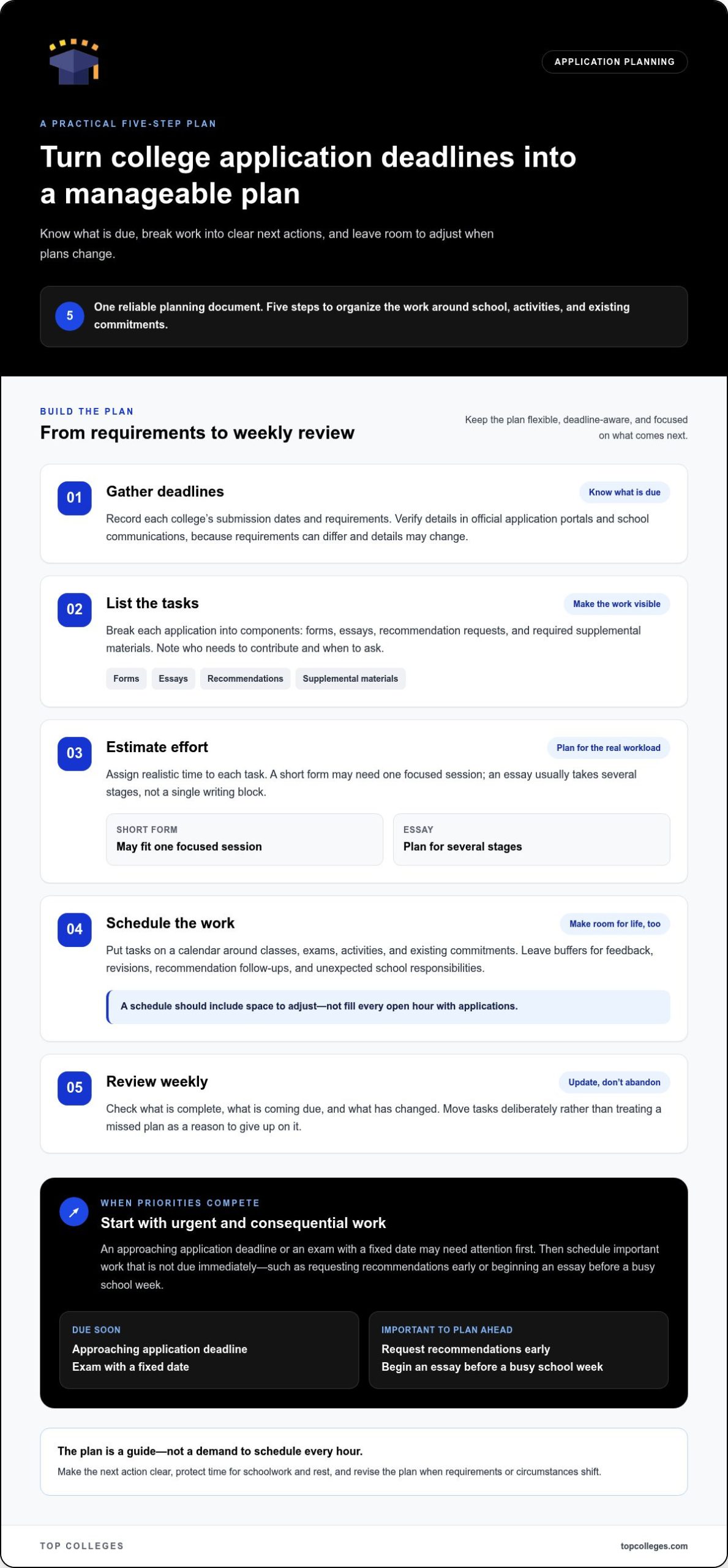
A plan turns a crowded season into a sequence of decisions. It doesn’t need to predict every complication; it should show what’s due, what needs doing next, and where there’s room to adjust. To reduce stress during college application season, make one planning document your reliable reference, then use this five-step process to build it.
- Gather deadlines. Record each college’s submission dates and requirements. Verify them in official application portals and school communications, since requirements can differ and details may change.
- List the tasks. Break each application into components, such as forms, essays, recommendation requests, and required supplemental materials. Note who needs to contribute and when to ask.
- Estimate effort. Assign a realistic amount of time to each task. A short form may need one focused session; an essay usually involves several stages, not a single writing block.
- Schedule the work. Put tasks on a calendar around classes, exams, activities, and existing commitments. Leave buffers for feedback, revisions, recommendation follow-ups, and unexpected school responsibilities.
- Review weekly. Check what’s complete, what’s coming due, and what has changed. Move tasks deliberately rather than treating a missed plan as a reason to abandon it.
A useful application plan is flexible, deadline-aware, and broken into clear next actions. It guides your choices without demanding that every hour be scheduled.
Turn application deadlines into small, scheduled tasks
“Write the essay” is too broad to guide a work session. Divide it into brainstorming, drafting, getting feedback, revising, and proofreading. Track each institution’s requirements in one document, with a separate entry for each school so supplemental prompts and materials don’t get lost in a general checklist. Then choose a few realistic priorities for the week. Protect time for rest and schoolwork instead of filling every open hour with applications.
Prioritize when schoolwork and applications compete
Start with tasks that are both urgent and consequential, such as an approaching application deadline or an exam with a fixed date. Then schedule important work that isn’t due immediately, including requesting recommendations early or beginning an essay before a busy school week. Reassess if a college updates a requirement, a teacher needs more time, or your circumstances shift. The college admissions counseling strategic blueprint offers broader application-planning context, while the National Association for College Admission Counseling (NACAC) publishes a journal with perspectives on admission practices and related issues.
If you want structured feedback as you set priorities, personalized college admissions counseling can help clarify application components and next steps. Explore how college admissions guidance may fit into your planning process.
How to manage pressure while completing applications
A plan helps organize the work, but how you approach each task matters too. A long, unbroken session can leave you drained, while trying to perfect every sentence can make starting feel impossible. The aim isn’t to work constantly or feel calm at every moment. It’s to complete meaningful steps at a sustainable pace, with room for rest and support.
Use a sustainable routine for focused application work
Begin each session with one achievable task, such as outlining a paragraph or checking a form for missing information. Choose a work period that feels realistic, then take a planned break before deciding whether to continue. Set a stopping point in advance. Sleep, meals, schoolwork, and restorative activities—whether taking a walk outside or unwinding with relaxation specialists like City Cave Carnegie—belong in your routine too; they aren’t rewards you have to earn by finishing every application task.
Before you stop, write down the next action: “add the example to paragraph two” is more useful than “work on essay.” That note makes it easier to restart later. If a task repeatedly takes longer than expected, adjust your plan rather than assuming you should sacrifice rest to catch up.
Keep essays personal without chasing perfection
An essay is an opportunity to communicate your perspective, not to invent an idealized version of yourself. Draft first, then revise for clarity and detail. Trying to polish every sentence while you’re still discovering what you want to say can stall progress. A trusted reader can tell you whether your meaning comes through. For more focused advice on shaping a personal statement, the college essay strategy guide offers essay-specific guidance.
Comparison can make a personal process feel like a race. A classmate’s finished draft, a relative’s expectations, or application talk online may not reflect your priorities or timeline. When you notice yourself measuring progress against someone else’s, pause and ask: “What is my next useful step?” Return to your own list and choose one action you can take today. You don’t need to match another applicant’s pace to make steady progress.
Support can be specific and manageable. Rather than asking someone to solve the whole process, ask for what would help right now: listening without advice, sitting nearby while you work, or reviewing your task list for clarity. Naming the request can make it easier for a parent, trusted adult, or friend to respond usefully.
Routines and breaks are tools for ordinary pressure, not substitutes for additional help. If distress persists, worsens, or begins interfering with sleep, eating, school, relationships, or everyday responsibilities, tell a trusted adult and consider speaking with a school counselor or qualified health professional. You don’t have to wait until you’re unable to keep up before asking for support.
How parents and trusted adults can reduce application-season pressure
Support is most useful when it strengthens a student’s ability to manage the process rather than replacing their judgment. Before stepping in, ask what kind of help would feel useful. A student may want someone to listen, look over a calendar, or make quiet work time possible, not advice about which college to choose.
Supportive involvement is collaborative: adults can offer structure and encouragement while students remain in charge of their choices and work. That includes students retaining ownership of application accounts, essays, and decisions. An adult can help review a task list or think through questions, but shouldn’t log in, write application responses, or make choices on the student’s behalf.
Start conversations that lower pressure instead of raising it
Choose a calm moment and begin with an open question: “What part of the process is taking up the most energy?” or “Would you like me to listen, help you plan, or give you space?” Listen before bringing up school preferences, rankings, or admission outcomes. Even well-meant questions can feel like another deadline if they come up repeatedly throughout the day.
Agree on a predictable check-in instead. A student might choose to review upcoming tasks with a parent once a week. Practical help can be specific: setting aside a quiet place to work, checking a calendar together, offering a requested reminder, or listening while the student talks through a concern. Ask before changing the arrangement. What helps one student may feel intrusive to another.
For students, it’s reasonable to state a boundary clearly: “I’ll manage my application account, but I’d appreciate help checking whether my calendar is realistic.” For adults, the response can be simple: “I can do that. Would you like feedback or just a second pair of eyes?” This keeps responsibility clear while making assistance available.
Recognize when stress calls for additional support
Application pressure can sometimes coincide with persistent changes in sleep, mood, usual activities, or the ability to manage everyday responsibilities. These changes deserve attention, especially if they continue or worsen. A student can tell a trusted adult, school counselor, or qualified mental health professional what they’ve noticed and ask for help. A parent or caregiver can raise a concern gently, describe the change without judgment, and offer to help the student take that next step.
Planning conversations and application guidance may make tasks clearer, but they are not mental health care. If there’s immediate danger or a crisis in the United States, call or text 988 for crisis support, or contact emergency services when there is immediate danger.
For students who want structured help clarifying application priorities and next steps, college admissions counseling can provide personalized guidance on application strategy and preparation.
When admissions guidance can make the process more manageable
Sometimes the pressure comes less from the amount of work than from not knowing which application task matters next. Admissions guidance can help students clarify priorities, understand application components, and turn broad concerns into practical steps. That structure may make the process easier to approach, but it can’t control institutional decisions or remove every difficult feeling. Reducing stress during college application season is about building a manageable process, not securing a particular result.
What application-focused counseling can help students organize
Personalized college admissions counseling can provide strategic feedback on an application portfolio, personal statements, and interview preparation. For example, a student unsure how to approach an essay can work through what they want it to communicate, identify a useful revision, and decide what to tackle next. A student preparing for an interview can organize their thoughts and practice discussing their experiences clearly.
Structured feedback can make application work more specific: rather than facing “fix everything,” a student can focus on clarifying one section or addressing one part of a portfolio. The student remains the author and decision-maker. Counseling supports preparation and reflection; it doesn’t guarantee admission, promise a stress-free season, or replace the student’s own judgment.
Choose the next step that fits your immediate need
Start by identifying what kind of difficulty you’re facing. The right next step depends on whether the challenge is an unclear workload, application strategy, or distress that needs care beyond application planning.
- If the workload feels unclear, write down open tasks and upcoming deadlines, then talk with a trusted adult about what help would be useful.
- If you want more structure around application materials, consider whether personalized college admissions counseling could help clarify priorities and next steps.
- If distress persists or worsens, prioritize speaking with a qualified mental health professional or school counselor.
These forms of support address different needs. Admissions guidance focuses on application strategy and preparation. A mental health professional can support concerns affecting emotional well-being and daily life. Seeking one kind of help doesn’t rule out needing the other. If you’re unsure where to begin, tell a trusted adult what’s been difficult and ask for help finding appropriate support.
If structured application feedback would be useful, individualized guidance can help you decide what to work on next.
Take the next step at a pace you can sustain
The application season won’t resolve every uncertainty at once. But you can choose a next step that fits what you need now, whether that means taking a pause, asking someone you trust to listen, or getting a clearer view of your application strategy. Reducing stress during college application season isn’t about controlling an admission decision; it’s about making thoughtful progress without letting the process define your worth or your future.
If you’d benefit from structured feedback on your application work, personalized college admissions counseling can support your portfolio development, personal statement review, and interview preparation. The aim is to help you approach those components with greater clarity, not to promise a particular outcome. Choose support that complements your judgment and respects the parts of the process you want to manage independently.
One deliberate step is enough to begin. You can move forward with care, clarity, and confidence in the effort you bring.
Frequently Asked Questions
Why is college application season so stressful?
College application season can feel stressful because decisions about the future arrive alongside deadlines and existing responsibilities. A student might be revising an essay after a full school day while also wondering whether a family member’s expectations match their own goals. Those pressures don’t mean the student is doing something wrong. Naming the main source can guide the response: a confusing requirement calls for clarification, while persistent emotional distress calls for support.
How can I reduce stress during college application season?
To reduce stress during college application season, make the next action concrete and small enough to begin. Instead of writing “finish applications,” choose “check whether the writing supplement is complete.” Keep a short list of current priorities where you can see it, and move unfinished tasks forward rather than treating them as failures. A deliberate pause can also help you return with more focus; taking a break isn’t the same as falling behind.
Can parents help with college application stress without adding pressure?
Yes. Parents can make support feel collaborative by asking, “Would it help if I listened, or do you want help thinking through a problem?” That gives the student room to choose the kind of assistance they need. If a student requests a reminder, agree on how and when to give it. Avoid interpreting a quiet or unfinished moment as a request to take over; check in first and respect the student’s ownership of the application.
What should I do if college application stress is affecting my sleep or daily life?
If stress is disrupting sleep or daily life, tell a trusted adult what you’ve noticed and ask them to help you find support. You might describe a specific change, such as regularly being unable to settle at night or withdrawing from activities you usually enjoy. A school counselor or qualified mental health professional can help assess what’s going on. Application-planning strategies aren’t a substitute for mental health care. In immediate danger in the United States, call 988 or emergency services.
Is it normal to feel anxious while applying to college?
Some anxiety is understandable during a process with important decisions and unknown outcomes, but there’s no single standard for how applicants should feel. Instead of deciding whether your reaction is “normal,” consider how long it has lasted and whether it’s changing your daily routines. Feeling nervous before submitting an application differs from ongoing distress that keeps you from managing ordinary responsibilities. If it persists or worsens, share what you’re experiencing with someone you trust.
How do I stop comparing my college applications with other students’?
You may not be able to stop comparison from arising, but you can choose what to do next. Mute or step away from conversations and online posts that leave you more unsettled, then identify one task tied to your own goals. Another student’s list, timeline, or essay doesn’t show the full context behind their choices. If comparison begins affecting your well-being, talk with a trusted adult rather than trying to manage the pressure alone.
When should I seek professional help for application stress?
Consider reaching out to a qualified mental health professional if distress continues, gets worse, or interferes with sleep, schoolwork, relationships, or activities you usually value. A trusted adult or school counselor can help you identify a suitable next step. Admissions counseling addresses application strategy, not mental health treatment, so it isn’t a substitute when emotional well-being is the concern. For immediate danger or crisis support in the United States, call 988 or emergency services.