

Disclaimer
Content on this page of topcolleges.com is computer generated and therefore is not guaranteed to be 100 percent accurate about various aspects of the education sector. On balance, however, many students and families seek general information about high schools, colleges and universities, graduate programs, testing, education and career planning, and job placement before beginning one-on-one admissions counseling tailored to their specific needs.
What if the most glowing review tells you less about a consultant’s judgment than about one student’s outcome? Families searching for independent educational consultant reviews often encounter selective praise, vague claims, and testimonials that are difficult to verify. Reviews can offer useful clues, but admission decisions depend on many factors. A successful result alone cannot establish what a consultant contributed or whether their approach would suit your student.
It makes sense to look for evidence before making a consequential choice. Assess more than star ratings: consider whether reviewers describe the support they received, whether their circumstances resemble your student’s, and whether claims can be checked. Then use what you learn to shape the questions you ask directly.
This guide explains how to evaluate review credibility, compare a consultant’s methods, scope, and communication style, and assess fit for your student’s goals. You’ll also learn how to discuss expectations clearly without treating admission as guaranteed. The aim is not to find the most impressive promise, but to make a considered decision based on the strategy behind it.
Key Takeaways
- Assess independent educational consultant reviews by checking their source, specific details, relevance to your situation, and corroborating evidence.
- Compare the consultant’s services and expertise with the application stage you’re facing, whether college, transfer, graduate, MBA, law, or medical school.
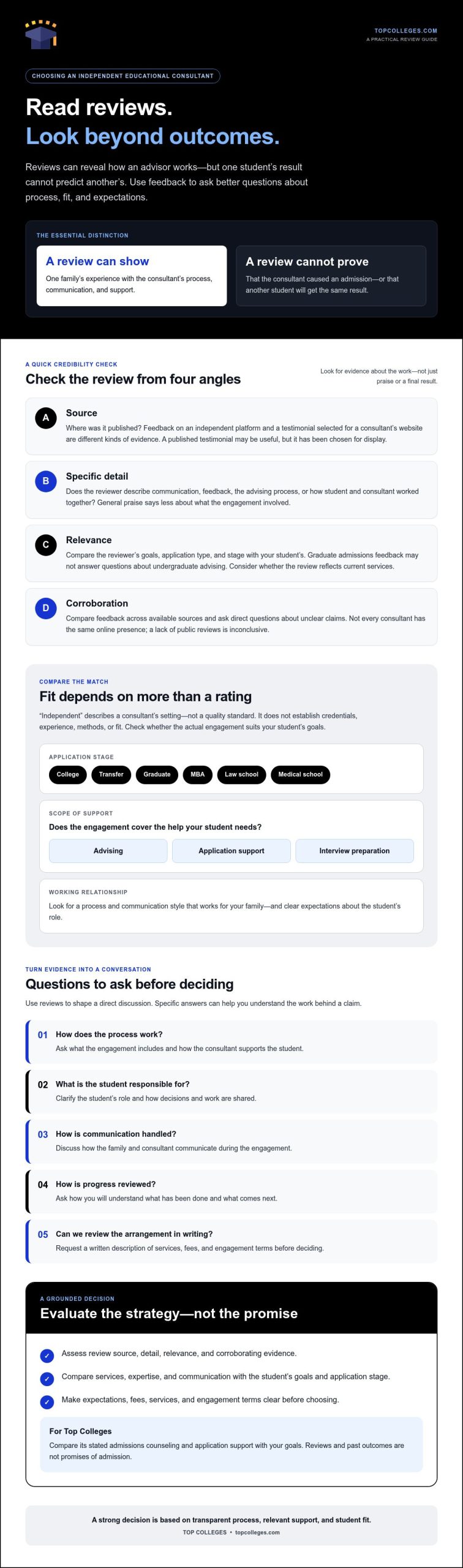
- Ask how the process works, what the student is responsible for, how communication is handled, and how progress is reviewed.
- Request a written description of the services, fees, and engagement terms before deciding whether the arrangement fits your needs.
- Evaluate Top Colleges by comparing its stated admissions counseling and application support with your goals. Reviews and past outcomes are not promises of admission.
What independent educational consultant reviews can and cannot tell you
A review can offer a useful account of one family’s experience. It cannot tell you, by itself, whether a consultant is qualified for your student’s needs or whether your student will be admitted. Treat independent educational consultant reviews as evidence to examine, not as a verdict. Admissions decisions reflect each applicant’s circumstances and choices, as well as the institutions reviewing their applications.
What does “independent educational consultant” mean?
An independent educational consultant advises students and families on education planning, which may include college or graduate admissions. Unlike a school-based counselor, who works within a school and supports its student community, an independent consultant is engaged outside that school setting. The Educational consultant overview provides broader context on the role, but services can vary by consultant.
“Independent” describes the setting, not a quality standard. It doesn’t establish a consultant’s credentials, experience, methods, or fit for a particular applicant. Before relying on a review, check what the engagement covers, such as advising, application support, or interview preparation, and whether that scope matches the student’s goals.
Do consultant reviews prove that a student will get admitted?
No. A testimonial can’t guarantee admission or prove that a consultant caused a particular result. Two students may work with the same advisor yet have different academic profiles, application choices, priorities, and outcomes. Institutions also make decisions independently. A successful result is part of one student’s story, not a reliable forecast for another.
Look for a different kind of evidence: details about how the consultant worked. Does the reviewer describe clear communication, thoughtful feedback, a defined process, or guidance that helped the student make decisions? Specifics can help you understand the experience. Praise such as “incredible” or “got my student into a top school” reveals less about the work behind the claim.
A consultant review can describe one family’s experience with an advisor’s process and communication. It cannot establish that the same approach will produce the same admissions outcome for another student.
Use reviews to form better questions, then look for transparency in the consultant’s explanation of services and expectations. Strong evidence focuses on what the consultant did and how the family experienced the process. Outcomes may offer context, but they shouldn’t replace an assessment of process quality, communication, and student fit.
How to verify independent educational consultant reviews before trusting them
A polished testimonial may be genuine and still tell you very little about whether a consultant is right for your student. Verify feedback by establishing where it came from, examining what it describes, judging its relevance, and looking for reasonable corroboration. This helps distinguish evidence of a thoughtful advising experience from broad praise or an admissions claim that can’t be independently assessed.
- Identify the source. Is the review on an independent platform, or is it a testimonial selected and published on the consultant’s own website? Both can be useful, but they aren’t the same kind of evidence. A consultant-published testimonial has been chosen for display. Consider asking about its original context and whether it was published with the reviewer’s permission.
- Inspect the detail. Look for descriptions of the advising process, communication, feedback, or how the student and consultant worked together. “The consultant was excellent” is praise, but it doesn’t show what the engagement involved.
- Check relevance. Consider the student’s goals, application type, and stage of the process. Feedback about graduate applications may not answer questions about undergraduate advising. Note the review date, too. Older feedback may not reflect current services or practices.
- Seek corroboration. Compare available feedback across sources, while recognizing that not every consultant will have the same online presence. Ask direct questions if a claim is unclear. A lack of public reviews is inconclusive, not automatic evidence for or against a consultant.
Which details make a consultant review useful?
The most useful feedback gives enough context to understand the experience without exposing private student information. It may explain what support was included, how communication worked, and whether expectations were clear. Specific process details are more informative than sweeping claims such as “guaranteed success” or “the best advisor.” Those claims don’t establish what happened or whether a similar approach would suit your family.
How can families cross-check testimonials and public feedback?
Compare what a consultant says about their services with what reviewers describe, then ask about gaps or ambiguities. If a testimonial appears on the consultant’s site, ask whether it’s shared with permission and in its original context. Feedback on an independent platform can add another perspective, but the absence of a profile or review history alone doesn’t establish poor quality.
Review check: Verify the source, date, detail, and relevance before treating feedback as evidence.
Once you’ve assessed the available feedback, use the same criteria to discuss scope and communication directly with prospective advisors. For example, families can review college admissions counseling information and ask how the stated services align with their student’s needs.
How to compare consultant reviews, services, and student fit
A high rating is a starting point, not a selection strategy. Compare what reviewers actually describe with the services the consultant says they provide and the support your student needs. The goal is to assess the approach, not assume that positive feedback or a polished profile predicts a particular admissions result.
Use a comparison framework to make differences visible:
| What to compare | What to look for | Question to ask |
|---|---|---|
| Review evidence | Specific, relevant descriptions of the process, not just overall praise or an outcome claim. | Does this feedback describe work similar to what my student needs? |
| Service scope | A clear account of what support is included and what falls outside the engagement. | Which parts of our application process would you advise on? |
| Communication | Clear expectations for feedback, contact, student responsibilities, and progress updates. | How will we know what to do next and when? |
| Applicant-stage fit | Experience relevant to the student’s program type and current stage. | How does your approach adapt to this applicant’s goals and circumstances? |
What should families compare beyond star ratings?
Look past the overall sentiment in independent educational consultant reviews. A detailed account of how feedback was delivered or how a family and advisor worked together may help you evaluate the experience. Then check whether the consultant’s stated services match the applicant’s priorities. A student seeking help with college essays, for example, should clarify whether essay feedback is included, how it works, and what the student is expected to contribute.
Ask prospective consultants to explain the process in practical terms: roles, timelines, communication, and deliverables. Compare those explanations with the experiences reviewers describe. A mismatch doesn’t automatically mean the review is unreliable, but it is a reason to ask for clarification.
How do you judge fit for a specific applicant?
Application type matters. College, transfer, graduate, MBA, law, and medical school applications can call for different knowledge and advising priorities. Look for experience that aligns with your student’s actual goal, then test the fit through discussion. Ask how recommendations would account for the student’s background, interests, and application stage.
Personal fit can’t be established by testimonials alone. Consider whether the consultant listens carefully, explains their reasoning, and sets expectations your family understands. For college applicants, compare the proposed advising process with the student’s needs around application planning and essay strategy. A clear conversation about scope and approach will tell you more than a star rating by itself.
Questions to ask an independent educational consultant before hiring
Reviews can help you identify topics to discuss, but the conversation itself is where you can test whether an advisor’s approach is clear and responsive. Bring your student’s goals, application type, and immediate questions. Listen for answers that explain how the work would proceed, not just broad assurances of support.
What should you ask about the advising process?
Ask how the consultant would build a strategy around your student’s interests, priorities, and application stage. Then clarify who does what and how the work is reviewed. For example:
- What services and deliverables are included in the proposed engagement?
- Who reviews application materials, and how is feedback shared?
- What work is the student expected to complete independently?
- How do you track progress and decide what needs attention next?
- How might the approach change if the student’s goals or circumstances shift?
Specific answers help you picture the working relationship. If an advisor describes a strategy, ask how it would apply to your student rather than accepting a generic process as personalized guidance. You should also understand how the student’s own ideas and decisions shape the work.
How should you discuss expectations and boundaries?
Before committing, request a written description of the service scope, fees, communication expectations, and engagement terms. Confirm what support is included, how questions are handled, and how the family will know whether planned work is on track. Clear terms reduce misunderstandings later.
Discuss how the consultant supports authentic student work and decision-making. Ask how they guide a student’s writing without replacing the student’s voice, and how they help families weigh options while keeping the applicant involved. Answers should be realistic about what an advisor can influence and what remains outside their control.
Be cautious of absolute admissions promises. No consultant can guarantee an institution’s decision, and a responsible discussion should distinguish the work the advisor provides from outcomes they cannot control. Apply the same standard when interpreting independent educational consultant reviews: focus on evidence of a transparent process, then check whether the consultant can explain that process in terms relevant to your student.
Assess the answers for three qualities: specificity, realism, and responsiveness. A useful response addresses your actual question, defines the consultant’s role, and acknowledges uncertainty without evasion. If important details remain vague, ask for clarification before deciding.
How to decide whether Top Colleges fits your admissions goals
Review evidence is only one part of a hiring decision. To assess Top Colleges, compare the firm’s stated counseling scope with your student’s application type, priorities, and preferred way of working. Apply the same standard you would use for any consultant: focus on the support described and whether it addresses your needs, not on unverified testimonials or admissions outcomes.
What services does Top Colleges describe?
Top Colleges describes personalized admissions counseling and application support, including portfolio development, personal statement review, and interview preparation. Its stated areas of admissions consulting include college and graduate programs, as well as specialized paths such as MBA, law, medical school, and college transfer applications. The firm is led by educational consultant Steven Roy Goodman.
Check the firm’s website for current service details before relying on any list of offerings. Then connect the services to a specific need. A student preparing a personal statement, for example, should clarify the extent of the review and how feedback fits into the wider application plan. A graduate applicant should confirm that the relevant program type is within the current scope.
What should a first conversation help you determine?
Use an initial discussion to find out whether the firm’s services address the student’s application type and immediate priorities. Ask how the work would be organized, what the student and family would be responsible for, how communication and feedback are handled, and what written engagement terms apply. Clear answers should make the proposed support easier to assess, without implying that any admission result is assured.
Compare those answers against the same criteria you’ve used to evaluate independent educational consultant reviews and other consultants: relevance, clarity, process, and fit. Consider whether the advisor listens to the student’s circumstances and explains how the stated services might address them. If a key need falls outside the described scope, ask directly rather than assuming it’s included.
The decision is not about finding a perfect review or a guaranteed path. It’s about determining whether the available counseling aligns with your goals, whether expectations are clear, and whether the student can engage meaningfully in the process. A direct conversation can help your family make that assessment on informed terms.
Choose an advising relationship built around your goals
The most useful independent educational consultant reviews help you ask sharper questions, not predict an admissions decision. Verify who is speaking and what their experience describes, then compare the consultant’s services, communication, and approach with your student’s specific application goals. A clear explanation of process and responsibilities is more valuable than a promise of results.
Top Colleges describes personalized college and graduate admissions counseling, portfolio development, personal statement review, and interview preparation. Led by educational consultant Steven Roy Goodman, the firm is one option families can assess against the same criteria they use for any consultant. Confirm current services and engagement terms directly, and consider whether the stated scope addresses your student’s priorities.
A thoughtful decision starts with clear expectations and a process your student can engage in. Evaluate the fit carefully, keep admissions outcomes in perspective, and contact Top Colleges to discuss your student’s admissions goals.
Frequently Asked Questions
Are independent educational consultant reviews reliable?
They can be useful, but treat them as individual accounts rather than definitive proof of quality or fit. A detailed review may explain how an advisor communicated, what support the family received, and whether expectations were clear. A brief rating or broad praise offers less context. Consider the source, date, and relevance of each review, then compare what it describes with the consultant’s stated services and your student’s needs.
How can I verify an educational consultant’s reviews?
Start by identifying where each review appears. Feedback on an independent platform differs from a testimonial selected for the consultant’s own website, though either may offer useful context. Check when it was published, whether it describes a relevant application type, and whether it gives concrete details about the process. Compare available sources and ask the consultant about testimonials’ permission and context. A lack of public reviews alone doesn’t prove anything.
Can reviews guarantee college admission?
No. Reviews can’t guarantee admission or establish that a consultant caused a student’s result. Applicants have different academic backgrounds, goals, application choices, and personal circumstances, while institutions make their own decisions. A testimonial about an acceptance describes one experience, not a promise for another applicant. Evaluate what the advisor did, how the process worked, and whether expectations were transparent. No review can remove the uncertainty inherent in an admissions decision.
What should I look for in an independent college consultant review?
Look for relevant detail about the student’s goals, the services received, communication, and how the advisor supported the application process. For example, a review that explains how essay feedback was delivered may be more informative than one that says only “great results.” Consider whether the account is recent enough to reflect current practices and whether the applicant’s needs resemble your student’s. Treat admissions outcomes as context, not a measure of guaranteed future results.
How much does an independent educational consultant cost?
Fees vary by consultant and engagement, so there’s no single price that applies to every family. The cost may depend on the application type, services included, and how the work is structured. Request a written breakdown of fees and scope before deciding. Confirm what deliverables are included, whether support is limited to particular tasks, and what engagement terms apply. Compare proposals based on the work offered, not price alone.
What questions should I ask before hiring an educational consultant?
Ask what services are included, how the consultant develops an approach for your student, and who reviews application materials. Clarify how feedback is delivered, what the student is expected to do, and how progress and communication are handled. Request written service details, fees, and engagement terms. Ask how advice adapts if goals change. Strong answers should address your student’s specific situation, explain responsibilities, and avoid promises of a particular admission outcome.
Is an independent educational consultant different from a school counselor?
Yes. An independent educational consultant is engaged outside a school to advise students and families on education planning, which may include admissions applications. A school counselor works within a school and supports students as part of that school setting. Their responsibilities, availability, and scope can differ. Neither title alone establishes the quality or suitability of the guidance. Ask each advisor what support they can provide and how it fits your student’s needs.