

Disclaimer
Content on this page of topcolleges.com is computer generated and therefore is not guaranteed to be 100 percent accurate about various aspects of the education sector. On balance, however, many students and families seek general information about high schools, colleges and universities, graduate programs, testing, education and career planning, and job placement before beginning one-on-one admissions counseling tailored to their specific needs.
What if the early college admissions surge isn’t merely an applicant advantage, but an institutional mechanism designed to control university yield? Weighing early decision vs early action pros and cons requires looking far beyond simplistic acceptance rate comparisons. You likely already recognize the high-stakes tension: you want the definitive statistical boost that early rounds offer, yet signing a binding commitment without the leverage to compare financial aid packages feels like an unacceptable gamble. At the same time, wondering whether your profile is truly competitive by early November deadlines introduces genuine strategic friction.
You don’t have to approach these decisions blindly. In this guide, you’ll master the strategic differences, institutional acceptance dynamics, and critical financial implications of every early admissions pathway. We break down how selective colleges use early yield to build their incoming classes, clarify the restrictive rules governing non-binding alternatives, and establish a disciplined, risk-mitigated calendar that maximizes your odds without sacrificing your family’s financial flexibility.
Key Takeaways
- Understand the binding legal commitment of Early Decision compared to the non-binding flexibility of Early Action before submitting November deadlines.
- Unpack how institutional yield management drives higher statistical acceptance rates, distinguishing genuine early advantages from hooked applicant data.
- Evaluate the critical early decision vs early action pros and cons regarding financial aid packages, ensuring you protect merit scholarship opportunities and aid comparison leverage.
- Deploy a disciplined four-step diagnostic protocol to verify whether your academic portfolio and testing profile are truly optimized for early review.
- Formulate a risk-mitigated application calendar that pairs strategic reach schools with flexible regular decision pathways.
Defining Early Decision vs Early Action: The Structural Differences
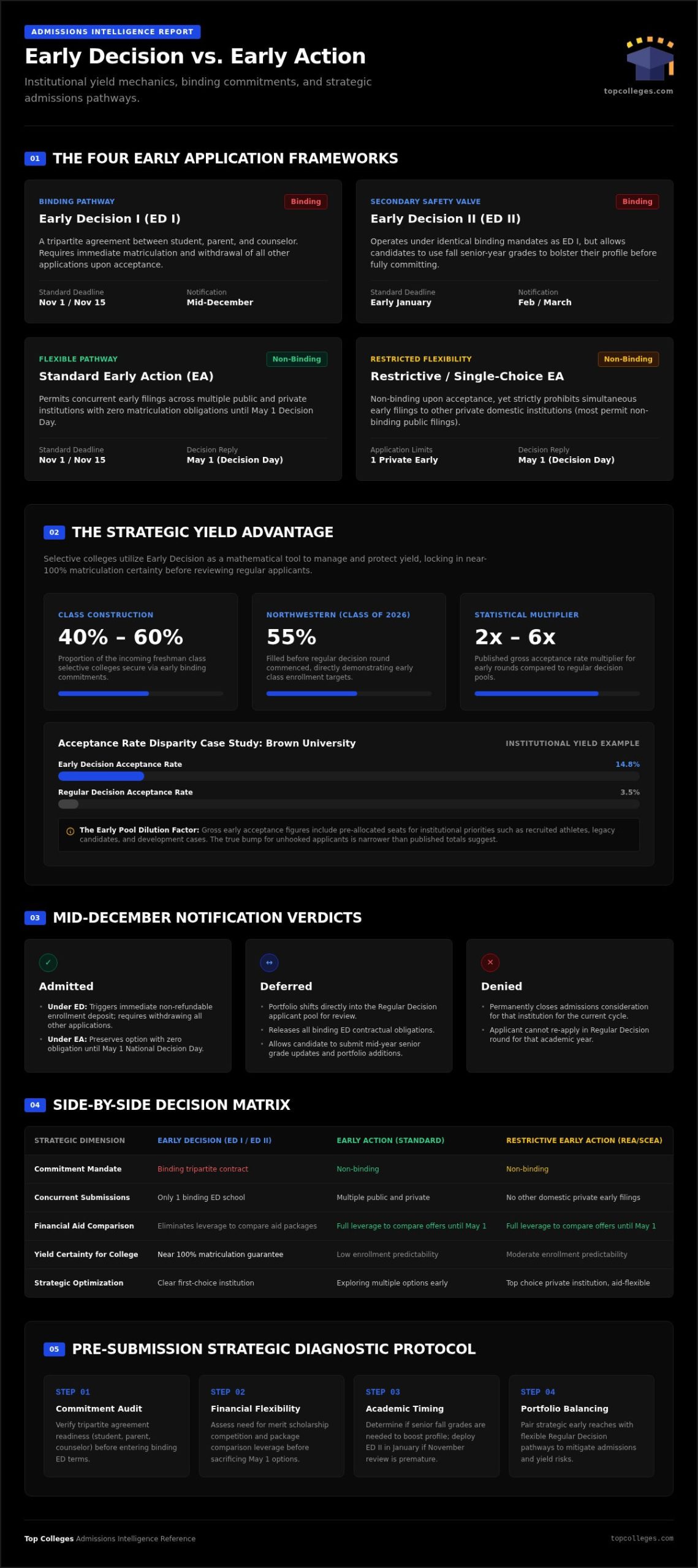
Every November, thousands of high-achieving seniors face a critical tactical choice. Deciding between early admissions pathways requires looking past common misconceptions. To properly weigh the early decision vs early action pros and cons, you must first dissect the legal mechanisms and institutional incentives governing each submission model. Most early deadlines fall on November 1 or November 15, forcing families to choose between binding contractual surrender and non-binding strategic flexibility long before regular winter deadlines arrive.
Early Decision (ED I and ED II) Mechanics
As codified across higher education, Early decision represents a legally non-actionable but ethically binding tripartite agreement signed by the student, parent, and high school counselor. Submitting an ED application commits you to immediate matriculation upon acceptance, requiring the immediate withdrawal of all other active submissions. While ED I deadlines hit in mid-November, ED II operates under identical binding mandates but utilizes early January deadlines. This second round provides a powerful safety valve for candidates who need fall senior-year grades to bolster their profile before committing fully.
Early Action Variations: Standard, Restrictive, and Single-Choice
Unlike binding commitments, early action programs preserve your final decision until National College Decision Day on May 1. However, assuming all non-binding pathways offer equal freedom is a critical misstep. Universities deploy three distinct early action frameworks:
- Standard Early Action (EA): Permits concurrent early filings across multiple public and private institutions with zero matriculation obligations.
- Restrictive Early Action (REA): Non-binding upon acceptance, yet strictly prohibits simultaneous early filings to other private domestic institutions.
- Single-Choice Early Action (SCEA): Operates identically to REA, restricting applicants from applying to any other private college early, though most allow non-binding public university filings.
Admissions Notification Timelines and Decision Classifications
By mid-December, early applicants receive one of three official verdicts: admitted, deferred, or denied. A denial permanently closes consideration for that admission cycle. An acceptance under Early Decision triggers an immediate non-refundable enrollment deposit, officially ending your admissions campaign. Conversely, a deferral shifts your portfolio into the regular decision pool. This transition releases binding obligations, allowing you to re-evaluate the full landscape of early decision vs early action pros and cons as you deploy mid-year grade updates and second-semester strategy adjustments.
The Strategic Advantage: Acceptance Rates and Institutional Yield
Admissions offices do not offer early pathways out of benevolence. They utilize them as mathematical yield management tools. By securing binding commitments early, selective colleges lock in 40 to 60 percent of their incoming freshman class before reviewing a single regular decision folder. For instance, Northwestern filled 55% of its incoming class for 2026 before the regular round began. Understanding this institutional incentive changes how an applicant should calculate early decision vs early action pros and cons, turning raw admission data into actionable portfolio leverage.
Deconstructing the Statistical ‘Early Bump’
Gross acceptance rates paint an incomplete picture. Published figures show early rounds admitting students at two to six times regular decision rates, such as Brown’s 14.8% ED rate versus 3.5% for RD. However, these pools are heavily diluted by institutional priorities: recruited athletes, legacy candidates, and development cases. When you strip out these pre-allocated seats, the bump for unhooked, academically competitive applicants remains real, but it is far narrower than advertised. Colleges aggressively protect yield, knowing an ED acceptance guarantees a matriculation rate near 100%.
Demonstrated Interest as Admissions Currency
Nothing signals enrollment certainty quite like an Early Decision contract. Mid-sized research universities and elite liberal arts colleges actively monitor applicant interest because unpredictable yields disrupt institutional budgeting and enrollment modeling. Early Action confers a far more modest statistical lift simply because colleges cannot bank on the student’s final arrival. Families must carefully evaluate how applying early affects financial aid, balancing that yield currency against the risk of foregoing competitive institutional merit awards elsewhere.
The Opportunity Cost of Early Deferral
Committing your top early asset carries an inherent strategic cost. If an institution defers your November application, your file is cast into a much larger, highly competitive regular decision pool. A sound application strategy prevents this setback from derailing your entire cycle:
- Mitigate single-school risk: Don’t allow an early deferral to stall your momentum on January regular decision portfolios.
- Pivot to ED II targets: Identify secondary binding targets immediately if your primary profile requires further winter evaluation.
- Strengthen deferred files: Deploy targeted updates, new honors, and strong senior-year semester grades to demonstrate sustained momentum.
Navigating these complex admission mechanics requires meticulous planning. Working alongside an expert in college admissions counseling ensures your portfolio architecture, testing submissions, and timing strategies extract maximum statistical leverage from every application round.
Evaluating the Pros and Cons: A Side-by-Side Analysis
Every strategic choice in selective admissions involves an explicit trade-off. Pinpointing your optimal pathway requires calibrating psychological relief against tactical flexibility. To evaluate the early decision vs early action pros and cons, you must compare what you gain in institutional preference against what you surrender in comparative leverage and narrative control.
The Case for Early Decision: Unmatched Commitment
Early Decision delivers the most concentrated statistical advantage available to general applicants. By removing yield risk, it forces admissions committees to take serious notice. Securing an acceptance in mid-December ends the grueling admissions marathon before winter break, eliminating months of senior-year stress. Yet the tactical trade-offs remain severe. A binding acceptance permanently eliminates your ability to cross-shop merit aid packages or leverage rival scholarship offers. Furthermore, rushing an underprepared application into an early round risks an irreversible rejection, barring you from competing in the regular decision pool altogether.
The Case for Early Action: Non-Binding Flexibility
Standard Early Action provides an early verdict without an institutional stranglehold. It allows you to collect multiple acceptances by January, establishing early admissions baselines while keeping your ultimate options open until May 1. This non-binding posture safeguards your leverage to compare competing financial aid packages across institutions. However, Early Action offers minimal acceptance rate inflation compared to binding rounds. It also demands pristine personal statements and finished supplemental essays under the exact same compressed November deadlines.
Senior Year Trajectory: When to Wait for Regular Decision
Submitting an early application is not always the correct move. Applying in November freezes your high school transcript at the end of junior year. For students executing an upward academic trajectory, waiting for January deadlines provides measurable tactical advantages:
- Senior Fall Grades: Mid-year reports can prove your mastery over advanced coursework, transforming borderline academic credentials into compelling arguments for admission.
- Standardized Testing Retests: A late autumn test sitting can push your composite score into a selective college’s top quartile, especially as standardized testing requirements return across top national institutions.
- Extracurricular Culminations: Major fall leadership milestones, varsity distinctions, and national competitions often materialize in November or December, creating fresh thematic substance for essays.
Rigorous portfolio development means knowing when to strike early and when to hold. Balancing the early decision vs early action pros and cons demands cold analysis of your application materials: if waiting two months elevates your portfolio from good to formidable, the Regular Decision round remains your strongest strategic pathway.
The Financial Dilemma: Merit Aid, Need-Based Aid, and FAFSA Strategy
Financial exposure represents the single greatest risk in early admissions planning. Committing to a university without knowing the final net cost can jeopardize years of careful financial preparation. When analyzing early decision vs early action pros and cons, families must recognize that financial aid formulas operate entirely differently under binding agreements than they do under flexible submission models.
Financial Aid Packages Under Binding Agreements
Colleges have zero incentive to discount tuition for students who have already pledged to attend. While institutional need-based grants will adhere strictly to calculated aid formulas, competitive merit scholarships often vanish from Early Decision packages. Before applying ED, families must run the institution’s Net Price Calculator, inputting precise figures from tax filings. With recent FAFSA simplifications utilizing the Student Aid Index (SAI) and removing family farm and small-business assets for companies with 100 or fewer employees, running current estimates through both the FAFSA and the CSS Profile is essential before executing a binding contract.
Breaking an Early Decision Contract Ethically
Can you walk away from a binding acceptance? Yes, but only under narrow, highly scrutinized circumstances. To secure an ethical release from an Early Decision agreement, you must follow a strict procedural protocol:
- Demonstrate genuine discrepancy: The actual financial aid offer must deviate substantially from the estimate generated by the university’s official Net Price Calculator.
- Initiate an official appeal: You must submit written documentation and complete a formal appeals process with the institutional financial aid office before requesting a contract discharge.
- Protect your high school’s reputation: Walking away casually because of a change of heart can result in colleges blacklisting future applicants from your high school counseling office.
Early Action as a Shield for Merit Scholarships
Non-binding pathways preserve vital fiscal leverage. Numerous top-tier public and private universities mandate November Early Action submissions specifically to qualify applicants for their premier honors colleges and merit-based presidential scholarships. Early Action enables you to assemble multiple verified offers by winter. When admissions decisions arrive, you retain the critical ability to compare net costs across campuses, initiate competitive appeals, and safeguard your family’s multi-year investment before National College Decision Day on May 1.
Every household faces unique financial considerations when structuring an admissions portfolio. Thoroughly balancing early decision vs early action pros and cons ensures you extract maximum admissions value without signing away vital financial flexibility.
The Decision Matrix: Determining Your Optimal Application Path
Selecting an admissions strategy requires a disciplined diagnostic process rather than emotional preference. Moving past generalized early decision vs early action pros and cons means evaluating your candid personal metrics against institutional selectivity. If your testing, academic standing, and financial parameters do not align precisely with an institution’s profile, filing an early application can waste critical momentum. You need a structured blueprint to determine exactly when and where to deploy your candidacy.
Step-by-Step Profile and Financial Audit
Begin by running an objective diagnostic protocol across three distinct areas:
- Academic and Testing Alignment: Verify that your cumulative unweighted GPA, course rigor, and standardized test scores place you firmly within or above the target school’s middle 50 percent range.
- Fiscal Feasibility: Confirm that your household can absorb the net price projected by the institution’s official calculator without needing to compare alternative institutional aid offers.
- Narrative Readiness: Ensure your core personal statement and school-specific supplemental essays present an authentic, distinct angle that clearly stands out from peer applicants.
Categorizing Target Institutions: ED I, ED II, EA, or Regular
Map your list into coordinated submission tiers to mitigate overall cycle risk. If you have an unequivocal top-choice private university and your financial projections align, anchor your strategy with a single ED I or Restrictive Early Action filing. Concurrently, submit several standard Early Action applications to non-restrictive institutions, establishing early foundational acceptances. Reserve an Early Decision II target among selective schools offering January binding deadlines. This safeguards your competitive positioning if your primary early application results in a mid-December deferral.
Executing a Flawless Application Campaign
High-stakes admissions execution leaves zero room for eleventh-hour administrative oversights. Secure letters of recommendation and complete comprehensive institutional supplements by mid-October, well ahead of November deadlines. Verify that every transcript, fee waiver, and testing report synchronizes cleanly across digital application portals. Successfully synthesizing these variables demands seasoned tactical oversight. Align your submission roadmap with the strategic blueprint for college admissions counseling, transforming high-stakes uncertainty into a calculated, outcome-oriented admissions campaign that optimizes your selective university chances.
Mastering Your Early Admissions Blueprint
Navigating early decision vs early action pros and cons requires an unsparing assessment of your institutional targets, academic readiness, and financial boundaries. Early Decision delivers formidable yield leverage at selective institutions, while Early Action safeguards crucial fiscal flexibility and merit scholarship competition. The most successful candidates don’t rely on guesswork. They coordinate deadlines, senior transcripts, and essay narratives into an integrated campaign.
Securing admission to elite national universities demands seasoned foresight and sophisticated positioning. Backed by over two decades of high-stakes admissions strategy experience, nationally published author and higher education commentator Steven Roy Goodman designs customized portfolio architectures aligned with selective institutional priorities.
When you approach November deadlines with a rigorous, risk-mitigated blueprint, you replace application anxiety with decisive momentum. Your college journey deserves nothing less than calculated excellence.
Frequently Asked Questions
Can you apply to Early Action and Early Decision at the same time?
Yes, you can submit one Early Decision application alongside multiple standard Early Action applications, provided the EA institutions do not enforce single-choice or restrictive policies. If your binding Early Decision school admits you in mid-December, you must immediately withdraw all active Early Action submissions. You cannot combine Early Decision with Restrictive Early Action at private universities, as REA guidelines prohibit concurrent early filings at other private institutions.
What happens if you are accepted Early Decision but cannot afford the financial aid offer?
You can be released from an Early Decision contract if an institution’s final financial aid package falls demonstrably short of your documented financial need. Before requesting a release, you must contact the financial aid office to submit a formal appeal with updated tax documentation. If the college cannot bridge the gap between their official Net Price Calculator estimate and the final offer, you can decline enrollment without penalty.
Does applying Early Decision significantly increase your admissions chances at elite colleges?
Yes, applying Early Decision provides a measurable statistical advantage, though the true lift for unhooked applicants is narrower than published gross rates suggest. Elite institutions use ED to guarantee 40 to 60 percent of their incoming classes, yielding acceptance rates two to three times higher than regular decision. Evaluating early decision vs early action pros and cons means recognizing that recruited athletes inflate those figures, yet binding commitments still confer substantial applicant leverage.
Can an applicant apply to more than one Early Action school simultaneously?
Yes, under standard Early Action policies, you can apply to as many participating public and private universities as you choose. Standard EA does not restrict where else you can submit early files. This flexibility lets candidates accumulate non-binding offers and compare merit scholarship packages well ahead of regular deadlines. The only exceptions occur when an institution enforces Restrictive Early Action rules that explicitly cap additional early filings.
What is the difference between Early Decision I and Early Decision II?
The primary difference between Early Decision I and Early Decision II lies in their submission timelines, not their contractual terms. ED I deadlines occur in November with mid-December notifications, whereas ED II deadlines align with regular decision deadlines in early January, releasing decisions in February. Both pathways are completely binding. ED II provides a vital tactical fallback for students who need senior-year fall grades before committing.
Is Early Action binding if an applicant receives an acceptance letter?
No, Early Action is never binding upon acceptance. When admitted under standard, restrictive, or single-choice Early Action, you maintain complete enrollment autonomy until National College Decision Day on May 1. You are free to submit regular decision applications, await alternate offers, and evaluate financial aid awards across competing schools. Early Action delivers early peace of mind without stripping away your ultimate decision-making power.
Can a student back out of an Early Decision agreement to attend another university?
No, you cannot back out of an Early Decision agreement simply because you changed your mind or received a late admission offer elsewhere. The signed agreement represents an ethical commitment backed by your high school counselor. Defaulting on a binding offer without a valid financial release risks having both institutions rescind their acceptances. Weighing early decision vs early action pros and cons requires acknowledging this reality before entering a binding contract.
Why do selective private universities prefer Restrictive Early Action over standard Early Action?
Hyper-selective private universities utilize Restrictive Early Action to limit non-serious applications and identify high-intent candidates without requiring a binding contract. By preventing students from applying early to other private competitors, institutions filter for genuine institutional preference while protecting their predictive yield models. REA gives elite colleges an early cohort to evaluate while leaving the door open for applicants who legitimately require financial aid cross-shopping before May 1.