

Disclaimer
Content on this page of topcolleges.com is computer generated and therefore is not guaranteed to be 100 percent accurate about various aspects of the education sector. On balance, however, many students and families seek general information about high schools, colleges and universities, graduate programs, testing, education and career planning, and job placement before beginning one-on-one admissions counseling tailored to their specific needs.
What if the college that looks most impressive on paper isn’t the place where you’ll do your best work? Rankings can signal reputation, but they rarely reveal what an ordinary Tuesday feels like: how students engage in class, find community, or respond when they need support. A thoughtful college cultural fit assessment asks a more useful question: does this campus give you room to grow without asking you to become someone else?
It’s reasonable to want a clear way to compare colleges, especially when websites and brief visits offer only partial views of campus life. The answer isn’t to chase comfort or prestige. It’s to assess compatibility in both directions: what the college offers, and what you hope to contribute and need to thrive.
This article offers a practical framework for identifying priorities, looking beyond marketing, and comparing colleges against the same personal criteria. You’ll learn how to record evidence, weigh trade-offs, and use what you discover to shape a considered college search and application strategy.
Key Takeaways
- A college cultural fit assessment helps you evaluate how your needs, values, and goals align with campus life, without treating reputation or selectivity as a measure of fit.
- Gather evidence from institutional information, student conversations, campus visits, and repeated observations. Separate firsthand insight from promotional claims and assumptions.
- Distinguish a productive academic challenge from conditions that make it difficult to participate, learn, or feel supported.
- Use a consistent comparison matrix to record your priorities, evidence, importance ratings, and unanswered questions for each college on your shortlist.
- Use your findings to develop a thoughtful college list and application narrative grounded in genuine interests, alongside academic, financial, and admissions considerations.
What a college cultural fit assessment measures, and what it does not
A college cultural fit assessment examines how well a student’s needs, values, and goals align with the environment a college creates. That environment is more than a school’s public image. It takes shape in classrooms, advising relationships, residential life, student organizations, and the everyday ways people interact.
This is not a prestige score. Rankings, selectivity, and reputation may describe aspects of an institution, but they can’t tell you whether its academic expectations, community norms, or support systems suit your priorities. Nor is there one ideal campus for every student. A setting that energizes one person may feel isolating or limiting to another.
Assessment should be two-way: identify what you need to participate and grow, then examine what each institution makes possible. The goal is a more informed choice, not a prediction. No framework can determine whether you’ll be admitted, guarantee happiness, or forecast future success. It can help you ask better questions before you decide.
Which parts of college culture matter to students?
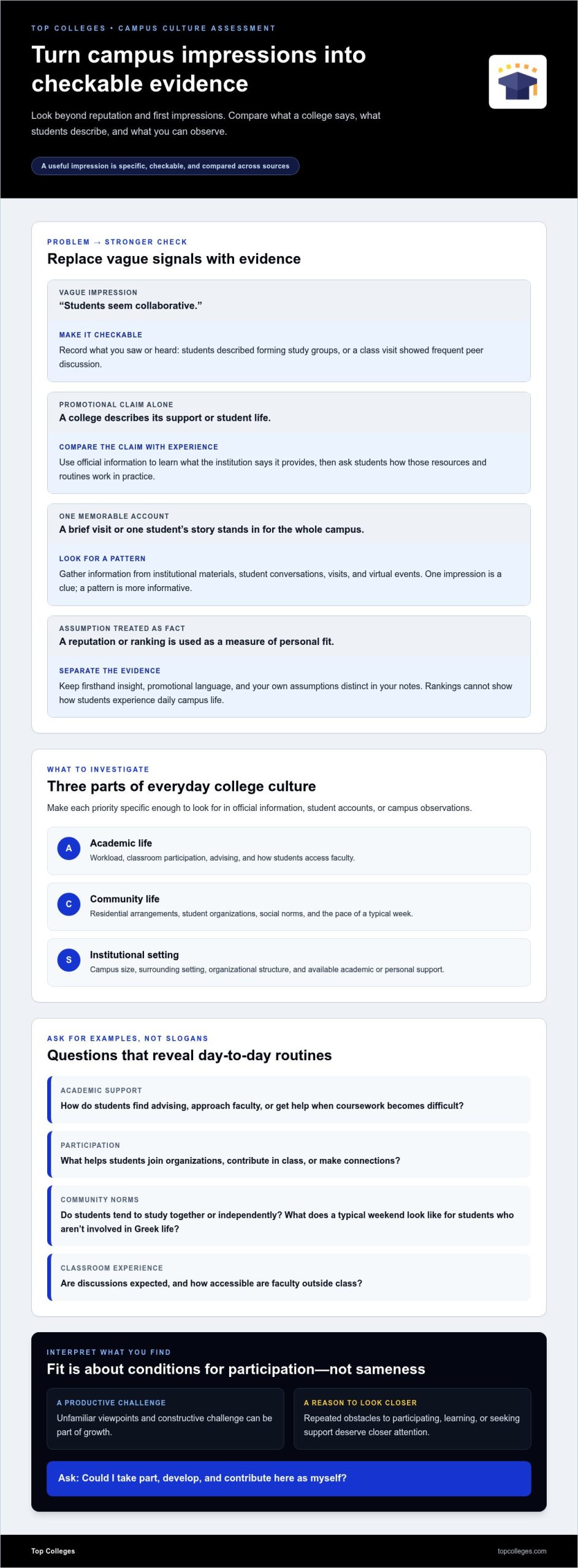
Make each dimension specific enough to investigate. “Strong academics” is broad; “classes where discussion is expected and faculty are accessible outside class” gives you something concrete to look for. Compare formal structures with the routines students describe.
- Academic life: Consider workload, classroom participation, advising, and how students access faculty.
- Community life: Look at residential arrangements, student organizations, social norms, and the pace of a typical week.
- Institutional setting: Compare campus size, its surrounding setting, organizational structure, and available academic or personal support.
These factors interact. A large institution may offer a wide range of organizations, for example, while requiring students to take a more active role in finding community. Treat that as a question to investigate, not an automatic advantage or drawback.
How is cultural fit different from simply fitting in?
Belonging is not the same as becoming a copy of the people around you. Ask whether students with varied interests and perspectives can access courses, communities, and support, rather than whether you already resemble the most visible student group. A strong match may include unfamiliar viewpoints and constructive challenge. It should not require you to suppress your identity to participate.
Fit concerns the conditions for participation, not sameness among students. Consider whether you can contribute in class, pursue interests, and seek help without facing persistent barriers. Some discomfort can accompany growth. Repeated obstacles to engaging deserve closer attention.
Use this distinction to interpret what you learn about a college. The question isn’t simply, “Would I fit in here?” It’s also, “Could I take part, develop, and contribute here as myself?”
How to assess college culture beyond rankings and first impressions
Rankings can help narrow a search, but they can’t show how students experience a college day to day. For a useful college cultural fit assessment, gather evidence from several sources and compare each school against the same questions. This keeps a compelling reputation, polished tour, or memorable conversation from carrying more weight than it deserves.
Start with official institutional information to understand the structures a college describes, such as course formats, advising, student organizations, and residential or student-life resources. Then look for firsthand perspectives from students. Campus visits and virtual events can add context by letting you observe interactions and ask focused questions. Compare what you hear and see across sources. One impression is a clue; a pattern is more informative.
What evidence can reveal a college’s everyday environment?
Use each source for what it can reliably tell you. Course descriptions and advising pages show what the institution says it provides, not necessarily how students experience it. Student conversations can add lived detail, while visits let you observe spaces and interactions. Neither a brief visit nor one student’s account represents the entire campus.
A cultural impression becomes useful when it’s tied to a specific, checkable observation. Instead of writing “students seem collaborative,” note what you saw or heard: students described forming study groups, or a class visit showed frequent peer discussion. Keep promotional language, personal anecdotes, and your own assumptions distinct in your notes.
Which questions expose more than a college’s public image?
Ask questions that invite examples rather than slogans. “Is the community supportive?” may prompt a general answer. “How did you get help in a challenging course?” or “What does a typical weekend look like for students who aren’t involved in Greek life?” can reveal routines and access more concretely.
- Academic support: How do students find advising, approach faculty, or get help when coursework becomes difficult?
- Participation: What helps students join organizations, contribute in class, or make connections?
- Community norms: Do students tend to study together or independently? How do they describe the balance between campus activities and time away?
Ask students with different experiences where possible, and treat each response as a perspective rather than a verdict. Compare their examples with institutional descriptions. If a college promotes close faculty relationships, for instance, record what students say about how they actually connect with instructors. Note gaps instead of filling them with assumptions.
Use the same prompts for every school, and record the source beside each observation. This makes comparisons more balanced and shows where you need more information. If you want help connecting campus priorities to a college search, personalized college admissions counseling can help you turn those priorities into a considered strategy.
Does college cultural fit mean avoiding challenge or choosing the most comfortable campus?
No. A college cultural fit assessment isn’t a search for comfort, sameness, or effortless belonging. College will involve unfamiliar expectations and perspectives. The key question is whether those challenges can support learning and participation, or whether the environment repeatedly makes it difficult to engage.
Consider a student who wants demanding seminars but is used to asking questions in small groups. A college with discussion-based courses may stretch that student in a productive way, particularly if expectations are clear and guidance is accessible. By contrast, if the student’s questions are routinely dismissed, that may indicate a barrier rather than a challenge to overcome. The distinction depends on the conditions surrounding the experience.
Familiarity can ease a transition, and new perspectives can prompt intellectual growth. Neither should automatically outweigh the other. A student’s priorities, circumstances, and support needs determine how much weight each factor deserves. Rather than asking which campus is universally “best,” ask what trade-offs you’re prepared to make and what conditions help you do your best work.
When can a challenging environment still be a strong fit?
A challenging setting may be a good match when students can participate meaningfully, access guidance, and understand what success requires. Be specific about the stretch involved: heavier reading, more independent planning, unfamiliar viewpoints, or speaking in class. Ask yourself which experiences feel energizing and which repeatedly leave you unable to engage.
Academic ambition also calls for realistic expectations. Consider the workload you can manage, how much independence you want, and what kinds of guidance help you adapt. A demanding course can build confidence when expectations and support are workable. Challenge without a way to seek help may be a very different proposition.
How can students distinguish growth from pressure to conform?
Look for whether students can express varied interests and perspectives, rather than assuming everyone experiences campus in the same way. Ask how different students find community, participate in class, and access support. Then consider your own reaction carefully: discomfort may reflect healthy adjustment, while exclusion may point to a real obstacle. Neither feeling alone proves a college is right or wrong for you.
- Growth: You’re encountering unfamiliar ideas or expectations, but can participate and find appropriate guidance.
- Conformity pressure: You feel you must hide an important interest or viewpoint to be accepted or included.
- Unclear evidence: You’ve had an uneasy first impression, but don’t yet know whether it reflects a recurring pattern or a single moment.
Don’t force a quick verdict. Record what happened, what you need, and what remains uncertain. A balanced decision makes room for challenge while taking sustained barriers seriously. Priorities differ: one student may value close-knit community, while another may seek independence and a broad range of perspectives. The right trade-off is personal, not a universal formula.
How to complete a college cultural fit assessment and compare your shortlist
A structured process turns broad impressions into a comparison you can revisit. In a college cultural fit assessment, the aim isn’t to produce a mathematically perfect winner. It’s to clarify which conditions matter most, what the evidence supports, and where important questions remain.
How should students set priorities before comparing colleges?
Before discussing specific schools with family or friends, list your own academic, social, support, and community needs. Choose a short set of priorities and explain why each matters. Mark deal-breakers separately from preferences you could negotiate, and note what you still need to learn. This helps prevent someone else’s expectations or a college’s reputation from setting your criteria for you.
How can a comparison matrix prevent a rushed decision?
Use the same prompts for every college, and keep observable evidence separate from personal impressions. Mark whether evidence is strong, limited, or uncertain instead of assigning precise scores that suggest more certainty than you have. A matrix makes gaps visible and helps you reconsider trade-offs before an early favorite becomes the default choice.
- Reflect: Describe the academic, social, and community conditions that help you participate and learn.
- Prioritize: Identify essential needs, flexible preferences, and the reasons behind each priority.
- Research: Gather information for each school using the same questions and a mix of sources.
- Score the evidence: Record what you observed or learned, its source, and how confident you are in it. Rate importance, not the college’s overall worth.
- Revisit trade-offs: Review what each option offers, where it falls short, and which unanswered questions could change your view.
Build a simple matrix with one row for each dimension you care about and one column for each college. Useful fields include:
- Student-defined dimension: For example, discussion-based classes, access to advising, or a close-knit community.
- Importance: Mark whether the factor is essential, highly valued, or a preference.
- Evidence and source: Note the specific information or observation, and where it came from.
- Impression and uncertainty: Record your response, evidence strength, and what you still need to investigate.
Don’t add the ratings into one score and treat the result as a verdict. A college might meet an essential academic need while leaving a social question unresolved. That trade-off deserves discussion, not arithmetic. Check whether reputation has influenced your judgment, whether a lower-ranked preference is being mistaken for a deal-breaker, or whether a missing answer calls for more research.
Once your priorities are clear, connect them to a thoughtful application plan. The Strategic Blueprint for College Admissions Counseling in 2026 offers a way to think through that planning.
Turn your college cultural fit findings into a more coherent application strategy
Your assessment can inform a more intentional college search. Use what you’ve learned to test whether each school aligns with your academic and personal priorities, but keep fit in perspective. Academic readiness, financial considerations, and admissions requirements remain part of the decision. A strong cultural match can help shape a thoughtful list, but it can’t replace the broader work of planning it.
How can fit insights shape a thoughtful college list?
Review each college against your priorities and the evidence you’ve collected. If access to faculty matters, connect that priority to a specific academic feature you’ve researched, then consider how it fits alongside your other needs. Keep more than one dimension in view: a campus might offer a compelling academic environment while leaving an important community question unresolved.
Revisit your list as you learn more. New information may challenge an assumption, reveal a trade-off, or show that a preference isn’t as essential as you first thought. Treat your college cultural fit assessment as a decision-making aid, not a formula that automatically removes schools from consideration. Fit is one part of a balanced college strategy.
How can application materials reflect fit without sounding generic?
Build a clear connection between what you’ve learned about a college and what genuinely matters to you. Name a specific academic or community feature, then explain how it connects to an interest, experience, or goal. For instance, instead of calling a college “the perfect place to grow,” describe how a particular course format relates to the way you like to explore ideas. Specific reasons are more credible than broad praise.
Your application should sound like you, not like a campus brochure. Avoid claims of perfect fit or statements about a school’s culture that you can’t support with research. The strategic blueprint for college essays can help you shape authentic experiences into a focused narrative without overstating what they mean.
Fit findings can also guide preparation beyond essays. Personalized college admissions counseling can help connect priorities to a coherent college list and application narrative. Portfolio development, personal statement review, and interview preparation can draw on genuine interests and informed reasons for applying. Their purpose is to help present a thoughtful, consistent account of the student, not to promise an admissions result.
Before submitting applications, check that each school on your list still makes sense across your academic, personal, and practical considerations. Your reasoning may evolve as you learn more. That’s a strength: a deliberate strategy can adapt to better evidence while staying grounded in your goals.
Move forward with a college search grounded in your priorities
The next step isn’t to find certainty. It’s to make your decision process more deliberate, then let new information refine it. Keep your college cultural fit assessment close as you develop your application plan. The priorities behind your choices can help you explain what you hope to explore and how you may contribute, while leaving room for your interests to evolve.
Educational consultant Steven Roy Goodman helps students connect personal priorities to a coherent admissions strategy. Personalized admissions counseling and portfolio development can help clarify how interests and experiences fit together. Personal statement review and interview preparation can help students communicate those connections with purpose. The aim is an authentic application, not a promise of a particular outcome.
You don’t need every answer before taking the next step. Let the evidence guide you, but keep your own goals at the center. A thoughtful plan can begin with the questions you’ve already identified and develop as your understanding deepens.
Choose with intention, and give yourself the opportunity to thrive as you learn, contribute, and grow.
Frequently Asked Questions
Can you assess college cultural fit before visiting campus?
Yes. You can begin a college cultural fit assessment with course catalogs, advising pages, student organization listings, and virtual events. For example, compare how two colleges describe introductory classes, then note what those descriptions don’t tell you, such as how often students speak up. Current students can add useful perspective, but their experiences are individual. A campus visit may deepen your understanding, but it isn’t a prerequisite for starting your research.
Is college cultural fit the same as student life?
No. Student life covers social and community experiences, but it doesn’t capture the whole environment. A student might enjoy a college’s clubs yet find its classroom format difficult to engage with, or appreciate its academic structure while wanting more community connection. Consider how learning, support, and participation work alongside social opportunities. This broader view can help you identify which parts of campus life matter most to your everyday experience.
Can a student fit more than one college?
Yes. More than one college may support a student’s goals, though each could do so in a different way. One school might offer a preferred academic pathway, while another provides a community structure that feels more appealing. Rather than searching for a single perfect match, compare the strengths and compromises of each option. Then weigh those findings alongside academic choices, affordability, admissions factors, and the circumstances that matter to your family.
Should parents complete a college cultural fit assessment with their student?
Parents can take part, but the student’s own priorities should remain central. To make the conversation productive, each person can independently choose a college under consideration and explain the evidence behind their view. If opinions differ, ask what need or concern is driving each perspective. A parent may raise a practical question the student hasn’t considered, while the student can explain what daily experience they value. The goal is shared understanding, not a verdict imposed by someone else.
Do college rankings measure cultural fit?
No. Rankings can help organize information about colleges, but they can’t establish whether a particular student will feel engaged or supported on a campus. A highly ranked school may not offer the classroom style or community opportunities a student is seeking, while a less prominent institution may align closely with those priorities. Treat rankings as one reference point, not evidence of personal compatibility, and base judgments about campus experience on relevant information.
What should you do if a college seems academically right but culturally uncertain?
Pinpoint what feels uncertain before making a decision. Is the question about classroom participation, connecting with faculty, or finding community outside class? Then seek information that speaks directly to it, such as a virtual academic event or a conversation with a student involved in a relevant program. Write down what the answer clarifies and what it doesn’t. Compare that uncertainty with the same issue at other colleges, and consider whether it concerns a core need or a new experience.