

Disclaimer
Content on this page of topcolleges.com is computer generated and therefore is not guaranteed to be 100 percent accurate about various aspects of the education sector. On balance, however, many students and families seek general information about high schools, colleges and universities, graduate programs, testing, education and career planning, and job placement before beginning one-on-one admissions counseling tailored to their specific needs.
What if transferring is the strategic move that brings your education back into focus? Learning how to successfully transfer to another college starts with more than finding a new campus. Identify what isn’t working, decide what you need from a different institution, and make sure the move supports your academic and personal goals.
It’s reasonable to feel uncertain. Application requirements and deadlines vary, and the possibility of losing credits or financial support can make a promising change feel risky. A strong transfer plan replaces guesswork with clear priorities, institution-specific research, and a realistic timeline.
This guide will help you assess your reasons for transferring, prepare a focused application, compare colleges, and plan for the transition. You’ll also learn how to investigate credit policies and financial considerations before deciding. A clear rationale and careful preparation can help you approach the process with greater confidence.
Key Takeaways
- Distinguish a lasting academic or personal mismatch from the temporary challenges of adjusting before deciding to transfer.
- Build your application in a deliberate order: review each college’s current requirements, gather records, develop your rationale, submit, and monitor your materials.
- Compare destinations by program access, course availability, advising, campus environment, and practical fit. Research how each college evaluates transfer credits.
- Work backward from each institution’s published deadlines, and plan application, departure, and enrollment tasks separately.
- Personalized transfer counseling can help turn your research and reasons into a coherent application strategy, without promising an admission outcome.
How to Decide Whether Transferring Colleges Is the Right Move
Reconsidering your college is a significant decision. It doesn’t automatically mean your first choice was a mistake. Your priorities, academic interests, or circumstances may have changed. Before acting, identify what is driving the question and whether transferring could address it.
A transfer student moves from one college to another, but the decision involves more than changing campuses. It can affect academic progress, relationships, routines, and finances. The key question isn’t simply whether another college looks more appealing. It’s whether that institution can meet a specific need your current college cannot.
Which reasons can support a thoughtful transfer decision?
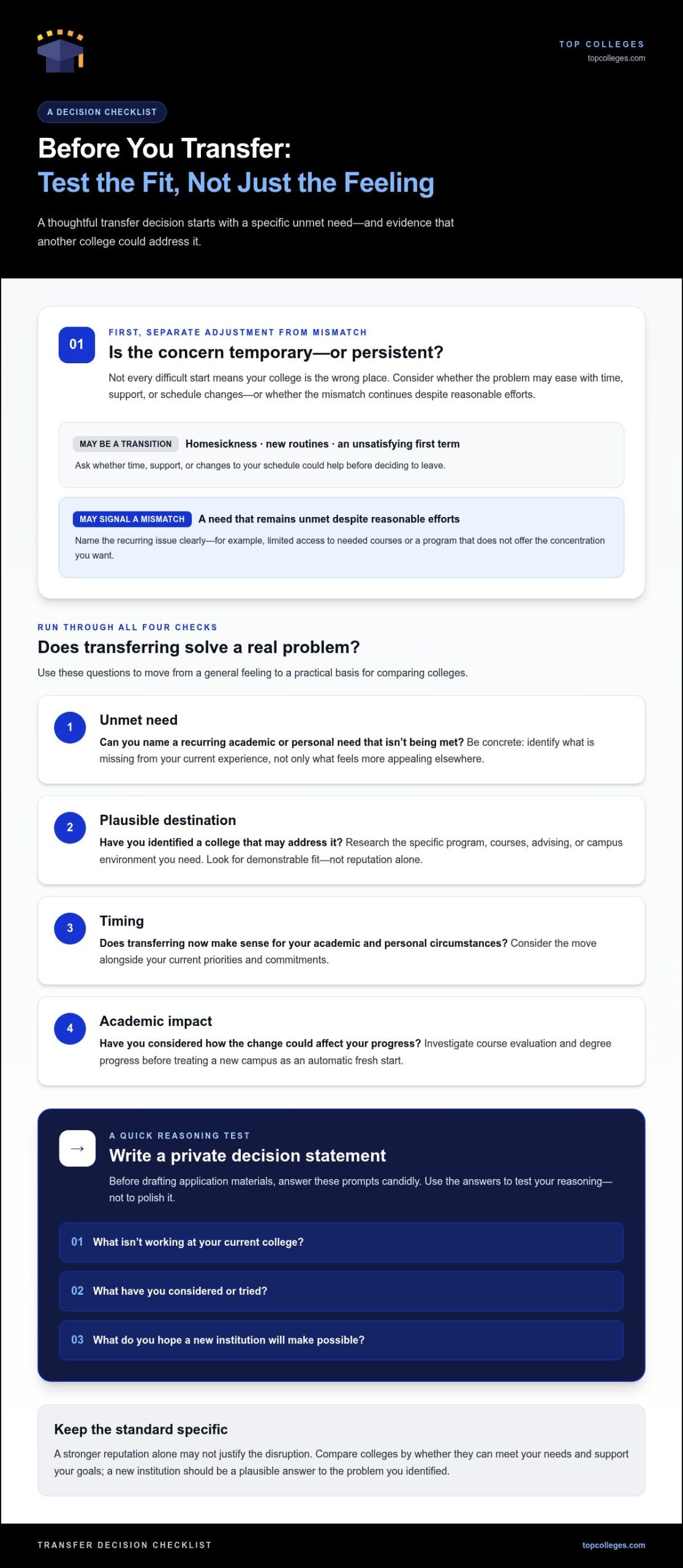
Start with a concrete explanation. Your current college may not offer the concentration you want, the courses you need may be difficult to access, or the campus environment may make it hard to take part in the academic or community life you value. Naming the unmet need gives you a practical basis for comparing alternatives.
Next, consider whether the concern is persistent or part of a challenging transition. Homesickness, difficulty adjusting to new routines, or an unsatisfying first term may ease with time, support, or schedule changes. A mismatch that continues despite reasonable efforts may call for a different response. Ask yourself: What do I expect to gain at another institution, and what evidence suggests it can provide that?
A stronger reputation alone may not justify the disruption. Prestige is not a substitute for access to your intended program, a suitable learning environment, or a workable path to graduation. When evaluating how to successfully transfer to another college, look for a destination that fits your goals in specific, demonstrable ways rather than relying on its name or perceived status.
What should you resolve before starting an application?
Research whether a prospective college offers the courses, program access, advising, or campus environment you’re seeking. Review its academic structure and identify questions about application timing and course evaluation that you need to answer before making a commitment.
Consider the full trade-off. A new college could be a stronger academic fit, but the move may affect your progress toward a degree and personal priorities, such as staying near family or maintaining important commitments. Make a preliminary comparison before investing time in an application.
Use this checklist to test your decision:
- Unmet need: Can you name a recurring academic or personal need that isn’t being met?
- Plausible destination: Have you identified a college that may address it?
- Timing: Does transferring now make sense for your academic and personal circumstances?
- Academic impact: Have you considered how the change could affect your progress?
Before writing application materials, draft a private decision statement. In a few sentences, explain what isn’t working, what you’ve considered, and what you hope a new institution will make possible. Keep it candid rather than polished. This exercise helps test your reasoning. Later, you can adapt it into an application explanation grounded in verified details about each destination.
How to Build a Strong College Transfer Application
A strong transfer application is a connected case for why you’re seeking a change and how your academic record, experiences, and goals support that choice. Requirements vary by college and sometimes by program, so use each institution’s current official instructions as your authority. There is no universal formula.
Build the application in sequence:
- Research requirements. Review the transfer admissions page and instructions for your intended program. Record each deadline, required form, essay prompt, transcript procedure, recommendation policy, and submission method.
- Assemble records. Identify the academic records and supporting documents each college requests. Request transcripts early, and save copies of submitted materials and confirmation messages.
- Develop the rationale. Use your private decision statement as a starting point. Connect your academic interests and goals to specific opportunities at each destination.
- Submit accurately. Follow the institution’s process, proofread written responses, and confirm that required fields and documents are complete before submitting.
- Monitor your file. Track portal updates and messages, respond to requests by their stated deadlines, and keep a record of what you submit.
How do you research transfer requirements and deadlines?
Create a separate tracker for every college. Include the application deadline, required materials, recommendation instructions, program-specific conditions, transcript procedures, and follow-up tasks. Check the admissions and department pages for the application cycle you’re targeting, since deadlines and policies can change. If an instruction is unclear, ask the institution for clarification rather than relying on an old checklist or another college’s process.
How do transcripts, recommendations, and essays fit together?
Request transcripts according to each college’s instructions, including whether records must come directly from your current institution. Choose recommenders who can speak specifically to your academic preparation, classroom contributions, or relevant growth. Give them enough context to write informed letters, while letting them describe your strengths in their own words.
Your current coursework and activities can show readiness, so focus on evidence that genuinely reflects your experience. A substantial project, a demanding course, or sustained campus involvement may demonstrate preparation or initiative when relevant to your goals. Don’t add activities simply to fill space. Aim for each application component to reinforce your reason for transferring: your academic record shows what you’ve pursued, recommendations add perspective, and your essay explains what you intend to do next.
Write the transfer essay with a forward-looking emphasis. Explain the academic direction you’re pursuing and why the receiving institution fits that plan, using specific details rather than broad praise. Before finalizing, compare the essay with the rest of your application and make sure the central rationale is consistent. For broader planning around the aid implications of a move, consult Federal Student Aid’s guidance for transfer students.
Top Colleges offers personalized transfer application guidance to help applicants organize their rationale and materials into a focused strategy.
How to Compare Colleges, Transfer Credits, and Financial Fit
A destination should solve more than one problem on paper. Compare how each college supports your academic plan and daily life, then assess whether the transition is practical. As NACAC explains about the transfer process, transfer pathways differ. Assess each institution on its own terms rather than assuming similar names or programs lead to similar outcomes.
How can you assess whether credits will transfer?
Start with each college’s published transfer-credit policy and evaluation process. Look for course equivalencies, minimum grades, limits on applicable credits, and whether credits count toward general education, electives, or your major. A course may transfer without satisfying a particular degree requirement.
Compare your current course titles and descriptions with the receiving college’s catalog. If its process requests syllabi, reading lists, or other academic details, gather them while they’re accessible. Credit decisions are institution-specific, and only the receiving college determines how prior coursework applies to its degree requirements. Treat any early estimate as provisional until the institution completes its evaluation.
Which measures reveal a stronger academic and personal fit?
Look beyond overall reputation. Check whether students in your intended program can access required courses, whether the sequence fits your likely entry point, and what advising or relevant academic opportunities are available. Then consider whether the learning environment addresses the needs that prompted you to explore transferring.
Financial fit involves more than tuition. Use each college’s official aid information to understand how aid eligibility and award terms may apply to your circumstances. Compare your full attendance budget, including housing, meals, transportation, books, and other likely expenses. If you need flexible ways to manage living expenses while enrolled, educational resources like earnonlineguides.com offer guidance on building digital skills and remote income streams. Record unanswered questions and follow up through the institution’s official financial aid resources.
Use a school-by-school table to separate documented evidence from assumptions. Rate each criterion according to your priorities rather than a generic ranking.
| Criterion | School-specific evidence | Unanswered question | Decision importance |
|---|---|---|---|
| Program and course access | Required courses and sequence in the catalog | Can I enroll in the courses I need at my expected entry point? | High, medium, or low |
| Credit evaluation | Published transfer policy and evaluation steps | How might prior courses apply to my intended degree? | High, medium, or low |
| Advising and opportunities | Program advising and relevant academic options | What support is available to students in this program? | High, medium, or low |
| Campus and practical fit | Environment, location, housing, and attendance assumptions | Can this option work with my personal priorities and budget? | High, medium, or low |
This comparison makes how to successfully transfer to another college a more disciplined decision. Weigh verified fit, identify unresolved questions, and don’t treat an unconfirmed credit or cost assumption as settled.
How to Manage Transfer Timing and the Move Between Colleges
A transfer involves several timelines, not just an application deadline. Each destination sets its own submission dates, enrollment steps, and response requirements. Build a flexible plan around the current instructions published by every college. Work backward from the earliest relevant deadline, leaving time to review materials and respond if an institution requests more information.
What belongs on a transfer application timeline?
Put each college’s dates and tasks in one calendar or tracker. Include research, transcript and recommendation requests, essay drafts, submission deadlines, portal checks, and follow-ups. Add enrollment requirements and decision dates when published. Set personal milestones ahead of official deadlines so you have time to correct missing information or resolve submission problems.
Track each application separately. A useful tracker records the task, due date, submission date, confirmation, next follow-up, and any unresolved condition. Check each portal on a planned schedule and review institutional messages promptly. Don’t assume one college’s deadline or process applies to another.
Plan beyond the application itself. Separate your responsibilities into three stages:
- Application: Complete forms, arrange supporting records, submit materials, and monitor each file.
- Current college: Understand relevant academic and administrative responsibilities while you remain enrolled. Keep your plans flexible until you have a decision.
- After a decision: Review conditions, confirm next steps with the destination, and coordinate the transition before making changes to your current enrollment.
What should you do after receiving an admission decision?
An offer is a decision point, not the end of the process. Read the written decision and any conditions carefully, then compare each option with your academic and personal priorities. Note the response deadline and required enrollment steps. Don’t commit based on an assumption about credits, costs, or course placement that the college hasn’t resolved.
Before withdrawing from your current college, clarify the destination’s next steps. Review the credit evaluation, discuss course planning or advising, and identify any records or forms still needed. Then coordinate departure and arrival responsibilities, such as housing arrangements or final academic records, according to the institutions’ instructions. Keep copies of important messages and confirmations.
Careful sequencing is central to how to successfully transfer to another college. Keep current-college responsibilities distinct from application tasks, and don’t make an irreversible move until you understand the new institution’s written requirements and your next steps. A well-maintained timeline shows what’s complete, what needs attention, and what remains uncertain.
How Personalized Transfer Counseling Can Strengthen Your Plan
Transfer planning brings several decisions together: why you want to move, which destinations merit consideration, and how to present your goals in an application. An advisor can help connect those decisions so your materials read as a considered plan rather than a set of unrelated answers. This perspective can be useful when you’re weighing multiple colleges or explaining a change in direction.
Top Colleges provides personalized transfer-college consulting, including application strategy, portfolio development, and personal statement review. The goal is to organize your reasoning and present your experience clearly, not to promise admission or control how a college evaluates an application. Your goals and evidence remain central.
What can a strategic review help an applicant clarify?
A review can help test whether your transfer rationale is specific, credible, and focused on what you hope to pursue next. An advisor can assess whether your reasons are supported by your coursework, activities, and research into each destination. If your materials praise a program without showing how it connects to your goals, that gap may need attention.
Consistency matters. Your personal statement, academic history, and supporting materials should present a coherent picture of your interests and direction, while each component contributes something distinct. A strategic review can also identify where a preferred college’s documented opportunities don’t align with claims in your application. You can then refine your research or reconsider whether that destination belongs on your list.
How can an applicant prepare for a counseling conversation?
Preparation makes the discussion more focused. Bring a concise, candid account of why you’re considering a transfer and what you hope a new institution will support. You don’t need a polished essay. Clear notes are more useful than language designed to sound impressive.
Gather a working set of materials and questions:
- Academic context: Current coursework, interests, and activities that help explain your direction.
- Destination research: Colleges under consideration and the specific program features or opportunities that attract you.
- Process details: Known deadlines, application requirements, and any materials already prepared.
- Open questions: Unresolved issues about requirements, credit evaluation, academic fit, and financial considerations.
That preparation gives an advisor a clear basis for helping organize your next steps and application strategy. For students working out how to successfully transfer to another college, personalized guidance can align the rationale, destination research, and written presentation. Top Colleges’ transfer counseling can include portfolio development and personal statement review tailored to the applicant’s goals and materials.
Turn Your Transfer Decision Into a Clear Next Step
You don’t need to rush into a commitment. Use what you’ve learned to make a deliberate plan: prioritize the questions that matter most, seek reliable answers, and keep your goals at the center. That approach can help turn uncertainty into a decision you can explain with confidence.
If you’re still working out how to successfully transfer to another college, personalized guidance can help translate your priorities into a focused application strategy. Top Colleges offers transfer-college consulting, including strategy, portfolio development, and personal statement review. The aim is to strengthen how you present your goals and experience, not to promise an admission result.
Your next chapter can begin with a well-considered choice. Take it one informed step at a time.
Frequently Asked Questions
Can I transfer to another college after just one semester?
Some institutions consider transfer applicants after limited college coursework, but eligibility and required records vary. Check each destination’s current transfer requirements and deadlines before deciding when to apply. A college may request your college transcript alongside high school records or other materials, depending on how much coursework you’ve completed. For how to successfully transfer to another college, follow each institution’s instructions rather than assuming there’s one minimum-credit rule.
Do I need to tell my current college that I am applying to transfer?
Applying elsewhere and formally withdrawing are separate actions. You may not need to announce an application immediately, but understand your current college’s policies for records, advising, housing, and enrollment status. If you live on campus, for example, review housing procedures while an application is pending. Avoid changing your enrollment or giving up access to current resources before you understand your options and have a destination decision.
Can I transfer colleges with a low GPA?
Possibly, but colleges and programs set their own evaluation criteria, so there’s no single GPA threshold that applies everywhere. Review each destination’s published academic requirements and consider whether your recent coursework shows a change in performance or direction. Explain relevant context honestly and present evidence of readiness alongside a clear academic plan. Additional materials can provide perspective, but they don’t automatically offset grades or guarantee a successful application.
Do transfer students need to submit SAT or ACT scores?
Testing requirements depend on the college, program, and application cycle. Don’t assume a first-year applicant’s testing policy applies to transfer applicants. Read the current transfer instructions for every destination, including program-specific directions, and note whether scores are required, optional, or not requested. Colleges may also ask for other academic records or materials, such as transcripts or course details, so use the official checklist to determine what your application needs.
Will all of my college credits transfer to another school?
Don’t assume every credit will transfer or count toward your intended degree. The receiving institution evaluates prior coursework under its own policies, considering factors such as course content and program requirements. Review its official transfer-credit information and find out whether it provides a written evaluation before enrollment. A course, for example, might be accepted as an elective rather than as a requirement for your major. Confirm how credits apply, not only whether they transfer.
Can I apply to more than one college as a transfer student?
Yes, you can apply to multiple destinations, but each may require a separate application, supporting materials, deadline, and fee. Keep a school-specific tracker so a recommendation or transcript request for one college isn’t mistaken for a requirement at another. Prioritize institutions where your academic goals and personal preferences align with documented opportunities. Before submitting, review each college’s official transfer instructions for the relevant application cycle.