

Disclaimer
Content on this page of topcolleges.com is computer generated and therefore is not guaranteed to be 100 percent accurate about various aspects of the education sector. On balance, however, many students and families seek general information about high schools, colleges and universities, graduate programs, testing, education and career planning, and job placement before beginning one-on-one admissions counseling tailored to their specific needs.
Your college list should reflect your future, not someone else’s unfinished plans. Dealing with parental pressure during college admissions starts with identifying what matters to you, explaining your priorities clearly, and setting boundaries around your parents’ involvement. You can welcome useful support without giving up ownership of the decision.
It’s understandable to feel caught between your own interests and the expectations of people who care about your future. A focused conversation can help you explain what excites or worries you, hear your parents’ concerns, and agree on practical ways they can help. This article explains how to build confidence in your choices, discuss uncertainty and school fit, manage involvement in essays and deadlines, and seek support from a trusted adult or professional when the pressure becomes difficult to handle.
Key Takeaways
- Identify the interests and priorities that should guide your college choices, rather than building your plans around pressure or prestige.
- Set aside a calm time to discuss your concerns with your parents, and explain what support would help you most.
- Agree on practical ways your parents can contribute, such as brainstorming essay ideas or tracking deadlines, while keeping responsibility for your application.
- If conversations remain difficult, involve a guidance counselor or another trusted adult; seek a counselor or therapist if the pressure is affecting your well-being.
- Define success by how well a school fits your academic, social, and emotional needs, and keep your options open as you make decisions.
1. Affirming independence and self-confidence
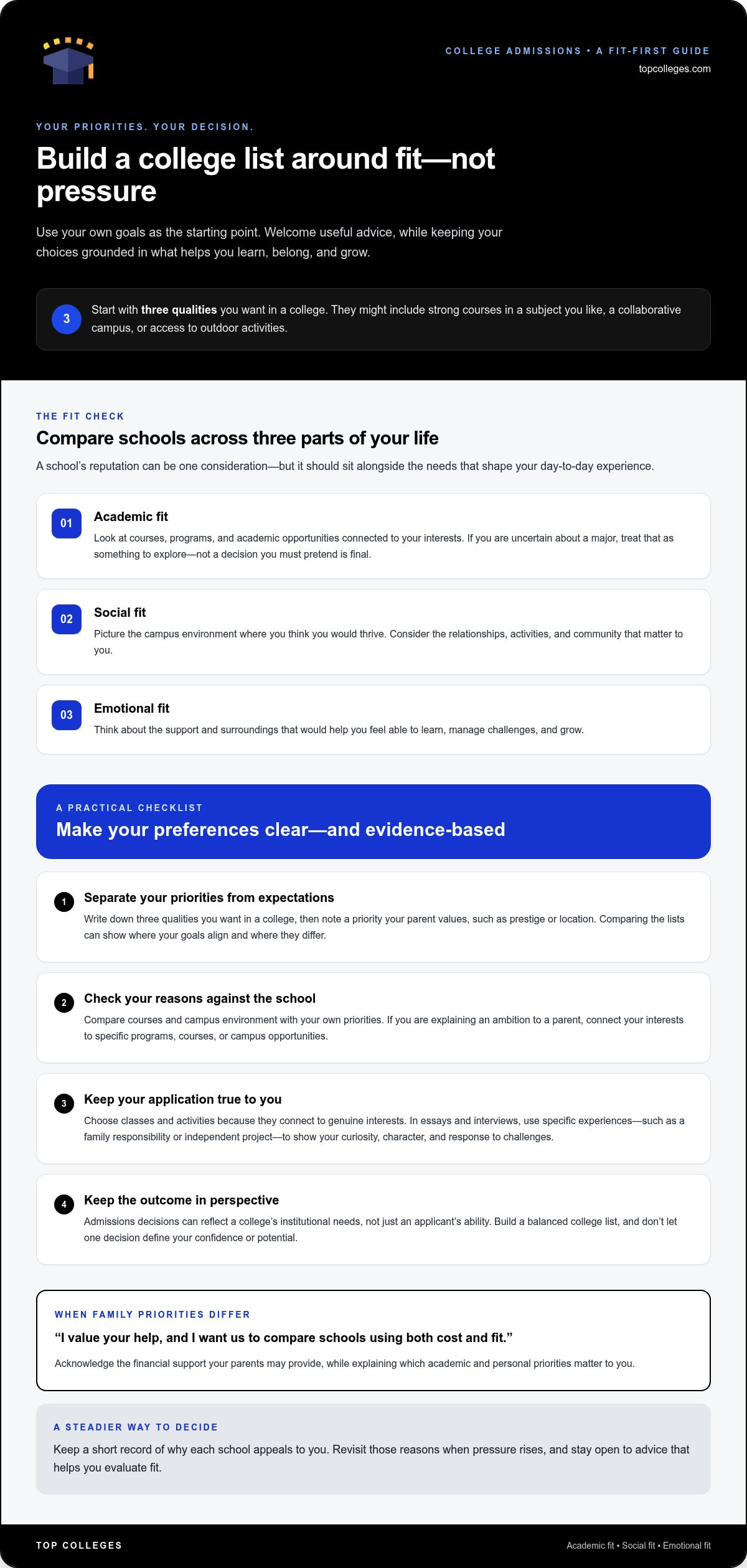
Start by separating your preferences from the expectations you hear at home. Write down three qualities you want in a college, such as strong biology courses, a collaborative campus, or access to outdoor activities. Then note a priority your parent values, such as prestige or location. Comparing the lists can show where your goals align and where they differ.
Excessive parental pressure can undermine self-esteem and make it harder to trust your judgment. When criticism makes you doubt a choice, pause and ask what evidence supports it. For example, compare a college’s courses and campus environment with your own priorities rather than treating a parent’s preferred ranking as the deciding factor.
Your application should reflect who you are, not a profile constructed solely to impress. Choose classes and activities because they connect to genuine interests, not just because they might strengthen an application. In essays and interviews, share specific experiences that reveal your curiosity, character, and response to challenges. A debate tournament, family responsibility, or independent project can show your individuality when you explain what it taught you.
Keep the longer view in mind. Over time, character and how you handle adversity shape success more than whether you attended a top-ranked school. That perspective doesn’t make college choices unimportant. It puts a school’s reputation alongside factors such as academic fit, relationships, and opportunities to grow.
Admissions decisions also reflect institutional needs. A highly qualified applicant may be rejected because a college needs a tuba player or more debaters in a particular class. That outcome isn’t a complete judgment of your ability or potential. It’s one reason to create a balanced college list rather than tie your confidence to a single decision.
If a parent doubts your ambitions, prepare a calm, evidence-based explanation. Show how your interests connect to specific programs, courses, or campus opportunities. If your parent emphasizes selectivity, research the number of U.S. high schools and the number of test takers scoring 33 or higher on the ACT and 1500 or higher on the SAT. Use those figures to frame the competition, not to measure your worth.
Financial support can shape family conversations, so acknowledge what your parents may contribute toward college costs. You can appreciate that support while explaining which academic and personal priorities matter to you. Try saying, “I value your help, and I want us to compare schools using both cost and fit.”
Confidence grows through deliberate choices. Keep a short record of why each school appeals to you, and revisit it when pressure rises. Your notes give you concrete reasons to stand by your preferences while leaving room for useful advice.
Discussing college interests and uncertainties
If your parents insist on a college or major you don’t want, explain your reasons calmly and offer alternatives that address their concerns. For example, if they favor a large university but you prefer a smaller campus, compare class formats, academic programs, and support resources together. If the discussion becomes difficult to keep productive, ask a guidance counselor to help facilitate it.
Choose a specific time to talk rather than raising college decisions during an argument. Tell your parents you want to discuss your interests, uncertainties, and what you need from them. Start with a question that invites them to listen: “Can you hear what excites me about these schools before advising me?” This shows that you value their perspective while making space for your own.
Prepare a few examples before the conversation. Name a subject you enjoy, a campus environment where you think you would thrive, or a concern you still need to explore. You might say, “I’m interested in environmental science, but I’m unsure whether I want to study it as a major.” This distinction helps your parents respond to your actual uncertainty instead of assuming you’ve already made a final decision.
Ask your parents what they hope a particular college or major will provide. They may be focused on career options, safety, or the experiences they want for you. Listen to the concern before responding, then connect it to a practical next step. If they worry about career prospects, compare relevant programs and possible academic paths rather than arguing only about a school’s name.
Keep exploring. A hobby, such as photography or playing an instrument, doesn’t have to become your degree. It can remain an important part of your life as you investigate other fields through classes, conversations, or campus programs. Likewise, choosing a major now doesn’t mean every interest must be permanent. Explain what you want to learn next and how you’ll reassess.
A guidance counselor can act as an intermediary when conversations at home stall. Ask the counselor to help clarify your priorities, identify questions for your parents, or guide a joint meeting. If your family disagrees about a school, compare academic fit, campus life, and practical concerns. A shared framework can shift the discussion from competing preferences to informed choices.
Close by agreeing on a next step, such as visiting a campus, researching a department, or revisiting the conversation after you’ve gathered information. If you want help organizing your priorities into a coherent college plan, college decision planning can provide a useful framework.
3. Managing parental involvement in applications and deadlines
Set boundaries by agreeing on specific tasks, communication times, and decisions that remain yours. For example, tell your parents you’ll review applications together each Sunday, but you’ll write and submit your own essays. A clear arrangement gives them a role without turning every study session or application step into a family checkpoint.
Pressure can intensify when parents hover, direct your choices, or repeatedly nag you about studying and applications. Instead of debating every reminder, propose a system. Keep a shared deadline calendar and choose a regular time to review upcoming tasks. If you’ve agreed to update it, your parent can consult the calendar instead of asking about applications throughout the day.
Decide where parental help is genuinely useful. You might invite a parent to brainstorm essay ideas, discuss how an experience shaped you, or help track deadlines. Keep the final essay in your own voice and make the final application decisions yourself. This lets a parent offer perspective without taking over the work that should represent you.
Some tasks involve family information or coordination. You can ask a parent to help prepare FAFSA and other financial aid documents while staying involved in understanding each step. Be specific about what you need: “Could we set aside time to organize these documents, then review the application checklist together?” A clear request is easier to act on than a general demand for help.
When a boundary is crossed, name the behavior and restate your agreement. For instance: “I know the deadline matters. We agreed I’d update the calendar tonight, so repeated reminders aren’t helping.” Keep your tone respectful, then follow through on the task. Consistency makes the boundary clearer than having a new argument each time.
Separate support from control by agreeing on who handles each part. Your parent might offer feedback on a college list while you decide which schools match your priorities. They can remind you at the agreed check-in while you manage daily work. If verbal agreements keep changing, put the arrangement in writing as a simple list of responsibilities and next steps.
If family discussions keep disrupting your work, ask a guidance counselor to help establish a workable communication plan. A counselor can clarify responsibilities, facilitate a conversation, and keep attention on your application priorities. If you miss a planned task, focus on the next action and update the calendar. A missed step calls for a revised plan, not constant monitoring.
You can ask your parents to brainstorm college essay ideas, track deadlines, or prepare FAFSA and other financial aid documents. Keep those requests tied to the tasks you agreed on, and stay involved in decisions and follow-through. Practical help can support your application without shifting ownership of your work.
4. Seeking a counselor, therapist, or trusted adult
Manage application stress by naming what feels difficult, taking a short walk, and speaking with someone you trust. If you feel very down, tell your parents how their words affect you and ask for help finding a counselor or therapist. If things at home feel very bad, speak immediately with a trusted adult.
Choose the right person for the problem. A guidance counselor can help you work through college decisions and may act as an intermediary in conversations with your parents. A therapist can offer support when distress feels persistent or difficult to manage alone. For broader personal development and future direction, personal coaching services such as Rainmakers Coaching International can help young adults build self-awareness and clarify their goals. A trusted adult, such as a relative, teacher, or coach, can also listen and help you plan what to do next.
Make the first conversation specific. Instead of saying, “Everything is stressful,” try, “I’m having trouble sleeping after our talks about my college list.” Describe what happened, how it affected you, and what support you want. For example, you might ask a teacher to help arrange a meeting with your parents and guidance counselor.
Use a counselor meeting to prepare, not to hand over your decision. Before you go, write down the main issue: perhaps a parent dismisses your interests or application discussions turn into arguments. Ask the counselor to help you explain your perspective and identify a constructive next step. If you want the counselor present, say so directly.
When speaking with your parents, focus on one recent example and its effect. You could say, “When you compare my choices with someone else’s, I feel discouraged and stop sharing my questions.” Then make a clear request, such as listening before offering advice. If the conversation becomes heated, pause and continue later with a trusted adult present.
Build short breaks into demanding application days. Step away from the screen, take a walk, or sit somewhere quiet before returning to an essay or deadline. Choose one task to resume, such as revising a paragraph or checking an application checklist. A defined next step can make the workload feel more manageable than trying to solve every concern at once.
After asking for support, agree on a practical follow-up. A counselor might help schedule a family conversation, while a trusted adult could check in afterward. If you still feel very down, tell your parents plainly that you need help speaking with a therapist. If the situation at home feels very bad, don’t wait for the next college meeting. Tell a trusted adult immediately.
5. Parental pressure during college admissions
Pressure can be harder to manage when college decisions carry several family expectations. A parent may be concerned about your safety and well-being or hope you’ll have college experiences similar to their own. Recognizing that context can help you respond to the concern beneath the demand without treating your parent’s preferred school as your only option.
Signs that parental pressure may be affecting your mental health include rising anxiety, ongoing burnout, and declining academic performance. Notice patterns around specific events, such as feeling overwhelmed after college conversations or struggling to focus on assignments. If these changes persist, tell a trusted adult and explain what has been happening.
Address the issue rather than avoiding every conversation. Try reflecting your parent’s words in your own phrasing, a technique called active listening: “You’re worried I won’t be safe far from home.” Then explain your view: “I want to compare safety and support alongside academics.” This acknowledges their concern while keeping your priorities in the discussion.
Be clear about decision-making. You can say, “I want to make my college decisions, and I’m willing to consider advice that helps me evaluate my options.” Letting your parents weigh in on choices that matter less to you can make it easier to stand firm about a school or program central to your plans.
Make your reasoning visible. A short presentation can compare each school’s academic programs, campus environment, and support for your goals. If your parents focus on selectivity, explain how many students score above 1500 on the SAT. Use that context to discuss admissions competition, not to define your ability or worth.
Agree on a broader definition of success: finding a college that fits your academic, social, and emotional needs. Rejection from a top-tier college isn’t a measure of failure, and fixating on one school narrows your choices. Apply to multiple schools that fit, then discuss the strengths of each option with your parents.
If a conversation becomes stressful, suggest taking a walk or making space to clear your head before continuing. Return with one concrete point, such as why a school fits your goals or what advice you’re prepared to consider. A practical approach to dealing with parental pressure during college admissions keeps the focus on your future while making room for respectful family input.
Excessive parental pressure can increase college students’ anxiety, so address the problem with your parents rather than hiding from it. Their expectations may reflect concern about your safety and well-being or a hope that you’ll have college experiences similar to their own. Recognizing these possible reasons doesn’t mean you have to accept every preference as a requirement.
You can explain that you want to make your own college decisions while remaining open to helpful parental advice. Let your parents weigh in on some choices, and stay polite but firm about the decisions that matter most to you.
Top Colleges: College Admissions Counseling
Top Colleges offers College Admissions Counseling for students who need structured guidance through college applications and family disagreements. If pressure makes it difficult to clarify your priorities or present your experiences, counseling can help you develop a focused application strategy. Support may include personalized admissions counseling, portfolio development, and interview preparation, helping you approach each part of the process with greater clarity.
This guidance can help when you and your parents disagree about how to present your interests or when you want an informed perspective on your application choices. It complements the conversations and boundaries discussed above while keeping your goals at the center of your admissions plan.
Visit topcolleges.com to learn more about College Admissions Counseling.
Choose a college path that reflects your future
Your next step is to turn reflection into an approach to decision-making you can sustain. As you continue dealing with parental pressure during college admissions, keep your goals visible and treat family advice as input, not a substitute for your judgment. You can listen carefully, ask questions, and still choose a direction that feels meaningful to you.
When you want expert help shaping your application strategy, Top Colleges offers College Admissions Counseling. The firm also provides MBA Admissions Consulting and Law School Admissions Consulting for applicants pursuing those paths. Focused guidance can help you clarify how to present your interests and approach the admissions process with greater intention.
You don’t have to resolve every family disagreement before taking a thoughtful next step. Stay curious about your options, make decisions carefully, and keep moving toward a college experience that fits the person you’re becoming.
Frequently Asked Questions
How do you deal with overbearing parents during the college process?
Make the conversation specific, and separate advice from decisions you need to make yourself. For example, if a parent insists on removing a college from your list, ask them to explain the concern, then compare it with your own reasons for applying. If discussions become circular, pause and return to the issue with a school counselor present. A neutral facilitator can help keep the conversation focused on options rather than blame.
How can students talk to parents about college choices and admissions pressure?
Explain how the pressure affects you using a recent, concrete example, then say what would make the discussion more useful. You might say, “After our last conversation, I felt unable to explain why I’m interested in this program. Could you tell me your main concern first?” That opening invites a response without surrendering your point of view. If you disagree, address one concern at a time instead of debating every college choice together.
What can students do if parental pressure becomes emotionally abusive or threatens their safety?
If you feel unsafe, speak immediately with a trusted adult, such as a teacher, school counselor, relative, or coach. Describe the specific words or actions that concern you, and say plainly whether you feel safe going home or continuing the conversation. Don’t confront a parent alone if doing so could put you at risk. Ask the trusted adult to help you find a safe next step and involve appropriate support.