

Disclaimer
Content on this page of topcolleges.com is computer generated and therefore is not guaranteed to be 100 percent accurate about various aspects of the education sector. On balance, however, many students and families seek general information about high schools, colleges and universities, graduate programs, testing, education and career planning, and job placement before beginning one-on-one admissions counseling tailored to their specific needs.
What if transferring isn’t the answer, but a clearer understanding of what you need from college is? When your current institution no longer supports your academic or personal direction, it’s natural to consider a change. But dissatisfaction alone can’t explain why another college is the right next step. Thoughtful transfer college admissions consulting helps you assess the decision and build a credible, student-authored case for it.
The process can be difficult to untangle. Requirements and deadlines vary by institution, credits may not transfer as expected, and application materials need to show more than a wish to start over. A focused strategy connects your college experience to specific academic goals, helping you explain what you’re seeking and why.
This guide explains how transfer consulting can help you evaluate your options, plan for the application process, and present your direction clearly. You’ll also learn how personalized guidance, portfolio development, personal statement review, and interview preparation can help you communicate your experiences and goals in your own voice.
Key Takeaways
- Separate a temporary challenge from a lasting mismatch before deciding whether transferring supports your academic direction.
- Use transfer college admissions consulting to connect your goals, school research, and application narrative in a coherent strategy.
- Understand what admissions guidance can strengthen, and why no consultant can control an institution’s decision or guarantee admission.
- Plan around each college’s current transfer requirements and deadlines, especially when considering several schools.
- Use personalized guidance, portfolio development, and personal statement review to communicate your experiences clearly and authentically.
Transfer College Admissions Consulting: Start by Clarifying Why You Want to Transfer
Considering a different college can bring relief, doubt, or both. Before researching applications, identify what is prompting the decision. Transfer admissions consulting provides individualized strategy for students weighing a change of institution. It helps them examine their academic direction, consider whether another setting better supports their goals, and connect that reasoning to application decisions. The focus is not simply on leaving, but on deciding what a purposeful next step would look like.
Uncertainty is part of that assessment. A difficult semester, a disappointing course, or the strain of adjusting to a new environment can feel decisive in the moment. Those experiences deserve attention, but they don’t automatically signal a lasting mismatch. Reviewing the transfer admissions process in the United States can provide context, while the personal decision depends on the student’s own circumstances and goals.
Strategic guidance, not a guarantee: Transfer consulting can help a student clarify their reasons, plan an application approach, and communicate their experiences. It cannot control an institution’s review or promise admission.
How to tell whether transferring fits your academic goals
Move beyond the question “Am I unhappy here?” Ask what you want to study, access, or pursue that your current setting doesn’t support. Perhaps your intended field requires a course sequence or academic environment you can’t find there. Or perhaps the concern is less specific: adjusting socially, feeling overwhelmed, or being disappointed by one term. Naming the difference helps you determine whether a new institution would address the underlying issue.
Consider what could change if you stayed. Would a different major, an academic adviser, a new course plan, or greater involvement in campus life meaningfully resolve the concern? These options don’t rule out transferring. They help you test whether you need a different college or a different experience at the one you attend. If the mismatch remains after that reflection, you’ll have a clearer basis for exploring alternatives.
What a compelling transfer rationale needs to explain
A credible rationale links three elements: what you’ve experienced, what you’ve learned about your educational priorities, and what you hope to pursue next. For example, a student who becomes interested in environmental policy through current coursework might explain how that interest developed, then identify the academic opportunities they want to pursue. The aim isn’t to polish the story at the expense of honesty. It’s to show how reflection has informed a considered next step.
Describe the environment you’re seeking in specific, constructive terms. Focus on academic priorities and goals rather than criticizing your current college or treating another institution as an escape. As you shape your explanation, ask:
- Which experiences clarified what matters to me academically?
- What do I hope to pursue at a new institution?
- How does that next step follow from what I’ve learned?
These questions give transfer college admissions consulting a useful starting point: a rationale rooted in the student’s experience, not a generic claim that another college is simply “a better fit.”
How Transfer College Admissions Consulting Builds a Coherent Application Strategy
A sound transfer plan turns reflection into decisions, then decisions into application materials that reinforce one another. Transfer strategy links a student’s reasons, record, and next-step goals. Transfer college admissions consulting provides structure for that work, while practical education planning keeps the strategy grounded in what the student wants to learn and pursue, not simply a list of schools.
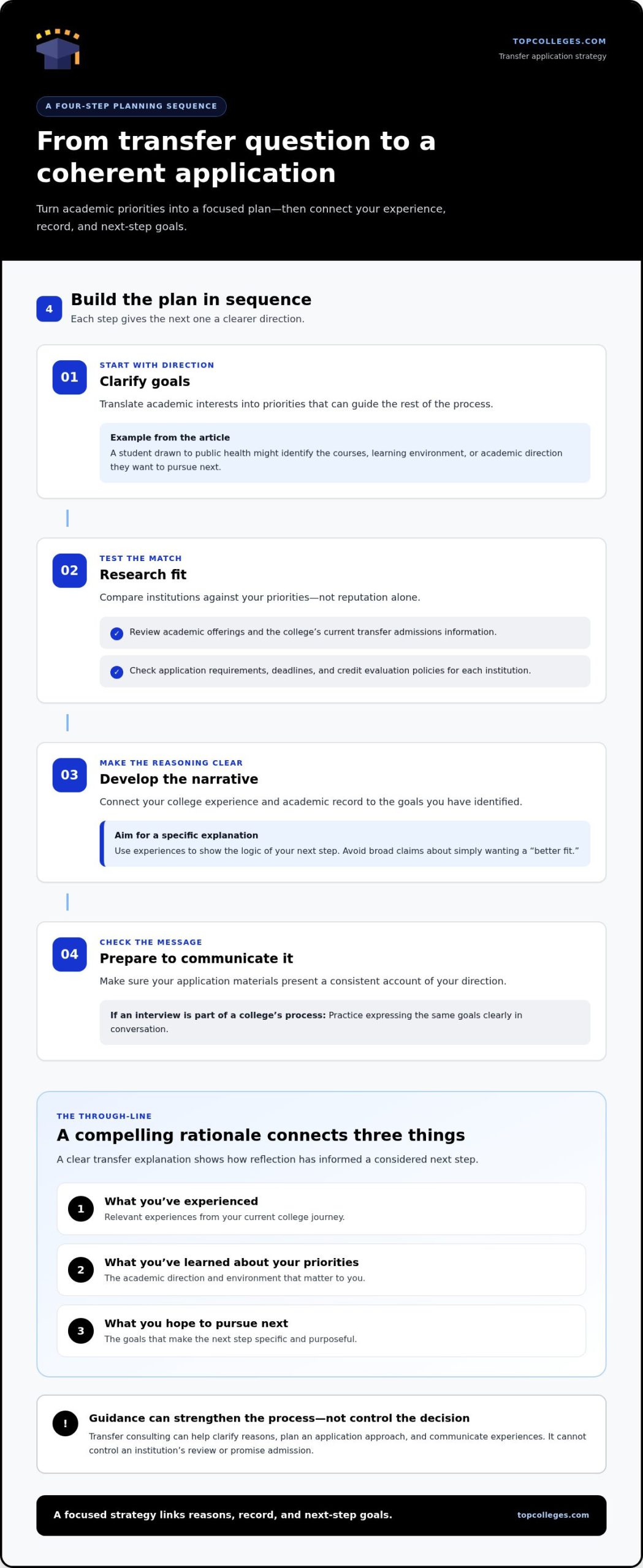
Use this four-step sequence to move from broad intentions to a focused application plan:
- Clarify goals. Translate academic interests into priorities. A student drawn to public health, for example, might identify the courses, learning environment, or academic direction they want to pursue next. These priorities give the rest of the process a reference point.
- Research fit. Compare institutions against those priorities rather than reputation alone. Review academic offerings alongside each college’s current transfer admissions information, including application requirements, deadlines, and credit evaluation policies.
- Develop the narrative. Connect the student’s college experience and academic record to the goals they’ve identified. The application should explain the logic of the next step, using specific experiences rather than broad claims about wanting a better fit.
- Prepare to communicate it. Check that the application materials present a consistent account of the student’s direction. If an interview is part of a college’s process, practice expressing the same goals clearly in conversation.
These steps work as a cycle of planning and reflection. Research may refine a student’s priorities; reviewing the academic record may reveal experiences that sharpen the application story. Transfer also involves practical questions, including how credits may apply to a future program. The Brookings Institution discusses some of the benefits and challenges of college transfer, illustrating why the decision deserves careful consideration of the student’s circumstances and potential pathway.
Build a transfer school list around educational fit
Start with the student’s academic priorities, then identify colleges whose offerings appear relevant. For each school, review its official admissions information and compare current requirements and timelines. Keep a planning document with deadlines, required materials, credit policies, and questions to resolve. This makes differences between institutions visible early, without treating a school’s reputation or apparent fit as a prediction of admission.
Coordinate the application story and supporting materials
Map each required item to the transfer rationale: the personal statement can explain the student’s direction, while the academic record provides context for their college experience. Personal statement review can strengthen organization and expression while preserving the student’s authorship. Interview preparation, when applicable, helps the student discuss goals in their own words. For individualized guidance that connects reflection with application planning, Top Colleges’ admissions counseling supports a student-centered strategy.
What Transfer Consulting Can, and Cannot, Do for Your Admission Chances
Can a consultant make a college admit you? No. An admissions consultant can’t control an institution’s decision, override its requirements, or guarantee an outcome. The value of transfer college admissions consulting is practical: it gives students a structured way to reflect on their goals, plan their applications, and communicate their experiences clearly.
Admissions strategy can improve the clarity of an application, but it cannot determine a college’s decision. Strong preparation is within a student’s reach; the final evaluation belongs to each institution.
What personalized admissions guidance can strengthen
Guidance can help a student organize the elements of an application into a thoughtful whole. That may include revisiting academic goals, developing an application portfolio, reviewing the personal statement, and preparing for an interview when required. Each part should help explain the student’s direction, not create a polished persona disconnected from their actual experience.
Ethical review preserves student authorship. A reviewer can ask questions, identify unclear passages, and suggest ways to improve structure or expression. The student remains responsible for the ideas, experiences, and final language. A consultant should not invent a motivation, write a student’s personal history, or misrepresent academic performance. The objective is clearer communication, not a manufactured story.
Why no consultant can promise a transfer admission outcome
Colleges set their own requirements and make decisions through their own evaluation processes. Applicants may face different criteria depending on the institution and their circumstances, so no outside adviser can guarantee how a specific application will be assessed. A consultant should not present acceptance-rate figures as a personal prediction or imply special influence over an admissions office.
Research can help explain the wider transfer landscape, but population-level patterns don’t determine one student’s result. The National Student Clearinghouse Research Center’s transfer research provides information about transfer student outcomes. Such research can offer context for planning; it cannot tell an individual applicant what a college will decide.
Measure progress by the quality of preparation, not by promises about admission. A student can aim to:
- Present a rationale grounded in their academic experience and goals.
- Submit accurate, considered materials that follow the college’s stated requirements.
- Explain their educational direction in their own words, including in an interview when applicable.
These aims focus on what the student can shape. Personalized admissions guidance brings structure to the work while leaving the student’s choices, voice, and record intact. The result is a more deliberate application process, not certainty about its outcome.
When Transfer College Admissions Consulting Is Most Useful
Some students know exactly what they want from another college. Others sense that something needs to change but can’t yet explain what a different institution would offer. That gap is where structure can help. Transfer college admissions consulting is especially useful when a student needs to turn uncertainty into a practical plan, organize competing priorities, or connect different parts of their academic story.
It can also help when the workload feels fragmented. Researching colleges, tracking application tasks, understanding credit policies, and preparing for interviews each demand attention. A structured approach helps the student see how these tasks fit together, while practical and self-reflective education planning keeps decisions connected to their goals.
Signals that an applicant may benefit from structured guidance
Look for questions the student can’t yet answer or gaps between what they say they want and what their application materials communicate. These aren’t signs that a student must transfer. They point to areas where reflection and planning may be valuable.
- The student can’t clearly describe what they want to study, access, or pursue at a different college.
- Application materials present separate interests without showing how they connect to the student’s direction.
- The student is considering several schools and needs a consistent way to compare them.
- Research, deadlines, application tasks, and interview preparation feel difficult to coordinate.
Guidance can help organize these questions without deciding for the student. The aim is to make the next steps more deliberate, whether the student proceeds with transfer research or continues exploring options at their current college.
What to prepare before beginning a transfer plan
A useful starting point is a brief working inventory. It doesn’t need to be polished. It should give the student and adviser a shared view of what matters, what needs investigation, and what information is already available.
- Academic priorities: Note subjects, programs, learning experiences, or other educational opportunities the student hopes to pursue.
- Current concerns: Describe what feels misaligned and distinguish lasting academic or environmental concerns from immediate frustrations.
- Academic history: Gather a record of coursework and progress to inform planning and later research into credit policies.
- School-specific research: For each college under consideration, record current transfer requirements, required materials, deadlines, and published credit guidance.
Application rules and timing vary by institution, and a student’s options may depend on their circumstances. Use each college’s official admissions information to verify current requirements and dates; don’t assume one school’s timeline applies to another. Keep a simple tracker and revisit it as plans develop.
At Top Colleges, Steven Roy Goodman, MS, JD, leads personalized admissions strategy grounded in practical and self-reflective education planning. This guidance helps students organize their questions, priorities, and next steps into a considered transfer plan.
Work With Top Colleges on a Student-Centered Transfer Strategy
A transfer application should reflect more than a wish to change institutions. It should show how a student’s experience has shaped their academic direction and why the next step is purposeful. Top Colleges provides personalized transfer admissions guidance led by Steven Roy Goodman, MS, JD, Educational Consultant and Admissions Strategist. The work centers on practical, self-reflective education planning, with application decisions shaped around each student’s goals and experiences.
How Steven Roy Goodman supports transfer applicants
Goodman helps students bring structure to a process that can feel fragmented. Together, they can examine educational priorities, consider how those priorities inform school research, and shape an application approach grounded in the student’s circumstances. The purpose is not to prescribe a single path, but to help the student make informed decisions and explain their direction clearly.
Support includes portfolio development and personal statement review. Thoughtful feedback can help a student organize ideas and express their reasoning while keeping the work authentically theirs. Interview preparation helps students practice discussing their goals and transfer rationale in their own words. The emphasis is clear, credible communication, not a promised admissions result.
Connect transfer planning with broader admissions strategy
Transfer planning draws on the same central discipline as other admissions work: aligning a student’s goals, experiences, and application materials. For a wider view of how those elements can inform a plan, explore this guide to college admissions counseling strategy. Transfer has its own considerations, so a student’s academic record, intended direction, and each institution’s requirements should remain central.
Students who want to examine that framework can read more about transfer college strategy. The key point is the role of individualized guidance: it can help a student connect reflection to concrete application decisions, organize supporting materials, and prepare to speak consistently about their plans. The student remains the author of their story and the decision-maker throughout the process.
With transfer college admissions consulting, the aim is a considered strategy that reflects the student’s priorities and helps them present their direction with care. Top Colleges brings practical planning and self-reflection together so students can approach the next step with greater focus, while recognizing that each institution makes its own admissions decisions.
Make Your Next College Decision With Greater Clarity
A transfer decision doesn’t need to begin with a finished explanation. It can begin with a question: what do you want your education to make possible next? Answering honestly gives you a stronger foundation for choosing where to apply and shaping an application that reflects your direction. Transfer college admissions consulting can turn that reflection into deliberate next steps while keeping the student’s voice and choices at the center.
At Top Colleges, Educational Consultant and Admissions Strategist Steven Roy Goodman, MS, JD, provides personalized guidance that includes admissions strategy, portfolio development, personal statement review, and interview preparation. The goal is thoughtful preparation and clear communication, not a promise about an institution’s decision.
You don’t have to resolve every question at once. Start by identifying the academic priorities that matter most, then use them to guide your next decision. A considered plan can help you move forward with purpose.
Frequently Asked Questions
Can I transfer colleges after one semester?
Possibly, but a student’s ability to transfer after one semester depends on the receiving college’s current rules, application cycle, and completed academic work. Some institutions may expect a particular amount of college coursework, while others set different criteria. Check each target school’s official transfer page for eligibility and deadlines. You can clarify academic priorities and research options now, even if you apply in a later cycle. Transfer college admissions consulting can help organize that early research.
Does my GPA reset when I transfer to another college?
There isn’t one universal GPA-reset rule. The receiving college decides how it reviews prior grades for admission and which completed courses it accepts for credit. Those are separate questions: a course may be considered during admission review yet not apply to a particular degree requirement, depending on the school’s policies. Compare transfer and credit-evaluation guidance at every institution on your list before relying on an assumed GPA or credit outcome.
Do transfer applicants need to submit high school transcripts?
Sometimes, but requirements differ. A college may request high school records based on how much college coursework you’ve completed or its transfer application policy. Use the current transfer checklist for each institution rather than assuming college transcripts replace all earlier records. Build time into your plan to request high school and college transcripts, along with any other documents the application instructions require, so missing records don’t cause an avoidable delay.
Can I use the Common Application to apply as a transfer student?
Possibly. The Common App for transfer is open for the 2026-2027 application season, but participating colleges and application methods vary. Confirm that each intended school accepts the platform for transfer applicants, then follow that college’s current instructions for forms, required materials, and submission. A school may use a different application or require additional steps, so review its transfer admissions information rather than relying on the platform alone.
How many colleges should I apply to as a transfer student?
There’s no ideal number for every transfer applicant. Build a focused list of colleges that match your academic priorities and where you can complete each application carefully. The right scope depends on how different the school requirements are, how much time the materials demand, and whether you can explain your reason for applying to each institution. A purposeful list is more useful than applying broadly without a clear academic rationale.
Can international students get help with transferring to a U.S. college?
Yes. Top Colleges provides admissions guidance to international students pursuing U.S. higher education, including transfer planning. Students can use that guidance to organize academic goals, application materials, and institution-specific research. Requirements differ by college, so use each institution’s current admissions information for transfer rules and required documents. The focus is admissions planning, with each college’s published instructions serving as the reference for its process.