

Disclaimer
Content on this page of topcolleges.com is computer generated and therefore is not guaranteed to be 100 percent accurate about various aspects of the education sector. On balance, however, many students and families seek general information about high schools, colleges and universities, graduate programs, testing, education and career planning, and job placement before beginning one-on-one admissions counseling tailored to their specific needs.
What if the goal isn’t to eliminate uncertainty, but to stop it from directing every decision? For students balancing applications and families carrying high expectations, managing college application anxiety can feel like another task with no clear finish line. The pressure is real: deadlines, essays, school choices, and expectations can all compete for attention.
A useful first step is to separate what you can influence from what you can’t. You can’t control an admissions decision, but you can build a thoughtful school list, organize the work, and agree on how your family will communicate. A clear plan won’t guarantee an outcome, but it can make the process easier to navigate.
This guide explains what may be driving stress, how to choose practical next steps, and how to set realistic expectations together. It also covers when admissions guidance or mental-health support may help. The aim isn’t to make applications effortless. It’s to move through the process with greater clarity, agency, and support.
Key Takeaways
- Application anxiety often reflects uncertainty and high perceived stakes, not a lack of ability or preparation.
- Sort worries into actions you can take, questions you can clarify, and outcomes you can’t control.
- For managing college application anxiety, create a realistic plan that breaks the workload into clear, manageable steps.
- Supportive family conversations start with listening and asking what help the student wants, rather than taking over decisions.
- Personalized admissions guidance can help students organize choices and clarify next steps while outcomes remain uncertain.
Why college application anxiety feels so intense, and what it can mean
College application anxiety is stress tied to uncertainty, competing demands, and the feeling that the stakes are unusually high. A student may worry about choosing colleges, presenting themselves well, meeting deadlines, and what an admissions decision could mean for the future. These concerns can build even when the student is capable and making steady progress.
Feeling pressure doesn’t prove a student is unprepared. They may be organized, thoughtful, and well suited to pursue college, yet still find it difficult to make consequential choices without all the information they want. When applications, schoolwork, activities, and family conversations converge, several manageable tasks can start to feel like one overwhelming demand.
Testing can add another layer. For students concerned about exams, understanding test anxiety offers a starting point for considering how performance pressure may affect thoughts and feelings. Application stress, however, is broader than test anxiety and varies from student to student.
Application stress describes a response to a demanding process; it is not, by itself, a mental-health diagnosis. Ordinary pressure may rise near a deadline and ease when a task is complete. More persistent distress deserves attention, particularly when it starts to interfere with everyday routines or functioning. The goal isn’t to label a student, but to notice when additional support could help.
What parts of the college application process create uncertainty?
Uncertainty can arise at several points. A student may be clarifying their goals, deciding what makes a college a good fit, waiting to learn whether they’ll be admitted, or wondering what their future will look like. These questions can feel especially difficult because answers may not come quickly and aren’t always within the student’s control.
Applying to several colleges can also mean managing different essays, forms, recommendations, and deadlines. Without a clear view of each requirement, the workload can blur into one daunting project. Family expectations and comparisons with peers may add pressure, especially when students aren’t sure how to express their own preferences.
When is application stress a reason to seek more support?
Pay attention to meaningful changes in daily life. If stress makes it difficult to sleep, eat, concentrate, attend school, keep up with ordinary responsibilities, or stay connected with others, treat that as a reason to check in, not as proof of a diagnosis. One difficult day doesn’t define a student’s mental health, but a persistent pattern deserves care.
Students don’t have to manage college application anxiety alone. They can tell a trusted adult what feels difficult and describe the kind of support they need. If distress persists or significantly affects daily life, speaking with a qualified mental-health professional can help the student assess what’s happening and identify appropriate support. Additionally, for adolescents who experience heightened social anxiety or struggle to stay connected with peers during stressful transitions, resources from Social Skills Australia provide practical techniques for initiating conversations and building supportive friendships.
Understanding college application anxiety: uncertainty, control, and perspective
An admissions decision can feel like a verdict on a student’s ability or future, even though it’s one decision made by one institution at one point in time. When an outcome matters deeply but remains unknown, attention can get fixed on possibilities that aren’t yet answerable. Not every concern can be resolved right away. The useful question is whether there’s an action to take or whether the next step is to tolerate uncertainty.
Perfectionism can intensify the pressure. A student may revise an essay repeatedly to avoid every possible misinterpretation, or compare activities with classmates and conclude they’re falling behind. Neither approach gives the student full control over how an application will be read. Thoughtful preparation matters, but trying to anticipate every reader’s reaction can keep attention focused on what remains unknown.
Planning can strengthen an application and improve preparation, but it cannot guarantee an admission decision. That distinction is central to managing college application anxiety: direct effort toward decisions and tasks a student can influence, rather than trying to control an institution’s judgment. For more context on organizing choices, explore this college admissions counseling strategy guide.
Which parts of an application are within a student’s control?
A student can make considered choices about where to apply, how to describe personal experiences, and how to track application requirements. They can decide when to seek feedback and set aside time to revise. These choices shape the quality and completeness of an application, but admissions offices make their own decisions. Students can’t dictate how every reader will interpret what they submit.
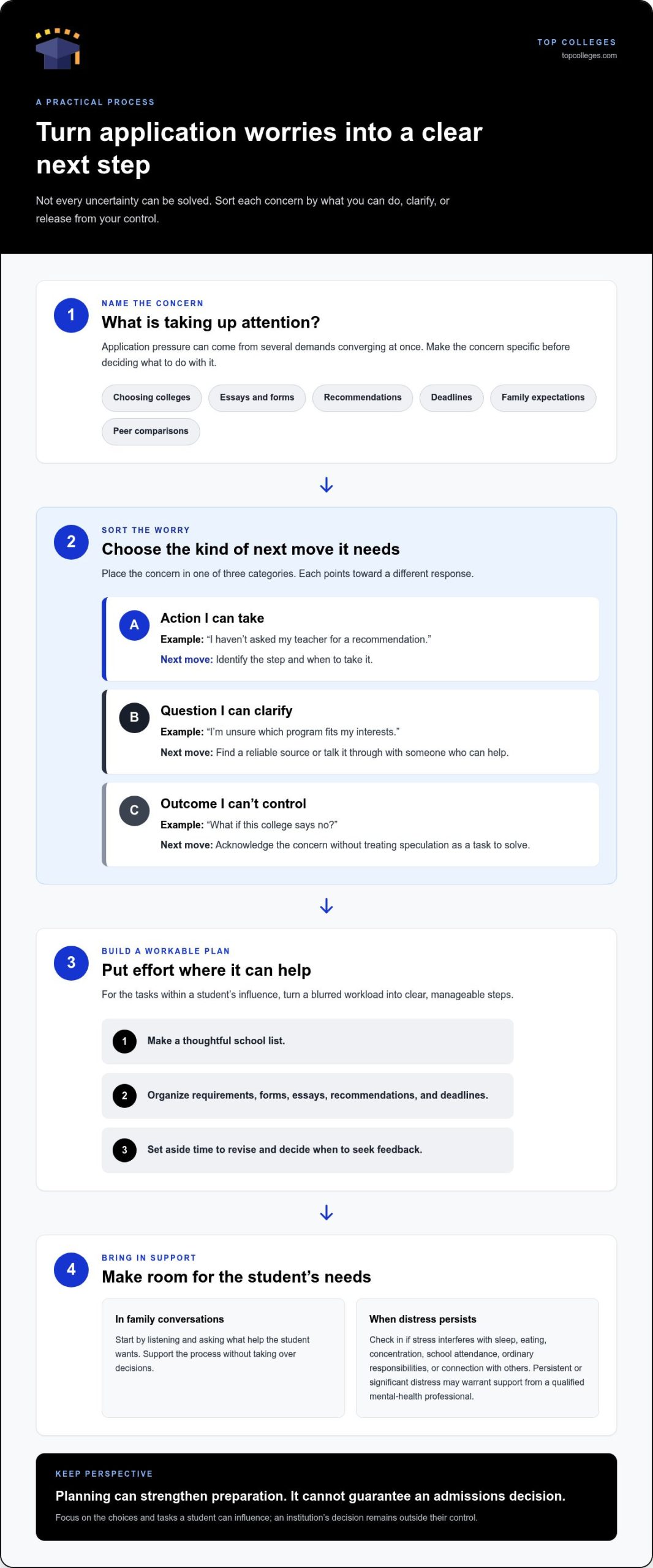
To separate action from uncertainty, sort a worry into one of three categories:
- Action I can take: “I haven’t asked my teacher for a recommendation.” Identify the next step and when to take it.
- Question I can clarify: “I’m unsure which program fits my interests.” Find a reliable source or talk it through with someone who can help.
- Outcome I can’t control: “What if this college says no?” Acknowledge the concern without treating speculation as a task to solve.
This approach doesn’t dismiss a worry. It helps direct effort where it can be useful. The National Association for College Admission Counseling shares advice from college admission counselors that can offer additional perspective on easing application pressure.
How can students put uncertainty into perspective?
Start by describing the specific fear in one sentence. Then ask: Is there an action to take, a question to clarify, or an outcome I have to wait on? Next, return to personal priorities. A college’s ranking or a peer’s plans may be part of the discussion, but neither determines which environment, academic options, or experience matters most to an individual student.
If sorting through these choices feels difficult, personalized college admissions counseling can provide a structured setting to reflect on priorities and clarify next steps, while recognizing that final decisions remain outside the student’s control.
Helpful support versus added pressure during college applications
Family support can make a demanding process feel more manageable, but good intentions don’t always land as intended. Advice offered too quickly may sound like criticism. Taking over a task may ease stress in the moment but leave the student feeling less ownership. Rather than judging either person, notice how a response affects communication and the student’s ability to make decisions.
Use this comparison as a conversation guide, not a scorecard. The same response may feel helpful to one student and pressuring to another, so ask what kind of support works for them.
| Supportive action | Response that may increase pressure |
|---|---|
| Ask, “What would help most right now: listening, thinking it through, or practical help?” | Jump straight to advice before understanding what the student needs. |
| Offer to help organize agreed-upon tasks or reminders. | Take over the application calendar or make decisions without the student’s input. |
| Listen to concerns without promising an outcome. | Say “You’ll definitely get in” or dismiss the worry with “Don’t stress.” |
| Set a mutually agreed time to discuss applications. | Make every conversation, meal, or check-in about admissions progress. |
| Keep essays and college choices student-led, offering feedback when requested. | Rewrite a personal statement or steer the student toward a choice that reflects someone else’s priorities. |
Reassurance doesn’t require certainty. Promising admission can’t remove the unknown, and dismissing a concern may leave a student feeling unheard. A steadier response is to acknowledge the feeling and focus on the support available now: “I can see this is weighing on you. Would it help to talk through one part together?”
How can parents help without taking control?
Begin with one open question: “What would be most useful from me today?” If the student wants practical help, agree on a specific task, such as sorting upcoming deadlines or setting a reminder. Keep application choices and personal statements student-led. Then choose a calm, mutually agreed time to check in, so applications don’t become the subject of every family conversation.
Boundaries can help both sides. A parent might say, “Let’s talk about applications after dinner on Sunday,” while the student agrees to bring questions or updates then. A predictable check-in creates room for support without constant monitoring. If the plan stops working, adjust it together rather than treating a missed task as evidence of a lack of commitment.
How can students ask for the support they need?
A direct request can name both the stressor and one specific form of help: “I’m overwhelmed by the essay, and I’d like you to listen while I explain my ideas. Please don’t rewrite it.” Or: “I’m worried about keeping track of deadlines. Could you help me organize the list?” Clear requests make it easier for others to help without guessing.
If a family conversation feels difficult, a student can start with another trusted adult, such as a school counselor or relative. Asking for help isn’t weakness or proof that a student can’t manage college applications. It’s a practical way to identify what would make the next step more manageable.
A practical plan for managing college application anxiety
A plan won’t remove every unknown, but it can make the work visible and give each task a place. Treat it as a flexible working document, not another standard to meet perfectly. Adjust it when school demands, priorities, or application requirements change.
- Gather every task. List each application, essay, recommendation request, form, and follow-up. Include schoolwork and other commitments so the plan reflects the student’s actual capacity.
- Confirm the deadlines. Check requirements and dates through each college’s official admissions information. Record submission deadlines, along with earlier dates for tasks that depend on someone else’s input.
- Prioritize the next actions. Identify what is time-sensitive, what depends on another person, and what can wait. A recommendation request may need to happen before an essay’s final revision, even if the essay feels more urgent.
- Schedule realistic work periods. Assign tasks to specific blocks that fit around classes, responsibilities, and rest. Break a broad task into an observable action, such as “write three possible opening ideas” instead of “finish the personal statement.” Include short breaks.
- Review and adjust. Check progress at a regular, agreed-upon time. Leave room for questions, feedback, and revision before submission dates, and update the plan if a task takes longer than expected.
Choose one reliable tracker, such as a calendar or task list, and keep deadlines there. Checking several apps, lists, and messages repeatedly can create more noise than clarity. Starting selected tasks early, such as requesting recommendations or drafting an essay before its final review, can leave room for feedback. It doesn’t guarantee less stress, but it may help avoid preventable last-minute pressure.
How can students make application tasks feel manageable?
Turn each large assignment into a next action small enough to begin. “Complete applications” might become “open the application and note the unanswered questions.” “Work on the essay” could become “choose one experience to explore.” Schedule a realistic work period, then stop or reassess when it ends. A clear endpoint makes progress easier to see.
What should students do when anxiety interrupts the plan?
Pause and name the immediate concern: is there a specific task, an unanswered question, or a fear about an outcome? Take a break, speak with someone trusted, or reset the schedule before choosing one manageable action. Keep a short list of people to approach, such as a family member, school counselor, or trusted adult. If distress persists or significantly disrupts daily life, seek support from a qualified mental-health professional.
Structured admissions guidance can help students organize choices and clarify next steps through an individualized, realistic plan.
Managing college application anxiety with personalized admissions guidance
A structured plan can make college applications easier to approach, but students don’t have to build that plan alone. Personalized admissions counseling brings practical, self-reflective education planning to a process that may otherwise feel like a series of disconnected choices. The purpose isn’t to remove every doubt. It’s to help a student understand their priorities, organize the work, and make informed decisions while uncertainty remains.
This distinction matters. Counseling can help students prepare, but it can’t guarantee an offer of admission or determine how a college will evaluate an application. Managing college application anxiety means focusing on thoughtful preparation without treating an advisor’s guidance as a promise about the outcome.
What can personalized admissions counseling help organize?
A useful planning process starts with the student: their interests, experiences, goals, and questions about college fit. Those priorities can inform an admissions strategy and provide a coherent framework for decisions and tasks. Portfolio development, personal statement review, and interview preparation can each help students work through a distinct part of the application process without losing sight of the larger picture.
For example, a student might have meaningful experiences but feel unsure which ones best reflect their interests. Reviewing a portfolio or discussing admissions strategy can help them consider how those experiences fit into their education plans. Feedback on a personal statement can help clarify whether the essay communicates the student’s perspective, while interview preparation gives them an opportunity to reflect on how they want to discuss their goals. For more focused essay planning, see this college essay strategy guide.
This guidance can connect separate tasks to a purpose. Instead of approaching each requirement as an isolated hurdle, a student can understand what they’re trying to express and identify a practical next step. The student remains the author of their choices and personal materials; guidance helps them examine and refine their approach.
How can families use guidance without raising the stakes?
Before beginning a planning process, students and families can discuss what each person hopes to gain and how responsibilities will be shared. A student might want help clarifying priorities and reviewing materials, while a parent may want a clearer sense of next steps. Naming those expectations can keep support constructive and preserve the student’s voice.
Admissions counseling provides expertise, direction, and structure, but it isn’t a guarantee of admission or a substitute for emotional support. If distress is persistent or disrupting daily life, qualified mental-health support may also be appropriate. These forms of support serve different purposes, and a student may benefit from one or both.
A thoughtful plan can strengthen preparation while respecting each student’s choices. Explore admissions counseling with Top Colleges to consider how personalized guidance can bring greater structure to the process.
Take the Next Step with Greater Confidence
You don’t need to resolve every uncertainty before moving forward. Choose one useful next step, whether that means clarifying a priority, setting aside time to work, or asking for support. Managing college application anxiety is an ongoing process of making room for preparation without demanding certainty from yourself or your family.
For students who would benefit from a more structured admissions plan, Top Colleges offers admissions counseling and educational consulting to families across the United States. Founder Steven Roy Goodman, MS, JD, is an Educational Consultant and Admissions Strategist. His practical, self-reflective approach can help students think carefully about their education plans and next steps.
Progress doesn’t require having the whole future figured out. One thoughtful step at a time is a strong place to begin.
Frequently Asked Questions
Is it normal to feel anxious even when I have good grades?
Yes. Strong grades don’t prevent anxiety about decisions, expectations, or the transition to college. Academic performance and emotional responses to uncertainty are different things. For managing college application anxiety, notice when worry tends to peak: before writing, after comparing options, or while waiting for news. Identifying the trigger can help you decide whether you need a clearer plan, a conversation, or support beyond application logistics.
Can I apply to fewer colleges if the application process feels overwhelming?
Yes, a smaller list may be reasonable if it still reflects your priorities and includes options you’d genuinely consider attending. Before removing a school, consider what draws you to it, its application requirements, and whether you’d feel comfortable with the overall set of choices. The right list varies by student. If reducing applications is mainly a reaction to acute stress, discuss the decision with a trusted adult before changing your plans.
Should I tell colleges that I have anxiety?
You can decide whether sharing that information is relevant to your application; anxiety doesn’t automatically need to be part of it. If you choose to discuss it, focus on accurate context that helps explain your experience, rather than feeling pressured to disclose personal details. If you’re seeking accommodations or have questions about describing an impact on your education, review each college’s guidance and talk with a school counselor.
What can I do if my parents and I disagree about where I should apply?
Try to identify the concern behind each position before debating particular schools. You might ask your parents what matters most to them, then explain your own priorities with specific examples, such as a program or campus environment. Create a shared list of criteria and compare schools against it. If the conversation keeps circling, a trusted school counselor can help everyone discuss options without turning disagreement into a judgment about commitment or ambition.
Can I ask a teacher or school counselor for help with application stress?
Yes. You can tell a teacher that a specific application task feels difficult and ask for focused help, such as feedback on whether an essay answers its prompt. A school counselor may help you think through college choices or organize questions about the process. Make the request concrete and allow time for the person to respond. Asking for guidance is a responsible step, not a sign that you’re incapable.
What should I do if application anxiety is affecting my sleep or daily routine?
Take the change seriously and tell a trusted adult what you’ve noticed, such as regularly losing sleep or struggling to complete everyday responsibilities. If the disruption continues or substantially affects daily life, reach out to a qualified mental-health professional for support. You don’t need to determine the cause by yourself before asking for help. Application planning can be adjusted, but your well-being deserves attention in its own right.